

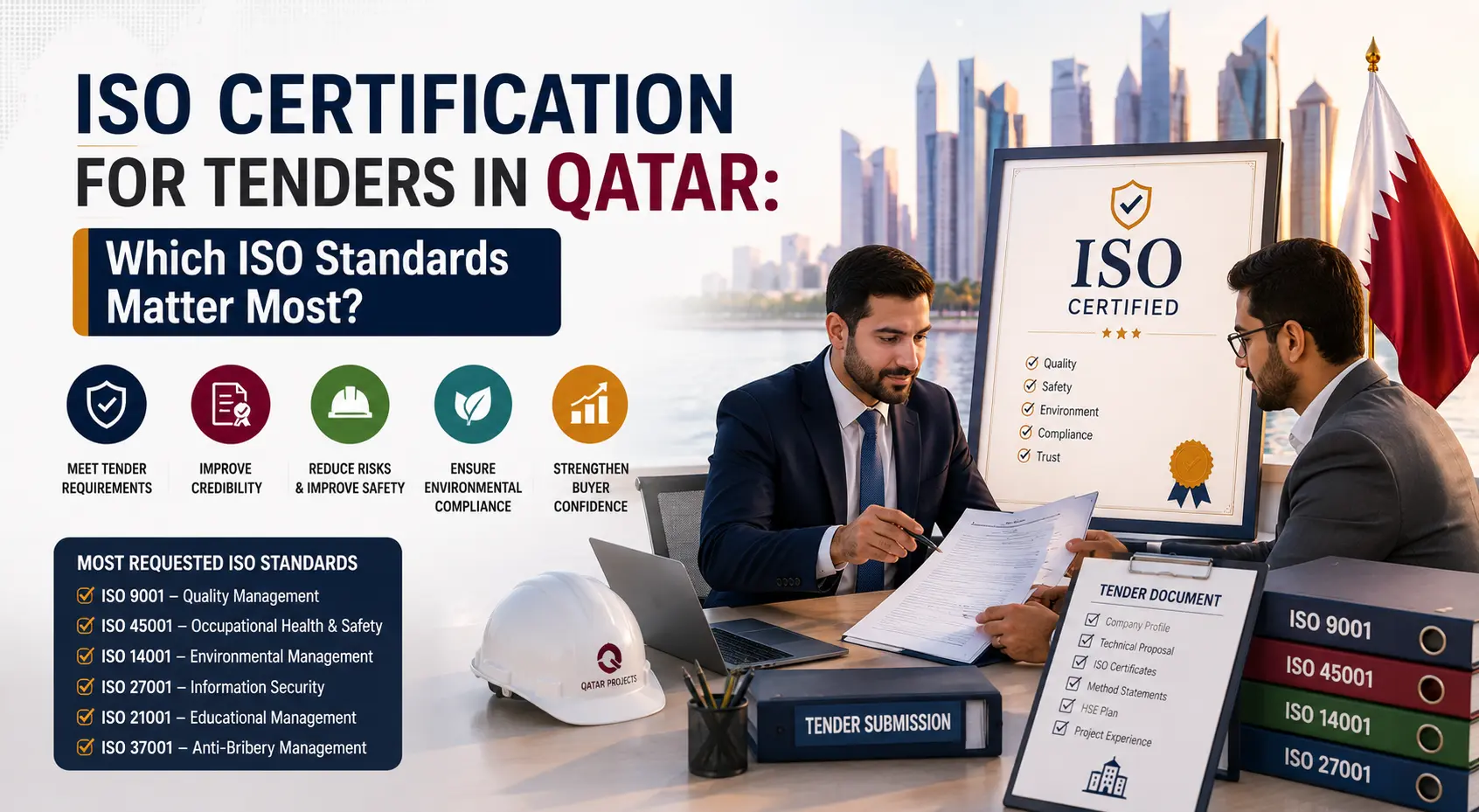
ISO certification for tenders in Qatar helps businesses meet vendor registration, prequalification, and tender expectations by proving they run structured systems for quality, safety, environment, information security, and governance. The standards most commonly requested are ISO 9001, ISO 45001, and ISO 14001, with ISO 27001 often relevant for IT or data-sensitive work. For education-related projects, ISO 21001 may apply, and ISO 37001 can support contracts where strong governance and anti-bribery controls are expected.
Introduction: Why Does ISO Certification Matter in Qatar and Middle East Tenders?
ISO certification for tenders in Qatar and the Middle East increasingly evaluate more than price and technical capability. Buyers also want to know whether a supplier can deliver work in a controlled, safe, consistent, and auditable way.
That is why ISO certification matters. In a tender context, it helps show that a business has structured systems for quality, safety, environmental management, information security, or governance, depending on the standard.
This matters even more in Qatar’s current development environment. Under Qatar National Vision 2030, businesses are operating in a market shaped by infrastructure, sustainability, digital transformation, and stronger institutional performance. In this kind of environment, suppliers with structured management systems are naturally in a stronger position during tender evaluation.
What Does ISO Certification Mean in a Tender Context?
What ISO Certification Shows in a Tender
In a tender context, ISO certification shows that a company has a management system that has been audited against an international standard.
Depending on the standard, it can show structured controls in areas such as:
- Quality management
- Occupational health and safety
- Environmental management
- Information security
- Anti-bribery controls
- Educational management systems
For buyers, this reduces uncertainty and helps show that the supplier is working through defined procedures, responsibilities, records, controls, and reviews.
Why It Is More Than Just a Certificate
A certificate alone is not the full story. In real tender evaluations, buyers often look at:
- Whether the standard is relevant to the project
- Whether the certificate scope matches the work
- Whether the certificate is current and valid
- Whether the company can support it with procedures, records, and implementation evidence
That is why ISO certification should be treated as part of tender readiness, not just a submission attachment.
How Buyers and Tender Committees View ISO-Certified Suppliers
In practical terms, ISO-certified suppliers are often viewed as more structured and more prepared for delivery. They may not win only because of certification, but it can improve confidence in their ability to perform consistently.
A strong Qatar example comes from Ashghal’s September 2024 subcontractor renewal checklist, which requires applicants to submit updated, valid, and traceable ISO 9001:2015, ISO 14001:2015, and ISO 45001:2018 certificates issued by an accredited certification body, along with supporting documentation and scope-related details. (Add your reference link here.)
Why Does ISO Certification Matter for Tenders in Qatar and the Middle East?
Credibility and Buyer Confidence
ISO certification helps build buyer confidence because it shows that the supplier has structured systems in place rather than relying only on informal practices.
A useful public-sector case study is Ashghal’s ISO 9001:2015 certification. Ashghal reported that it achieved the certification after an extensive external audit across all departments, with zero non-conformance. It also stated that the certification scope covered major project areas such as roads, drainage, buildings, schools, hospitals, and asset operations, while more than 300 operational processes and 22 corporate policies had been improved over three years. (Add your reference link here.)
Tender Eligibility and Supplier Prequalification
In many tenders, ISO certification supports:
- Supplier prequalification
- Technical credibility
- Buyer trust
- Evidence of system maturity
- Stronger vendor readiness
In practice, buyers may expect certification to be supported by other documents such as method statements, risk assessments, project references, and compliance records.
Risk Control and Project Readiness
One of the main reasons ISO certification matters in tenders is that buyers want to reduce risk. They want suppliers that can better control:
- Quality issues
- Safety incidents
- Environmental problems
- Documentation gaps
- Information-security risks
- Governance weaknesses
ISO standards help businesses build systems around those risks before they become project problems.
Why This Matters Now in Qatar
Qatar’s project pipeline continues to support major activity across transport, energy, sustainability, and digital development. This makes structured management systems even more relevant in tender environments.
| Industry | ISO Standards That Matter Most | Why |
| Construction and infrastructure | ISO 9001, ISO 45001, ISO 14001 | Quality control, safety management, environmental control |
| Oil and gas | ISO 9001, ISO 45001, ISO 14001, sometimes ISO 37001 | Safety, environmental discipline, governance expectations |
| Import & export industry | ISO 9001, ISO 14001, ISO 27001 | Quality consistency, documentation control, supply chain reliability, and secure handling of trade and business information |
| Chemical industry | ISO 9001, ISO 14001, ISO 45001 | Process control, environmental management, workplace safety, and higher-risk operational compliance |
| IT and technology | ISO 9001, ISO 27001 | Service quality and information security |
| Healthcare | ISO 9001, ISO 27001 | Process reliability and data protection |
| Education and training | ISO 21001, ISO 9001 | Educational consistency and structured delivery |
| Manufacturing and logistics | ISO 9001, ISO 14001, ISO 45001 | Quality, environmental, and safety control |
Which Industries Need Which ISO Standards Most?
| Industry | ISO Standards That Matter Most | Why |
| Construction and infrastructure | ISO 9001, ISO 45001, ISO 14001 | Quality, safety, environmental control |
| Oil and gas | ISO 9001, ISO 45001, ISO 14001, sometimes ISO 37001 | Safety, environmental discipline, governance |
| Engineering and industrial services | ISO 9001, ISO 45001, ISO 14001 | Process control, safety, consistency |
| Facility management | ISO 9001, ISO 45001, ISO 14001 | Service quality, site safety, operational control |
| IT and technology | ISO 9001, ISO 27001 | Service quality and information security |
| Healthcare | ISO 9001, ISO 27001 | Process reliability and data protection |
| Education and training | ISO 21001, ISO 9001 | Educational consistency and structured delivery |
| Manufacturing and logistics | ISO 9001, ISO 14001, ISO 45001 | Quality, environmental, and safety control |
Is One ISO Certificate Enough for a Tender?
When One ISO Standard May Be Enough
One certificate may be enough when:
- The tender is limited in scope
- The buyer asks for only one standard
- The project risk is relatively lower
- The work is mainly service or office-based
Example: some tenders may place the strongest weight on ISO 9001 alone.
When Multiple ISO Certifications Are Stronger
Multiple certifications are often stronger when the project includes:
- Field operations
- Workforce safety exposure
- Environmental obligations
- Infrastructure delivery
- Complex operational risk
- Data sensitivity
- Governance expectations
For example, a contractor bidding for infrastructure work is often more competitive with ISO 9001 + ISO 45001 + ISO 14001 than with one certificate alone.
Why Integrated Systems Can Strengthen Competitiveness
Integrated systems help show that quality, safety, and environmental controls are managed together. In tendering, that often gives buyers more confidence in the maturity of the supplier’s systems.
How to Choose the Right ISO Standard for Your Tender Type
Based on Industry
The first step is to match the standard to the sector. A construction tender does not carry the same risk profile as an IT or education tender.
Based on Tender Requirements
Always review the tender documents carefully. Some tenders list exact ISO requirements. Others indicate them indirectly through safety, quality, environmental, governance, or data-related expectations.
Based on Project Risk and Scope
Ask practical questions:
- Is the project site-based?
- Does it involve safety exposure?
- Does it involve environmental impact?
- Does it involve sensitive information?
- Does it involve governance-sensitive work?
The answers usually point toward the right standard.
Based on Buyer Expectations in Qatar and the Middle East
Buyers may assess:
- Certificate relevance
- Scope alignment
- Sector fit
- Supporting records
- Implementation evidence
- Governance or ethics signals
That means the correct certification should fit both the tender and the actual operation.
What Are the Most Common Mistakes Businesses Make When Applying for ISO Certification for Tenders in Qatar?
Choosing the Wrong Standard
A business may hold a valid ISO certificate, but if it is not relevant to the tender, it adds little value.
Focusing Only on Paperwork
Certification should reflect a working system. If the system exists only on paper, it can create problems during audits, reviews, and project delivery.
Not Preparing Staff for Audit
If employees cannot explain how the system works in practice, gaps appear quickly between documentation and real operations.
Ignoring Local Client and Tender Expectations
Some businesses assume that any ISO certificate is enough. In reality, buyers may check:
- Certification body credibility
- Scope relevance
- Implementation quality
- Documentation systems
- HSE performance
- Audit readiness
Some tenders may also expect combinations such as:
- ISO 9001 + ISO 45001
- ISO 9001 + ISO 14001
- Integrated systems for higher-risk sectors
Ignoring these expectations can lead to delays, rejection, or weaker technical standing.
What Businesses Should Know Before Bidding in the Middle East
Why Local Expectations Matter
Even though ISO standards are international, buyer expectations are local and project-specific. The system needs to match the real market and tender context.
Why Certification Scope Must Match Actual Operations
A certificate is most useful when its scope clearly reflects the actual activities being bid for.
Why Local Coordination Can Make Tender Preparation Easier
Local coordination can help with:
- Audit planning
- Documentation alignment
- Buyer expectations
- Faster clarification
- More practical tender preparation
How Businesses Can Prepare Before Submitting a Tender
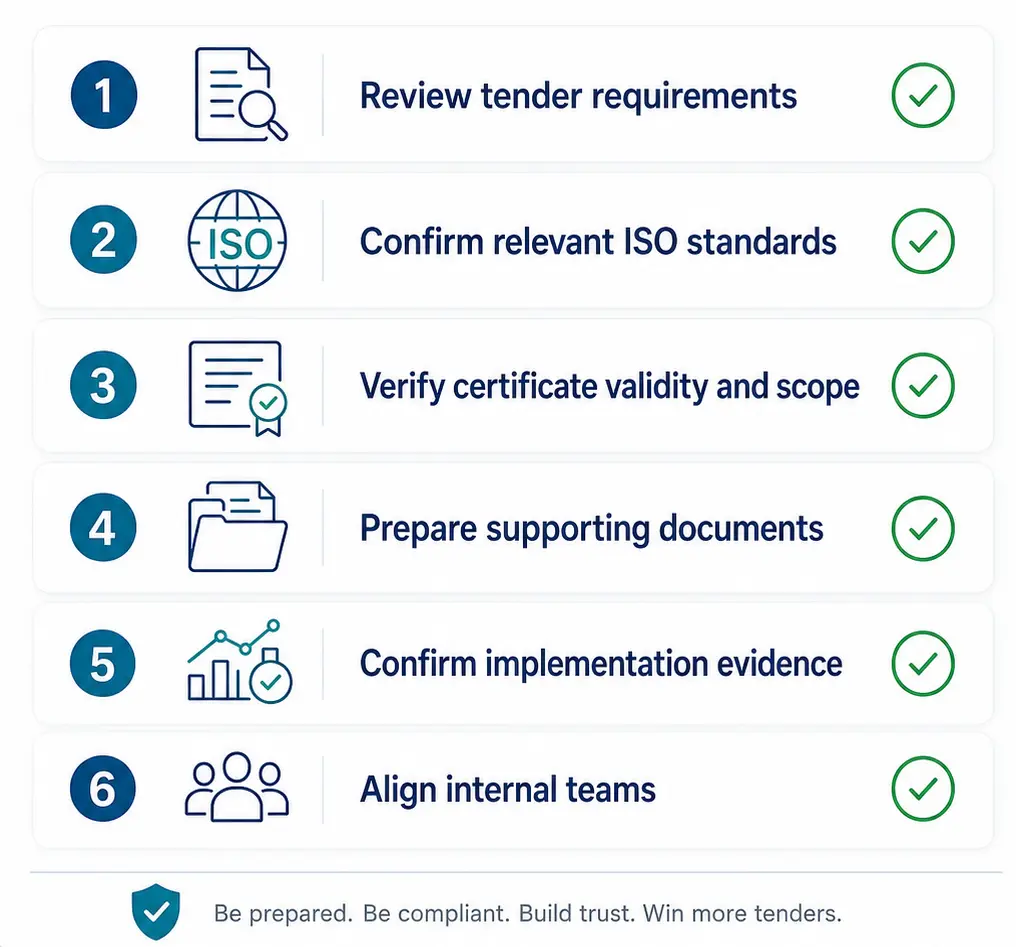
Where Guardian Middle East LLC Fits In (Qatar)
Guardian Middle East LLC supports businesses in Qatar with local coordination, major ISO standard support, QS-recognized positioning, and internationally recognized accreditation-backed certification structures. This helps businesses move through certification and tender-readiness planning with more clarity and confidence.
Local Presence in Qatar
Local support can make audit planning, site coordination, documentation review, and certification timelines easier to manage.
Support Across Major ISO Standards
Guardian Middle East LLC supports major standards including:
- ISO 9001 – Quality Management System
- ISO 14001 – Environmental Management System
- ISO 45001 – Occupational Health & Safety Management System
- ISO 21001 – Educational Organization Management Systems
- ISO 27001 – Information Security Management System
- ISO 37001 – Anti Bribery Management System
QS-Approved Positioning
Guardian Middle East LLC highlights its QS-recognized structure in Qatar, including:
- QS Registration Number: RB066-26
- QFC Registration: QFC 03870
Internationally Recognized Accreditation Support
Its certification support is also linked to recognized structures including:
- UAF- United Accreditation Foundation
- IAS- International Accreditation Service, USA
Key Takeaways
- ISO certification for tenders in Qatar strengthens tender credibility and supplier readiness.
- The ISO standards for tenders in Qatar that matter most usually include ISO 9001, ISO 45001, ISO 14001, and ISO 27001.
- The right standard depends on sector, tender scope, project risk, and buyer expectations.
- Real procurement practice in Qatar shows that ISO certification can be part of actual supplier evaluation.
- Businesses that prepare early are usually more competitive than those that treat certification as a last-minute requirement.
Conclusion: Choose the Right ISO Standard Before the Tender Requires It
ISO certification for tenders is not just about attaching a certificate to a bid. It is about showing that your business has the systems and controls to deliver work responsibly and consistently.
For businesses competing in Qatar and the wider Middle East, the right ISO standard can improve buyer confidence, support supplier approval, and strengthen tender readiness.
The best approach is to choose the right standard before the tender forces the issue, build the system properly, and be ready when the opportunity comes.
Based in Doha, Qatar | Serving the Middle East
Guardian Middle East LLC supports organizations in Qatar and across the wider Middle East through ISO certification journeys aligned with real tender and audit expectations.
Contact Guardian Middle East LLC (Doha) | Serving the Middle East
Location: Abo Hamour Area, Doha, Qatar.
P.O. Box: 23277, Doha, Qatar
Mobile: +974 7770 2602 | +974 7213 7770
Email: info@guardian.qa
Website: www.guardian.qa
Frequently Asked Questions
2. Is ISO 9001 alone enough for a tender?
Sometimes yes, but not always. If the tender is lower risk or mainly service-based, ISO 9001 may be enough. But for site-based, infrastructure, industrial, or higher-risk projects, buyers may also expect ISO 45001 and ISO 14001.
3. Why do tenders ask for ISO certification?
Tenders ask for ISO certification because buyers want to reduce risk. It helps show that the supplier has systems for quality, safety, environmental control, information security, or governance, depending on the standard and project type.
4. Which ISO standards matter most for contractors in the Middle East?
For contractors, the most important standards are usually:
- ISO 9001 for quality management
- ISO 45001 for occupational health and safety
- ISO 14001 for environmental management
These are especially relevant in construction, infrastructure, engineering, and industrial projects.
5. Does ISO certification improve supplier prequalification chances?
Yes. ISO certification can improve supplier prequalification because it supports credibility, system maturity, and buyer confidence. It does not guarantee approval, but it often strengthens the supplier’s position during technical evaluation and vendor registration.
6. What do buyers check besides the ISO certificate itself?
Buyers often check:
- whether the certificate is valid
- whether the scope matches the work
- whether the certification body is credible
- whether the business has supporting records, procedures, and implementation evidence
That is why ISO certification should be treated as part of full tender readiness.
7. Which ISO standard matters most for IT or digital tenders?
For IT, telecom, software, cloud, and data-sensitive tenders, ISO 27001 is often the most relevant standard. It helps show that the supplier manages information security risks in a structured way.
8. When do businesses need more than one ISO certification for a tender?
More than one ISO certification is usually helpful when the project includes:
- field operations
- workforce safety exposure
- environmental obligations
- infrastructure delivery
- data sensitivity
- governance expectations
In those cases, integrated certifications often make the supplier stronger in evaluation.
9. Can a business use ISO certification for both vendor registration and tender submission?
Yes. In many cases, the same ISO certification supports both vendor registration and tender submission, as long as the certificate is valid, relevant, and properly aligned with the company’s actual scope of work.
10. What is the most common mistake businesses make with ISO certification in tenders?
One of the biggest mistakes is assuming that having any certificate is enough. In reality, the standard must fit the project, the scope must match the work, and the company must be able to support the certificate with real implementation and documentation.
11. How should a business prepare before submitting a tender that asks for ISO certification?
Before submitting, the business should:
- review the tender requirements carefully
- confirm which ISO standards are relevant
- verify certificate scope and validity
- prepare supporting records and compliance documents
- make sure internal teams are ready to support the submission
12. Why does local certification support matter in Qatar?
Local support can help businesses align their certification, documentation, scope, and tender preparation with actual buyer expectations in Qatar. This is especially useful for businesses handling urgent bids, vendor approvals, site-based audits, or region-specific documentation requirements.
Comments are closed