

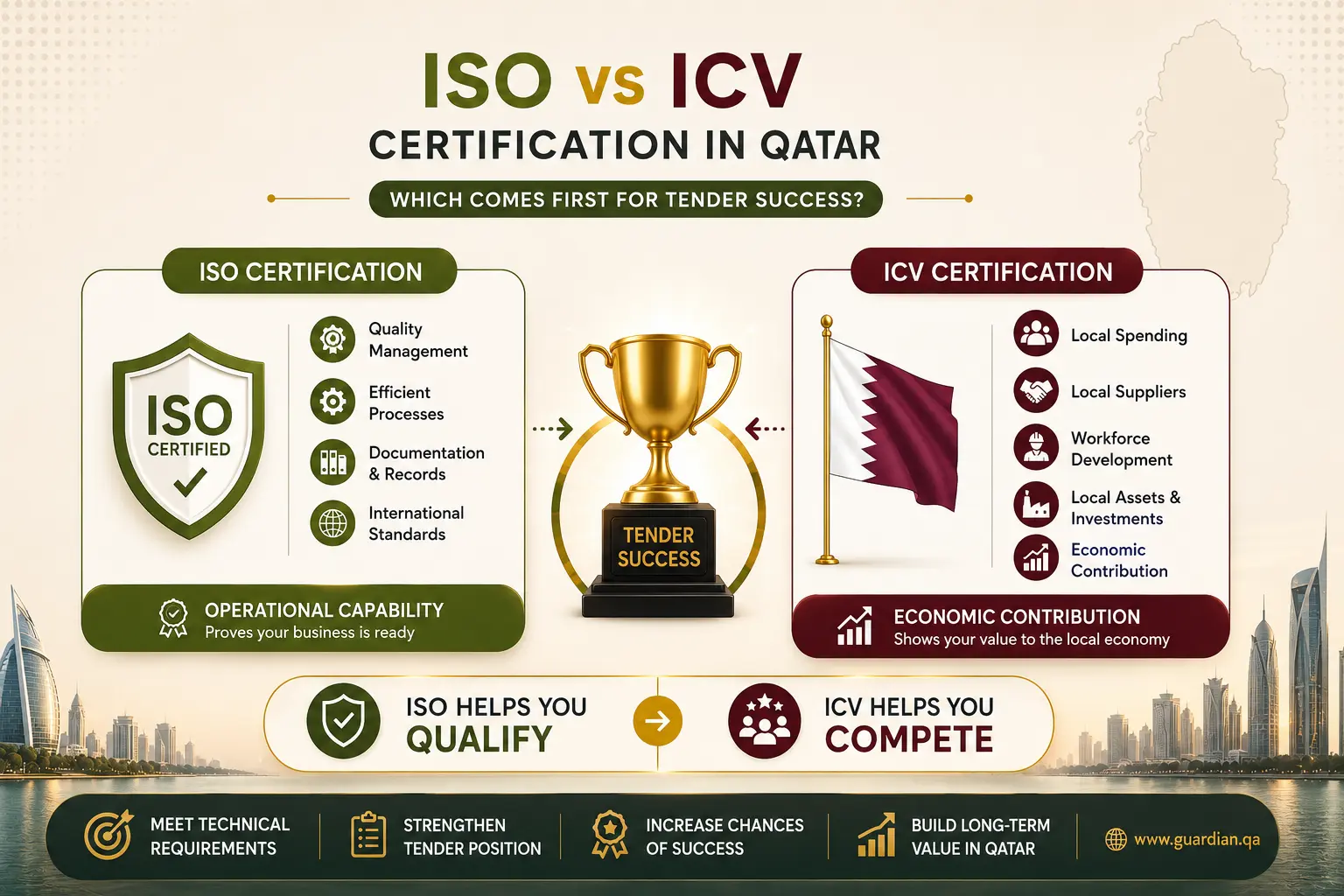
For companies bidding, ISO certification in Qatar and ICV certification are not the same thing. They both matter in tender preparation, but they answer two very different questions.
From an ISO certification point of view, this is the easiest way to understand it:
ISO shows whether your company is technically and operationally ready.
ICV shows how much your company contributes to the local economy.
Table of Contents
ISO certification demonstrates that your business follows recognized management system standards for quality, safety, environmental management, information security, or other operational areas. In many tenders, ISO is checked during vendor registration or technical evaluation because buyers want to know whether your company has proper systems, controls, documentation, and audit readiness.
ICV, or In-Country Value, looks at a different side of the business. It measures local economic contribution through areas such as local spending, local suppliers, workforce development, assets, training, and investment.
So, which one should come first?
The honest answer is: check the tender requirement first.
If the tender clearly asks for ISO certification in Qatar, then ISO should usually be the first priority. Without the required ISO certificate, your company may struggle at the technical qualification stage. ICV becomes important when the buyer also evaluates local value contribution.
Why Companies in Qatar Often Confuse ISO and ICV
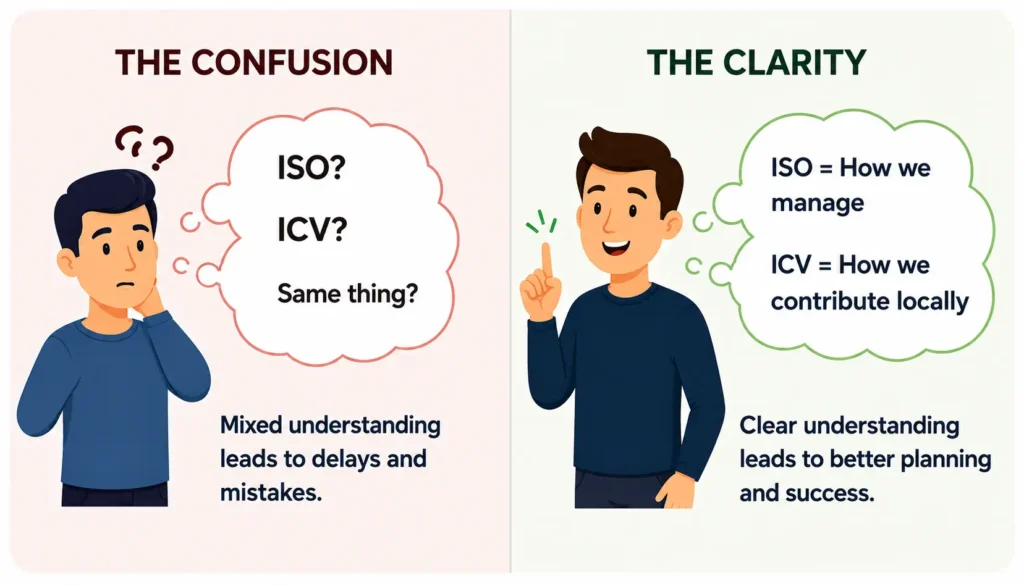
We see this confusion quite often when companies prepare for tenders in Qatar.
A business owner may open a tender document and see terms like ISO certification, vendor registration, audits, documentation, supplier qualification, ICV, local value, and financial records. Naturally, it can start to feel like all these requirements are connected.
And yes, they are connected to tender readiness. But they are not the same.
ISO certification in Qatar focuses on how your company is managed. It looks at your systems, processes, responsibilities, records, audits, risk controls, and how consistently your team follows defined procedures.
ICV focuses on your local economic contribution. It looks at how much value your company creates inside the country through local purchases, local suppliers, local assets, workforce development, and financial data.
A simple way to remember it is:
ISO proves how well your business is organized.
ICV shows how much your business contributes locally.
This difference matters because many tender delays happen when companies treat ISO and ICV as interchangeable. They are not. ISO cannot replace ICV, and ICV cannot replace ISO.
For companies bidding with major buyers such as QatarEnergy, Ashghal, Kahramaa, or other government and semi-government organizations, the smart approach is to review the tender document early. Check whether the buyer is asking for technical certification, local value scoring, or both.
That one step can help avoid last-minute pressure, wrong certification planning, missing documents, and unnecessary delays.
What is ISO Certification?
ISO certification means your company follows an internationally recognized management system standard.
In practical terms, it shows that your business is not working randomly. It has defined processes, clear responsibilities, proper documentation, controls, records, audits, and improvement practices.
For tender purposes, this matters because buyers want confidence. They want to know that your company can manage quality, safety, environment, information security, or other operational requirements in a structured way.
Common examples include:
- ISO 9001 for quality management
- ISO 14001 for environmental management
- ISO 45001 for occupational health and safety
- ISO 27001 for information security
In simple words, ISO certification shows that your company is structured, controlled, and ready to perform professionally.
What is ICV Certification?
ICV stands for In-Country Value.
While ISO looks at your management system, ICV looks at your local economic contribution. It measures how much value your company creates inside the country.
This may include local spending, local suppliers, local assets, workforce development, training, investment, and financial records.
For example, a company that buys from local suppliers, employs and trains local workers, invests in local assets, and supports local business activity may have a stronger ICV position.
In simple words, ICV certification shows how much your company contributes to the local economy.
So, ISO and ICV both support tender readiness, but in different ways. ISO helps prove capability. ICV helps show local contribution.
ISO vs ICV: Complete Comparison
When companies in Qatar prepare for tenders, ISO and ICV often appear in the same conversation. That is why many business owners assume they are similar. But from a certification point of view, they are very different.
ISO certification looks at how your company works internally.
It checks whether your business has proper systems, clear responsibilities, documented processes, risk controls, internal audits, and management reviews.
In simple terms, ISO answers questions like:
- Is the company following structured processes?
- Are roles and responsibilities clearly defined?
- Are risks identified and controlled?
- Are quality, safety, environmental, or information security practices properly documented?
- Are internal audits and management reviews actually being done?
ICV certification looks at your company’s local economic contribution.
It checks how much value your business creates inside the country through local spending, suppliers, assets, workforce development, and financial records.
ICV answers questions like:
- How much does the company spend locally?
- Does the company use local suppliers?
- Has the company invested in local assets?
- Does the company support workforce development?
- Are the financial records ready for evaluation?
So, the easiest way to understand it is this:
ISO is about operational capability.
ICV is about local economic value.
ISO vs ICV Comparison Table
| Comparison Point | ISO Certification | ICV Certification |
| Main Purpose | To confirm that a company follows an international management system standard | To measure a company’s local economic contribution |
| Primary Focus | Quality, safety, environment, information security, risk control, and process management | Local procurement, local investment, workforce development, local spending, and financial contribution |
| Nature of Evaluation | Management system audit | Financial and economic contribution assessment |
| Scope | Based on the company’s activities, locations, departments, and certification scope | Based on legal entity, audited financial records, procurement data, and local value indicators |
| Recognition | Internationally recognized across many countries and industries | Country-specific or program-specific |
| Common Examples | ISO 9001, ISO 14001, ISO 45001, ISO 27001 | Tawteen in Qatar, National ICV in the UAE, IKTVA in Saudi Arabia |
| Tender Role | Often supports technical qualification or vendor approval | May support commercial evaluation or local value positioning where required |
| What It Proves | The company has structured and controlled management systems | The company contributes value to the local economy |
| Who Usually Needs It | Companies in construction, oil and gas, manufacturing, facility management, logistics, engineering, IT, healthcare, and industrial services | Companies bidding for projects where local value scoring or national procurement programs apply |
| Assessment Basis | Policies, procedures, operational records, internal audits, risk controls, training records, and management reviews | Audited financial statements, local supplier spend, local assets, workforce data, and other program-specific indicators |
| Validity / Time Period | Usually valid for 3 years, subject to required surveillance audits, with recertification at the end of the cycle | For Qatar Tawteen ICV, the certificate validity is generally 12 months, with a 3-month grace period, making the grace period expiry up to 15 months |
| Renewal / Ongoing Requirement | Requires surveillance audits during the certification cycle and recertification before expiry | Requires renewal based on updated financial and ICV-related records under the applicable program |
| Main Business Benefit | Improves operational control, documentation, audit readiness, client confidence, and tender readiness | Strengthens local value positioning in applicable procurement frameworks |
| Best Used For | Demonstrating operational capability and management system maturity | Demonstrating economic contribution within a specific country |
| Global or Local? | Global | Local or regional |
| Key Question It Answers | “Is this company well-managed and capable of meeting standard requirements?” | “How much value does this company create inside the country?” |
In practice, ISO and ICV serve different purposes and are often used together rather than separately. Understanding how each applies to your business and the specific tender requirements will help you choose the right approach and avoid unnecessary delays during the certification process.
Why ISO and ICV Play Different Roles in Qatar Tenders
Here’s where things become practical.
When a business owner in Qatar prepares for a tender, the buyer is not always asking for the same thing. One tender may ask for ISO certification to check whether your company is technically ready. Another tender may consider ICV to understand how much your business contributes to the local economy. And in some major projects, both may matter.
Think of it this way:
ISO helps answer: “Can this company do the work properly?”
ICV helps answer: “How much value does this company bring to the local economy?”
For example, a construction contractor may need ISO 9001 to show quality management and ISO 45001 to show workplace safety. If local value scoring applies, the same contractor may also need ICV-related documents.
Similarly, an oil and gas supplier may need ISO certification for vendor registration, but also financial and procurement records for ICV evaluation.
So, ISO and ICV should not be treated as interchangeable. One cannot replace the other. They solve two different procurement questions.
Which One is More Important?
There is no one-size-fits-all answer. It depends on the tender, buyer, industry, project scope, and submission requirements.
But here’s the practical rule:
If ISO is listed as a mandatory technical requirement, start with ISO first.
Why? Because without the required ISO certificate, your company may struggle to pass the technical evaluation stage. And if you do not pass the technical stage, your pricing or ICV position may not even get proper attention.
ICV becomes important when the buyer evaluates local economic contribution. Once your technical requirements are cleared, a stronger ICV position may help your business compete better during commercial evaluation.
A Simple Way to Decide
| Business Situation | What to Prioritize |
| You need to prove quality management capability | ISO 9001 |
| You need to prove environmental responsibility | ISO 14001 |
| You need to prove workplace health and safety controls | ISO 45001 |
| The tender clearly asks for ISO certification | ISO certification first |
| The tender includes local value scoring | ICV readiness |
| You are preparing for major government, energy, or industrial projects | Review both ISO and ICV requirements early |
| You already have ISO but want stronger tender positioning | Check whether ICV applies |
| You are unsure what the tender requires | Review the tender document before applying |
How ICV and Similar Programs Work Across the GCC
Let’s Talk About GCC Local Value Programs:
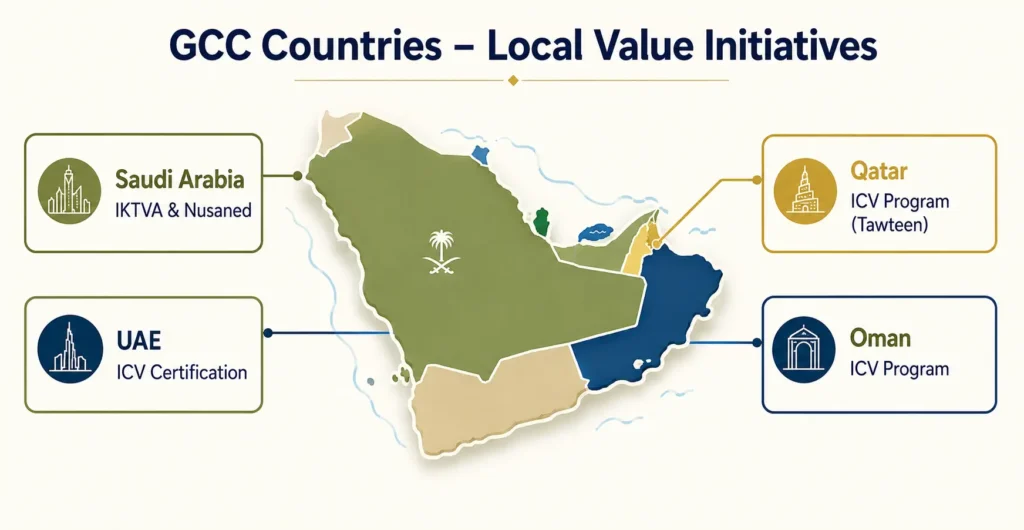
Alright, so here’s the thing — across the GCC, countries are really stepping up their game when it comes to boosting their local economies. And how are they doing that? Through some pretty interesting programs like Qatar’s Tawteen, the UAE National ICV, and Saudi Arabia’s IKTVA.
Now, don’t get it twisted — these are not your typical ISO certifications. Nope. These programs are all about one big question: “How much are you actually contributing to the local economy?” Think local hiring, local sourcing, local investments — the whole package.
On the flip side, ISO is more like your business’s backbone. It focuses on how well your systems run, how consistent your processes are, and whether you’re meeting international standards.
So, if we break it down in simple terms — ICV programs are all about your local impact, while ISO is about making sure your business is solid, structured, and ready to perform.
How Government Tenders Are Usually Evaluated
When companies prepare for government, semi-government, energy, construction, or industrial tenders in Qatar, one thing is important to understand: the buyer is not only looking at the price.
Before the commercial offer is reviewed, the buyer usually wants to know whether the company is technically capable, properly documented, and ready to deliver the work. This is where ISO certification and ICV play different roles.
From a certification point of view, we often see businesses getting confused here. ISO and ICV may appear in the same tender process, but they are not checked for the same reason.
ISO certification is usually linked with technical readiness.
It helps show that your company has proper systems, documented processes, quality controls, safety practices, environmental controls, or other management system requirements.
ICV is usually linked with local value positioning.
It may support your company’s position where the buyer also considers local economic contribution.
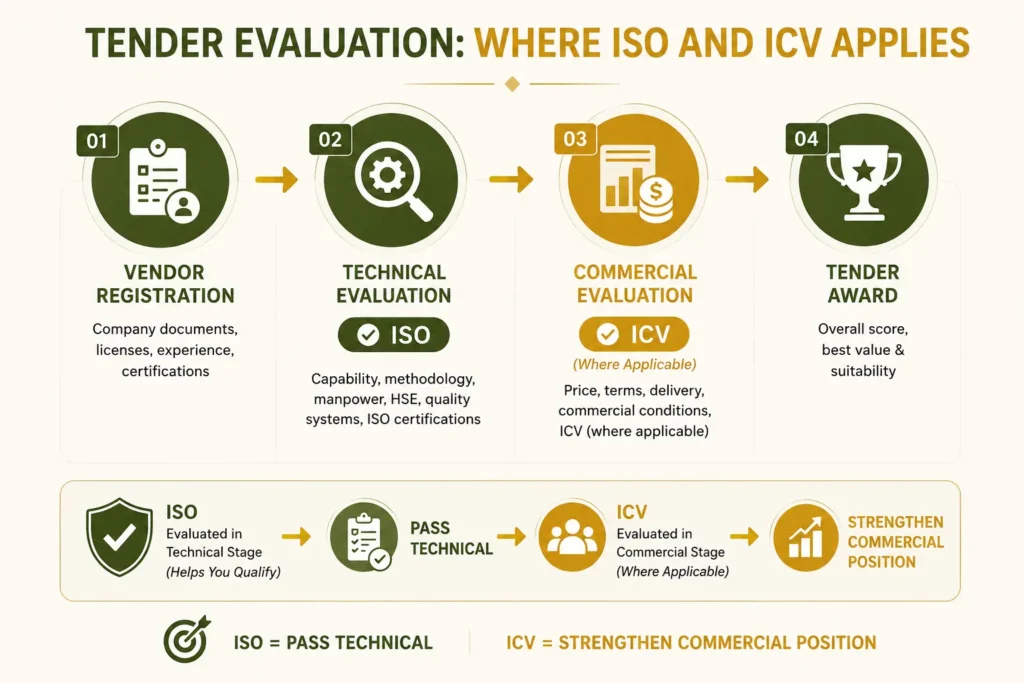
The Typical Tender Evaluation Flow
A simplified tender process usually looks like this:
Stage 1: Pre-qualification or Vendor Registration
This is where the buyer checks whether your company is eligible to participate. They may review your trade license, company documents, past project experience, financial standing, vendor approval documents, and required certifications.
Stage 2: Technical Evaluation
This is one of the most important stages. The buyer checks whether your company can actually perform the work.
They may review your technical proposal, manpower, equipment, project methodology, previous experience, HSE documents, quality systems, and ISO certifications where required.
If ISO certification is mentioned in the tender, this is usually where it becomes important.
Stage 3: Commercial Evaluation
Once the technical requirements are cleared, the buyer reviews the commercial offer. This may include pricing, payment terms, delivery timelines, commercial conditions, and local value considerations where applicable.
This is where ICV may become relevant if the tender includes local value scoring.
Stage 4: Final Award Decision
At this stage, the buyer compares qualified bidders and makes the final decision based on the tender rules. The decision may consider technical score, price, delivery capability, risk, previous experience, local value contribution, and overall suitability.
How ISO Certification Supports Tender Qualification
ISO certification usually plays a role in the technical side of tender evaluation.
If a tender asks for ISO 9001, ISO 14001, ISO 45001, ISO 27001, or another ISO standard, the buyer may expect a valid certificate with the correct scope.
For example:
- ISO 9001 may be requested to show quality management capability.
- ISO 14001 may be requested for environmental management.
- ISO 45001 may be requested for occupational health and safety.
- ISO 27001 may be requested for information security management.
If the required ISO certificate is missing, the company may face clarification requests, scoring issues, delays, or possible rejection depending on the tender conditions.
This is why ISO is often seen as a technical gatekeeper. It does not guarantee that a company will win the tender, but if ISO is mandatory, it can help the company pass an important qualification stage.
Where ICV Applies
ICV is usually positioned into the local value or commercial evaluation side of the tender process, where applicable.
It helps the buyer understand how much economic value your company creates inside the country. This may include:
- local supplier spending
- local procurement
- local assets
- workforce development
- training and employment contribution
- audited financial records
- other program-specific indicators
A strong ICV position does not replace ISO certification. It does not prove that the company has a quality, safety, environmental, or information security management system.
In the same way, ISO certification does not prove local economic contribution.
Both may matter, but they answer different questions.
The Two-Envelope Tender System Explained
Many companies understand the tender process better when it is explained through the two-envelope model.
Envelope 1: Technical Bid
This is where the buyer checks whether your company is capable of doing the work. The technical bid may include project methodology, experience, manpower, equipment, quality controls, safety systems, environmental controls, and required ISO certifications.
Envelope 2: Commercial Bid
This is where the buyer reviews the price and commercial offer. If local value requirements apply, ICV-related information may also support the company’s overall position.
The key point is simple: your commercial offer may not matter if your company does not pass the technical stage first.
That is why companies should not wait until the last moment to arrange ISO certification. If the tender requires ISO, preparation should start early.
ISO vs ICV in the Tender Journey
| Tender Stage | What the Buyer Checks | Where ISO Fits | Where ICV Fits |
| Vendor Registration | Company eligibility, licenses, basic documents, previous experience | May be requested as part of vendor approval | May be requested depending on buyer or sector |
| Technical Evaluation | Capability, quality, safety, environment, manpower, methodology | Strong relevance, especially if ISO is mandatory | Usually limited unless local value is part of technical scoring |
| Commercial Evaluation | Price, payment terms, delivery, commercial conditions | Supports credibility, but may not directly affect price | May support local value positioning where applicable |
| Final Award | Overall suitability and procurement criteria | Helps demonstrate technical readiness | Helps demonstrate local economic contribution |
In practical terms, ISO helps show that your company is ready to perform the work in a structured and controlled way, while ICV reflects how your company contributes to the local economy where local value is considered.
For Qatar tenders, the smarter approach is to review both early. Check the tender document, identify the required ISO standards, confirm the certification scope, and see whether ICV or local value documents are also needed.
Taking these steps early can save time, reduce pressure, and position your company more confidently for a successful tender outcome.
Why This Is Important for Qatar Business Owners
For companies bidding in Qatar, tender preparation should start early. Waiting until the tender is published often leaves insufficient time to complete ISO certification.
Many companies face pressure when they realize ISO 9001, ISO 14001, ISO 45001, or other standards are required but not ready. Early preparation allows time to organize documents, complete audits, and confirm certification scope.
This is especially important in sectors like construction, oil and gas, EPC, logistics, manufacturing, and engineering, where requirements are strict.
In short: the earlier you prepare, the stronger your tender position.
Which Certification Should You Get First?
The key question is: Which should you prepare first—ISO or ICV?
It depends on the tender, but one rule is clear:
If ISO is required, start with ISO.
ISO is usually checked during technical evaluation. Without it, your bid may not progress, regardless of pricing or ICV strength.
ICV becomes relevant when local value contribution is evaluated, typically after technical requirements are met.
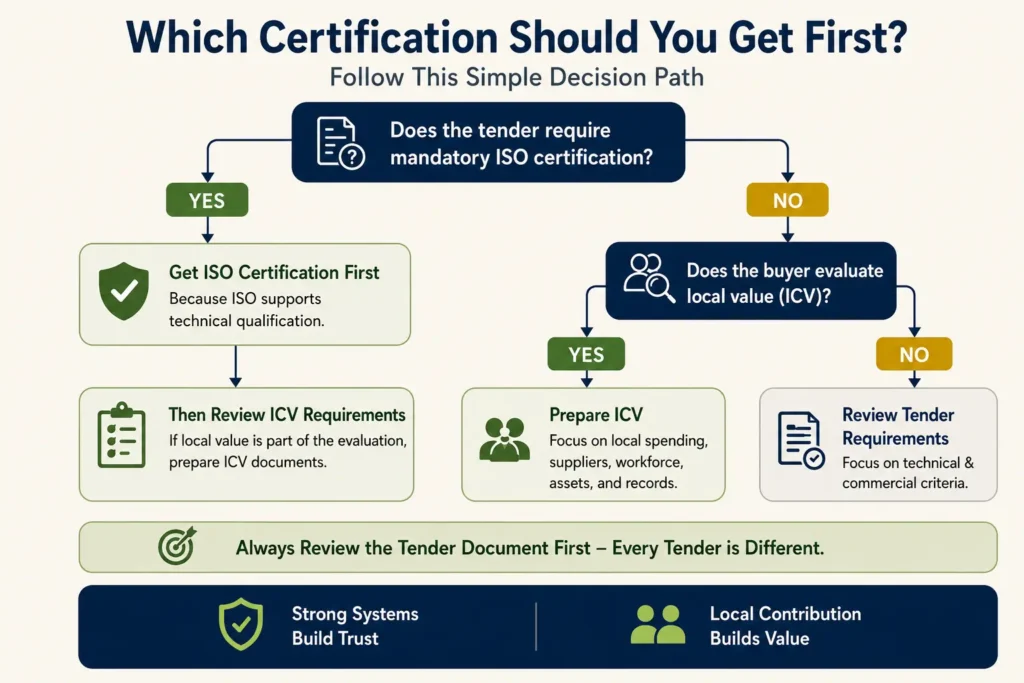
Why ISO Usually Comes First
ISO certification supports technical qualification. If required, it must be submitted early in the process.
Without ISO, companies may face delays, lower scores, or rejection. It does not guarantee winning, but it is often necessary to compete.
When ICV Becomes Important
ICV matters when buyers assess local economic contribution, including local spending, workforce, and procurement.
It strengthens your position after technical requirements are met but does not replace ISO.
Both are important, but they serve different roles in the tender process.
Decision Framework: ISO or ICV First?
| Business Situation | Recommended First Step |
| Your tender requires ISO certification | Start with ISO certification |
| You need to qualify technically for a project | Start with the required ISO standard |
| You are new to government or semi-government tenders | Begin with ISO 9001 and review buyer requirements |
| You operate in construction, contracting, or industrial services | Consider ISO 9001 and ISO 45001 based on tender needs |
| Your work has environmental impact | Consider ISO 14001 where relevant |
| You are supplying energy, oil and gas, or major industrial buyers | Review both ISO and ICV requirements early |
| Your buyer evaluates local value contribution | Prepare for ICV where applicable |
| You already have ISO certification | Check whether ICV applies to your target tender |
| You are unsure what is required | Review the tender document before applying |
The safest approach is simple: do not guess.
Before starting ISO or ICV preparation, review the tender document carefully. Check the required ISO standard, the certification scope, buyer-specific conditions, submission deadline, and whether local value or ICV documents are also requested.
This helps your company avoid wrong certification choices, incomplete documentation, rushed audits, and last-minute tender pressure.
Need Help Choosing the Right ISO Standard for Your Tender?
If you are unsure which ISO certification your Qatar tender requires, Guardian Middle East LLC can guide you.
Speak with our ISO team before your deadline.
Call: +974 7770 2602 | +974 7213 7770
Email: info@guardian.qa
Website: www.guardian.qa
Can You Prepare for ISO and ICV Together?
Yes, in many cases, you can prepare for ISO and ICV at the same time. But it is important to understand one thing clearly: the preparation work is not the same.
From an ISO certification point of view, ISO preparation is mainly about your management system. Your company may need proper policies, procedures, risk assessments, internal audit records, training records, operational controls, corrective actions, and management review evidence.
ICV certification preparation is different. It is more focused on financial and economic contribution. Your company may need audited financial statements, procurement records, local supplier data, workforce information, local asset details, and other program-specific documents.
So yes, both can be prepared together, especially if your company is targeting major tenders and you have enough time before submission. But if the tender clearly lists ISO as a mandatory technical requirement and your company does not already have the certificate, ISO should usually get urgent attention first.
Practical Example
Let’s say a Doha-based facility management company wants to bid for a government building maintenance contract.
The tender may ask for:
- ISO 9001 for quality management
- ISO 45001 for occupational health and safety
- company registration documents
- previous project experience
- technical manpower details
- commercial pricing
- local value information where applicable
In this case, ISO certification supports the technical side of the bid. It helps show that the company has organized operations, safety controls, service quality systems, and proper documentation.
ICV-related preparation may support the local value side if the buyer includes it in the evaluation. But if the company does not have the mandatory ISO certificate, it may struggle to move forward in the technical stage.
That is why we always recommend checking the tender requirement early. It helps you understand what needs immediate action and what can be prepared alongside the main certification process.
The Best Approach for Qatar Businesses
The best approach is simple: do not guess.
Before starting ISO or ICV preparation, review:
- the tender document
- vendor registration requirements
- required ISO standards
- scope of certification required
- buyer-specific conditions
- local value or ICV-related requirements
- submission deadline
- current documentation readiness
This helps avoid wasted time, wrong certification scope, incomplete documents, rushed preparation, and last-minute pressure.
For Qatar businesses, early preparation makes a big difference. When ISO documents, audit records, management reviews, and tender files are already organized, the company can respond to opportunities with more confidence.
Real Qatar Tender Scenarios
ISO and ICV become much easier to understand when we look at real tender situations in Qatar.
In our experience, many companies only start thinking about ISO certification when they are preparing for vendor registration, government tenders, semi-government projects, or oil and gas opportunities. By that time, the tender document may already be asking for specific ISO certificates, technical records, safety documents, and sometimes local value information.
Here are two common examples.
Scenario 1: Construction Contractor Bidding for an Ashghal Infrastructure Project
Let’s say a construction company in Qatar wants to bid for an Ashghal infrastructure project.
In this type of project, the buyer is not only checking price. They also want to see whether the contractor has proper systems for quality, site safety, environmental controls, inspections, documentation, and project management.
That is where ISO certification can become important.
Common ISO certifications may include:
- ISO 9001 for quality management
- ISO 14001 for environmental management
- ISO 45001 for occupational health and safety
These certifications help show that the contractor is not working in an unstructured way. The company has processes, records, responsibilities, audits, and controls in place to manage the work properly.
If local value scoring applies, ICV-related documents may also be considered. This could include local procurement, workforce details, use of local subcontractors, and other local contribution records.
Scenario 2: Oil and Gas Supplier Preparing for QatarEnergy Vendor Qualification
Now imagine a supplier wants to work with QatarEnergy or enter the oil and gas supply chain in Qatar.
In this sector, vendor qualification is usually more detailed. The buyer may review technical documents, product specifications, quality procedures, inspection records, supplier controls, traceability, HSE systems, and management system certifications.
Common ISO certifications may include:
- ISO 9001 for quality management
- ISO 45001 for occupational health and safety
- ISO 14001 for environmental management
For oil and gas suppliers, ISO certification can help demonstrate that product quality, inspections, safety practices, environmental responsibilities, and supplier management are properly controlled.
ICV may also become important in this sector through initiatives such as Tawteen, where suppliers may need to show local investment, local procurement, workforce contribution, and other local value indicators.
How ISO Certification Supports Better Bid Preparation
ISO certification helps companies stay organized and ready for tenders by improving systems, documentation, and controls. Buyers often expect proof such as procedures, audit records, training, and risk management.
ISO 9001: Quality- Ensures consistent quality through clear processes, audits, and corrective actions.
ISO 14001: Environment- Manages environmental impact through policies, controls, and monitoring.
ISO 45001: Safety- Improves workplace safety with risk assessment, training, and incident control.
ISO 27001: Information Security- Protects data through risk management, access control, and security practices.
Key Benefits for Tender Readiness
ISO certification can support tender readiness by helping companies build:
- better documentation and record control
- clearer roles and responsibilities
- stronger audit readiness
- more organized tender submissions
- better responses to buyer questions
- stronger confidence during technical evaluation
In simple words, ISO certification helps your company look more prepared, more organized, and more reliable when submitting tenders.
It does not guarantee that you will win the project, but it can help your company present a stronger technical position where ISO certification is required or expected.
Common Mistakes Companies Make
Many Business Owners in Qatar face tender delays due to poor preparation, weak documentation, and confusion between ISO and ICV. Common mistakes include:
- Treating ISO and ICV as the same: ISO covers management systems, quality, safety, environment, and documentation. ICV covers local contribution, financial records, procurement, and workforce value.
- Waiting until the tender is announced: ISO needs planning, documentation, implementation, audits, and review. Late starts lead to rushed work.
- Using generic ISO documentation: Templates may not match real operations. Documents should reflect actual practices.
- Choosing certification only based on price: Cheap options may not be accepted. Check accreditation, scope, and acceptance.
- Ignoring the scope of certification: The scope must match tender activities. It should clearly reflect services.
- Not involving top management: ISO is not only for quality teams. Management must support policies, goals, and resources.
- Poor record control: Auditors may request training records, reports, audits, actions, supplier data, and review minutes.
- Missing renewal or surveillance deadlines: Missed audits can make certificates inactive or invalid.
- Not preparing financial records for ICV: ICV may require audited statements, procurement data, supplier details, workforce data, and local spending.
- Not reviewing tender requirements carefully: Each tender is different. Some need ISO 9001 only, others require more standards or approvals.
Tender Readiness Checklist: What to Prepare Before You Bid
Before applying for ISO certification or preparing ICV-related documents, check your tender readiness first.
Many companies in Qatar start late, leading to missing documents, unclear ISO scope, and rushed preparation. A better approach is simple: prepare early.
Use this checklist before bidding for major projects.
1. Review the Tender Requirements
Read the tender carefully and identify required documents:
- ISO 9001, ISO 14001, ISO 45001, ISO 27001
- ICV documents
- vendor registration
- project experience
- HSE documents
- financial records
- manpower details
This helps you understand exactly what is needed.
2. Identify the Required ISO Standards
Select relevant ISO standards based on the tender:
- ISO 9001 – quality
- ISO 14001 – environment
- ISO 45001 – safety
- ISO 27001 – information security
The certificate must match your business activity.
3. Check the Scope of Certification
Ensure your ISO scope matches your services. A clear and relevant scope strengthens your tender.
4. Conduct a Gap Assessment
Identify missing elements such as:
- policies and procedures
- documentation
- risk assessments
- training records
- audit readiness
This helps avoid issues during audits and submission.
5. Prepare ISO Documents
Key documents include:
- policies and objectives
- process documents
- risk assessments
- training records
- audit and review records
- corrective actions
Documents should reflect actual operations, not templates.
6. Complete Internal Audit and Management Review
Conduct internal audits and management reviews to ensure the system is working and improving.
7. Organize ICV Financial Records
Prepare:
- audited financials
- local spending records
- procurement data
- workforce details
ISO focuses on systems; ICV focuses on financial and local value data.
8. Verify Certificate Validity
Check:
- expiry date
- audit status
- certification details
- scope accuracy
Valid and relevant certificates strengthen your submission.
9. Prepare a Tender Document Folder
Keep ready:
- company profile
- trade license
- ISO certificates
- HSE documents
- project records
- financial and ICV documents
This saves time during submission.
10. Start Early
Avoid last-minute preparation. ISO and ICV processes take time.
Starting early ensures better quality and a stronger tender response.
In simple words, early preparation builds confidence and improves your chances of success.
Industries That Frequently Need ISO and ICV in Qatar
Not every business in Qatar needs both ISO and ICV, but some industries come across these requirements more often, especially when dealing with tenders, supplier approvals, government-linked projects, or large buyers.
For business owners, the key is simple: ISO helps show that your company is technically ready, while ICV may help show your local economic contribution where required.
| Industry | Why ISO is Commonly Needed | Common ISO Standards | Where ICV May Apply |
| Manufacturing | Manufacturing companies need to show product consistency, process control, inspection records, supplier control, and corrective action systems. Buyers want to know that products are made under controlled and reliable conditions. | ISO 9001, ISO 14001, ISO 45001 | ICV may apply where local production, local assets, local materials, and domestic manufacturing contribution are considered. |
| Oil and Gas | Oil and gas suppliers usually face strict vendor qualification. Buyers often check product traceability, inspection records, safety practices, environmental controls, and supplier management. | ISO 9001, ISO 14001, ISO 45001, ISO 29001 where applicable | ICV is important where local value programs such as Tawteen are linked with Qatar’s energy supply chain. |
| Food and Hospitality Supply Chains | Food suppliers, catering companies, hospitality providers, and food processors need strong control over food safety, hygiene, quality, storage, and supplier management. | ISO 9001, ISO 22000, ISO 45001 | ICV may apply where buyers consider local sourcing, local production, and domestic supply chain contribution. |
| Healthcare and Medical Services | Healthcare providers, medical suppliers, laboratories, and health service companies need to show quality, safety, risk control, and proper documentation. Trust and accuracy are very important in this sector. | ISO 9001, ISO 13485 where applicable, ISO 45001 | ICV may be relevant where local supply, local service delivery, or local operational contribution is considered. |
| IT Services | IT service providers may handle software, cloud systems, cybersecurity, government platforms, client data, or sensitive business information. Buyers want confidence that information and systems are properly managed. | ISO 27001, ISO 9001, ISO 22301 where applicable | ICV may apply where buyers evaluate local workforce, local service delivery, local investment, or technology-related local value. |
| Import and Export | Importers and exporters often need strong documentation, supplier control, shipment records, product traceability, quality checks, and customer handling processes. This becomes important when supplying larger buyers or regulated sectors. | ISO 9001, ISO 14001, ISO 45001 where relevant | ICV may apply where local warehousing, local distribution, local suppliers, local workforce, or domestic value addition is considered. |
In the end, choosing the right certifications and preparing in advance can make your business more competitive, reliable, and ready for new opportunities.
How Guardian Middle East Helps Qatar Business Owners Become ISO-Ready for Tenders
At Guardian Middle East LLC, we help companies in Qatar prepare for ISO certification in a practical and tender-focused way. Our role is not only to support certification, but also to help businesses understand which ISO standard is relevant, what scope should be considered, and how documentation should be prepared before tender deadlines become stressful.
This support is especially useful for companies working in oil and gas, manufacturing, food, healthcare, IT services, import/export, construction, facility management, and other sectors where ISO certification may be requested during vendor registration or technical evaluation.
Based in Doha, Guardian Middle East LLC represents Guardian Assessment UK Ltd, a United Kingdom-based certification body recognized by UAF (United Accreditation Foundation) and IAS (International Accreditation Service, USA).
We support businesses that want to:
- identify the ISO standards required for tenders
- improve documentation and audit readiness
- align certification scope with business activities
- prepare for ISO 9001, ISO 14001, ISO 45001, ISO 27001, or other relevant standards
- understand how ISO certification and ICV readiness fit into tender planning
- move toward certification with more clarity and confidence
Guardian Middle East LLC (Doha) | Serving Qatar and the Middle East
Location: Abo Hamour Area, Doha, Qatar
P.O. Box: 23277, Doha, Qatar
Mobile: +974 7770 2602 | +974 7213 7770
Email: info@guardian.qa
Website: www.guardian.qa
Final Thought
For companies bidding in Qatar, ISO and ICV should not be seen as competing requirements. They support different parts of tender readiness.
ISO certification helps prove that your business has structured systems, clear processes, proper documentation, and reliable operational controls. ICV, where applicable, helps show how your company contributes to the local economy.
From a certification point of view, the biggest mistake is waiting until a tender is already announced. By that time, there may not be enough time to prepare documents, complete audits, review the certification scope, or organize financial records properly.
A better approach is to prepare early. Review your target tender, identify the ISO standards relevant to your business, check whether ICV applies, and make sure your documentation is ready before deadlines become urgent.
In simple words, ISO helps your business become technically ready, while ICV may help strengthen your local value position. Companies that understand both early are in a much better position when major Qatar and GCC tender opportunities come up..
Frequently Asked Questions
2. Which certification should a Qatar business get first: ISO or ICV?
If ISO certification is required for tender or vendor registration, it should usually be prioritized first because it supports technical qualification. ICV becomes important when the buyer or procurement framework evaluates local value contribution.
3. Is ISO certification mandatory for tenders in Qatar?
ISO certification is not mandatory for every tender in Qatar, but it is commonly requested in government, semi-government, construction, oil and gas, engineering, facility management, logistics, manufacturing, and industrial projects.
4. Is ICV required for all companies in Qatar?
No. ICV is not required for every company. It becomes relevant when the buyer, project owner, or procurement framework asks for local value information, especially in energy, government-linked, and large industrial projects.
5. Can a company have ISO certification without ICV?
Yes. A company can have ISO certification without ICV. ISO certification is based on international management system standards, while ICV is linked to specific local value programs or procurement requirements.
6. Can a company have ICV without ISO certification?
Yes, but if the tender also requires ISO certification, ICV alone may not be enough. ICV shows local economic contribution, while ISO shows structured systems and operational readiness.
7. Which ISO standards are commonly requested in Qatar tenders?
Common ISO standards requested in Qatar tenders include ISO 9001 for quality management, ISO 14001 for environmental management, ISO 45001 for occupational health and safety, and ISO 27001 for information security.
8. Does ISO certification help with ICV?
ISO certification does not replace ICV and should not be treated as an automatic way to improve ICV results. However, ISO can improve documentation, process control, internal audits, environmental practices, and safety systems, which supports better tender readiness.
9. What documents are usually needed for ISO certification?
Common ISO documents include policies, objectives, process documents, risk assessments, training records, internal audit reports, management review records, corrective action records, supplier evaluation records, and operational evidence.
10. Does ISO certification guarantee tender approval?
No. ISO certification does not guarantee tender approval or project award. Tender results depend on technical capability, pricing, previous experience, manpower, methodology, buyer requirements, local value considerations, and commercial terms. However, ISO can help a company present stronger technical documentation.
Comments are closed