
ISO/IEC 27001 Certification in Qatar

ISO/IEC 27001 Certification in Qatar
Quick Contact
Introduction
ISO 27001 certification is independent confirmation that an organisation’s Information Security Management System (ISMS) meets the requirements of the internationally recognised ISO/IEC 27001 standard. An Information Security Management System is a framework businesses use to identify security risks, protect sensitive data, control access to information, respond to security incidents, and improve their security measures over time. Published jointly by the International Organization for Standardization (ISO) and the International Electrotechnical Commission (IEC), ISO/IEC 27001 sets out requirements for protecting the confidentiality, integrity, and availability of information. Information security management system certification checks whether an organisation has established and implemented appropriate security policies, risk management processes, and operational controls. It assesses more than just the use of cybersecurity software.
For example, an IT company in Doha may use its ISMS to protect cloud infrastructure and customer databases, while a healthcare provider may use it to safeguard patient records and control access to medical information. Although their operations are different, both organisations can use ISO 27001 to manage information security risks systematically and strengthen their cybersecurity resilience.
At Guardian Middle East LLC, based in Doha, we represent Guardian Assessment UK Ltd, a United Kingdom–based certification body recognized by UAF (United Accreditation Foundation) and IAS (International Accreditation Service, USA). Through this representation, we provide accredited ISO 27001 certification services in Qatar, helping organizations demonstrate their commitment to information security, data protection, and the management of information security risks in local and global markets.
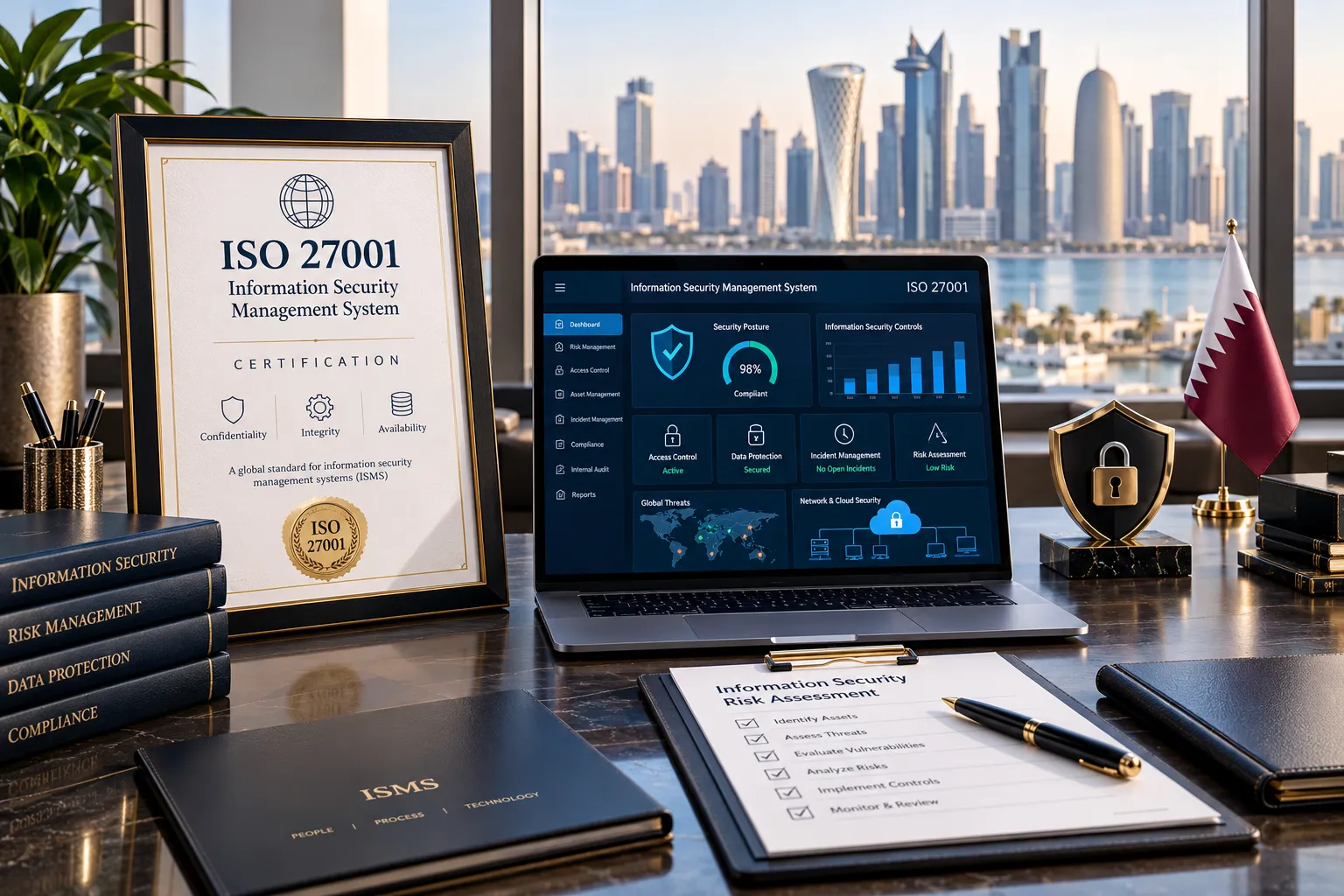
Benefits of ISO 27001 Certification
ISO 27001:2022 is an international standard for Information Security Management Systems (ISMS). It provides organizations with a structured framework to identify, manage, and protect sensitive information from risks such as data breaches, cyberattacks, and unauthorized access. An effectively implemented ISMS can help businesses:
- Strengthen Information Security: Protect confidential information from unauthorised access, disclosure, changes, and loss.
- Manage Cybersecurity Risks: Identify security threats, assess vulnerabilities, and take appropriate steps to manage risks.
- Support Data Protection Compliance: Establish security controls that support applicable privacy and cybersecurity requirements.
- Improve Customer Confidence: Demonstrate that their information security management practices have been independently assessed.
- Support Tender and Contract Requirements: Provide evidence of accredited certification when customers or procurement authorities require it.
- Improve Incident Management: Strengthen security monitoring, incident response, recovery planning, and continual improvement.
ISO 27001 certification demonstrates that an organisation meets the applicable information security management requirements. However, it does not guarantee protection against every cyberattack or automatically establish legal compliance.
Why ISO 27001 Certification Is Important for Businesses in Qatar
As Qatar’s digital economy continues to grow, businesses in banking, healthcare, information technology, energy, education, and professional services increasingly rely on secure handling of confidential and business-critical information. Cybersecurity threats, data breaches, unauthorised access, and service disruptions can affect business continuity, customer trust, and contractual relationships. ISO 27001 provides a structured way to manage these risks through information security governance, access controls, risk assessments, supplier management, incident response, and performance monitoring. For organisations providing technology services or handling sensitive customer information, accredited certification may also help demonstrate their information security management capabilities during customer evaluations and supplier prequalification.
Supporting Cybersecurity Under Qatar National Vision 2030
Qatar National Vision 2030, Digital Agenda 2030, and the National Cyber Security Strategy 2024–2030 support the development of secure digital infrastructure, stronger cybersecurity resilience, and a trusted digital economy. ISO 27001 supports these objectives by helping organisations establish clear information security practices, manage cyber risks, and continually improve their security performance.
For example, technology companies can strengthen cloud security and data protection, while financial service providers can improve access controls and incident management. ISO 27001 certification is not mandatory under Qatar National Vision 2030. Its value lies in helping organisations adopt information security practices that support the country’s digital transformation objectives.
Industries That Benefit from ISO 27001 Certification in Qatar
ISO 27001 is suitable for organisations of all sizes and across different industries. It is particularly useful for businesses that handle sensitive information, operate critical IT systems, or face specific cybersecurity requirements from customers.
- Banking, Finance and Fintech: Banks, financial service providers, and fintech companies use ISO 27001 to protect customer financial information and transaction records, manage access controls, address cybersecurity risks, and assess third-party security.
- Information Technology, Cloud and Telecommunications: Software companies, IT service providers, cloud operators, and telecommunications businesses use ISO 27001 to protect customer data, manage vulnerabilities, control privileged access, and improve incident response.
- Healthcare and Medical Services: Hospitals, clinics, laboratories, and healthcare providers use ISO 27001 to safeguard electronic health records, patient information, medical systems, and confidential communications.
- Oil, Gas and Energy: Engineering contractors, technical service providers, and energy-related businesses use ISMS controls to protect confidential project information, sensitive engineering documents, information systems, and supplier access.
- Government Contractors and Professional Services: IT contractors, consulting firms, legal practices, and professional service providers use ISO 27001 to protect client confidentiality, secure project information, manage documents, and control third-party access to data.
- Education and Training Institutions: Schools, universities, colleges, and training centres use ISO 27001 to protect student and staff records, examination information, research data, learning platforms, and administrative systems.
The certification scope depends on each organisation’s activities, information assets, security risks, and the boundaries of its ISMS.
Request a Quote
Request a Quote
Is ISO 27001 Certification Mandatory in Qatar?
ISO 27001 certification is not generally mandatory for every business operating in Qatar. However, certain customer contracts, government-related procurement procedures, and regulated-sector requirements may call for information security certification or other evidence of cybersecurity assurance.
Organizations must also comply with the data protection and cybersecurity regulations applicable to their operations, whether or not they hold ISO 27001 certification.
1. Qatar Personal Data Privacy Protection Law No. 13 of 2016: Qatar’s Personal Data Privacy Protection Law No. 13 of 2016 sets out requirements for protecting personal information and meeting applicable privacy obligations. Organizations covered by the law must implement appropriate safeguards for personal data and meet relevant requirements relating to its processing, confidentiality, and protection. In January 2026, Qatar’s National Cyber Security Agency (NCSA) also published advisory guidance on establishing personal data privacy programes and managing personal information throughout its lifecycle. ISO 27001 can help organizations implement relevant information security controls, including risk assessments, access management, incident response, supplier security, and monitoring.
However, ISO 27001 certification does not automatically establish compliance with Qatar’s Personal Data Privacy Protection Law. Organizations must assess their privacy-specific obligations separately. Businesses operating within the Qatar Financial Centre should also consider the applicable QFC Data Protection Regulations 2021 and related rules.
2. Qatar National Information Assurance (NIA) Requirements: Qatar’s National Cyber Security Agency administers the National Information Assurance (NIA) framework, which includes NIA Standard V2.1. The framework sets out national information security requirements covering governance, information classification, access controls, risk management, incident management, and security assurance. ISO 27001 can help organizations establish structured information security practices that are relevant to these requirements.
However, ISO 27001 certification and NIA certification are separate schemes. Businesses required to obtain NIA certification must follow the applicable national assessment and certification procedures. On 4 October 2026, NCSA and the Qatar Financial Markets Authority (QFMA) announced additional information assurance controls and a dedicated NIA compliance certification programe for QFMA-regulated entities. The programe is based on NIA Standard V2.1 and additional cybersecurity controls for financial markets. It does not make ISO 27001 certification universally mandatory for financial institutions or replace the international ISO certification process.
3. ISO 27001 Requirements for Qatar Government Tenders: Some government tenders, IT service contracts, technology procurements, and supplier prequalification procedures may require information security certification. Qatar’s Ministry of Finance manages government supplier classification and procurement through the Monaqasat Government Procurement Portal.
However, general government supplier classification is separate from the information security requirements specified in individual tenders. Businesses should review the relevant tender documents to confirm whether ISO 27001 certification, NIA compliance, or other cybersecurity evidence is required.
4. ISO 27001 and KAHRAMAA Information Security Requirements: Qatar’s General Electricity and Water Corporation, KAHRAMAA, provides an example of ISO/IEC 27001:2022 being used in government information security management. Its Tender No. 3350/2026, which closed on 26 July 2026, covered the maintenance and improvement of its Information Security Management System (ISMS). The published procurement included activities such as information security risk assessments, control reviews, policy updates, employee training, asset registers, risk registers, and audit preparation.
This procurement demonstrates the relevance of ISO 27001 to Qatar’s public-sector cybersecurity programes. However, it does not mean that every KAHRAMAA supplier must hold ISO 27001 certification. Businesses should confirm the applicable certification and information security requirements before submitting a tender.
ISO 27001 Certification Requirements and Documentation
To obtain ISO 27001 certification, an organisation must establish, implement, maintain, and continually improve an Information Security Management System that meets the requirements of ISO/IEC 27001:2022. The ISMS should reflect the organisation’s information assets, business activities, cybersecurity risks, legal obligations, and security objectives.
Key Information Security Management System Requirements include:
- Organisational Context: Understanding relevant business issues, interested parties, and the scope of the ISMS.
- Leadership and Information Security Policy: Defining management commitments, assigning responsibilities, and setting measurable security objectives.
- Information Security Risk Assessment: Identifying threats, vulnerabilities, potential impacts, and information security risks.
- Risk Treatment and Security Controls: Selecting suitable measures to reduce or manage identified information security risks.
- Statement of Applicability (SoA): Recording applicable Annex A controls, their implementation status, and the reasons for including or excluding reference controls.
- Operational Security and Incident Management: Managing information access, assets, suppliers, security events, and relevant operational safeguards.
- Performance Evaluation and Improvement: Monitoring ISMS effectiveness, conducting internal audits, carrying out management reviews, and addressing nonconformities.
ISO/IEC 27001:2022 includes 93 Annex A reference controls, grouped into four categories: organisational, people, physical, and technological. Organisations select suitable controls based on their risk assessment and risk treatment. Not every Annex A control must be implemented without considering whether it applies to the organisation.
Documents Required for ISO 27001 Certification
The required documentation depends on the organisation’s size, information security risks, business activities, and ISMS scope. Common documents and records include the information security policy, ISMS scope, risk assessment and treatment records, Statement of Applicability, security objectives, relevant operational controls, internal audit reports, management review records, and corrective-action evidence.
Access control records, incident reports, asset inventories, supplier security assessments, and business continuity-related information may also be required, depending on the organisation’s activities. For the certification application, Guardian may request company registration details, employee numbers, operating locations, business activities, and the proposed certification scope.
How to Obtain ISO 27001 Certification in Qatar
The ISO 27001 certification process in Qatar follows a structured, internationally recognised audit framework. If you are researching how to get ISO 27001 certification, the process involves an independent assessment of your Information Security Management System against ISO/IEC 27001:2022 requirements. The certification process involves six key steps:
- Application: Submit your organisation’s details, including business activities, number of employees, operating locations, information security complexity, and proposed ISMS certification scope.
- Stage 1 Audit: The auditor reviews ISMS documentation, information security risk assessments, the Statement of Applicability, and the organisation’s readiness for the certification audit.
- Stage 2 Audit: The auditor assesses how effectively the ISMS has been implemented by interviewing personnel, evaluating security processes, and reviewing operational records and selected controls.
- Certification Decision: The authorised certification body independently reviews the audit findings and any required corrective-action evidence before making a decision.
- Certificate Issuance: Following a positive certification decision, the certification body issues the ISO/IEC 27001:2022 certificate for the approved scope and applicable certification cycle.
- Surveillance and ISO 27001 Renewal: Periodic surveillance audits, normally conducted annually, check that the organisation continues to meet the requirements. Recertification is required before the three-year certification cycle expires.
How long does ISO 27001 certification take?
The time required for certification depends on your organisation’s ISMS readiness, certification scope, information security complexity, and any nonconformities identified during the audit. Businesses with an established and effectively implemented ISMS may complete the certification assessment within several weeks. Those that need additional preparation or must address audit findings may take longer.
The certification process follows ISO/IEC 17021-1 and ISO/IEC 27006-1 requirements, supporting impartial, competent, and consistent third-party ISMS certification.
ISO 27001 Certification Cost in Qatar
The ISO 27001 certification cost in Qatar depends on factors such as the organization’s size, information security complexity, number of operating locations, and the time required for the audit. There is no single fixed certification fee for every business. To prepare an accurate quotation, the certification body needs to review the organization’s ISMS scope, business activities, and information security environment.
What Factors Affect ISO 27001 Certification Cost?
- Company Size and Number of Personnel: Audit planning takes into account the number of personnel and the activities covered by the ISMS.
- Information Security Complexity: Cloud systems, outsourced services, sensitive information, and complex IT environments may affect the audit effort required.
- Certification Scope: The information systems, processes, activities, and organizational boundaries included in the ISMS influence audit planning.
- Number of Operating Locations: Businesses operating across multiple sites or locations may require additional audit arrangements.
- Initial Certification or Renewal: Initial certification, surveillance audits, recertification, and changes to the certification scope involve different audit requirements.
The final quotation reflects the applicable audit and certification activities. Organisations should also plan for surveillance and ISO 27001 renewal expenses throughout the three-year certification cycle. Internal ISMS implementation, security technology, employee training, and operational improvements are separate from Guardian’s independent certification services.
Why Choose Guardian Middle East for ISO 27001 Certification?
Guardian Middle East LLC coordinates ISO 27001 certification services in Qatar through Guardian Assessment UK Ltd, a United Kingdom–based certification body, an accredited certification body listed by the International Accreditation Service (IAS). Our certification services are supported by:
- IAS Accreditation (MSCB-366): Guardian Assessment UK Ltd is accredited for ISO/IEC 27001:2022 within its published accreditation scope.
- International Certification Framework: ISMS certification activities follow ISO/IEC 17021-1 and ISO/IEC 27006-1 requirements.
- QFC-Licensed Organisation: Guardian Middle East LLC operates under Licence No. 03870.
- Local Presence in Doha: Direct coordination for certification enquiries, applications, and audits.
- Independent Auditing: Impartial ISMS assessments and independent certification decisions.
Guardian does not provide ISMS consultancy or management system implementation services to organizations it certifies, helping maintain the impartiality of the certification process. For accreditation details and verification, visit our Accreditation and Recognition Page
Guardian Middle East LLC | Serving Qatar and the Middle East
Location: Abo Hamour Area, Doha, Qatar
P.O. Box: 23277, Doha, Qatar
Phone: +974 7770 2602 | +974 7213 7770
Email: info@guardian.qa
Website: www.guardian.qa
Contact Guardian Middle East LLC today to discuss your ISO 27001 certification requirements and receive a quotation tailored to your organization’s needs.
Let’s discuss your Iso Certification needs—reach out today
Frequently Asked Questions
Organisations of different sizes and industries can apply, including IT companies, financial service providers, healthcare organisations, government contractors, educational institutions, and professional service businesses. The ISMS must have a defined scope and meet the applicable ISO/IEC 27001:2022 requirements.
The cost depends on the organisation's size, ISMS scope, security complexity, and audit requirements. Guardian can provide a quotation after reviewing the application details.
Yes. Organisations can operate an Integrated Management System covering information security, quality management, and business continuity. Integrated audits may be considered where appropriate and within the relevant certification bodies' accreditation scopes.