


What can ISO 9001:2026 actually change inside a business?
The 2026 edition of ISO 9001 is more than an updated quality management standard. It puts greater emphasis on leadership, quality culture, strategic alignment, and how organizations manage risks and opportunities. Published on 16 September 2026, it replaces ISO 9001:2015 and brings these areas further into the way a quality management system supports business decisions and performance.
For businesses in Qatar, this raises a more practical question: How can these requirements translate into real business benefits?
A well-implemented QMS can help organizations bring greater consistency to their processes, respond more effectively to customer requirements, identify risks before they become recurring problems, improve operational performance, and create stronger accountability for quality.
But there is an important distinction.
The value of ISO 9001:2026 does not come from the certificate alone. It comes from what the organization does with the system.
In this guide, we look at the practical benefits businesses in Qatar can gain from ISO 9001:2026, how those benefits can appear in everyday operations, and how an organization can measure whether its QMS is actually improving performance.
What Is ISO 9001:2026?
ISO 9001:2026 is the current edition of ISO 9001, the world’s most widely used quality management standard. It provides a framework for organizations to establish, implement, maintain, and continually improve a quality management system.
The standard can be used by organizations of different sizes and sectors, including manufacturing, construction, healthcare, services, education, technology, and other business activities.
The 2026 edition builds on the established ISO 9001 framework rather than replacing it with a completely different approach. Its updates include:
- Stronger emphasis on leadership and quality culture
- Greater focus on quality-related awareness and ethical behaviour
- Clearer consideration of risks and opportunities
- Stronger connection between quality management and organizational strategy
- Improved alignment with other ISO management system standards
These changes are particularly relevant when a business wants its QMS to support actual business performance rather than operate as a separate compliance exercise.
Why ISO 9001:2026 is Important for Businesses in Qatar
Qatar’s current economic strategy places emphasis on private-sector development, productivity, competitiveness, economic diversification, and creating a stronger business environment. The Third National Development Strategy 2024–2030 includes targets related to labour productivity, private-sector participation, and improvements in the business environment and digital competitiveness.
For businesses operating in Qatar, these priorities make process consistency, productivity, risk management, controlled growth, and continual improvement increasingly relevant. A structured quality management system can help organizations manage these areas through defined processes, clear responsibilities, performance monitoring, customer focus, and continual improvement.
7 Key Benefits of ISO 9001:2026 for Businesses in Qatar
1. More Consistent Quality and Business Processes
One of the practical benefits of ISO 9001:2026 is greater consistency in how work is performed.
A quality management system (QMS) helps an organization define and control the processes needed to meet customer and applicable requirements. Instead of relying heavily on individual employees’ methods or experience, important activities can be managed through clear responsibilities, appropriate controls, documented information, and performance monitoring.
For a growing Qatar business, this can be particularly useful when several departments, projects, teams, suppliers, or contractors are involved in delivering the same product or service.
For example, a business managing multiple projects may find that different teams follow different approaches to documentation, approvals, or quality checks. A structured QMS can establish a more consistent way of managing these activities.
The objective is not to create paperwork for every activity. It is to make important processes controlled, understood, and repeatable, supporting more predictable delivery.
2. Stronger Customer Confidence and Satisfaction
Customer expectations are easier to manage when an organization has a defined approach to understanding requirements, delivering its services, handling problems, and learning from feedback.
ISO identifies increased customer confidence and satisfaction, effective complaint resolution, and sound quality-control processes among the benefits associated with ISO 9001.
For example, a service company may receive repeated complaints because different employees handle the same customer request differently. A QMS can help the organization identify where the process is inconsistent, define appropriate controls, monitor results, and improve the process.
For businesses serving customers, clients, contractors, or other organizations in Qatar, this structured approach can help maintain more consistent service delivery as customer and project requirements change.
The benefit is therefore not simply having a certificate to show a customer. It is having a system that makes reliable service delivery more achievable.
3. Better Management of Risks and Opportunities
Risk management is an important part of effective business decision-making, but organizations also need to recognize opportunities that can improve performance.
ISO 9001:2026 provides clearer treatment of risks and opportunities, encouraging organizations to consider both when planning and making decisions.
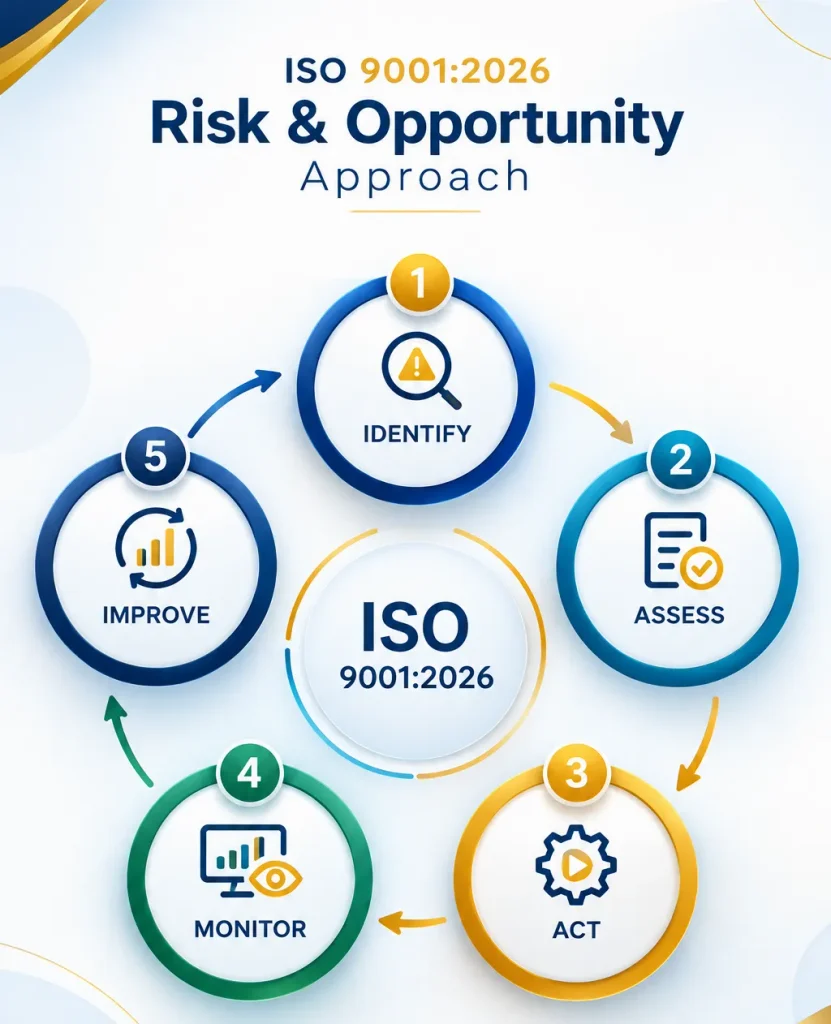
A practical approach can involve:
- Identifying relevant risks and opportunities
- Understanding their potential effect on business objectives
- Deciding what action is appropriate
- Assigning responsibility
- Monitoring whether the action is effective
- Reviewing the situation when circumstances change
This helps move risk management away from being a one-time exercise and toward being part of everyday business planning.
The stronger focus on risks and opportunities is particularly relevant to the 2026 edition because it encourages organizations to consider not only what could go wrong, but also circumstances that could improve performance, strengthen processes, support business objectives, or create opportunities for improvement.
For a Qatar business operating in a changing commercial environment, this can help connect quality management with everyday planning and decision-making.
Planning ISO 9001:2026 Certification in Qatar?
Understand the certification requirements and next steps for your organization.
Talk to Guardian Middle East LLC about ISO 9001:2026 certification in Qatar.
4. Stronger Leadership and Quality Culture
ISO 9001:2026 places greater emphasis on leadership, quality culture, accountability, and ethical behaviour.
This matters because quality cannot be maintained by the quality department alone. Management needs to establish direction and priorities. Process owners need to understand their responsibilities. Employees need to know how their work affects quality. Problems need to be reported and addressed rather than hidden.
A strong quality culture is therefore visible in everyday behaviour:
- Employees understand quality expectations.
- Managers use quality information when making decisions.
- Problems are investigated rather than repeatedly corrected.
- Employees understand their role in meeting customer requirements.
- Improvement becomes part of normal business activity.
Stronger leadership involvement can help connect quality objectives with business priorities and make responsibility for quality clearer across the organization.
For businesses in Qatar, this can become particularly relevant as organizations grow, add employees, manage more projects, or coordinate activities across different teams and functions.
5. Improved Operational Efficiency and Productivity
A quality management system can help an organization identify where its processes are consuming unnecessary time, resources, or effort.
ISO identifies process improvement, reduced inefficiencies, waste reduction, cost savings, and productivity gains among the potential benefits of ISO 9001.
The practical approach is to look at how work actually moves through the organization:
Process → Problem → Root Cause → Corrective Action → Monitoring → Improvement
For example, if a company repeatedly reworks documents because information is missing at the approval stage, the solution may not be to simply remind employees to “be more careful.” The organization can examine the process itself, identify why information is being missed, introduce an appropriate control, and monitor whether rework decreases.
For a business handling multiple projects, customers, suppliers, or operational activities, repeated errors and rework can consume time and resources. A structured approach to identifying root causes and improving processes can help the organization address the underlying problem rather than repeatedly correcting the same issue.
That is where a QMS can turn quality management into operational improvement.
6. Supports More Controlled Business Growth
Growth can create quality problems when processes that worked for a smaller organization are no longer sufficient for a larger one.
As a business expands, it may need to manage:
- More employees and responsibilities
- Additional suppliers and contractors
- More customers and projects
- Multiple operational locations
- Higher volumes of work
- Greater customer and stakeholder expectations
A structured QMS provides a framework for maintaining control while these activities become more complex.
This does not mean ISO 9001:2026 guarantees business growth. Rather, it can help an organization establish more consistent and controlled processes that are better suited to managing increasing operational complexity.
For businesses in Qatar, this can support organizations as they expand their operations, customer base, project portfolio, or internal responsibilities.
7. Easier Integration With Other ISO Management Systems
Many organizations operate more than one management system. For example, a company may have quality, environmental, occupational health and safety, or information security requirements.
ISO 9001:2026 adopts the latest Harmonized Structure used across ISO management system standards, which supports integration with other management systems.
This can help organizations avoid managing each system as a completely separate structure.
Depending on the organization’s needs, ISO 9001 may be integrated with standards such as:
- ISO 14001 for environmental management
- ISO 45001 for occupational health and safety
- ISO/IEC 27001 for information security
The practical advantage is a more coordinated management approach, with shared processes where appropriate rather than unnecessary duplication.
For a Qatar business that already manages multiple ISO standards, this can help coordinate common management processes and create a more connected approach to monitoring and improvement
ISO 9001:2026 Benefits at a Glance
The practical value of the standard can be summarized as follows:
| Business Area | What ISO 9001:2026 Can Help Improve | Practical Business Effect |
| Quality | Process consistency and control | More predictable delivery |
| Customers | Customer-focused processes and complaint handling | Greater confidence and satisfaction |
| Risk | Identification and management of risks and opportunities | Better-informed decisions |
| People | Leadership, awareness, and quality culture | Greater involvement in quality |
| Operations | Process evaluation and improvement | Better efficiency and productivity |
| Management | Performance monitoring and evaluation | More informed decisions |
| Growth | Structured and controlled processes | Better ability to manage increasing complexity |
Which Businesses in Qatar Can Benefit From ISO 9001:2026?
ISO 9001:2026 is not limited to a particular industry. ISO states that the standard can be used by organizations of different sizes and across different sectors.
In Qatar, it can be relevant to organizations such as:
- Construction and contracting companies
- Manufacturing businesses
- Engineering and technical service providers
- Oil and gas support companies
- Logistics and transportation businesses
- Information technology and technology companies
- Healthcare organizations
- Professional and business service providers
- Small and medium-sized enterprises
The important question is not simply whether a company belongs to a particular industry. It is whether the organization needs a structured approach to consistently meeting requirements, managing processes, monitoring performance, and improving its operations.
How ISO 9001:2026 Benefits Can Apply to Daily Business Activities
Add the new section here.
This is where you show practical activities rather than industries:
| Business Activity | How a QMS Can Help |
| Procurement | Supplier requirements → supplier evaluation → monitoring |
| Sales | Customer requirements → review → communication to operations |
| Operations | Defined process → quality control → monitoring |
| Complaints | Complaint → investigation → root cause → corrective action |
| Management | Performance data → management review → decision → improvement |
What Do These Benefits Look Like in Practice?
Consider an illustrative example of a growing Qatar-based contractor that is experiencing repeated delays in project documentation.
The immediate reaction might be to tell employees to check documents more carefully. But if the same problem keeps occurring, the organization needs to look at the process rather than repeatedly correcting the same error.
Before QMS Approach vs. Structured QMS
| Before a Structured QMS | With a Structured QMS |
| The same problem is repeatedly corrected | Root cause is investigated |
| Different teams follow different methods | Relevant processes are controlled |
| Complaints handled individually | Complaints are analysed for recurring causes |
| Management reacts after problems occur | Performance and risks are monitored |
| Improvement depends heavily on individuals | Improvement follows a defined process |
A QMS-based approach could look like this:
Problem: Project documents are repeatedly submitted with missing or incorrect information.
Root-cause review: The organization identifies where information is being lost or misunderstood.
Process improvement: Responsibilities, document requirements, review points, and approval controls are clarified.
Implementation: Employees are trained on the revised process.
Monitoring: The organization tracks document errors and delays.
Improvement: If the problem continues, the process is reviewed again, and further action is taken.
The value of ISO 9001 is therefore not the document itself. It is the disciplined cycle of understanding a problem, controlling the relevant process, evaluating results, and improving the system.
ISO 9001:2026 Benefits vs. Simply Having an ISO Certificate
It is important to distinguish between being certified and having an effective quality management system.
ISO 9001 certification is not mandatory. ISO describes certification as one way an organization can demonstrate conformity to the standard to customers and other interested parties.
A certificate by itself does not automatically:
- Improve a process
- Reduce customer complaints
- Increase productivity
- Eliminate risks
- Improve employee performance
- Guarantee new business
Those outcomes depend on how the organization operates its QMS.
The real value comes from using the system to:
- Monitor processes
- Evaluate performance
- Address problems
- Manage risks and opportunities
- Involve leadership and employees
- Conduct internal audits
- Take corrective action
- Continually improve
For this reason, organizations should approach ISO 9001:2026 as a management and improvement framework, not simply as a certification exercise.
Ready to Take the Next Step?
If your organization is considering ISO 9001:2026 certification, discuss your certification requirements and process with Guardian Middle East LLC.
Contact us to understand the next steps.
How Can a Business Measure the Benefits of ISO 9001:2026?
| Area | Possible Indicator |
| Customer | Complaints, feedback, satisfaction trends |
| Quality | Defects, nonconformities, rework |
| Operations | Delays, process performance, cycle time |
| Suppliers | Supplier performance/issues |
| Improvement | Corrective-action effectiveness |
| Management | Quality objectives and KPI performance |
If Your Business Already Has ISO 9001:2015
Organizations that already operate an ISO 9001:2015-based QMS do not necessarily need to rebuild their entire system from the beginning. A practical approach is to understand the changes in ISO 9001:2026, review the existing QMS against the updated requirements, identify relevant gaps, and strengthen the processes or controls that need attention. Organizations should also coordinate their transition arrangements with their certification body where applicable.
How Can a Qatar Business Start Getting These Benefits From ISO 9001:2026?
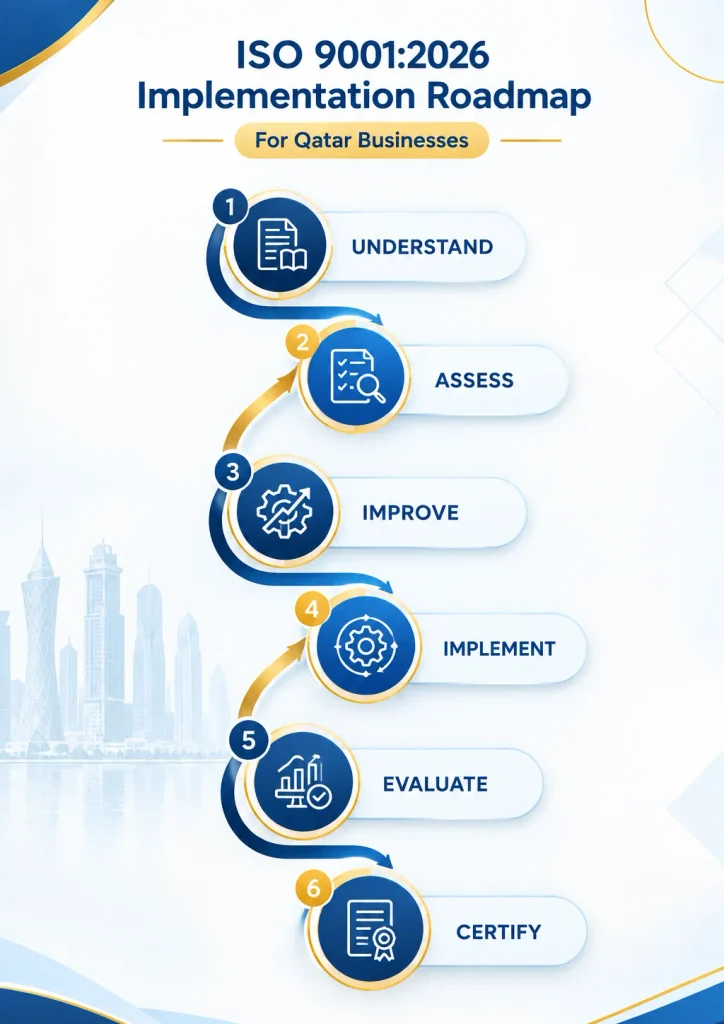
A business does not need to begin by changing everything at once. A practical approach is to understand the requirements, assess the current system, identify gaps, and then improve the areas that need attention.
Step 1: Understand the ISO 9001:2026 Requirements
Start by understanding what the standard requires and how those requirements relate to the organization’s actual activities.
Step 2: Review Existing Processes
Map the important processes that affect product or service quality, customer requirements, operational performance, and business objectives.
Step 3: Conduct a Gap Assessment
Compare current practices against ISO 9001:2026 requirements.
Look for gaps in areas such as:
- Leadership and responsibilities
- Customer requirements
- Risk and opportunity management
- Competence and awareness
- Operational controls
- Performance evaluation
- Improvement
Step 4: Implement Required Improvements
Address identified gaps by improving processes, responsibilities, controls, documented information, employee awareness, and monitoring arrangements as appropriate.
Step 5: Monitor and Evaluate the QMS
Implementation should not end when procedures are created.
The organization needs to evaluate whether its processes are actually working through appropriate monitoring, measurement, internal audits, management review, customer feedback, and other relevant information.
Step 6: Prepare for Certification, If Required
If the organization needs third-party certification, it can work with an appropriate certification body to plan the certification process.
Certification should be the result of an effectively implemented QMS, not the sole objective of the implementation.
ISO 9001:2026 Implementation Roadmap
| Stage | What the Organization Does | Main Purpose |
| 1. Understand | Review ISO 9001:2026 requirements | Establish direction |
| 2. Assess | Review existing processes and identify gaps | Understand current performance |
| 3. Improve | Address identified gaps and strengthen controls | Build an effective QMS |
| 4. Implement | Apply the system across relevant functions | Make processes consistent |
| 5. Evaluate | Monitor, audit, review, and improve performance | Check effectiveness |
| 6. Certify | Complete third-party certification, if required | Demonstrate conformity |
Start Your ISO 9001:2026 Certification Journey
Planning certification in Qatar? Contact Guardian Middle East LLC to discuss your organization’s requirements and certification process.
Get in touch with our team today.
Conclusion
For businesses in Qatar, the benefits of ISO 9001:2026 go beyond displaying an internationally recognized certificate. A properly implemented quality management system can help organizations create more consistent processes, strengthen customer confidence, manage risks and opportunities, improve operational performance, and build a stronger culture of quality.
The 2026 edition places greater emphasis on leadership, quality culture, strategic alignment, risks and opportunities, and integration with other management systems. These areas can help connect quality management more closely with how an organization is actually managed.
The key point is that these benefits come from how the QMS is implemented and used, not simply from obtaining certification. Organizations considering ISO 9001:2026 should therefore focus on understanding their requirements, assessing current processes, addressing relevant gaps, and building a management system that supports both quality and business objectives.
Your Partner for ISO 9001:2026 Certification in Qatar
Guardian Middle East LLC represents Guardian Assessment UK Ltd, a United Kingdom-based certification body recognized by UAF (United Accreditation Foundation) and IAS (International Accreditation Service, USA).
If your organization is planning ISO 9001:2026 certification in Qatar, Guardian can help you understand the certification requirements, prepare your quality management system, and move through the certification process with a clear and structured approach. Whether you are implementing ISO 9001 for the first time or preparing your existing QMS for the 2026 edition, our team can support you with the next steps toward certification.
Guardian Middle East LLC – Contact Details
- Location: Abo-Hamour Area, opposite the Medical Commission, Doha, Qatar
- P.O. Box: 23277, Doha, Qatar
- Mobile: +974 7770 2602 | +974 7213 7770
- Email: info@guardian.qa
- Website: www.guardian.qa
Frequently Asked Questions
Is ISO 9001:2026 mandatory in Qatar?
No, ISO 9001:2026 certification is not generally mandatory for businesses in Qatar. However, a customer, tender, contract, supplier requirement, or specific business arrangement may require ISO 9001 certification or conformity with particular quality requirements. Organizations should check the requirements that apply to their specific customers, contracts, and sector.
How can ISO 9001:2026 improve business performance?
ISO 9001:2026 provides a structured framework for managing processes, monitoring performance, addressing problems, managing risks and opportunities, and driving continual improvement. When properly implemented, it can help organizations identify recurring issues, reduce unnecessary rework, improve process consistency, and make decisions using relevant quality and performance information.
Does ISO 9001:2026 improve productivity?
It can support productivity by helping organizations identify inefficient processes, repeated errors, unnecessary rework, delays, and other operational problems. The QMS provides a structured approach to investigating root causes, implementing appropriate improvements, and monitoring results. However, productivity improvements depend on how effectively the organization applies and maintains its quality management system.
Is ISO 9001:2026 suitable for small businesses?
Yes. ISO 9001:2026 can be applied by organizations of different sizes and sectors, including small and medium-sized businesses. A smaller organization does not need to operate the same type of QMS as a large company. Its system should reflect its activities, processes, risks, customer requirements, and organizational context.
What is the difference between ISO 9001:2026 certification and having a QMS?
Yes. ISO 9001:2026 is the current edition and replaces ISO 9001:2015. Organizations currently operating an ISO 9001:2015-based QMS should review the updated requirements, identify relevant changes or gaps, and coordinate applicable transition arrangements with their certification body rather than assuming the existing system requires complete replacement.
How can a business start implementing ISO 9001:2026?
A business can start by understanding the ISO 9001:2026 requirements, reviewing its existing processes, conducting a gap assessment, and identifying areas that need improvement. The organization can then implement relevant controls, monitor performance, evaluate the QMS, and prepare for third-party certification if certification is required.
Can ISO 9001:2026 help businesses meet customer requirements?
Yes. A properly implemented QMS can help an organization establish a consistent approach to understanding customer requirements, controlling relevant processes, monitoring performance, handling complaints, and improving service or product delivery. Whether formal ISO 9001 certification is required depends on the specific customer, contract, tender, supply-chain, or sector requirement.
Can ISO 9001:2026 be integrated with other ISO standards?
Yes. ISO 9001:2026 can be integrated with other ISO management system standards where the organization's needs make this appropriate. For example, common management processes may be coordinated with ISO 14001, ISO 45001, or ISO/IEC 27001. This can help reduce unnecessary duplication and create a more connected approach to management and improvement.
Comments are closed