


Think about what happens when someone notices an unsafe situation at work. Does the problem get fixed before someone is hurt, or does everyone carry on until an accident happens?
That is where ISO 45001 can make a difference.
The benefits of ISO 45001 certification go beyond getting a certificate. It helps businesses create safer workplaces, prevent avoidable accidents, reduce work disruptions, and show clients that employee safety is taken seriously.
For businesses in Qatar, where industries such as construction, oil and gas, logistics, and facilities management involve different workplace risks, these benefits can be particularly valuable. But what does ISO 45001 actually do for your business, and is certification worth it?
What Does ISO 45001 Certification Actually Add to a Business?
Every business has some responsibility for keeping its workers safe. The challenge is making sure safety is managed properly every day, not just when an inspection is approaching.
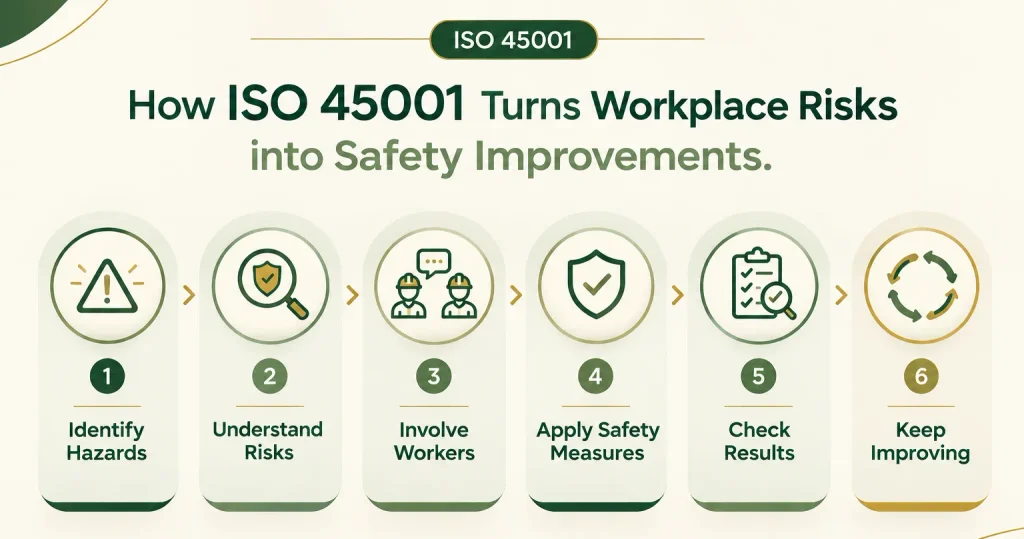
ISO 45001 certification gives businesses a structured way to do that. It is an international standard for managing workplace health and safety. It helps organizations identify possible dangers, take preventive action, involve employees, and keep improving their safety practices.
There are two things worth understanding:
- Implementing ISO 45001 certification means putting these safety practices into everyday work.
- Getting ISO 45001 certified means an independent certification body checks whether your system meets the standard.
So, the benefits of an ISO 45001 certification management system come from how well you use it. Certification adds independent assurance that your system meets the standard. The current published edition is ISO 45001:2018, with Amendment 1:2024 addressing climate-change considerations. A revised edition is being developed for 2027, although its final publication date may change.
How Does ISO 45001 Turn Safety Measures into Real Results?
Let’s understand this with a simple example. Imagine a construction site in Doha where a crane is lifting heavy materials close to an area where workers regularly walk.
Without proper planning, someone could enter the lifting area and get injured. A company following ISO 45001 certification would identify the danger, assess what could go wrong, separate workers from the lifting area, check the equipment, and make sure everyone understands the precautions.
Supervisors would also check that these measures are actually being followed. This is how the benefits of implementing ISO 45001 certification become visible in daily operations. Instead of waiting for an accident to reveal a problem, the business looks for risks and deals with them early.
What Are the 7 Main Benefits of ISO 45001 Certification?
The benefits of ISO 45001 certification for an organization are not limited to safety alone. They can also make everyday operations more reliable and improve how customers view the business.
Here are seven practical benefits worth understanding.
1. Helps Prevent Workplace Injuries and Occupational Illnesses
The biggest benefit is simple: helping people return home safely after work.
ISO 45001 certification encourages businesses to look for possible dangers before anyone gets injured. This might involve checking equipment, improving working methods, controlling exposure to harmful substances, or ensuring workers have suitable protection.
Heat stress is a good example for Qatar.
According to the International Labour Organization (ILO), heat-related clinic cases in Qatar dropped from 1,520 in summer 2020 to 351 in summer 2022—a 77% reduction following national heat-protection measures. This reduction was not specifically caused by ISO 45001 certification. However, it shows why identifying risks and taking preventive action matters.
For an individual employer, that could mean planning outdoor work carefully, monitoring heat exposure, providing suitable rest arrangements, and training workers to recognize warning signs.
2. Makes Legal and Safety Compliance Easier to Manage
Following safety regulations can be challenging, especially when a company manages several sites, contractors, or different types of work. ISO 45001 certification helps businesses keep track of the safety requirements that apply to their activities and check whether they are meeting them.
For example, Qatar Labour Law No. 14 of 2004 requires employers to inform workers about occupational risks and take precautions to protect them. Qatar also restricts covered outdoor work between 10:00 a.m. and 3:30 p.m., from 1 June to 15 September, under its heat-stress regulations.
With an organized safety system, businesses can assign responsibilities, maintain necessary records, and regularly check their practices. However, ISO 45001 certification does not automatically mean a company complies with every law. Those obligations must still be assessed and fulfilled.
3. Improves Worker Participation and Safety Awareness
Employees are often the first to notice when something is unsafe. A worker might spot damaged equipment, a blocked emergency exit, or an activity being carried out without proper precautions.
But noticing a problem only helps when employees feel comfortable reporting it, and management takes action. ISO 45001 certification encourages businesses to involve workers in safety decisions, listen to their concerns, and provide training they can understand.
These ISO 45001 benefits for employees are particularly useful in Qatar’s workplaces, where teams may speak different languages. Clear instructions, suitable language support, and practical safety demonstrations can help everyone understand what they need to do.
4. Reduces Operational Disruptions and Avoidable Costs
An accident doesn’t only affect the injured employee. It can also interrupt an entire operation. Work may stop while an incident is investigated. Equipment might need repair, employees may be absent, and planned activities can be delayed.
Preventing these problems can help a business avoid unnecessary expenses and keep operations running more smoothly. These are important ISO 45001 certification benefits for employers, particularly in industries where delays can affect project schedules.
Of course, getting certified does not guarantee financial savings. The real value comes from preventing incidents, reducing avoidable interruptions, and checking whether safety improvements are producing results.
5. Strengthens Contractor Control and Emergency Preparedness
On many Qatar worksites, several companies operate in the same location.
For example, a construction project may involve electrical contractors, equipment operators, maintenance teams, and other subcontractors working alongside one another. If everyone follows different safety arrangements without proper coordination, problems can arise.
ISO 45001 certification helps businesses establish clearer responsibilities, check contractor safety arrangements, coordinate hazardous activities, and prepare for emergencies. This makes it easier to manage safety when different teams and activities overlap.
6. Builds Client Confidence and Supports Tender Readiness
When selecting a contractor, clients often want to know whether the company can manage workplace risks responsibly.
ISO 45001 certification provides independent evidence that a business has a safety management system assessed against a recognized international standard. This can support supplier evaluations and tender applications where such certification is requested or accepted.
For example, Ashghal’s October 2025 prequalification renewal checklist requests relevant manufacturers’ ISO 45001 certificates or accepted alternatives/equivalents. Similarly, QatarEnergy’s contractor HSE guidance emphasizes safety requirements for contractors. This doesn’t mean every Qatar tender requires ISO 45001. Requirements vary depending on the client and project.
Still, certification can help a business demonstrate its approach to safety when customers ask for evidence.
7. Creates Clear Responsibilities and Encourages Continuous Improvement
Having a safety policy is one thing. Making sure people follow it is another. ISO 45001 certification helps businesses make safety responsibilities clear, so employees and managers understand what they need to do.
Suppose an inspection identifies damaged equipment. Instead of simply recording the problem, the business assigns someone to fix it, checks that the repair is completed, and looks at how to prevent the same issue from happening again. Over time, this approach helps businesses understand what is working, what needs attention, and where further improvements are needed.
Which Industries in Qatar Benefit Most from ISO 45001?
The benefits of ISO 45001 certification in Qatar depend on the type of work a business carries out. A construction contractor faces different risks from a warehouse operator, but both can use ISO 45001 to manage those risks more effectively.
Table 1: ISO 45001 Benefits Across Key Industries in Qatar
| Industry | Common workplace risks | How ISO 45001 helps |
| Construction & MEP | Working at height, lifting, heat stress | Better site safety and contractor coordination |
| Oil & gas contractors | Hazardous operations, simultaneous activities | Better planning and control of high-risk work |
| Logistics & warehousing | Forklifts, vehicle movements, manual handling | Safer material handling and vehicle routes |
| Facilities management | Electrical work, equipment maintenance | Better maintenance safety and emergency planning |
| Manufacturing | Machinery, chemicals, noise | Safer equipment use and exposure control |
The ISO 45001 benefits for construction companies are especially relevant when projects involve several contractors, changing worksites, and activities with higher safety risks.
However, ISO 45001 is not only for large or high-risk companies. Small businesses and service providers can also use it to manage safety in a way that suits their operations.
A Real-World Example from Qatar: Ashghal
ISO 45001 is not just something private contractors use. In January 2021, Qatar’s Public Works Authority, Ashghal, announced that it had received ISO 45001:2018 certification for occupational health and safety, alongside ISO 14001:2015 certification for environmental management.
The certifications followed an external audit conducted in October 2020. This is a useful local example of how a major organization responsible for infrastructure activities can include workplace safety management within its wider operations. It does not prove that certification caused a particular reduction in accidents or costs, but it demonstrates the standard’s relevance to Qatar’s infrastructure sector.
How Can You Measure the Business Benefits of ISO 45001?
Once a business starts improving its safety practices, how can it tell whether those changes are working? The answer is to look at what is actually happening in the workplace.
For example, are fewer people getting injured? Are employees reporting hazards? Are problems being fixed promptly? Is less working time being lost because of incidents? These are practical ways to understand the results.
Table 2: How to Measure ISO 45001 Certification Benefits
| What to measure | What it tells you |
| Injuries causing time off work | Whether serious injury trends are improving |
| Near-miss reports | Whether workers are identifying and reporting potential dangers |
| Time taken to fix safety problems | How quickly identified issues are addressed |
| Working hours lost after incidents | How much incidents interrupt operations |
| Effectiveness of safety training | Whether employees understand and follow precautions |
One important point: more near-miss reports do not always mean the workplace has become less safe. Sometimes, they show that employees are more confident about speaking up. The key is to look at the overall picture rather than focusing on one number. For businesses that need more detailed measurements, ISO 45004:2024 guides the evaluation of workplace health and safety performance.
Is ISO 45001 Certification Worth It for Your Business?
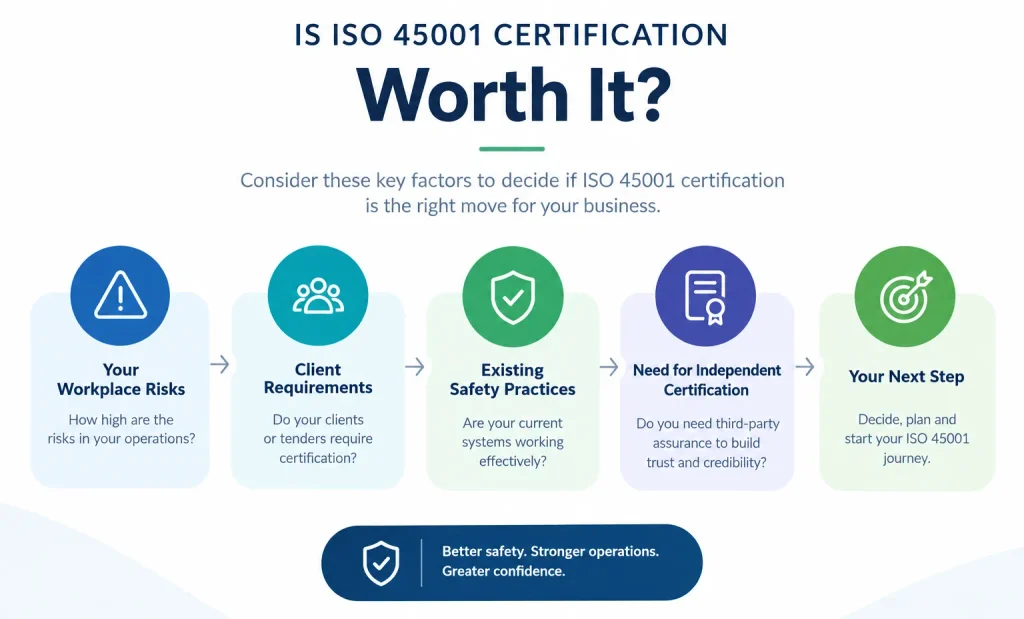
The importance of ISO 45001 certification depends on your business activities, workplace risks, and customer expectations.
If your company manages hazardous work, operates across several sites, or works with multiple subcontractors, having an organized and independently assessed safety system may offer considerable value.
Certification may also be useful when clients want proof of your safety arrangements. For a small business with limited workplace risks, implementing good safety practices may be the immediate priority, even if certification is not yet necessary.
The best decision is to look at what your business needs, what customers require, and whether your existing safety arrangements are working. Remember, certification does not guarantee zero accidents, lower insurance costs, or successful tender applications.
How Can Your Business Start Getting These Benefits?
You don’t need to start with complicated documentation. Start by looking at your current workplace safety practices. What risks do your employees face? Which safety measures are already working? Where are the gaps? From there, your business can improve safety procedures, train employees, assign responsibilities, and begin checking whether the changes are effective.
Once your system is ready, an independent certification body can assess it through Stage 1 and Stage 2 audits. The audit arrangements depend on the size, activities, and risks of your organization. Surveillance audits follow certification. Before choosing a certification body, check its accreditation, the standards and industries covered by that accreditation, and whether the certificate will meet your client’s requirements.
Get ISO 45001 Certification in Qatar with Guardian Middle East
Ready to get your business ISO 45001 certified?
Contact Guardian Middle East LLC to start your ISO 45001 certification process in Qatar.
Based in Qatar, Guardian Middle East LLC represents Guardian Assessment UK Ltd, a UK-based certification body recognized by UAF (United Accreditation Foundation) and IAS (International Accreditation Service, USA). We help businesses pursue ISO 45001 certification to demonstrate their commitment to occupational health and safety, manage workplace risks, and strengthen confidence among clients and business partners.
Start your ISO 45001 certification process today.
Phone: +974 7770 2602 | +974 7213 7770
Email: info@guardian.qa
Contact our team today to begin your certification process and demonstrate your commitment to occupational health and safety.
Frequently Asked Questions
1. Can small businesses benefit from ISO 45001 certification?
Yes. ISO 45001 is useful for businesses of different sizes. Small companies can use it to identify workplace hazards, improve safety practices, and show customers that they take employee safety seriously.
2. Can a company benefit from ISO 45001 without getting certified?
Yes. A company can apply ISO 45001 requirements and improve its workplace safety without obtaining a certificate. Certification adds independent confirmation that the management system meets the standard.
3. How long does it take to see benefits from ISO 45001 implementation?
Some improvements can happen quickly, such as fixing unsafe equipment or introducing better safety procedures. Other benefits, such as fewer injuries or less downtime, may take longer to measure. Results depend on the business and how consistently the safety measures are followed.
Comments are closed