

Introduction
If you run a restaurant, catering company, food factory, warehouse, hotel kitchen, or food distribution business in Qatar, you may eventually face the same question: do we need HACCP or ISO 22000 certification, or both?
The confusion is understandable because both deal with food safety.
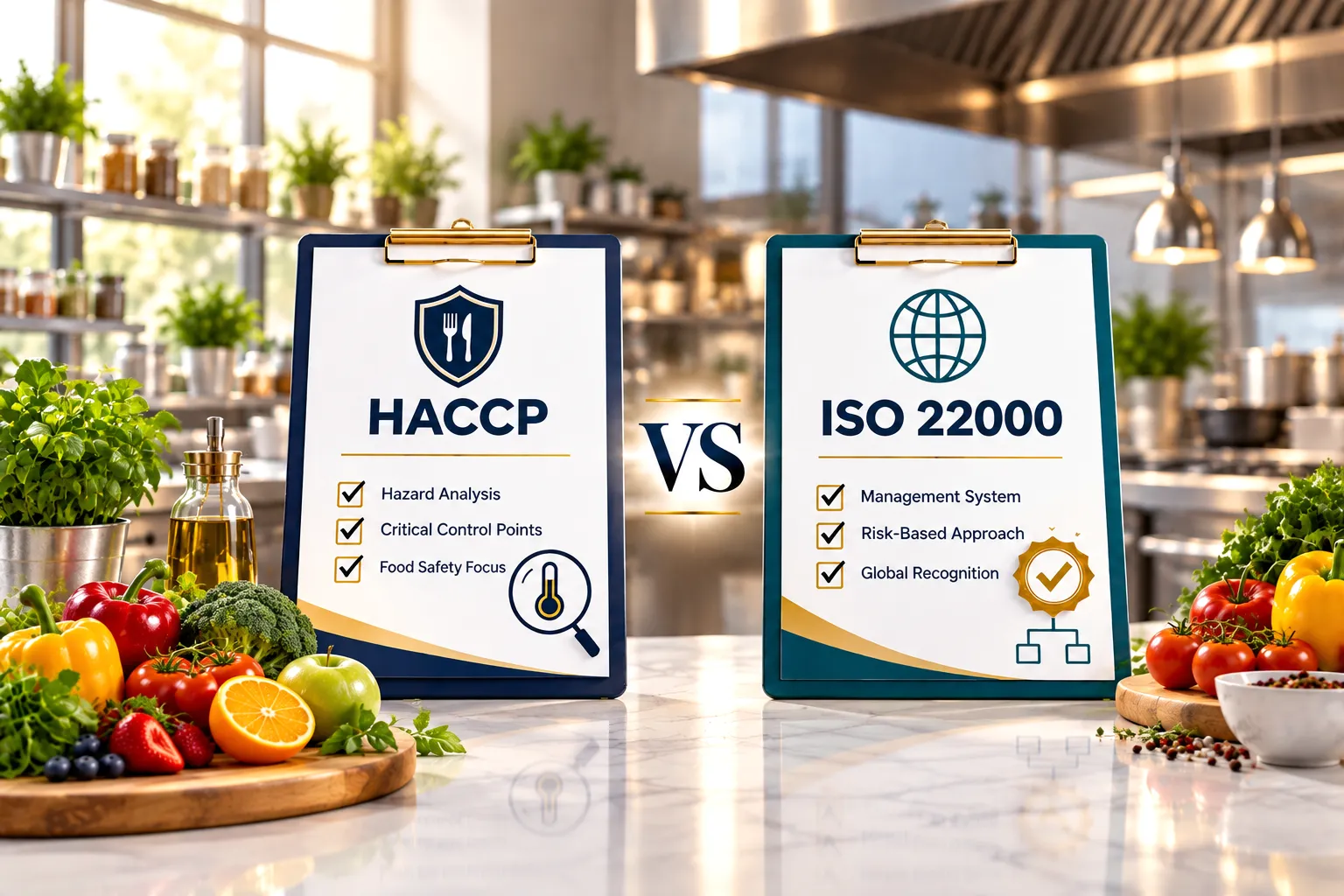
However, ISO 22000 vs HACCP is not simply a comparison between two competing certifications. HACCP is primarily a systematic method for identifying and controlling food-safety hazards. ISO 22000 takes those food-safety controls and places them inside a broader Food Safety Management System, or FSMS.
In practical terms, HACCP helps you control hazards in your food operation. ISO 22000 certification in Qatar helps you manage the wider system around those controls, including responsibilities, communication, documentation, internal audits, performance monitoring, and continual improvement.
For a food business in Qatar, the right approach depends on your activities, customers, contractual requirements, operational complexity, and applicable regulatory obligations.
What Is HACCP and What Does It Actually Do?
HACCP stands for Hazard Analysis and Critical Control Points.
It is a preventive food-safety approach designed to identify hazards before they cause a problem rather than relying only on inspection of the finished food.
A HACCP system focuses on three main types of food-safety hazards:
- Biological hazards, such as harmful bacteria, viruses, or parasites
- Chemical hazards, including cleaning chemicals, allergens, or chemical contamination
- Physical hazards, such as glass, metal fragments, or foreign objects
The HACCP methodology is built around seven recognised principles:
- Conduct a hazard analysis.
- Identify Critical Control Points, or CCPs.
- Establish critical limits.
- Establish monitoring procedures.
- Define corrective actions.
- Establish verification procedures.
- Maintain appropriate records and documentation.
A Simple HACCP Example
Consider a central kitchen preparing cooked chicken.
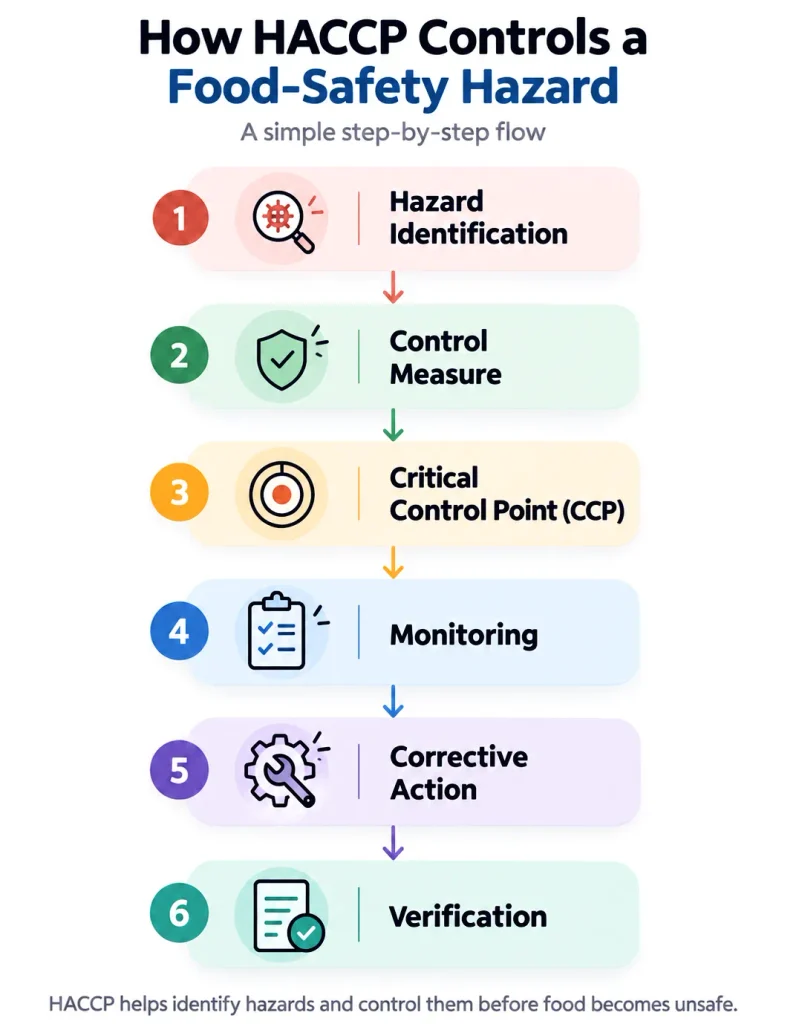
One significant hazard may be the survival of harmful microorganisms if the chicken is not cooked adequately. The business identifies cooking as a control point, establishes an appropriate time and temperature limit, monitors each batch, records the result, and takes corrective action if the required limit is not achieved.
That is HACCP in practical terms: identify the hazard, determine how it will be controlled, monitor the control, and act when something goes wrong.
What Is ISO 22000 and How Is It Broader Than HACCP?
ISO 22000 is an international standard for a Food Safety Management System.
Rather than concentrating only on individual food hazards, ISO 22000 certification creates a structured management framework around the entire food-safety operation.
It covers areas such as:
- leadership and management responsibility;
- food-safety objectives;
- competence and employee awareness;
- internal and external communication;
- prerequisite programmes;
- hazard analysis and operational control;
- traceability;
- emergency preparedness;
- documentation and records;
- internal audits;
- management review;
- corrective action; and
- continual improvement.
This is the main distinction in the ISO 22000 and HACCP difference.
HACCP primarily addresses food-safety hazards and their controls. ISO 22000 incorporates hazard control into a wider management system that helps an organisation consistently manage food safety across departments, people, suppliers, processes, and locations.
Does ISO 22000 Include HACCP?
Yes. ISO 22000 incorporates the principles of HACCP within its broader food safety management framework.
This means an organization implementing ISO 22000 still needs to identify food-safety hazards, determine appropriate control measures, monitor those controls, verify their effectiveness, and respond when controls fail.
However, ISO 22000 goes further.
It also requires the organisation to consider leadership, responsibilities, communication, system performance, internal auditing, management review, improvement, and other management-system elements.
This is why the answer to “Is ISO 22000 the same as HACCP?” is no.
A business may have a functioning HACCP plan without having a complete ISO 22000 management system.
Similarly, ISO 22000 should not be viewed as simply “HACCP with additional paperwork.” The additional requirements are intended to make food safety part of the organization’s overall management process.
ISO 22000 vs HACCP: What Are the Key Differences?
The simplest way to understand ISO 22000 vs HACCP is to compare what each system is designed to achieve.
| Area | HACCP | ISO 22000 |
| Main purpose | Identify and control food-safety hazards | Establish and maintain a complete Food Safety Management System |
| Main focus | Operational hazard control | Management system plus operational hazard control |
| Hazard analysis | Central requirement | Central component of the FSMS |
| Critical controls | CCPs and other relevant controls | Uses structured hazard-control approaches within the FSMS |
| Management responsibility | Present operationally, but not structured like an ISO management system | Leadership roles and responsibilities are formally defined |
| Prerequisite programmes | Normally support the HACCP system | Integrated into the overall FSMS |
| Internal audits | Depend on the HACCP programme or scheme being followed | Required as part of the management system |
| Management review | Not one of the seven HACCP principles | Formal management review is required |
| Continual improvement | May occur operationally | Built into the management-system approach |
| Third-party certification | Depends on the HACCP certification scheme or provider | ISO 22000 can be independently certified by a competent certification body |
The important point is that they operate at different levels.
HACCP asks: “What can make this food unsafe, and how will we control it?”
ISO 22000 also asks: “How will the organization ensure that the entire food-safety system continues to work effectively?”
Is HACCP Mandatory in Qatar? What About ISO 22000?
This is where food businesses need to separate three different matters: legal requirements, customer requirements, and voluntary certification.
HACCP Requirements in Qatar
Food businesses in Qatar are subject to food-safety requirements administered by the Ministry of Public Health (MoPH). The specific requirements can vary according to the type of food operation and applicable regulations.
For food-service establishments such as restaurants, caterers, and central kitchens, Qatar’s Ministry of Public Health provides food-safety guidance based on a HACCP approach. The applicable requirements can vary depending on the type of food operation, so businesses should check the requirements that apply to their specific activities.
However, a restaurant, food manufacturer, catering operation, warehouse, and importer may not all face exactly the same requirements.
Businesses should therefore check the requirements applicable to their specific operation with the relevant Qatar authorities rather than assuming that one rule applies identically to every food establishment.
Need Help Understanding Your Food Safety Requirements?
Not sure whether HACCP or ISO 22000 is more relevant to your food business in Qatar? Guardian Middle East LLC can help you understand the certification requirements and next steps.
[ Talk to Our ISO 22000 Team →]
Is ISO 22000 Mandatory in Qatar?
ISO 22000 certification is an international Food Safety Management System standard. Certification to ISO 22000 certification is one way for an organization to demonstrate that its food-safety management system meets the standard’s requirements. Whether a business needs certification depends on its applicable regulatory, customer, contractual, tender, or business requirements.
However, ISO 22000 certification may become commercially important where it is requested by:
- major customers;
- corporate procurement departments;
- hotels or hospitality groups;
- government or private tenders;
- institutional buyers;
- international customers; or
- supplier-prequalification programmes.
A business should therefore ask two separate questions:
“What does the law require us to implement?”
and
“What do our customers, contracts, or tenders require us to demonstrate?”
Those questions do not always produce the same answer.
HACCP or ISO 22000: Which One Makes Sense for Your Food Business?
Then use a short introductory paragraph and this table:
| If your main need is… | What to consider |
| Identify and control food-safety hazards | HACCP provides a systematic approach to hazard identification and control. |
| Meet a specific HACCP-based food-safety requirement | HACCP or the applicable food-safety scheme may be relevant, depending on the requirement. |
| Build a structured Food Safety Management System | ISO 22000 provides a broader management-system framework around food-safety controls. |
| A customer, tender, or contract requires ISO 22000 certification | ISO 22000 certification may be required to meet that specific commercial requirement. |
| You already have HACCP but need stronger management controls | ISO 22000 can provide a broader framework for responsibilities, audits, management review, corrective action, and continual improvement. |
| You need both hazard controls and a formal FSMS | ISO 22000 incorporates HACCP principles within its broader Food Safety Management System. |
There is therefore no single answer for every food business. If your immediate requirement is to identify and control food-safety hazards, HACCP may address that need. If your organization needs a broader, independently certifiable Food Safety Management System, ISO 22000 may be more appropriate. The decision should also take into account Qatar’s applicable requirements, customer expectations, contracts, tenders, and the complexity of your operations.
Restaurants and Cafés
For a restaurant, effective hazard control is usually the immediate priority.
The business needs to understand risks associated with receiving, storage, preparation, cooking, cooling, reheating, allergen management, cleaning, and personal hygiene.
ISO 22000 may become more relevant where the restaurant belongs to a larger group, operates several locations, serves demanding corporate customers, or wants a formally certified food safety management system.
Catering Companies
Catering operations can become considerably more complex.
A catering company may operate central kitchens, transport prepared food, serve multiple sites, employ large teams, and work under institutional contracts.
In this environment, HACCP remains fundamental, but a structured FSMS can help management maintain consistency across people, facilities, customers, and locations.
Food Manufacturers
Food manufacturers commonly deal with more complex supplier networks, production processes, traceability requirements, product specifications, allergens, packaging, and recall risks.
For such organizations, the broader structure of ISO 22000 can provide significantly more management control than relying on a standalone HACCP plan alone.
When Should a Business Move From HACCP to ISO 22000?
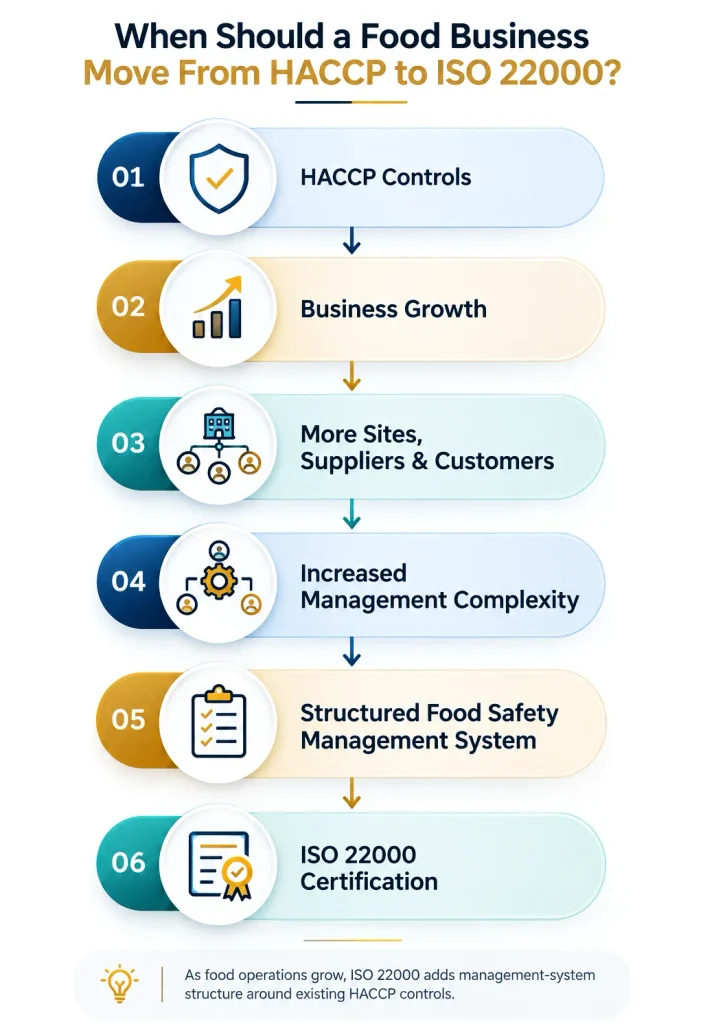
Moving towards ISO 22000 often makes sense when the organisation begins to outgrow a relatively simple food-safety control system.
Typical signs include:
- operations are expanding;
- the company operates multiple sites;
- the supplier network is becoming more complex;
- responsibilities are unclear between departments;
- customers are requesting recognised certification;
- tenders ask for a formal food safety management system;
- internal food-safety performance varies between locations;
- traceability is becoming more difficult;
- management wants structured internal audits;
- the company needs stronger corrective-action processes; or
- international customers expect a recognised FSMS.
Illustrative industry scenario:
A catering business operates one central kitchen and initially manages its major food-safety hazards through HACCP. As the company expands to multiple client sites, it adds more suppliers, delivery vehicles, employees, and production schedules. The HACCP controls remain important, but management begins facing inconsistent records, supplier issues, different practices between sites, and difficulty tracking corrective actions.
At this stage, ISO 22000 can provide additional structure through defined responsibilities, internal audits, management review, supplier controls, communication processes, traceability, and continual improvement.
The key lesson is that the company did not “replace HACCP.” It built a wider management system around its existing hazard-control approach.
Ready to Strengthen Your Food Safety System?
If your business is growing and your existing HACCP controls need a more structured management framework, explore how ISO 22000 certification can support your next stage.
Can a Company Use HACCP and ISO 22000 Together?
Yes, and in practice they are closely connected.
The question should not always be framed as HACCP or ISO 22000.
HACCP provides the core methodology used to identify and control significant food-safety hazards. ISO 22000 builds a larger management system around food-safety planning and control.
An organization implementing ISO 22000 therefore does not abandon HACCP principles. Instead, hazard analysis and control become part of the organization’s broader Food Safety Management System.
The practical objective is not to maintain two disconnected systems.
It is to ensure that operational hazard controls and management processes work together.
What Should You Do Before Choosing Between HACCP and ISO 22000?
Before deciding between HACCP certification and ISO 22000, first understand what your organisation actually needs.
Start by reviewing:
- applicable Qatar food-safety and licensing requirements;
- customer and contractual expectations;
- tender specifications;
- existing HACCP plans;
- prerequisite programmes;
- hygiene and sanitation controls;
- supplier-management arrangements;
- traceability processes;
- food-safety records;
- staff competence;
- internal responsibilities; and
- current gaps in your food-safety system.
If your organisation is considering ISO 22000, a proper gap assessment can help identify what is already in place and what still needs to be developed.
A business with a mature HACCP programme may already have several important operational elements.
The main work may then involve strengthening the surrounding management system rather than rebuilding every food-safety control from the beginning.
Final Takeaway: HACCP Controls Hazards; ISO 22000 Manages the Wider Food Safety System
The most important point in the ISO 22000 vs HACCP discussion is that the two are closely related but serve different purposes.
HACCP gives food businesses a systematic way to identify significant hazards and establish controls to keep food safe.
ISO 22000 takes those food-safety controls and integrates them into a wider management system covering leadership, responsibilities, communication, auditing, monitoring, corrective action, and continual improvement.
For a food business in Qatar, the right approach should be based on regulatory obligations, customer expectations, contractual requirements, operational complexity, and the need for third-party certification.
If your organization has already implemented HACCP and is considering a more structured and certifiable food safety management system, the next step is to understand the requirements and process for ISO 22000 certification in Qatar.
How Guardian Middle East LLC Supports ISO 22000 Certification in Qatar
Guardian Middle East LLC helps food businesses in Qatar prepare for ISO 22000 certification by understanding their food-safety requirements, strengthening Food Safety Management System (FSMS) practices, improving documentation, maintaining audit readiness, and supporting certification requirements.
Based in Doha, Guardian Middle East LLC represents Guardian Assessment UK Ltd, a United Kingdom–based certification body recognized by UAF (United Accreditation Foundation) and IAS (International Accreditation Service, USA).
This support is especially useful for food businesses that want to:
- strengthen their food-safety management system
- improve tender and supplier approval readiness
- meet customer or contractual food-safety requirements
- move from HACCP-based controls toward a more structured FSMS
- prepare for ISO 22000 certification with more confidence
Guardian Middle East LLC | Serving Qatar and the Middle East
Location: Abo Hamour Area, Doha, Qatar
P.O. Box: 23277, Doha, Qatar
Mobile: +974 7770 2602 | +974 7213 7770
Email: info@guardian.qa
Website: www.guardian.qa
Frequently Asked Questions
Does ISO 22000 include HACCP?
Yes. ISO 22000 incorporates HACCP principles into a broader food safety management system. Organisations implementing ISO 22000 still need to identify hazards, establish controls, monitor them, verify effectiveness, and take corrective action when needed.
Is ISO 22000 the same as HACCP?
No. ISO 22000 and HACCP are related, but they are not the same. HACCP is a hazard-control methodology, while ISO 22000 is a management-system standard that combines hazard control with wider organisational requirements such as leadership, audits, communication, and continual improvement.
Do I need ISO 22000 if I already have HACCP?
Not always. A business with an effective HACCP system may already control its operational food-safety hazards well. ISO 22000 becomes more relevant when the organisation needs a structured, independently certifiable food safety management system, especially for customer, tender, contractual, or business-growth requirements.
Can a restaurant use ISO 22000 instead of HACCP?
A restaurant can implement ISO 22000, but HACCP principles remain part of effective food-safety control. ISO 22000 does not remove the need for hazard analysis and operational controls. It adds a wider management framework around those controls.
Is ISO 22000 only for food manufacturers?
No. ISO 22000 can apply to organisations across the food chain, including manufacturers, restaurants, catering companies, warehouses, distributors, ingredient suppliers, and other businesses involved in food-related activities.
Can a company have both HACCP and ISO 22000?
Yes. In fact, they are designed to work closely together. HACCP provides the hazard-analysis and control methodology, while ISO 22000 integrates those controls into a broader management system. A company implementing ISO 22000 will normally use HACCP principles as part of its FSMS.
When should a food business move from HACCP to ISO 22000?
A business should consider ISO 22000 when operations become more complex, customers request certification, tenders require a formal FSMS, multiple sites need consistent controls, supplier networks expand, or management needs stronger systems for audits, corrective actions, traceability, and continual improvement.
Is ISO 22000 mandatory for food businesses in Qatar?
ISO 22000 should not be treated as a universal legal requirement for every food business in Qatar. Requirements can depend on the type of business, licence, customer, tender, or contract. Businesses should confirm the requirements that apply to their specific activities with the relevant Qatar authorities and customers.
Is HACCP mandatory for food businesses in Qatar?
HACCP-related requirements can depend on the type of food operation and the regulatory requirements that apply to it. Food businesses should confirm the exact food-safety obligations for their activity rather than assuming the same requirement applies to every restaurant, caterer, manufacturer, or distributor in Qatar.
Comments are closed