

What is the ISO 14001 Certification Cost in Qatar?
ISO 14001 certification in Qatar usually costs between $1,800 and $28,000 or more. The final cost depends on your business size, number of sites, environmental risk, scope, and audit time. Small low-risk companies pay less, while larger or more complex businesses pay more. It is becoming more important in Qatar as environmental expectations and project requirements continue to grow steadily.
ISO 14001 Cost in Qatar – Quick Breakdown
| Business Size | Employees | Estimated Cost |
| Small Business | 1–20 | $1,800–$4,500 |
| Medium Business | 20–100 | $4,500–$11,000 |
| Large Organization | 100+ | $11,000–$28,000+ |
Certification validity: usually 3 years, with ongoing surveillance activity during the cycle. Your ISO 14001 draft also notes that the 2026 transition affects all current ISO 14001:2015 certificate holders globally and that businesses should not delay transition planning.
Cost depends on:
- company size
- certification scope
- industry and environmental risk level
- number of locations
- readiness level
- audit duration
- whether the certification is integrated with ISO 9001 or ISO 45001
- whether it is a new certification, surveillance, recertification, or transition audit
Important note: These are indicative planning ranges, not an official fixed national tariff for Qatar. Final pricing is usually based on a case-by-case review of the organization.
Understanding ISO 14001 Certification Cost: What Businesses Often Overlook
When businesses first explore the ISO 14001 certification cost in Qatar, the first question is usually:
“How much does ISO 14001 certification cost?”
But the more useful question is:
“What am I actually paying for, and what value will it create for the business?”
ISO 14001 certification cost is the total investment required for implementation, audit, certification, and ongoing environmental management system maintenance. It is not just the cost of the certificate. It is the cost of building a structured system that helps a business manage waste, pollution risk, energy use, water use, environmental records, and compliance responsibilities in a more controlled way. ISO 14001 is more than an environmental standard—it is a practical management system that helps organizations improve environmental performance, manage risks, ensure compliance, and drive continual improvement.
In Practice
A small office-based company in Doha may expect ISO 14001 to be expensive, but if its activities are low risk and its controls are already organized, its cost can stay near the lower end. By contrast, a construction contractor, food business, logistics operator, or chemical-related business may need more audit time and stronger documentation because environmental controls are more demanding.
Key Insight
ISO 14001 certification is not a fixed-price service. It is a structured investment in environmental control, risk reduction, operational discipline, and long-term business credibility.
Why Does ISO 14001 Certification Cost Vary Between Companies in Qatar?
ISO 14001 cost varies because every organization has a different environmental footprint, operational complexity, and readiness level.
Key Factors That Directly Impact ISO 14001 Certification Cost
1. Company Size and Workforce
Larger organizations usually need more audit time because they have:
- more departments
- more employees
- more records
- more operational interfaces
In Practice
A company with one office and simple operations may need a short audit cycle, while a company with multiple departments, shifts, warehouses, vehicles, or production lines may require longer audit coverage.
2. Scope of Certification
A broader certification scope usually increases cost.
For example, certifying:
- One low-risk service function is usually simpler
- Multiple services, facilities, or operational sites is usually more complex
In Practice
Certifying one warehouse or one office is often more cost-effective than certifying a business covering operations, storage, transport, service delivery, and subcontracted activities under one broad scope.
3. Industry Complexity and Environmental Risk
This is one of the biggest cost drivers in ISO 14001.
Businesses in sectors like:
- construction and infrastructure
- manufacturing
- logistics and transport
- food operations
- chemical operations
- industrial support
- energy-related services
Often require deeper review because they deal with environmental risks such as waste handling, fuel use, spill response, storage controls, emissions, and emergency preparedness. These industries often prioritize ISO 14001 because environmental management plays a significant role in operational efficiency, regulatory compliance, customer expectations, and project requirements.
4. Number of Locations
Multi-site certification usually increases cost because:
- More sites may need to be reviewed
- Coordination is more complex
- Audit time can increase
- Travel may be involved
5. Level of Preparedness
Better preparation usually reduces total cost.
If a business already has:
- environmental procedures
- monitoring logs
- inspection records
- waste records
- training records
- internal reviews
Then the implementation and consultancy effort can be lower. Early preparation also helps organizations identify gaps in advance, making the certification process more efficient and cost-effective.
Breaking Down ISO 14001 Certification Costs: Where Your Money Goes
ISO 14001 Cost Components (Simple Breakdown)
| Cost Component | Typical Share |
| Implementation & Consultancy | 20–30% |
| Stage 1 & Stage 2 Audit | 40–50% |
| Certificate Issuance | 10–15% |
| Surveillance Audits | Ongoing |
| Recertification / Transition | Every 3 Years |
1. Implementation and Consultancy
This may include:
- gap analysis
- environmental aspect and impact review
- documentation
- employee training
- system setup support
In Practice
In our experience, organizations that already maintain environmental records and documented procedures generally complete implementation more efficiently than businesses building an EMS from scratch.
2. Certification Audit (Stage 1 and Stage 2)
- Stage 1: readiness and documentation review
- Stage 2: full implementation audit
Key Insight
For many organizations, the audit portion is one of the largest cost elements because it reflects the time needed to review scope, sites, risks, controls, and records.
3. Certificate Issuance and Registration
This usually includes:
- certificate issuance
- administration
- registration-related handling
4. Surveillance Audits
These are carried out during the certification cycle to check continued conformity and system maintenance.
5. Recertification or Transition Costs
These apply when:
- The 3-year cycle ends
- The business moves from ISO 14001:2015 to ISO 14001:2026
Following the publication of ISO 14001:2026 on 15 April 2026, organizations certified to ISO 14001:2015 are expected to complete the transition within the designated three-year transition period. Planning early can help reduce disruption and spread implementation costs over time.
Realistic ISO 14001 Certification Cost in Qatar (2026)
The table below provides a general planning estimate only. Final quotations vary depending on industry, environmental risk, readiness, and audit scope.
| Business Size | Estimated Cost Range |
| Small Businesses (1–20 employees) | $1,800 – $4,500 |
| Medium Businesses (20–100 employees) | $4,500 – $11,000 |
| Large Organizations (100+ employees) | $11,000 – $28,000+ |
Note
In Qatar, certification providers usually assess each organization individually before providing a final quotation.
In Practice
- A small office-based business may stay near the lower end.
- A medium-sized logistics or food company may fall in the middle range.
- A large construction, industrial, chemical, or energy-related business may go much higher because environmental risk and site complexity are greater.
Why Qatar-Specific Context Matters for ISO 14001 Cost
One reason ISO 14001 certification in Qatar should not be priced like a generic global service is that the local market environment matters.
Environmental development is one of the four pillars of Qatar National Vision 2030, highlighting the country’s long-term commitment to balancing economic growth with environmental sustainability. This growing focus on sustainable development has encouraged many organizations to strengthen their environmental management practices, making ISO 14001 increasingly relevant across various industries.
1. Qatar National Vision 2030 and Environmental Development
Environmental development is one of the four pillars of Qatar National Vision 2030, highlighting the country’s long-term commitment to balancing economic growth with environmental sustainability. As businesses increasingly align with these national priorities, ISO 14001 has become an important framework for improving environmental performance, demonstrating responsible business practices, and supporting long-term sustainability goals.
The Government Communications Office describes environmental development as one of the four pillars of Qatar National Vision 2030. It emphasizes balancing economic growth with environmental stewardship, including biodiversity protection, renewable energy, and water conservation. That makes ISO 14001 more than a voluntary internal system in Qatar. It aligns with the country’s long-term development direction.
2. Qatar’s Project-Driven Economy
Qatar’s official development pipeline includes major infrastructure and transport activity, such as the Doha Metro, Lusail Tram, the electric bus fleet goal by 2030, and the North Field Expansion Project. These sectors tend to increase interest in environmental systems because project owners and contractors expect stronger controls, records, and operational discipline.
3. Sustainability in Construction and the FIFA Legacy
Qatar’s sustainability ecosystem has also been shaped by GSAS, which is described as the first performance-based sustainability assessment system in the MENA region and was endorsed by FIFA in 2016 for Qatar’s 2022 stadiums. This shows why environmental performance and structured environmental systems have stronger visibility in the construction and infrastructure market than before.
4. Real Procurement Pressure
ISO 14001 draft references Ashghal’s subcontractor renewal checklist, which requires updated, valid, and traceable ISO 14001 together with supporting documents. That means for many Qatar-based businesses, the ISO 14001 cost is not only an internal management question. It is also tied to supplier approval, subcontractor credibility, and project readiness.
How Certification Bodies Calculate ISO 14001 Audit Cost
Certification bodies typically calculate cost based on:
- number of employees
- number of sites
- operational scope
- environmental risk level
- audit duration
- industry complexity
- travel requirements
- whether the business is low-risk or high-risk
- whether the audit is integrated with other standards
This is why ISO 14001 pricing is structured rather than random.
Hidden Costs of ISO 14001 Certification You Should Not Ignore
1. Internal Training and Awareness
Employees need to understand:
- environmental policy
- their responsibilities
- monitoring practices
- emergency response
- reporting expectations
2. Documentation and Process Setup
Many businesses need to create or improve:
- environmental procedures
- monitoring records
- inspection records
- waste handling records
- training records
- internal review records
3. Time and Productivity Adjustments
Implementation often takes internal time, especially when teams are still building:
- documentation
- monitoring habits
- reporting discipline
- environmental controls
In Practice
Businesses in Qatar may spend several weeks or months aligning processes before certification, particularly where environmental risks are significant. This preparation typically includes reviewing existing environmental risks, documentation, operational controls, employee training, and any gaps that should be addressed before the external audit.
Is ISO 14001 Certification Worth the Investment? (ROI Perspective)
For many businesses in Qatar, yes.
ISO 14001 can support value through:
- better environmental control
- stronger compliance awareness
- better waste and resource management
- stronger buyer confidence
- Better supplier review readiness
- improved long-term reputation
Key Insight
ISO 14001 is not only about environmental image. It can support real business value where environmental control affects operations, buyers, projects, and future readiness.
Cost vs Value: How ISO 14001 Supports Business Growth in Qatar
ISO 14001 can help businesses:
- build trust with clients and stakeholders
- improve internal discipline
- reduce environmental risk
- support vendor approval and buyer review
- strengthen credibility in sectors where environmental controls are visible
Many businesses in Qatar are choosing to implement ISO 14001 proactively rather than waiting until a client, tender, or regulatory requirement makes certification necessary. This proactive approach allows organizations to improve environmental performance, strengthen competitiveness, and prepare for future business opportunities.
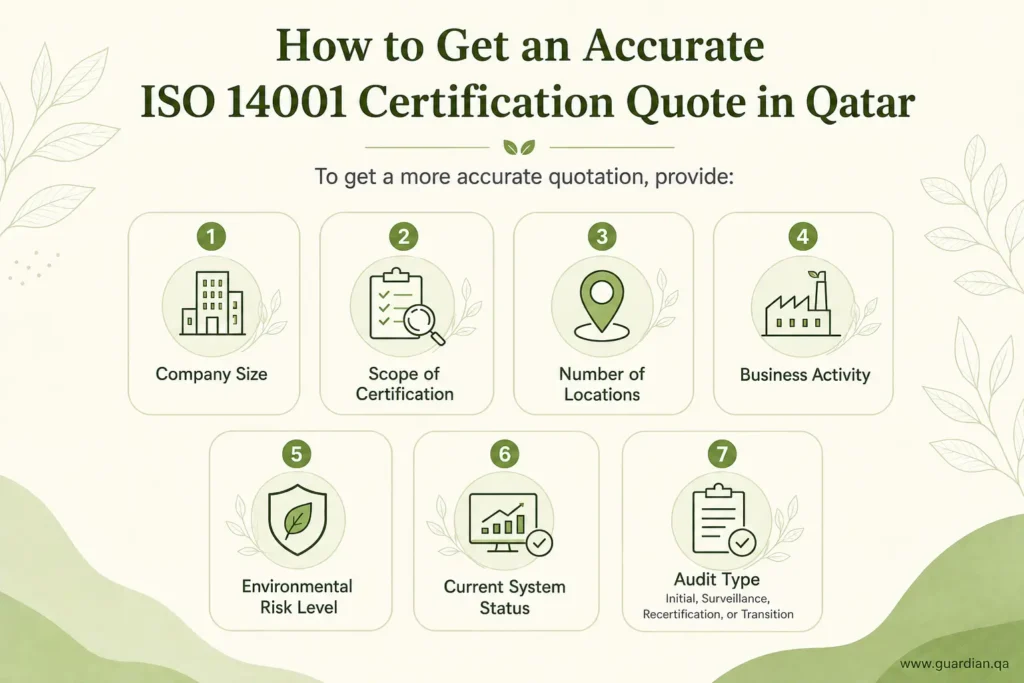
Planning ISO 14001 Certification in Qatar?
Whether you’re budgeting for certification, preparing for an external audit, or transitioning to ISO 14001:2026, our experts can help you assess your requirements, improve readiness, and receive a realistic quotation based on your organization’s size, scope, and environmental risks.
In Practice
Businesses that provide complete and realistic scope information usually receive more accurate quotations faster.
How Guardian Middle East LLC Supports ISO 14001 Certification in Qatar
Guardian Middle East LLC supports businesses across Qatar with practical guidance for ISO 14001 certification, helping organizations understand the factors that influence certification costs while improving audit readiness and environmental management practices. The focus is on building an effective Environmental Management System (EMS) that supports long-term compliance, operational efficiency, and successful certification.
Whether your organization is pursuing ISO 14001 certification for the first time or preparing for the transition to ISO 14001:2026, Guardian Middle East LLC can assist with:
- Understanding the key factors that affect ISO 14001 certification costs
- Gap analysis and implementation planning
- Environmental Management System (EMS) documentation
- Employee awareness and training
- Internal audit and audit readiness
- Certification support and transition planning
- Strengthening supplier approval and tender readiness
Based in Doha, Guardian Middle East LLC represents Guardian Assessment UK Ltd, a United Kingdom–based certification body recognized by the United Accreditation Foundation (UAF) and the International Accreditation Service (IAS), USA.
By helping organizations prepare effectively before the certification audit, Guardian Middle East LLC enables businesses to streamline implementation, improve environmental performance, and make informed decisions about their ISO 14001 certification investment.
Guardian Middle East LLC (Doha) | Serving Qatar and the Middle East
Location: Abo Hamour Area, Doha, Qatar
P.O. Box: 23277, Doha, Qatar
Mobile: +974 7770 2602 | +974 7213 7770
Email: info@guardian.qa
Website: www.guardian.qa
Final Thought
ISO 14001 certification cost in Qatar should not be viewed only as an expense. It is a practical investment in building a more controlled, efficient, and environmentally responsible business system.
Instead of focusing only on the starting cost, businesses should also look at the longer-term value:
- better environmental control
- stronger records
- stronger buyer confidence
- better readiness for procurement and supplier review
- stronger credibility in a market where environmental expectations are rising
For many businesses in Qatar, especially in construction, manufacturing, logistics, food, chemical, and industrial operations, ISO 14001 is becoming part of smart business planning rather than optional future thinking.
Frequently Asked Questions
2. Is consultancy included in the ISO 14001 certification cost?
Not always. Some certification providers offer consultancy and certification as separate services, while others may provide implementation support as part of a package. Before accepting a quotation, it is important to confirm whether it includes gap analysis, documentation support, employee training, internal audit assistance, and certification audit fees.
3. How long does ISO 14001 certification take in Qatar?
The certification timeline varies depending on the size and complexity of the organization. Small businesses that already have well-documented processes may complete certification within a few weeks, while larger or higher-risk organizations may require several months to implement the Environmental Management System (EMS), complete internal audits, and successfully pass the certification audit.
4. Is ISO 14001 certification mandatory in Qatar?
ISO 14001 certification is generally not a legal requirement in Qatar. However, many organizations choose to become certified to improve environmental performance, strengthen credibility, meet customer expectations, qualify for tenders, and enhance supplier approval opportunities.
5. How often are surveillance audits conducted after ISO 14001 certification?
ISO 14001 certification is typically valid for three years, with surveillance audits usually conducted annually to verify that the Environmental Management System continues to meet the standard's requirements. At the end of the three-year certification cycle, a recertification audit is required.
6. Can ISO 9001 and ISO 14001 be certified together?
Yes. Many organizations choose to implement and audit ISO 9001 (Quality Management) and ISO 14001 (Environmental Management) together as an Integrated Management System (IMS). Combining audits can reduce duplication, improve operational efficiency, and may lower the overall audit cost compared to obtaining each certification separately.
7. What factors have the biggest impact on ISO 14001 certification cost?
The main factors affecting ISO 14001 certification cost include company size, number of employees, certification scope, number of locations, industry type, environmental risk level, audit duration, and the organization's level of readiness. Businesses with multiple sites or higher-risk operations generally require more audit time, resulting in higher certification costs.
8. Will upgrading to ISO 14001:2026 increase certification costs?
Organizations transitioning from ISO 14001:2015 to ISO 14001:2026 may incur additional costs for updating documentation, training employees, revising processes, and completing the transition audit. However, businesses that begin planning early can often manage the transition more efficiently and minimise additional expenses.
Comments are closed