

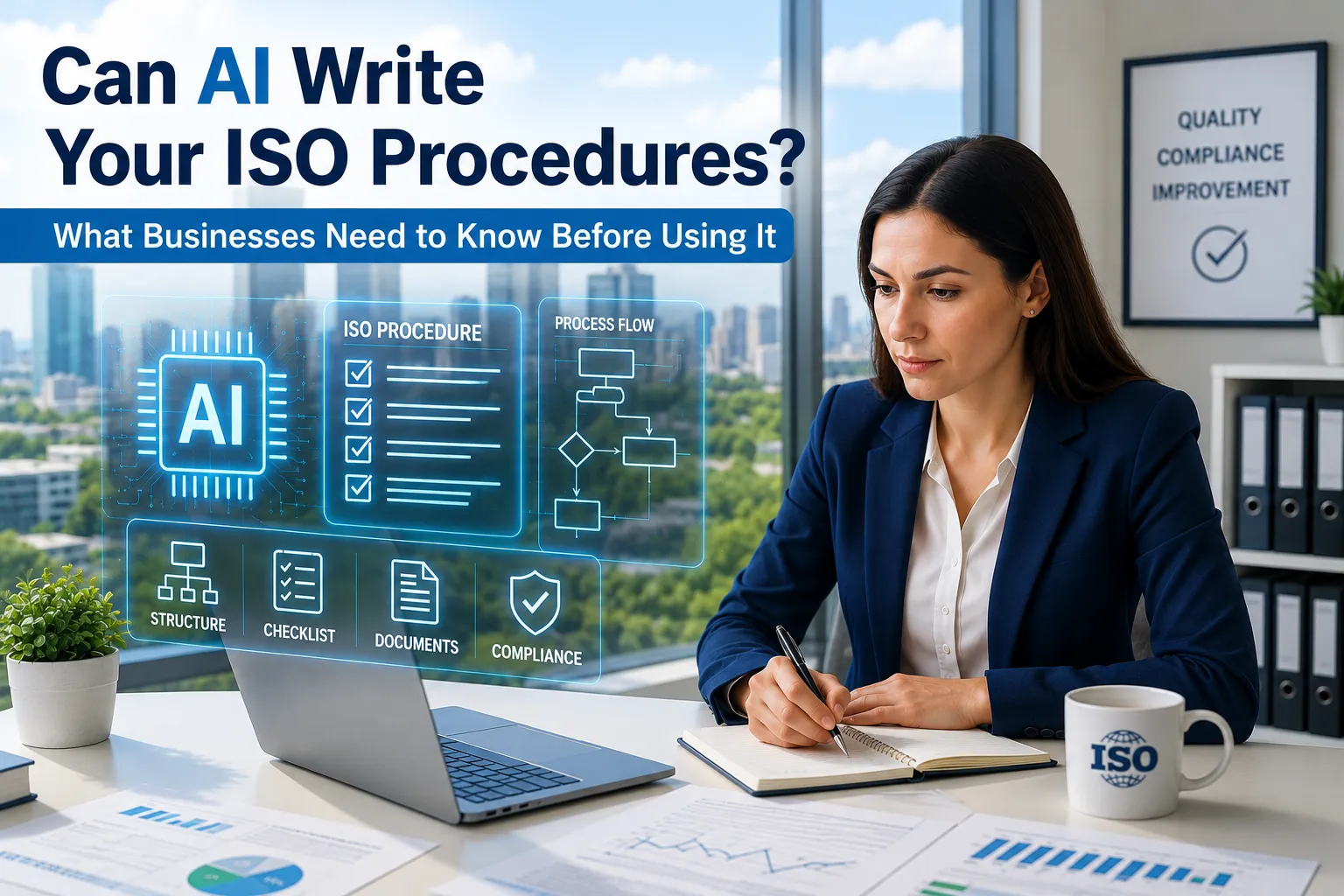
Can AI Write ISO Procedures?
Yes, AI can help create the first draft of an ISO procedure.
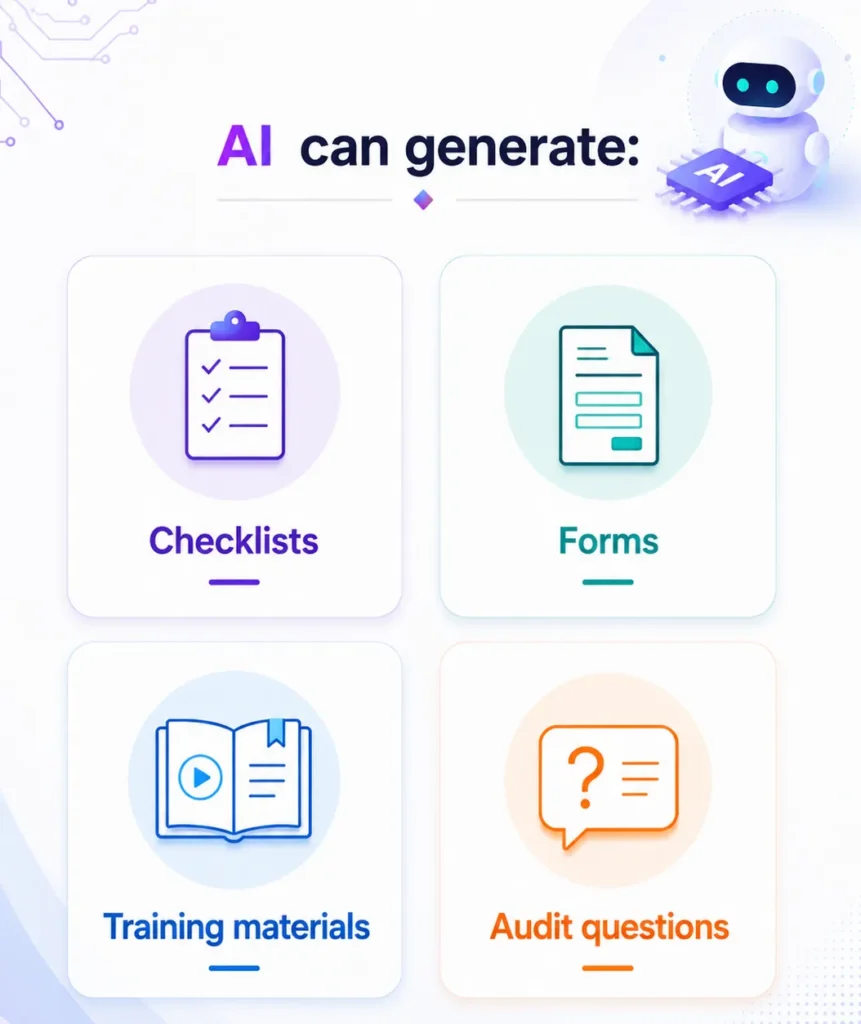
It can organize process information, improve wording, standardize document formats, and create supporting materials such as checklists, forms, and training content.
Table of Contents
However, AI cannot confirm whether a procedure:
- Accurately reflects your organization’s operations
- Meets applicable legal and regulatory requirements
- Addresses your actual risks and controls
- Is understood and followed by employees
- Is supported by appropriate records and evidence
- Meets the requirements of an ISO certification audit
An AI-generated procedure should therefore be treated as a drafting aid, not as a final compliance decision.
Your organization remains responsible for reviewing, approving, implementing, maintaining, and demonstrating the effectiveness of every procedure.
The most important question is not:
“Did AI write this procedure?”
The real question is:
“Does this procedure accurately reflect how our organization works, and can we demonstrate that it is being followed?”
What Is an ISO Procedure?
An ISO procedure is documented information explaining how an organization performs a particular process within its management system.
A procedure may explain:
- What needs to be done
- Who is responsible
- When the activity must be performed
- How the process should be carried out
- Which risks and controls must be considered
- What records or evidence must be maintained
- How results are reviewed or monitored
ISO procedures are not just for certification—they are tools to ensure consistency, accountability, and operational clarity.
Why Businesses Are Turning to AI for ISO Documentation
AI tools can generate structured documents within seconds.
Businesses can input a process description and receive:
- Purpose and scope
- Responsibilities
- Process steps
- Required records
- Monitoring requirements
This speed makes AI attractive—especially for organizations preparing for certification under tight timelines.
However, speed does not equal compliance.
A well-written document is only valuable if it reflects real operations and actual controls.
What AI Can and Cannot Do
| AI Can Help With | AI Cannot Reliably Do |
| Draft procedures | Understand your real operations |
| Improve readability | Verify legal compliance |
| Standardize formats | Conduct risk assessments |
| Create checklists | Confirm implementation |
| Suggest audit questions | Guarantee certification |
Real-World Example
An AI tool can generate a well-structured ISO 9001 Calibration Procedure with sections such as:
- Purpose
- Scope
- Responsibilities
- Process steps
- Required records
However, AI cannot know your organization’s:
- Actual equipment requiring calibration
- Calibration intervals
- Responsible personnel
- Acceptance criteria
- Applicable legal or customer-specific requirements
These details must be verified and customized by the organization before the procedure is approved and implemented.
Key takeaway: AI supports documentation—but cannot replace expertise, accountability, or implementation.
Where AI Adds Real Value
1. Drafting Procedures Faster
AI can convert raw process notes into structured procedures—saving time while maintaining consistency.
Example: Drafting an ISO Procedure with AI
Suppose a manufacturing company needs to create a Calibration Procedure for its ISO 9001 Quality Management System.
The company provides AI with information about its calibration process. AI can generate a structured draft that includes:
- Purpose
- Scope
- Roles and responsibilities
- Calibration process steps
- Required records
- References to related documents
However, AI cannot determine organization-specific information such as:
- Which equipment requires calibration
- Actual calibration frequency
- Who is responsible for performing and approving calibration
- Acceptance criteria
- Applicable legal, regulatory, or customer requirements
These details must come from the organization’s actual operations and be reviewed by competent personnel before approval.
Key takeaway: AI helps organize and structure procedures, but only the organization can ensure they accurately reflect real processes.
2. Improving Clarity
AI simplifies complex language, making procedures easier for employees to follow.
3. Standardizing Documentation
It ensures all procedures follow a consistent format, improving usability and control.
4. Creating Supporting Materials
5. Reviewing Existing Documents
AI can highlight inconsistencies, duplication, and unclear sections.
Where AI Becomes Risky
1. Misrepresenting Actual Processes
AI may create “ideal” processes that don’t match reality—leading to audit findings.
2. Legal and Regulatory Errors
AI cannot reliably interpret local laws or industry-specific regulations.
3. Technical and Safety Decisions
AI should never define safety limits, inspection criteria, or engineering controls.
4. Certification Misconceptions
AI cannot approve certification—only accredited certification bodies can.
Why Generic AI Procedures Fail Audits
Auditors compare documentation with:
- Employee practices
- Records and evidence
- Actual workflows
If your procedure says one thing and your team does another, it leads to nonconformities.
Rule: Always build procedures from real processes—not templates.
What You Should Provide AI
To get useful results, input:
- Actual process steps
- Roles and responsibilities
- Risks and controls
- Required records
- Applicable ISO and legal requirements
Without accurate input, AI will guess—and those guesses can create compliance risks.
Want to use AI without risking audit failures? Talk to our ISO experts about building audit-ready procedures.
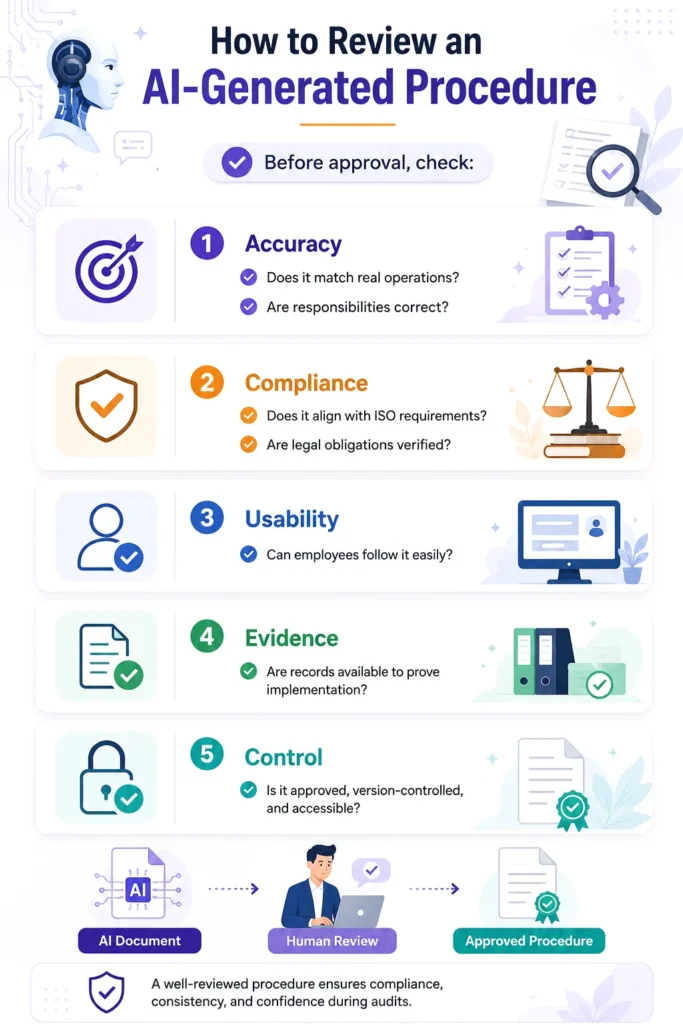
A Safe Step-by-Step Approach
- Understand your real process.
- Gather existing documents.
- Identify ISO and legal requirements.
- Remove sensitive data.
- Use AI to draft.
- Review with process owners.
- Test in real operations.
- Approve and control.
- Train employees.
- Monitor and improve.
What Auditors Will Still Expect
Regardless of AI use, auditors require:
- Procedures aligned with real operations
- Evidence of implementation
- Employee awareness
- Effective controls
- Continuous improvement
AI-generated documents alone will not pass an audit.
Final Answer: Should You Use AI for ISO Documentation?
Yes—but only as a support tool.
AI helps with:
- Speed
- Structure
- Clarity
But it cannot replace:
- Process knowledge
- Legal verification
- Technical expertise
- Implementation
- Certification decisions
Successful organizations use AI with expert oversight—not instead of it.
Independent ISO Certification Services in Qatar
Guardian Middle East LLC provides access to independent ISO certification services through Guardian Assessment UK Ltd, a United Kingdom–based certification body, recognized by UAF (United Accreditation Foundation) and IAS (International Accreditation Service, USA).
Auditors evaluate whether your management system:
- Meets ISO requirements
- Reflects real operations
- Is effectively implemented
- Is supported by evidence
- Demonstrates continual improvement
Guardian Middle East LLC does not create or approve your procedures—your organization remains responsible for its management system.
Contact Us
Guardian Middle East LLC
Abo Hamour Area, Doha, Qatar
P.O. Box: 23277
Mobile: +974 7770 2602 | +974 7213 7770
Email: info@guardian.qa
Frequently Asked Questions
2. Will AI-Generated Procedures Pass an Audit?
Only if they reflect real processes and are properly implemented.
3. Does Every ISO Process Need a Procedure?
No. Documentation depends on risk, complexity, and the requirements of the applicable ISO standard.
4. Is It Safe to Upload Documents to AI?
Only if the AI tool is approved by your organization and any data privacy or confidentiality risks have been properly managed.
5. Can AI Replace ISO Experts?
No. AI supports documentation but cannot replace process owners, auditors, consultants, or accredited certification bodies.
Comments are closed