

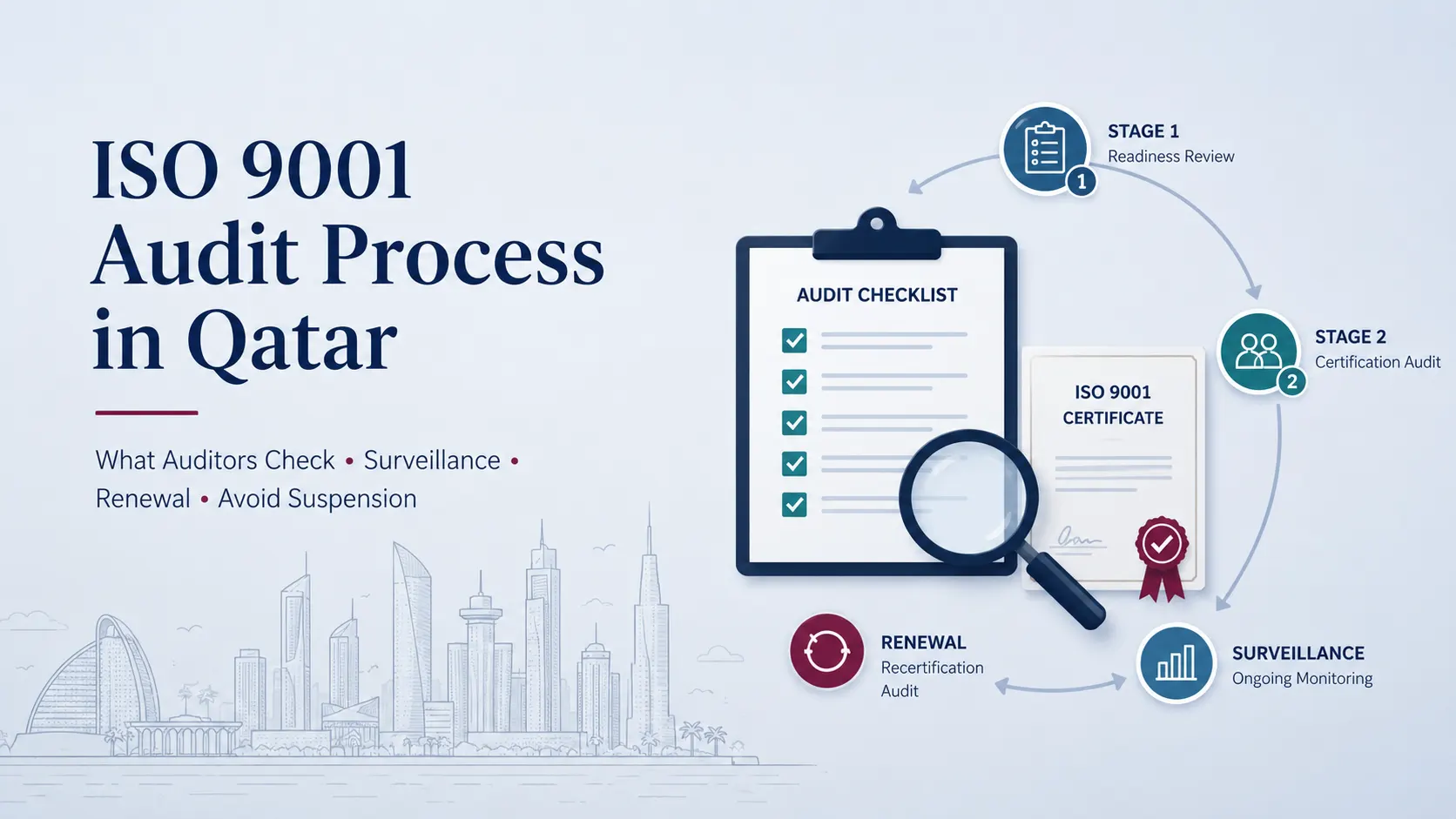
Quick answer: The ISO 9001 audit process in Qatar usually includes a Stage 1 audit (readiness and documented information review), a Stage 2 audit (implementation in practice), ISO 9001 surveillance audits (typically annually), and an ISO 9001 recertification audit (commonly every three years). ISO 9001 certificate suspension most often happens when major issues are not closed properly, internal audits and management review are weak, or the Quality Management System (QMS) is not maintained in day-to-day operations.
Who this is for: Businesses in Qatar preparing for ISO 9001 certification, organizations getting ready for ISO 9001 surveillance audit or ISO 9001 certification renewal in Qatar, and companies that rely on tender eligibility, supplier approvals, or client audits.
What this guide covers:
- The full ISO 9001 audit lifecycle (Stage 1, Stage 2, surveillance, recertification)
- Common ISO 9001 audit findings and recurring ISO 9001 nonconformities
- What causes an ISO 9001 certificate suspension, and how to avoid it
- Qatar sector-specific audit priorities
- A practical ISO 9001 audit checklist for audit readiness
Introduction
For many businesses in Qatar, ISO 9001 certification is no longer only a quality benchmark. It is increasingly linked to tender participation, supplier approvals, EPC contract expectations, healthcare quality requirements, infrastructure delivery, and long-term business credibility.
As regulated procurement standards rise and organizations face stronger expectations around operational consistency, risk control, and service quality, ISO 9001 certification maintenance has become a strategic business priority.
ISO 9001 certification is not a one-time achievement. It is an ongoing commitment to maintaining an effective Quality Management System (QMS), improving operational performance, reducing business risks, and demonstrating continual improvement across core business processes.
Certification bodies assess organizations not only during initial certification audits, but also through ISO 9001 surveillance audits and ISO 9001 recertification audits to verify that the system remains effective over time.
For businesses operating in Qatar’s construction, engineering, oil and gas support services, healthcare, manufacturing, logistics, and regulated supplier sectors, understanding the complete ISO 9001 audit lifecycle is essential.
Poor implementation, repeated nonconformities, weak internal controls, or failure to maintain the system can lead to certification delays, ISO 9001 certificate suspension, or certificate withdrawal. This can directly affect supplier confidence, tender eligibility, contract renewals, operational continuity, and market credibility.
This guide explains the complete ISO 9001 audit process, common certificate suspension risks, recurring audit failures, and how businesses in Qatar can maintain long-term ISO 9001 audit readiness.
Why ISO 9001 Certification Maintenance Is an Ongoing Business Commitment
ISO 9001 is designed to help organizations establish, maintain, and continually improve a QMS that supports consistency, customer satisfaction, operational control, and risk-based decision-making.
Certification is not permanent. Organizations must continuously demonstrate that the QMS remains active, effective, and aligned with real business operations.
Certification bodies typically expect evidence of
- Process effectiveness
- Controlled documentation and documented information
- Risk-based thinking
- ISO 9001 internal audit planning and results
- Corrective action (CAPA) management and closure evidence
- Leadership involvement
- Continual improvement
- Customer satisfaction monitoring
- Evidence-based decision-making
- ISO 9001 management review effectiveness
When these controls weaken, businesses become more vulnerable to common ISO 9001 audit findings, operational disruptions, and certification risks.
For organizations in Qatar, particularly those involved in supplier approvals, regulated service delivery, engineering contracts, healthcare operations, and international procurement, strong system maintenance often supports both business continuity and commercial trust.
Understanding the Complete ISO 9001 Audit Lifecycle
ISO 9001 certification typically follows multiple audit stages, each designed to verify readiness, implementation, and long-term effectiveness.
Stage 1 Audit ISO 9001: Documentation Review and Readiness Assessment
The Stage 1 audit ISO 9001 documentation is a preliminary review conducted before a full certification assessment. Its purpose is to determine whether the organization is adequately prepared for the certification process.
| What Auditors Check | Stage 1 Audit (Readiness + Document Review) | Stage 2 Audit (Implementation in Practice) |
| Main objective | Confirm readiness and that the QMS is defined and documented properly | Verify the QMS is implemented and effective in real operations |
| QMS scope | Scope is defined clearly and matches actual activities | Scope is applied correctly across departments/sites |
| Process structure | Process mapping and the interaction of processes are documented | Processes are followed consistently in daily work |
| Documented information | Controlled documents exist (policy, objectives, procedures as applicable) | Documents are used correctly; no outdated/unused versions in operation |
| Quality policy & objectives | Policy and objectives are documented and aligned with the organization | Objectives are tracked with evidence (KPIs/results) |
| Risk-based thinking | Risks/opportunities are identified in a structured way | Risk controls are applied and monitored in practice |
| Internal audits | Internal audit programme/plan exists (and evidence where available) | Internal audits are conducted effectively; findings are closed properly |
| Management review | Management review approach exists (and records where available) | Management review is done with meaningful inputs/outputs and actions |
| Readiness checks | Resource readiness, responsibilities, and overall preparedness | Employee awareness, competence, and operational controls are confirmed |
| Records & evidence | Checks that required record types are planned | Checks actual records: training, complaints, supplier evaluation, CAPA, monitoring/measurement, traceability/calibration (where applicable) |
| Outcome | Approval to proceed to Stage 2 or delays until gaps are closed | Certification decision (after closing findings, if any) |
Common Stage 1 audit issues (ISO 9001 audit preparation Qatar)
Organizations often experience delays when auditors identify:
- Incomplete documentation
- Unclear QMS scope
- Weak quality objectives
- Missing risk assessments
- Undefined process ownership
- Lack of internal audit records
- Poor management review of evidence
If major gaps are found, Stage 2 certification may be postponed until corrective actions are completed.
Stage 2 Audit ISO 9001: QMS Implementation and Effectiveness Verification
For most organizations, Stage 2 audit ISO 9001 is where certification success is determined.
At this stage, auditors assess whether the QMS functions effectively in real operational environments, not only on paper. They evaluate whether employees follow procedures, controls are applied consistently, records are maintained, and performance is monitored.
What auditors check in Stage 2 ISO 9001
Common audit focus areas include:
- Operational controls
- Production or service delivery processes
- Training and competency records
- Supplier performance management and supplier evaluation evidence
- Customer complaint handling
- Corrective action ISO 9001 (CAPA) implementation
- KPI tracking
- Monitoring and measurement
- Equipment calibration (where applicable)
- Traceability controls (where applicable)
- Process consistency
Common Stage 2 audit failures (common ISO 9001 audit findings)
Frequent issues include:
- Employees are unaware of process requirements
- Uncontrolled or outdated documents
- Poor record retention
- Process deviations
- Weak corrective action closure
- Incomplete supplier evaluation
- Inconsistent quality monitoring
- Lack of measurable evidence
For Qatar-based EPC contractors, healthcare providers, logistics companies, industrial suppliers, and oil and gas support businesses, this stage is particularly important because operational consistency directly affects customer confidence, supplier approval, and contract reliability.
Case example (Qatar, EPC contractor)
A mid-sized EPC contractor in Qatar passed Stage 1 but struggled in Stage 2 because site teams were using outdated procedures, and inspection records were inconsistent across projects. Findings included weak document control, incomplete supplier evaluation evidence, and corrective actions not closed with root-cause evidence.
What they did: updated document control, introduced a simple site inspection checklist, formalized supplier evaluation records, and set a CAPA closure timeline with clear ownership.
Outcome: findings were closed with stronger evidence, and the organization passed the audit with better readiness for ISO 9001 surveillance audit.
Ongoing Audit Requirements After ISO 9001 Certification
Receiving ISO 9001 certification is not the end of the audit process. Organizations remain under continued review to maintain certification validity.
ISO 9001 Surveillance Audit: What Happens After Certification
ISO 9001 surveillance audits are generally conducted annually. Their purpose is to verify that the QMS remains active, aligned with ISO 9001 requirements, and effective.
How often are ISO 9001 surveillance audits?
In most certification cycles, surveillance audits are conducted once every year after certification.
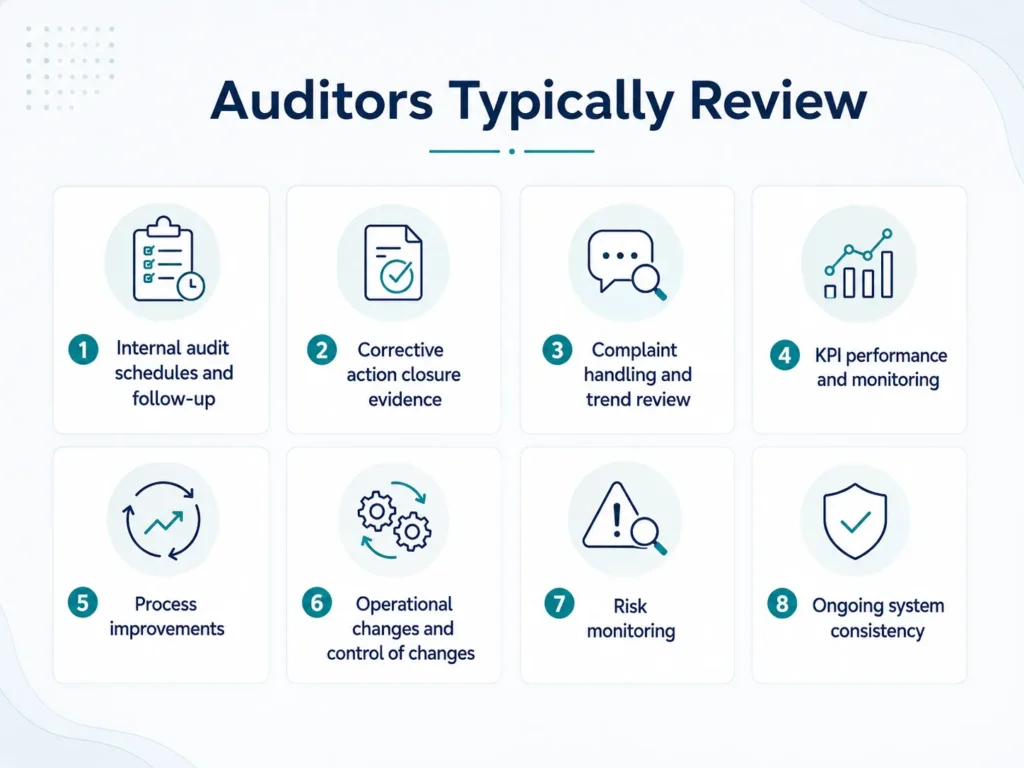
For businesses in Qatar involved in tender renewals, supplier qualification, regulated projects, and approved vendor programs, surveillance performance supports continuity and trust.
ISO 9001 Recertification Audit: Certification Renewal in Qatar
The ISO 9001 recertification audit is commonly conducted every three years. This assessment is broader than surveillance audits and evaluates long-term system maturity.
Difference between surveillance audit and recertification audit
- A surveillance audit checks ongoing maintenance and effectiveness (typically annually).
- A recertification audit is a broader review of overall QMS maturity for certificate renewal (typically every three years).
Key focus areas include
- Overall QMS effectiveness
- Leadership commitment
- Strategic risk management
- Continual improvement
- Resource planning
- Process maturity
- Business objective alignment
- Operational stability
Weak performance at this stage can affect ISO 9001 certification renewal in Qatar and commercial confidence.
Case example (Middle East, multi-site services)
A multi-site service provider operating across the Middle East faced repeated minor nonconformities during surveillance audits because internal audits were delayed and management reviews were not documented consistently. Complaint tracking existed, but trend analysis and corrective action follow-up were weak.
What they did: fixed the internal audit calendar, standardized management review minutes across sites, introduced KPI tracking for complaints and rework, and improved corrective action tracking with clear closure evidence.
Outcome: surveillance audits became smoother, repeat findings were reduced, and the QMS became easier to maintain across locations.
ISO 9001 Certificate Suspension: Why Certificates Get Suspended
ISO 9001 certificate suspension often occurs when organizations fail to maintain system effectiveness over time. Understanding what causes ISO 9001 certificate suspension helps businesses avoid avoidable risks.
1) Major nonconformities
Examples include:
- Missing critical controls
- Severe documentation failures
- Repeated operational breakdowns
- Customer-impacting quality failures
- Significant process nonconformity
2) Repeated minor nonconformities
Minor issues become higher-risk when repeatedly ignored. Examples:
- Incomplete records
- Training gaps
- Delayed corrective actions
- Missed audit schedules
- Weak follow-up activities
3) Failure to conduct internal audits
Internal audits are essential for identifying gaps before external audits. Missing audits often indicate weak oversight.
4) Ineffective management reviews
Leadership is expected to review:
- Risks
- Business objectives
- Process performance
- Resource needs
- Improvement opportunities
- Quality trends
Weak or missing reviews reduce audit confidence.
5) Corrective actions not properly closed
Auditors expect root-cause correction, not temporary fixes. Repeated unresolved issues can escalate to suspension risk.
6) Misuse of certification
This may include:
- Using expired certificates
- Incorrect certification claims
- Misrepresenting the scope of approval
This can significantly damage business credibility and trust.
Common ISO 9001 Nonconformities and Audit Findings
Recurring ISO 9001 nonconformities and common ISO 9001 audit findings often include:
- Poor document control
- Weak risk-based thinking
- Missing measurable KPIs
- Incomplete supplier evaluations
- Weak training records
- Calibration gaps
- Customer complaints are not analyzed
- Internal audit inefficiencies
- Lack of continual improvement evidence
- Weak data-based decision-making
These issues are often operational, not documentation-only.
| Industry in Qatar | Common ISO 9001 Audit Focus Areas |
| Construction & EPC Contractors | Supplier controls, site procedures, inspection records, equipment calibration, material traceability, and contract quality consistency |
| Oil & Gas Support Services | Documentation traceability, process consistency, competency management, contract requirements, operational risk controls |
| Healthcare & Medical Services | Service quality consistency, patient safety controls, documentation accuracy, staff competency, and incident management |
| Manufacturing & Industrial Supply | Production control, supplier performance, traceability, inspection accuracy, process repeatability |
| Logistics & Supply Chain | Delivery performance, complaint handling, traceability, vendor monitoring, service consistency |
Operational Gaps That Commonly Lead to ISO 9001 Audit Failure
Businesses that struggle during audits often show similar patterns.
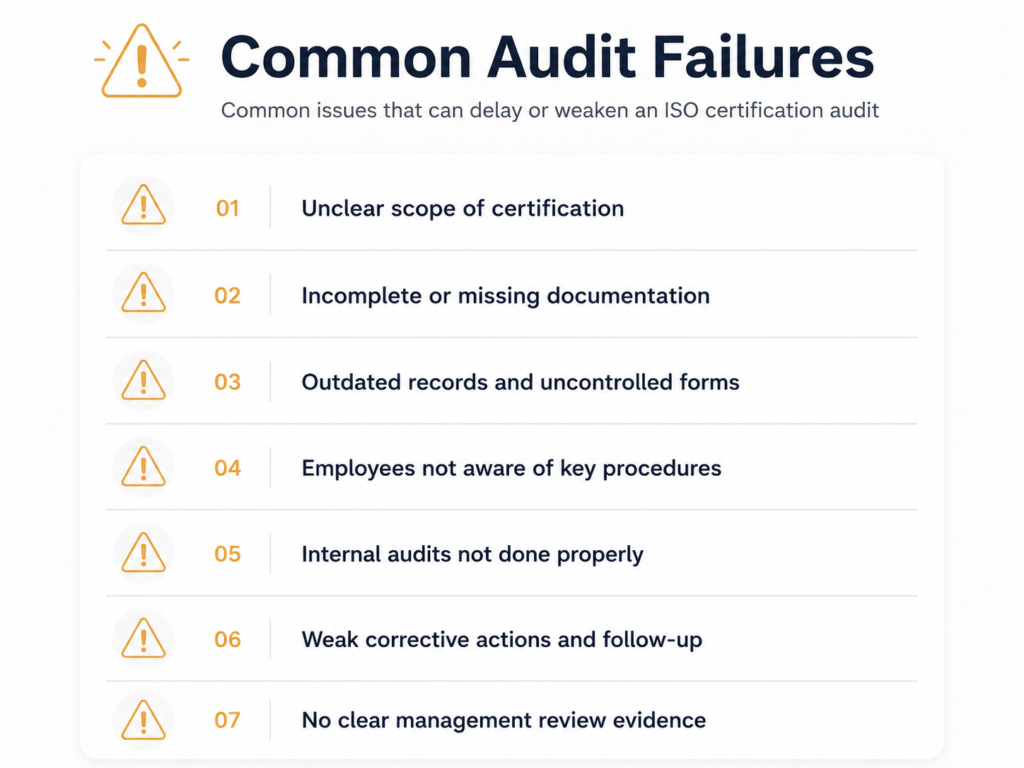
The strongest organizations use ISO 9001 as an operational management framework, not only a certification requirement.
How to Stay Audit-Ready: ISO 9001 Audit Readiness in Qatar
- Build strong process ownership- Every critical process should have clear accountability.
- Perform regular ISO 9001 internal audits- Do not wait for surveillance or recertification audits to identify weaknesses. Routine audits improve system maturity.
- Train employees consistently- Employees should understand actual operational requirements, not only procedures.
- Track KPIs, quality trends, and business risks
Monitor measurable indicators such as:
- Complaint rates
- Rework levels
- Delivery delays
- Supplier defects
- Nonconformity trends
- Process inefficiencies
- Strengthen corrective action systems (Corrective action ISO 9001 / CAPA)– Use root-cause analysis and preventive action methods to reduce recurrence.
- Conduct an effective ISO 9001 management review– Leadership involvement improves decision-making, audit readiness, and strategic alignment.
ISO 9001 Audit Checklist: Quick Audit Readiness Check
Before an audit, organizations should confirm:
- ✔ QMS documents updated
- ✔ Scope clearly defined
- ✔ Internal audits completed
- ✔ Corrective actions closed
- ✔ Management reviews documented
- ✔ Training records available
- ✔ Risks reviewed
- ✔ KPIs monitored
- ✔ Customer complaints tracked
- ✔ Supplier performance evaluated
- ✔ Process records maintained
- ✔ Improvement evidence available
How Long-Term ISO 9001 Maintenance Supports Business Growth in Qatar
Strongly maintaining ISO 9001 certification discipline can support:
- Tender eligibility and ISO 9001 for tenders in Qatar readiness
- Supplier approval confidence and ISO 9001 supplier approval Qatar requirements
- Contract renewal stability
- Customer trust
- Reduced rework
- Better operational consistency
- Stronger risk control
- Higher productivity
- Improved vendor credibility
- Better audit outcomes
- International competitiveness
For growing businesses in Qatar, ISO 9001 often becomes a strategic business framework that strengthens quality, trust, and operational resilience.
Conclusion
ISO 9001 certification is not the end of quality management. It is the beginning of long-term operational discipline.
Businesses in Qatar that maintain strong documentation, effective leadership oversight, internal audits, process ownership, and continual improvement are better positioned to retain certification, improve efficiency, strengthen supplier credibility, and compete more effectively in regulated and quality-driven markets.
Organizations that treat ISO 9001 as an active business framework, not a one-time audit requirement, often gain stronger long-term operational and commercial value.
Strengthen ISO 9001 Audit Readiness and Long-Term System Maintenance in Qatar
If you are preparing for an ISO 9001 audit or upcoming surveillance, the next step is keeping your system audit-ready and consistent in daily operations.
At Guardian Middle East LLC, based in Doha, we represent Guardian Assessment UK Ltd, a United Kingdom–based certification body, recognized by UAF (United Accreditation Foundation) and IAS (International Accreditation Service, USA).
Guardian Middle East LLC supports businesses in Qatar with ISO 9001 audit readiness, surveillance audit readiness, and recertification preparation. Based in Doha, Qatar, we support organizations locally and across the wider Middle East.
Contact Guardian Middle East LLC (Doha) | Serving the Middle East
Location: Abo Hamour Area, Doha, Qatar
P.O. Box: 23277, Doha, Qatar
Mobile: +974 7770 2602 | +974 7213 7770
Email: info@guardian.qa
Website: www.guardian.qa
Frequently Asked Questions
2) What happens during a Stage 1 audit ISO 9001?
A Stage 1 audit focuses on documentation review and readiness assessment. Auditors typically evaluate QMS scope, policies, procedures, risk assessments, internal audits, and management review records before approving readiness for Stage 2 certification.
3) What is checked during a Stage 2 audit ISO 9001?
A Stage 2 ISO 9001 audit assesses whether the QMS is effectively implemented in real operations. Auditors usually review process controls, employee awareness, records, supplier evaluation, complaint handling, corrective actions, and overall operational consistency.
4) How often are ISO 9001 surveillance audits conducted?
ISO 9001 surveillance audits are generally conducted once every year after certification. Their purpose is to confirm that the organization continues to maintain the system and improve processes.
5) How long is ISO 9001 certification valid?
ISO 9001 certification is commonly valid for three years, provided the organization successfully completes surveillance audits and maintains the QMS during that period.
6) Why can an ISO 9001 certificate be suspended?
An ISO 9001 certificate may be suspended due to major nonconformities, repeated unresolved audit findings, failure to conduct internal audits, weak corrective actions, poor management reviews, or misuse of certification claims.
7) What are the most common ISO 9001 audit nonconformities?
Common ISO 9001 nonconformities include poor document control, missing KPIs, weak risk-based thinking, incomplete supplier evaluations, outdated records, training gaps, ineffective internal audits, and a lack of continual improvement evidence.
8) How can businesses in Qatar avoid ISO 9001 certificate suspension?
Businesses in Qatar can reduce suspension risks by conducting regular internal audits, maintaining updated documentation, closing corrective actions on time, monitoring KPIs, strengthening leadership involvement, and ensuring continual improvement across operations.
9) Is ISO 9001 important for tenders and supplier approvals in Qatar?
Yes. For many businesses in Qatar, ISO 9001 certification can support supplier credibility, approved vendor status, tender readiness, contract confidence, and stronger trust in regulated industries such as construction, EPC, healthcare, manufacturing, and oil and gas support services.
10) What industries in Qatar benefit most from ISO 9001 certification?
ISO 9001 is highly relevant for construction, EPC contractors, oil and gas support services, healthcare, logistics, manufacturing, industrial supply, and organizations involved in regulated procurement or supplier qualification programs.
11) What is the difference between a surveillance audit and a recertification audit?
A surveillance audit is usually conducted annually to verify continued system effectiveness. A recertification audit is a broader review conducted typically every three years to assess long-term QMS maturity and certificate renewal readiness.
12) How can a company stay audit-ready for ISO 9001 certification?
To stay audit-ready, organizations should perform internal audits regularly, train employees, maintain process ownership, monitor risks and KPIs, close corrective actions, document management reviews, and ensure the QMS is actively used in daily operations.
Comments are closed