

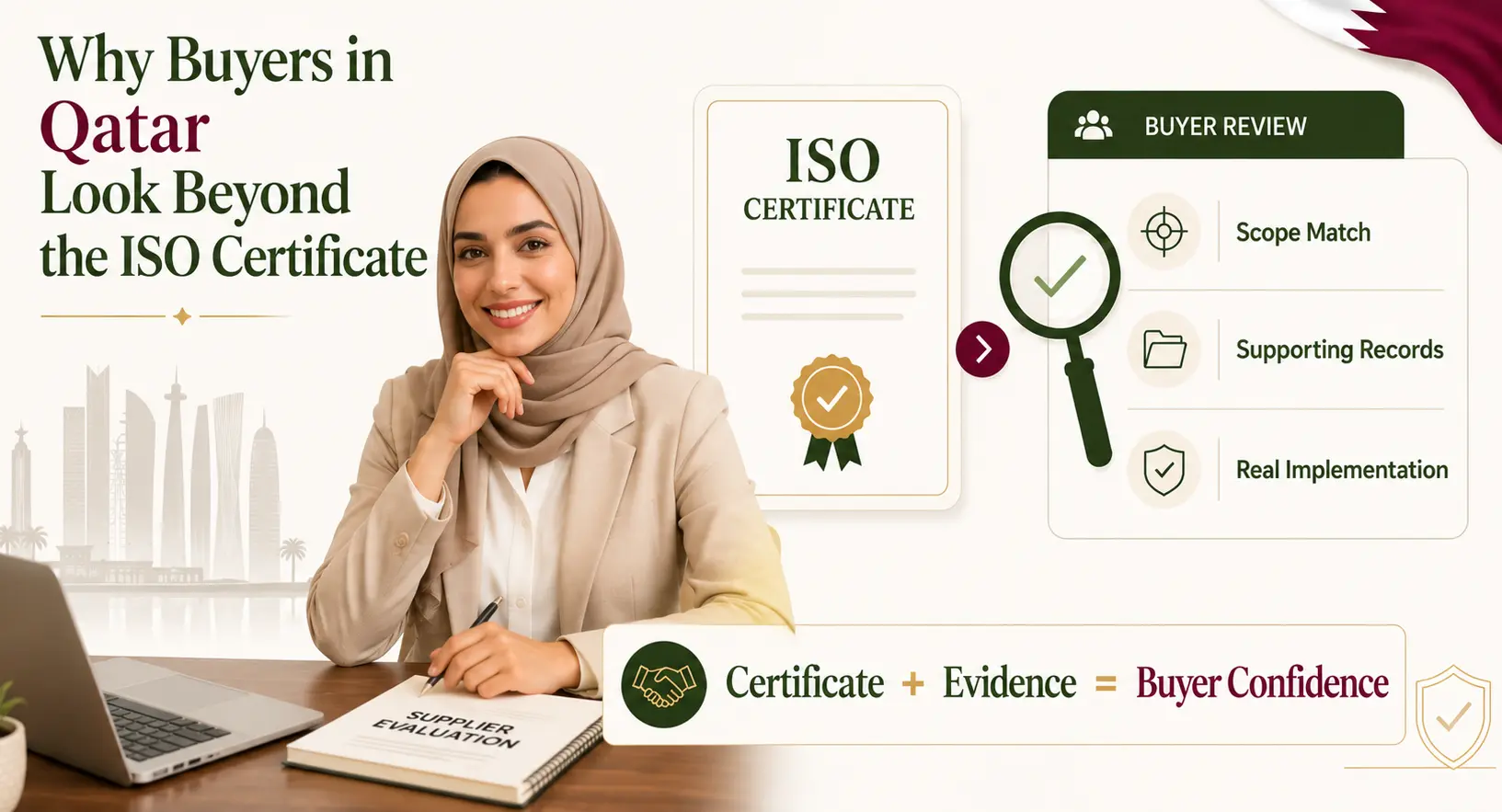
Quick Answer: Why the ISO Certificate Alone Is Not Enough
An ISO certification in Qatar can help open the door, but in Qatar it usually does not close the deal on its own. Buyers often look beyond the certificate to check whether the scope matches the actual work, whether the standard is relevant to the project, and whether the company can support the certificate with real records, procedures, audits, corrective actions, and evidence of implementation.
A practical Qatar example is Ashghal’s September 2024 subcontractor renewal checklist, which asks not only for valid ISO 9001, ISO 14001, and ISO 45001 certificates from an accredited certification body, but also for related scope details and other supporting documents.
Why Buyers in Qatar Look Beyond the ISO Certificate
Buyers in Qatar look beyond the ISO certificate because they want proof that the scope matches the work, the system is implemented in real operations, and supporting records are available during review.
Why certificates alone do not remove project risk
Many businesses assume that a valid ISO certificate automatically proves they are ready for approval, vendor registration, or client audit. In reality, that is rarely enough.
A certificate does not automatically prove that:
- the system fits the exact project
- the scope matches the work being offered
- staff follow the system consistently
- records are current and usable
- controls work in real operations
From a buyer’s point of view, the real question is simple:
Can this supplier deliver the work in a controlled, consistent, and reliable way?
Why buyers want evidence of real systems, not just documents
In project-driven markets, buyers are trying to reduce risk before it becomes a delivery problem. They want more than a certificate because project risk usually comes from:
- weak implementation
- poor records
- scope mismatch
- weak staff awareness
- operational gaps
That is the difference between certification and confidence.
Real buyer review observation from Qatar
A practical buyer review observation from Qatar comes from Ashghal’s September 2024 subcontractor renewal checklist. It requires applicants to submit not only valid and traceable ISO 9001:2015, ISO 14001:2015, and ISO 45001:2018 certificates issued by an accredited certification body, but also the subcontractor name, the related scope of work, inspection and test plans, staff and machinery lists, financial statements, authority approvals or licenses, project references, method statements, risk assessments, a compliance statement, and an anti-corruption commitment letter. The same checklist also states that the reviewer may ask for any other details if necessary during the review process. This is a strong real-world example showing that in Qatar, buyer review often goes far beyond checking whether a certificate exists.
Why this matters more in Qatar’s market
This matters even more in Qatar because the market is shaped by infrastructure, sustainability, transport, energy expansion, and stronger institutional performance. In that kind of environment, buyers naturally value suppliers that can demonstrate structured systems, not just formal certificates.
What the ISO Certificate Actually Proves and What It Does Not
| What an ISO Certificate Proves | What It Does Not Prove by Itself |
| A certification body audited the organization against a specific ISO standard | That the scope exactly matches the project being offered |
| The organization met the audit requirements at the time of certification | That teams on the ground understand the system fully |
| A defined management system exists within the certified scope | That records are complete, current, and ready for buyer review |
| The certificate is valid for a defined cycle, subject to surveillance and continued conformity | That subcontractor controls are effective in practice |
| The organization has been assessed within a formal certification process | That risks are being managed well today in live operations |
| The company has a recognized management system framework in place | That the company is fully ready for a buyer audit tomorrow |
Auditor-style explanation of what buyers really look for
From an auditor-style perspective, a certificate is only the starting point. The first question is whether the scope matches the actual activity being offered. The second is whether the company can produce current records that support the management system, such as audits, corrective actions, inspections, training, and operational controls. The third is implementation: whether people on the ground understand the process and whether actual site or operational practice matches the documented system. When one of these three areas is weak, buyer confidence usually drops, even if the certificate itself is valid. This is exactly the kind of review logic reflected in Qatar procurement practice, where scope, supporting documents, and evidence are checked alongside the certificate itself.
The First Thing Buyers Check: Certification Scope
Certificate scope is the description of the actual activities, services, or operations covered by the certification. If the scope does not match the work, buyer confidence usually drops quickly.
Why the scope must match the actual work
In buyer reviews, the scope is often the first real test.
For example:
- If a company is bidding for industrial maintenance, but the certificate scope only refers to office-based support services, buyers will notice.
- If a logistics company is offering warehousing and hazardous goods handling, but the certified scope only covers general transport administration, buyers may not treat the certificate as fully relevant.
A certificate is strongest when the scope clearly reflects the work the company actually performs.
Common scope mismatch mistakes
Common mistakes include:
- using a certificate with a very generic scope
- using a group-level certificate that does not clearly cover the operating entity
- having a scope that covers only one site when multiple sites deliver the work
- using a certificate that describes support functions, but not operational activities
- assuming one broad phrase will cover all service lines
Why scope matters in tenders, supplier approvals, and audits
Scope matters because buyers are not approving a brand. They are approving a supplier for a specific activity. That is why Ashghal’s checklist requires ISO certificates that clearly show the subcontractor name and related scope of work.
What Buyers in Qatar Check Beyond the Certificate
Once a certificate is submitted, buyers usually move to the real evidence behind it.
Validity of the certificate
They check whether the certificate is:
- current
- not expired
- traceable
- issued to the correct legal entity
Accreditation and certification body credibility
They often check whether the certificate came from a credible and properly recognized certification body.
In practice, credibility depends on:
- recognition or accreditation status
- sector experience
- independence and impartiality
- local market relevance
- whether the certificate can be verified properly
Relevance of the ISO standard to the work
A buyer may ask:
- Why is this company showing ISO 9001 here?
- Should this project also require ISO 45001?
- Should there be ISO 14001 because of environmental exposure?
- Is ISO 27001 needed because the work involves data?
Documented procedures and controls
Buyers often want to know whether procedures exist for:
- operational control
- inspection
- supplier control
- incident handling
- document control
- change management
- emergency response
Internal audit and management review records
These records help show that the system is active, not just written once and forgotten.
Corrective action and nonconformity records
This is where buyers see whether the company fixes issues properly or simply files paperwork.
HSE, environmental, or quality performance evidence
Depending on the project, they may ask for:
- safety records
- environmental monitoring
- inspection reports
- quality nonconformity logs
- trend data
- incident reports
Staff awareness and implementation on the ground
If supervisors, engineers, site teams, warehouse staff, or coordinators cannot explain the process, the certificate starts to look weak.
Contractor, supplier, and subcontractor controls
If the business relies on third parties, buyers often want to know how those parties are controlled, monitored, approved, and reviewed.
Project-specific supporting documents
For many projects, buyers also expect supporting files such as:
- method statements
- risk assessments
- inspection and test plans
- emergency plans
- competency records
- authority approvals where applicable
Buyer Review Checklist: What Procurement Teams Commonly Check
Before approving a supplier, many procurement teams and buyer review committees evaluate more than the ISO certificate itself.
| Review Area | What Buyers Commonly Check |
| ISO Certificate | Validity, expiry date, traceability |
| Certification Scope | Whether the scope matches the offered services |
| Accreditation | Credibility of the certification body |
| Internal Audits | Evidence of ongoing audits |
| Corrective Actions | How issues are identified and resolved |
| Risk Assessments | Current and relevant risk controls |
| Training Records | Staff competence and awareness |
| Procedures | Operational controls and documented processes |
| Project Documents | Method statements, ITPs, approvals |
| Performance Records | Quality, HSE, environmental evidence |
This checklist reflects the practical reality of many supplier reviews, vendor registrations, and procurement evaluations in Qatar.
What Supporting Documents Buyers Commonly Expect
Supporting documents help buyers see whether the management system is real, current, and relevant to the work being reviewed.
Policies and procedures
Typical examples include:
- quality policy
- HSE policy
- environmental policy
- document control procedure
- nonconformity procedure
- emergency response procedure
Method statements
These show how the actual work will be performed, not just what the company claims at a high level.
Risk assessments
Strong buyers want to see that risks were identified, reviewed, and controlled.
Inspection and monitoring records
These may include:
- quality inspections
- equipment checks
- site inspections
- environmental monitoring
- maintenance logs
- calibration records
Training and competence records
A business may have a procedure, but competence records show whether the team can actually apply it.
Emergency and incident records
These become especially important in site-based, industrial, chemical, logistics, and facility environments.
Legal, regulatory, or compliance-related records
Where relevant, buyers may want proof of:
- licenses
- approvals
- authority compliance
- legal registers
- permit-related controls
Ashghal’s checklist is again a useful real example because it asks for more than ISO certificates alone. It also asks for items like registration documents, inspection and test plans, resource lists, financial records, and authority approvals where applicable.
Why Implementation Matters More Than Presentation
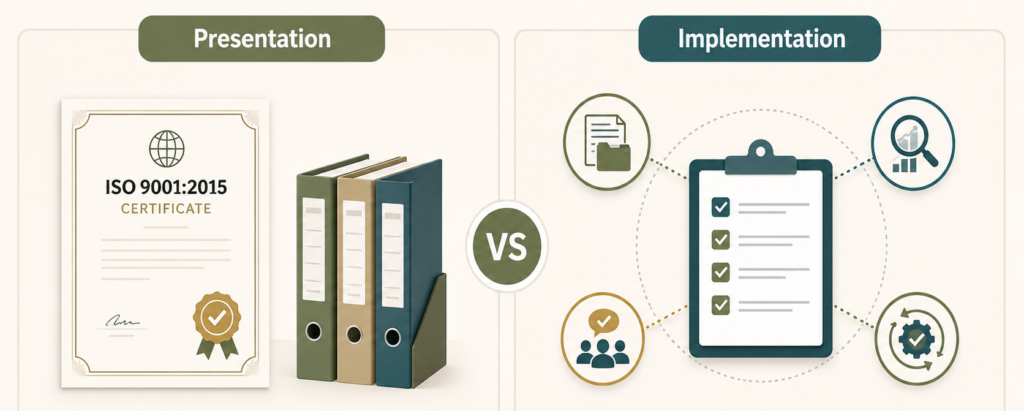
Implementation evidence means records, audits, controls, and staff awareness that prove the management system is active in practice.
Why a good-looking file set is not enough
A polished file folder can impress briefly. Real implementation matters for the whole contract.
Experienced buyers and auditors can usually tell the difference between:
- a system designed for real operations
- a system designed only to pass review
What weak implementation looks like
Weak implementation usually looks like this:
- documents are generic or copied
- staff do not understand them
- records are incomplete
- audits are done only on paper
- corrective actions are weak
- the scope is too broad or too vague
- site reality does not match the documented process
What strong implementation looks like
Strong implementation usually means:
- procedures match the actual workflow
- records are current and easy to retrieve
- supervisors know their responsibilities
- internal audits identify real issues
- corrective actions are followed through
- buyer questions can be answered clearly
- evidence exists beyond the certificate itself
Case study: Ashghal’s ISO 9001 certification
A useful Qatar case study is Ashghal’s ISO 9001:2015 certification. In March 2020, Ashghal announced that it had achieved the certification after a comprehensive external audit across all departments, with zero non-conformance reported. The certification scope covered major project functions including the design, construction, and management of roads, drainage, buildings, schools, hospitals, and the operation and maintenance of assets such as roads, drainage networks, and sewage treatment plants. This is a strong practical example of how a management system creates value not just because a certificate exists, but because it supports consistent control, quality culture, and continuous improvement in large-scale project environments.
Common Misconceptions Buyers and Suppliers Often Have
Misconception 1: A valid ISO certificate is enough for buyer approval
Reality: Buyers often also check scope, records, implementation, and supporting evidence.
Misconception 2: Any ISO certificate works for any project
Reality: The standard must match the type of work, risk level, and buyer expectations.
Misconception 3: A certificate proves the system is working perfectly today
Reality: Buyers still want current records, audit evidence, and implementation proof.
Misconception 4: Documentation matters more than practice
Reality: In real client reviews, weak implementation is usually exposed quickly.
Misconception 5: The certification body behind the certificate does not matter
Reality: Buyers often care about the credibility, recognition, and audit strength behind the certificate.
Common Mistakes Businesses Make When Relying Only on the Certificate
Common mistakes include:
- assuming the certificate guarantees approval
- using the wrong standard for the project
- having the wrong or weak scope
- poor recordkeeping
- weak staff awareness
- no audit trail for real implementation
When companies cannot show internal audits, management reviews, actions taken, and evidence of improvement, the certificate starts to look like a marketing asset rather than an operating system.
What This Looks Like in Different Industries in Qatar
| Industry | What Buyers Focus On | Why It Matters |
| Construction and Infrastructure | Quality controls, HSE implementation, inspection plans, method statements, subcontractor controls | Site-based projects carry higher coordination, safety, and execution risk |
| Oil and Gas | Permit-to-work controls, emergency readiness, competency, HSE discipline | Higher-risk operations require stronger control and documented compliance |
| Food Industry | Hygiene controls, traceability, inspection records, staff competence, corrective actions | Buyers need confidence that food safety, consistency, and documented controls are properly managed |
| Manufacturing | Process control, inspection records, calibration, corrective actions | Consistent production and traceability are critical for buyer confidence |
| Logistics and Transport | Movement controls, equipment records, handling procedures, traceability | Accuracy, traceability, and controlled operations directly affect delivery confidence |
| IT and Technology | Access controls, backups, incident response, data-handling controls | Buyers need assurance that systems and information are securely managed |
| Healthcare | Process reliability, documentation, risk control, staff competence | Sensitive operations require dependable controls and clear records |
| Import and Export | Documentation control, shipment accuracy, traceability, customs file discipline | Buyers rely heavily on complete records and smooth cross-border coordination |
| Chemical Industry | Storage controls, spill response, labeling, training, emergency preparedness | Environmental and safety risks make stronger controls essential |
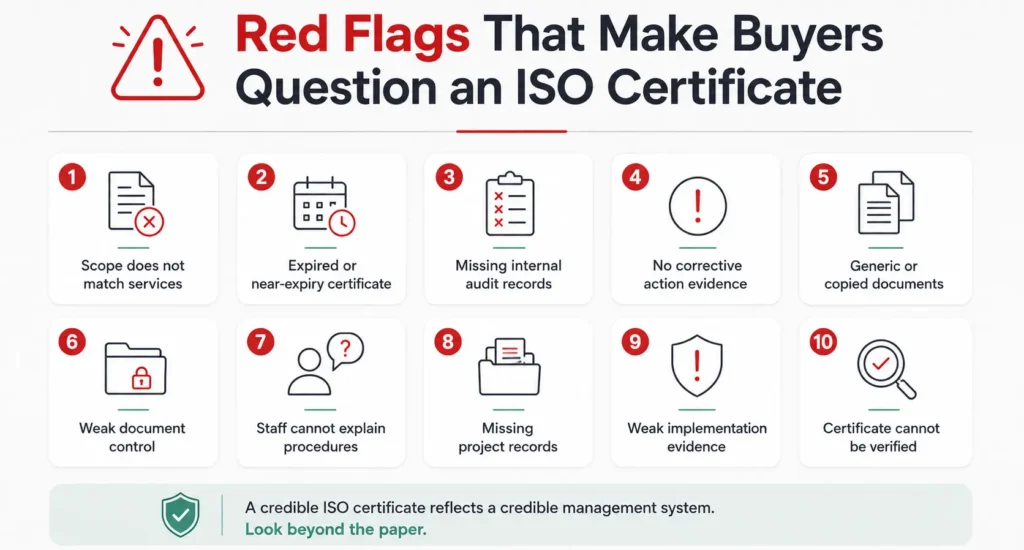
When several of these issues appear together, buyers often request additional information or conduct deeper reviews before approving a supplier.
What Can Go Wrong When the Certificate Is Not Supported Properly
A poorly supported certificate can lead to:
- buyer rejection
- vendor approval delays
- weaker tender scoring
- follow-up audit pressure
- reduced client confidence
- loss of commercial opportunities
- reputational damage
- extra time spent fixing avoidable issues at the last minute
How Businesses Can Prepare Before Buyer Review, Vendor Registration, or Audit
If your business is going through buyer review, vendor registration, or a client audit, preparation should focus on scope, records, and implementation evidence.
Review your certificate scope
Make sure the scope:
- matches the actual work
- names the right entity
- reflects the right services or activities
- covers the relevant site or operation
Organize supporting records
Do not wait until the buyer asks. Keep the most important files ready and current.
Check implementation evidence
Ask yourself honestly:
- Are we actually following the system?
- Can we show recent records?
- Can managers and staff explain how it works?
Prepare staff for questions
People on the ground should know:
- what process they follow
- what they record
- what happens if there is a problem
- who is responsible for what
Align the system with the actual project or service scope
When the management system is aligned to real operations, buyer reviews become easier and more credible.
How Guardian Middle East LLC Supports Businesses in Qatar
If your business is facing questions beyond the certificate, that usually means you need more than a document. You need clear alignment between certification, scope, records, implementation, and buyer expectations.
Guardian Middle East LLC supports certification backed by internationally recognized accreditation.
Our certification support is recognized by:
Why Businesses Choose Guardian Middle East LLC
- Local support from Doha, Qatar
- QFC Licensed Organization
- Support across multiple ISO standards
- Focus on implementation, not just documentation
- Assistance throughout certification and buyer review processes
Contact Guardian Middle East LLC
QFC License 03870 · Doha, Qatar
Location: Abo Hamour Area, Doha, Qatar
P.O. Box: 23277, Doha, Qatar
Mobile: +974 7770 2602 | +974 7213 7770
Email: info@guardian.qa
Website: www.guardian.qa
Whether your goal is ISO certification, vendor registration, tender participation, or supplier approval, having the right documentation, implementation evidence, and certification scope can significantly improve buyer confidence and reduce approval delays.
Key Takeaways
- Buyers in Qatar often check more than the ISO certificate itself.
- Scope relevance is one of the first and most important checks.
- Certificates help, but records, audits, corrective actions, and implementation matter just as much.
- Supporting documents are often expected in supplier reviews, onboarding, and audits.
- Certification body credibility also affects buyer confidence.
- A working system gives buyers more confidence than a certificate alone.
Frequently Asked Questions
What do buyers check besides the certificate?
They may check scope, validity, accreditation, procedures, audit records, corrective actions, staff awareness, and project-related supporting documents.
Why does certificate scope matter so much?
Because buyers are approving a supplier for specific work. If the scope does not match that work, the value of the certificate drops.
What records should businesses keep ready?
Policies, procedures, risk assessments, audits, training records, corrective actions, inspection reports, emergency records, and project-specific support files.
Can a company lose opportunities even with a valid ISO certificate?
Yes. A valid certificate can still be weak if the scope is poor, records are missing, or implementation is not convincing.
How can a company prove real implementation?
By showing recent records, internal audits, management reviews, corrective actions, staff awareness, and process evidence that matches real operations.
Does the certification body behind the ISO certificate matter?
Yes. Buyers may look at whether the certificate was issued by a credible and properly recognized certification body. A certificate from a weak or unclear source may reduce buyer confidence, even if it appears valid.
Why do buyers ask for internal audit records?
Internal audit records help show that the management system is active and reviewed regularly. They give buyers confidence that the company checks its own processes, identifies issues, and takes action before problems affect delivery.
Why are corrective action records important during buyer review?
Corrective action records show how a business responds when something goes wrong. Buyers want to see whether issues are identified, investigated, corrected, and prevented from happening again.
Can a valid certificate still create doubts for buyers?
Yes. Buyers may still have concerns if the certificate scope is too generic, records are missing, staff are not aware of procedures, or the company cannot show real implementation evidence.
Why do buyers ask for project-specific documents?
Project-specific documents such as method statements, inspection plans, risk assessments, and approvals help buyers confirm that the certified system is actually linked to the work being offered, not just maintained as a general document set.
What is the quickest way to improve buyer confidence beyond the certificate?
The quickest way is to make sure your certification scope is accurate, your supporting records are up to date, and your team can clearly explain how the system works in real operations.
Comments are closed