

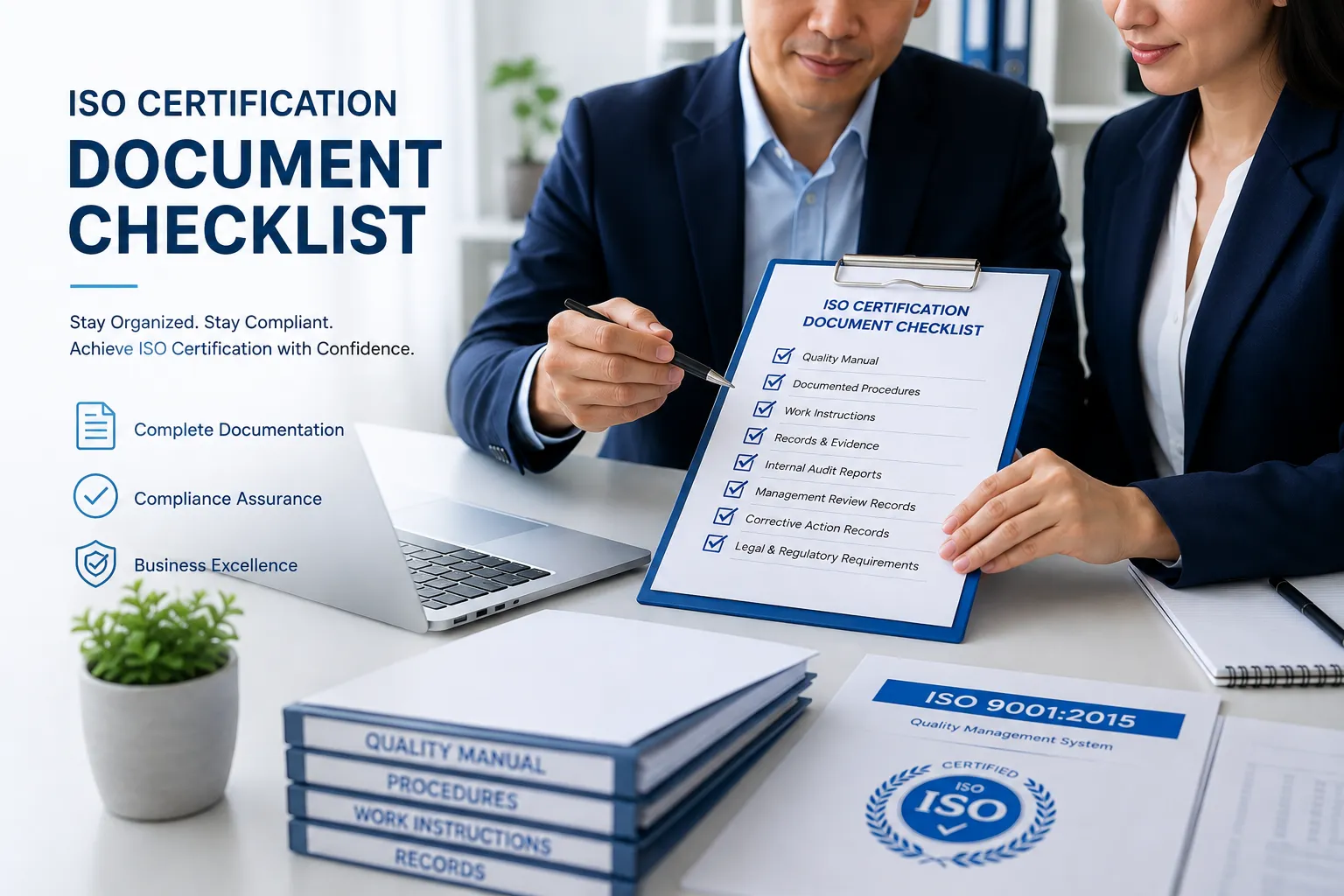
Getting ISO certified is a big step — it sharpens your quality processes, builds customer trust, and proves you meet internationally recognized standards. But before businesses even start the process, they almost always ask the same question first:
“What documents do I actually need for ISO certification?”
Here’s the honest answer: it depends. The documents you’ll need come down to which ISO standard you’re pursuing, how big your organization is, and how complex your operations are. That said, most standards share a common thread — they all expect documented proof that your processes are planned, carried out, monitored, and continuously improved.
And here’s the part that puts a lot of businesses at ease: ISO certification isn’t about drowning in paperwork. It’s about keeping documentation that’s clear, accurate, and genuinely reflects how your organization runs day to day.
One more thing worth knowing upfront: there’s no single, one-size-fits-all document list. What you need depends on your standard, your industry, your processes and risks, and your organization’s size. Think of the categories in this guide as the common ground across most ISO standards — a strong starting point, not a rigid checklist you’re required to complete line by line.
Documents Commonly Needed for ISO Certification
Depending on the ISO standard and the organization, businesses may need:
- Management system scope
- Applicable policy or policies
- Organizational roles and responsibilities
- Objectives and performance indicators
- Risk and opportunity assessments
- Procedures and operational controls
- Work instructions, where necessary
- Records and documented evidence
- Internal audit records
- Management review records
- Applicable legal and regulatory information
- Business registration documents for the certification application
Not every organization needs a separate document for each item. ISO standards focus on required documented information and effective implementation, rather than paperwork for its own sake. The sections below explain each category in more detail.
Why Documentation Matters in ISO Certification
Documentation is the foundation of every effective ISO management system.
Rather than relying on verbal instructions or informal practices, ISO certification require organizations to maintain documented information that provides objective evidence of how processes are managed and controlled.
During a certification audit, auditors review this documentation to verify that your management system conforms to the applicable ISO certification and is being implemented consistently across the organization. Documentation and record-keeping issues are among the areas that can lead to audit findings when documented information is incomplete, outdated, uncontrolled, or inconsistent with actual practice.
Well-maintained documentation helps organizations:
- Demonstrate compliance with ISO requirements
- Standardize business processes
- Improve operational consistency
- Reduce errors and business risks
- Preserve organizational knowledge
- Support employee training
- Simplify internal and external audits
- Drive continual improvement
More importantly, accurate documentation ensures that everyone within the organization understands their roles, responsibilities, and the processes they are expected to follow.
Two Categories of Documents: Registration Documents and Management System Documentation
Before getting into the specifics, it helps to understand that “documents required for ISO certification” actually covers two distinct categories, each serving a different purpose in the certification journey.
The first category is business registration documentation — the legal and administrative documents that confirm who your organization is, where it operates, and that it is legally authorized to conduct business. These are typically submitted at the application stage, before the audit process begins, so that the certification body can verify the organization’s identity and set the correct scope for certification.
The second category is management system documentation — the policies, procedures, records, and evidence that demonstrate how your organization actually plans, executes, and controls its processes. This is the documentation auditors examine during the certification audit itself, and it forms the bulk of this guide.
Both categories matter, but for different reasons: registration documents establish who you are as an organization, while management system documentation demonstrates how you operate. The section below covers registration documents; the sections that follow cover management system documentation in detail.
Business Registration Documents Required When Applying for ISO Certification
When an organization submits an application for ISO certification, the certification body typically requests a set of registration and administrative documents alongside the application form. These confirm the organization’s legal status and are used to define the certification scope, boundaries, and the entities covered.
It’s worth noting that these registration documents are a separate, administrative layer from the ISO documented-information requirements covered later in this guide — they establish the organization’s legal identity for the application, rather than forming part of the management system that gets audited.
Across the GCC, most of these requirements are common to every applicant, regardless of country:
- Passport copies of the owner(s) or authorized signatory
- Company letterhead or visiting card
- Company address proof (tenancy contract or recent utility bill)
- A written scope of business or business activities
- Organization chart
- VAT/tax registration certificate, where applicable
Where requirements differ is in the specific legal registration documents issued by each country’s authorities, since every GCC member state maintains its own commercial registration system. The table below is a regional reference for organizations applying in specific GCC markets — it reflects country-level administrative requirements, not universal ISO documentation.
| Country | Registration Documents Typically Required |
| Qatar | Commercial Registration (CR) from the Ministry of Commerce and Industry (MOCI); Trade License; Computer Card / Establishment Card from the Ministry of Interior; Chamber of Commerce membership certificate |
| Saudi Arabia | Commercial Registration (CR) from the Ministry of Commerce; Municipality License (Baladiya License); Chamber of Commerce Certificate; VAT Certificate from ZATCA |
| United Arab Emirates | Trade License (Mainland via the relevant DED, or Free Zone license); Certificate of Incorporation for free zone entities; Establishment Card from MOHRE; VAT Certificate from the Federal Tax Authority; Chamber of Commerce membership certificate |
| Bahrain | Commercial Registration (CR) from the Ministry of Industry and Commerce (MOIC), issued via the Sijilat portal; Municipality License, where applicable |
| Oman | Commercial Registration (CR) and Trade License from the Ministry of Commerce, Industry and Investment Promotion (MOCIIP); Oman Chamber of Commerce and Industry (OCCI) membership certificate |
| Kuwait | Commercial License from the Ministry of Commerce and Industry (MOCI); Kuwait Chamber of Commerce and Industry (KCCI) membership certificate |
Note: Document names, issuing authorities, and application portals can change as ministries update their registration systems. Organizations should confirm current requirements with the relevant national authority or their certification body before submitting an application, rather than relying solely on this table.
Once these registration documents are reviewed and the ISO certification scope is confirmed, the certification process moves into the management system documentation stage — which is where most of an organization’s preparation effort is typically focused, and what the remainder of this guide addresses.
Have questions about which registration documents apply to your business? Email us at info@guardian.qa , and our team will guide you through it.
Management System Documentation Required for ISO Certification
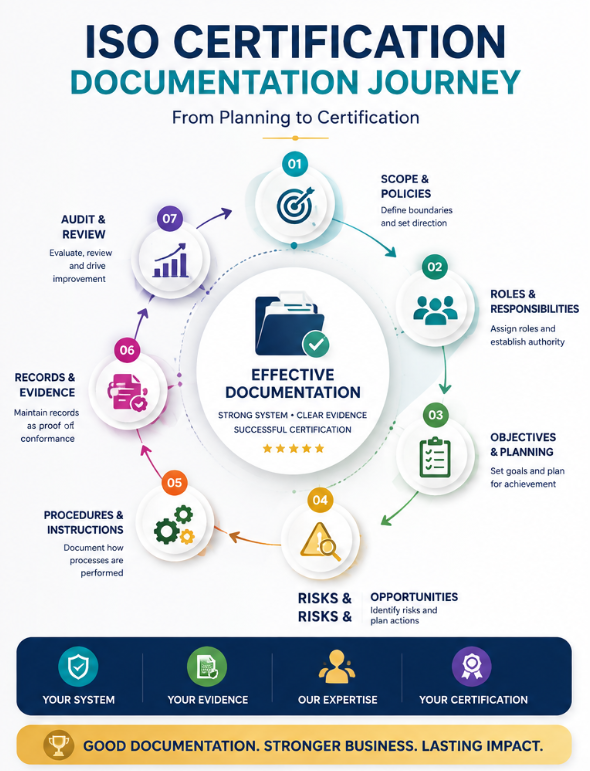
Once registration documents are reviewed, this is the documentation auditors examine to assess the management system itself. It’s worth clarifying three terms that are often used loosely, since they aren’t interchangeable:
- Documented information is the umbrella term ISO Certification use for anything an organization maintains in written or recorded form — it covers policies, procedures, plans, and records alike.
- A procedure describes how a process is carried out: the sequence of steps, responsibilities, and controls involved.
- A record is different in kind — it’s evidence that an activity actually took place, such as a completed training log or a signed inspection report.
In short: procedures describe intent, and records demonstrate that the intent was followed through. The following categories cover both.
1. Scope of the Management System
The scope defines the boundaries of your management system and explains what activities are covered by the certification.
It typically includes:
- Products or services covered
- Business locations
- Departments included
- Relevant business processes
- Any justified exclusions (where permitted)
A clearly defined scope helps auditors understand exactly what is included within the certification.
2. Management System Policy
Every ISO management system requires a policy that reflects top management’s commitment to the objectives of the applicable standard.
Depending on the certification, this may include:
- Quality Policy (ISO 9001)
- Environmental Policy (ISO 14001)
- Occupational Health & Safety Policy (ISO 45001)
- Information Security Policy (ISO 27001)
- Food Safety Policy (ISO 22000)
- Energy Policy (ISO 50001)
An effective policy should be:
- Approved by top management
- Communicated throughout the organization
- Available to relevant interested parties where applicable
- Reviewed periodically to ensure continued suitability
The policy serves as the foundation for the organization’s management system objectives.
3. Organizational Structure, Roles, and Responsibilities
Employees should clearly understand their responsibilities within the management system.
Organizations commonly maintain documentation that identifies:
- Organizational hierarchy
- Roles and responsibilities
- Authorities
- Reporting relationships
- Process owners
Clearly defined responsibilities improve accountability and help ensure management system processes are implemented consistently.
4. Objectives and Performance Targets
ISO certification require organizations to establish measurable objectives that support continual improvement.
These objectives should align with the organization’s overall business goals.
Examples include:
- Improving customer satisfaction
- Reducing workplace incidents
- Lowering energy consumption
- Improving environmental performance
- Strengthening information security
- Increasing operational efficiency
Each objective should include:
- Performance indicators
- Responsible personnel
- Monitoring methods
- Review timelines
Well-defined objectives allow organizations to measure progress and evaluate the effectiveness of their management system.
5. Risk and Opportunity Assessment
Modern ISO standards follow a risk-based approach.
Organizations should identify risks and opportunities that could affect the intended outcomes of their management system.
Depending on the applicable ISO standard, documentation may include:
- Business risks
- Operational risks
- Environmental aspects
- Health and safety hazards
- Information security risks
- Compliance obligations
- Improvement opportunities
Maintaining documented risk assessments helps organizations make informed decisions and proactively manage potential issues.
6. Documented Procedures
Procedures explain how important organizational activities are carried out.
Although not every process requires a separate written procedure, organizations should maintain documented information necessary for the effective operation of their management system.
Common documented procedures include:
- Document control
- Record control
- Internal audit
- Corrective action
- Nonconformity management
- Competence and training
- Purchasing and supplier evaluation
- Operational controls
- Emergency preparedness and response (where applicable)
These procedures help ensure that activities are performed consistently across the organization.
7. Work Instructions
While procedures describe a process, work instructions provide detailed guidance for performing specific tasks.
Work instructions are particularly useful for activities that require consistency or technical precision.
Examples include:
- Equipment operation
- Inspection methods
- Machine setup
- Product testing
- Calibration activities
- IT security controls
- Food handling practices
Clear work instructions reduce errors, improve efficiency, and support employee competency.
8. Records That Demonstrate Compliance
Unlike procedures, records provide evidence that activities have actually been completed.
Typical ISO records include:
- Employee training records
- Equipment maintenance logs
- Calibration certificates
- Inspection reports
- Customer feedback
- Monitoring results
- Incident reports
- Meeting minutes
- Production records
- Corrective action records
These records provide objective evidence during certification audits.
9. Internal Audit Reports
Internal audits help organizations evaluate whether their management system is operating effectively before the certification audit.
Documentation generally includes:
- Audit programme
- Audit schedules
- Audit checklists
- Audit findings
- Nonconformities
- Corrective actions
- Audit reports
Regular internal audits help identify improvement opportunities before external certification audits take place.
10. Management Review Records
Top management is expected to review the effectiveness of the management system at planned intervals.
Management review records commonly include discussions about:
- Internal audit results
- Customer feedback
- Process performance
- Achievement of objectives
- Resource requirements
- Risks and opportunities
- Improvement initiatives
- Decisions and action items
These records demonstrate leadership involvement and commitment to continual improvement.
Documents Required for Different ISO Certification
While many documentation requirements are common across ISO management system standards, each standard also includes specific documented information based on its purpose.
The table below provides a general overview of additional documents organizations may need to maintain.
| ISO Standard | Examples of Additional Documents |
| ISO 9001 – Quality Management System | Customer satisfaction records, quality objectives, process performance indicators, supplier evaluations |
| ISO 14001 – Environmental Management System | Environmental aspects register, compliance obligations, waste management records, environmental objectives |
| ISO 45001 – Occupational Health & Safety Management System | Hazard identification, risk assessments, incident investigation reports, emergency response plans |
| ISO 22000 – Food Safety Management System | HACCP plan, prerequisite programes (PRPs), food safety hazard analysis, monitoring records |
| ISO 27001 – Information Security Management System | Statement of Applicability (SoA), asset inventory, risk treatment plan, access control documentation |
| ISO 50001 – Energy Management System | Energy review, Energy Performance Indicators (EnPIs), energy baseline, energy action plans |
Note: The exact documentation required depends on your organization’s activities, the scope of certification, applicable legal and regulatory requirements, and the ISO standard being implemented.
Common Documentation Gaps Auditors Flag
Documentation gaps rarely come down to a single missing file. More often, they reflect a mismatch between what’s written down and what’s actually happening on the ground — a pattern auditors commonly encounter across industries and standards.
Generic, un-adapted templates. Auditors may identify when documentation appears to be copied from a generic template rather than built around the organization’s own processes. Content that doesn’t reference the organization’s actual activities, locations, or roles gives auditors little to verify against.
Documentation that doesn’t match practice. A well-written procedure carries less weight if staff describe the process differently during interviews. Auditors commonly cross-check documented procedures against what employees describe doing in practice — inconsistencies between the two can be a source of findings.
Weak document control. Outdated versions in circulation, missing approvals, or uncontrolled copies can raise doubt about which version of a procedure is actually in use, and may result in findings.
Incomplete records. Training logs, calibration certificates, inspection reports, and corrective action records are the evidence base an audit relies on. When these are missing or incomplete, auditors may have limited grounds to confirm conformity — regardless of how strong the written policies look on paper.
Absent or superficial internal audits. Where internal audits haven’t been conducted, or have been conducted without rigor, external auditors may encounter issues that a proper internal review would otherwise have caught first.
Stale documentation. Standards, regulations, and business processes change over time. Auditors look for evidence that documentation has been reviewed and updated to reflect the organization’s current operations — not its operations from an earlier point.
Documentation and record-keeping issues remain a recurring source of findings across ISO 9001, ISO 14001, and ISO 45001 audits alike. Understanding these patterns in advance helps organizations know what auditors will be looking for — and why.
What Auditors Expect to See Before an ISO Audit
Knowing what auditors typically check for can help organizations understand what “audit-ready” documentation actually looks like.
Alignment with the applicable standard. Auditors expect documented information to correspond directly to the clauses of the specific ISO standard being pursued — not a generic approximation of it.
Consistency between documents and current practice. Policies, procedures, and work instructions are expected to reflect how work is genuinely performed today, not how it was designed to be performed at some earlier point.
Complete, accessible records. Training logs, monitoring reports, maintenance records, calibration certificates, and corrective action records are expected to be readily available and complete — auditors will ask to see them as evidence, not just hear about them.
Evidence of internal audit activity. A documented internal audit trail — including findings and corrective actions — is one of the clearest signals to an external auditor that a management system is functioning, not just existing on paper.
Evidence of management review. Auditors look for records showing that top management has actively reviewed system performance, evaluated objectives, and discussed audit results, rather than delegating oversight entirely.
Organizations that understand these expectations in advance tend to approach the certification audit with greater clarity about what will be examined and why.
How Guardian Middle East LLC Supports Your Certification Journey
Preparing for ISO certification involves more than creating documents. Your management system needs to reflect your actual operations and meet the requirements of the applicable ISO certification.
Guardian Middle East LLC helps businesses in Qatar and across the Middle East understand their certification requirements, prepare the necessary documentation, and approach the certification audit with confidence.
Our team can help you understand:
- Applicable documentation and certification requirements
- Certification scope and audit expectations
- Required policies, procedures, and records
- Documentation gaps and areas requiring improvement
- The steps involved in the certification process
Guardian Middle East LLC is based in Doha, Qatar, we represent Guardian Assessment UK Ltd, a United Kingdom–based certification body, provides certification backed by internationally recognized accreditation, including UAF (United Accreditation Foundation) and IAS (International Accreditation Service, USA).
Ready to start your ISO certification? Contact our team to discuss your requirements and request an ISO certification quote.
Mobile: +974 7770 2602 | +974 7213 7770
Email: info@guardian.qa
2. Is an ISO manual still required?
Most modern ISO management system standards no longer require a formal management system manual. However, many organizations continue to maintain one because it provides a structured overview of their management system and supports employee understanding. It's optional rather than mandatory under current standard revisions.
3. Can ISO documentation be maintained electronically?
Yes. ISO standards allow organizations to maintain documented information in either electronic or paper-based formats, provided the documents are properly controlled, accessible, protected, and kept up to date. Most organizations today maintain a mix of both, depending on the document type.
4. How often should ISO documents be reviewed?
Organizations should review documented information periodically and whenever significant changes occur to business processes, legal requirements, organizational structure, or the applicable ISO standard. Annual review cycles are common, though high-change environments often review more frequently.
5. What happens if required documents are missing during an audit?
If essential documented information or records are unavailable, auditors may be unable to verify conformity with the ISO standard. Depending on the significance of the missing evidence, this may result in audit findings or nonconformities that need to be addressed before certification can be granted. Documentation-related issues are a recurring source of findings across ISO audits generally.
6. What business registration documents are needed to apply for ISO certification in Qatar?
Applicants in Qatar are typically asked for their Commercial Registration (CR) from the Ministry of Commerce and Industry, Trade License, Computer Card / Establishment Card, and Chamber of Commerce membership certificate, alongside general documents such as passport copies and address proof. These confirm the organization's legal status before the certification scope is finalized.
7. How long does it typically take to prepare documentation before a certification audit?
This varies by organization size, standard, and how developed existing processes already are. Organizations with well-established processes may need only a few weeks to formalize documentation, while others building a management system from the ground up may need several months. Early planning generally leads to a smoother audit.
8. Does a small business need the same level of documentation as a large organization?
The core documentation categories — scope, policy, procedures, and records — apply regardless of size, but the depth and complexity typically scale with the organization. A small business may combine several procedures into a single document, while a larger, more complex organization usually maintains more detailed, separated documentation.
9. What's the difference between a documented procedure and a work instruction?
A procedure describes how a broader process is carried out — for example, how nonconformities are managed. A work instruction gives detailed, task-level guidance for a specific activity within that process, such as how to calibrate a particular piece of equipment. Not every process requires a separate work instruction; it depends on the level of precision the task demands.
10. Can I prepare ISO documentation myself?
Yes. Organizations are free to develop their own documentation internally, and ISO standards don't require external assistance. What matters during an audit is whether the documentation reflects your actual processes and meets the requirements of the applicable standard — not who wrote it.
11. Do I need an ISO consultant?
This is a business decision, not an ISO requirement — organizations can prepare for certification with or without outside support. Where outside support is used, it's worth knowing that certification bodies are required to remain independent of any party that helped develop an organization's management system, in order to preserve the impartiality of the audit.
12. Can existing company documents be used?
Yes, in many cases. If existing procedures, policies, or records already reflect how the organization operates, they can often be adapted or referenced rather than rewritten from scratch. What matters is that the documentation accurately represents current practice and addresses the relevant clauses of the applicable standard — not that it be created from a blank page.
13. What documents are checked during Stage 1 and Stage 2 audits?
Stage 1 typically focuses on reviewing documented information — such as the scope, policy, and key procedures — to confirm the management system is ready for a full assessment. Stage 2 goes further, examining records and evidence of implementation, including training logs, monitoring results, and internal audit records, to verify the system is operating effectively in practice.
Comments are closed