

By Guardian Middle East LLC | Doha, Qatar
In today’s highly competitive business environment, ISO certification is no longer a symbol of pride – it’s a necessity. Whether you are a small business in Doha or a large company operating in the Middle East, ISO certification is a symbol to your customers, partners, and the government that you are operating at the highest international standards.
However, for most business owners, the process of certification seems daunting. What is the process? How long does it take? What happens during an audit?
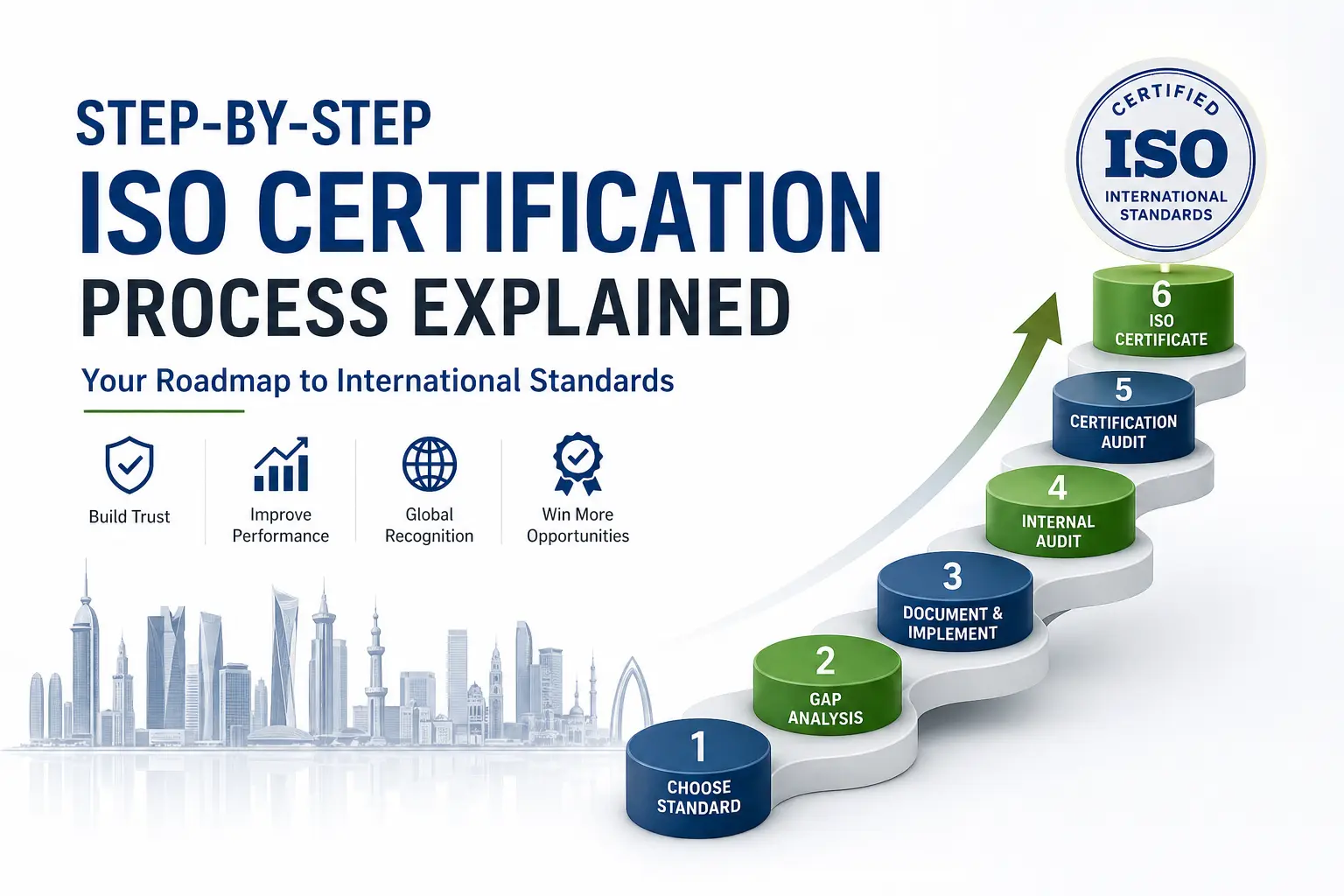
At Guardian Middle East LLC, we walk you through the entire process of certification. In this blog post, we will walk you through the entire ISO certification process in a simple, straightforward, and practical manner
What Is ISO Certification and Why Does It Matter?
ISO (International Organization for Standardization) certifications are world-renowned standards that show your organization’s commitment to quality, safety, efficiency, and continuous improvement. ISO certification is recognized in over 170 countries and is often required for both public and private tenders, especially in government and infrastructure projects across the Gulf region, including Qatar.
In Qatar’s growing economy, ISO certification strengthens your organization’s credibility, helps your business stand out in a competitive market, and ensures that you meet both local and international standards — particularly in industries like construction, oil and gas, and healthcare.
In short, if your business wants to win bigger contracts, build stronger trust, and align with Qatar National Vision 2030, ISO certification is the key first step.
Step 1: Identify the Right ISO Standard for Your Business
Not all ISO certifications are created equal. The first and most crucial step is to select the standard that suits your business needs the most.
Below are some of the most sought-after standards:
ISO 9001:2015 – Quality Management System (for all sectors)
ISO 14001:2015 – Environmental Management (for construction, manufacturing sectors)
ISO 45001:2018 – Occupational Health & Safety (for oil & gas, manufacturing sectors)
ISO 27001:2022 – Information Security Management (for IT, healthcare, smart city projects)
ISO 22000:2018 – Food Safety Management (for hospitality, retail, food sector)
ISO 21001:2018 – Educational Organizations Management
ISO 37001:2025 – Anti-Bribery Management
Before embarking on the certification journey, an organization needs to assess which standard is applicable to them, as each ISO standard has its own set of requirements in terms of quality management, environmental management, information security, or other business functions.
Guardian Middle East Tip: If you are confused about which standard is applicable to your business, our experts can help you through a free initial consultation to determine the most appropriate certification for your sector.
Step 2: Conduct a Gap Analysis
Now that you have chosen your standard, the next step is a Gap Analysis – a reality check on where your organization is today compared to where the ISO standard wants you to be.
In this stage, organizations compare their current processes, systems, and practices to the ISO standards they want to comply with. This process will help you identify the gaps in your organization.
This is your roadmap. The gap analysis will give you information on:
- Which processes are already ISO compliant
- Which areas need to be documented or improved
- How long the implementation process will take
- What resources you will need
This step will save you from surprises down the road.
Step 3: Build and Document Your Management System
This is the most intense part of the certification process. Now, based on your gap analysis, you start building or improving your management system and document all of this.
You will have to identify your key business processes, document them with the help of your employees, and then make sure that your procedures are being carried out exactly as you have written in your documents.
The most important documents that you will have to write are:
- Quality/management policies
- Standard Operating Procedures (SOPs)
- Process maps and workflow charts
- Risk assessment records
- Roles, responsibilities, and authorities
The most difficult part of the implementation process is the development of documentation, which involves aligning the documents with the technical specifications of the ISO standard while at the same time understanding and applying these specifications to your company.
Don’t rush this step. Well-documented processes are the foundation of a successful audit and long-term compliance.
Step 4: Train Your Team
ISO certification is not only a management system; it is your whole organization. All employees who have a role in the process must be aware of the new procedures and why they are important.
Training auditors internally to implement and audit the system, training managers sufficiently to enable results, and educating employees on the reasons for all the changes that are occurring are all critical steps in the process.
Training ensures that:
- All employees are following procedures
- Internal auditors are able to identify non-conformities prior to the external audit
- Your management system is sustainable well after certification
Step 5: Conduct an Internal Audit
However, before calling in an external certifying organization, your organization must perform an Internal Audit. An internal audit is essentially a self-check to ensure that your management system is indeed functioning as it is supposed to.
The purpose of the internal audit is to ensure that your organization is capable of providing products or services that meet regulatory standards on a consistent basis. Internal audits can be divided among products, processes, or organizational units, depending on what is best for your organization.
The non-conformities that are revealed during the internal audit must be addressed through Corrective Actions before moving on to the external audit.
Step 6: Management Review
After the internal audit, the senior management must perform a formal management review, which is a formal meeting where the management reviews the performance of the management system, discusses the results of the audit, establishes improvement objectives, and reconfirms the organization’s commitment to the ISO standard.
This is a formal requirement of most ISO standards and shows that your management is actively involved in the certification process, not just your quality manager.
Step 7: Choose an Accredited Certification Body
You are now ready for the external audit. The first step is choosing the appropriate Certification Body – a third-party organization recognized to audit and certify your management system.
Accreditation is an independent assurance of competence. To locate an accredited certification body, you can contact the national accreditation body in your country or search the International Accreditation Forum database, IAF CertSearch.
Why is accreditation important?
The IAF (International Accreditation Forum) is the global association of accreditation bodies. The IAF motto is “Certified Once, Accepted Everywhere.” This means that your certificate will be recognized worldwide, and your business will gain the maximum possible credibility.
At Guardian Middle East, we partner directly with Guardian Assessment Pvt. Ltd., India, which is accredited by both the United Accreditation Foundation (UAF) and International Accreditation Service (IAS, USA), ensuring that your certificate has maximum international credibility.
Step 8: The External Certification Audit (Two Stages)
The external audit process involves two stages:
Stage 1 – Document Review
The auditor will examine your documentation to determine if your management system is ready for a full on-site audit. They will check to ensure that your policies, procedures, and objectives are consistent with the requirements of the ISO standard.
Stage 2 – On-Site Audit
The certification body will conduct an on-site audit to confirm the implementation and effectiveness of your management system. If successful, the certification body will issue the ISO certificate.
During the Stage 2 audit, the auditor will:
- Conduct interviews with your employees
- Observe processes in operation
- Examine records of compliance
- Detect any non-conformities
Minor non-conformities may be allowed to be rectified before the certificate is issued.
Step 9: Receive Your ISO Certificate
Congratulations — once all non-conformities are resolved and the auditor is satisfied, your ISO Certificate is officially issued!
The certificate is valid for three years. During this period, your certification body will conduct periodic surveillance audits to ensure your practices continue to meet the required standards. After three years, you must complete a recertification audit to renew your certificate.
This means ISO certification is not a one-time achievement — it’s a commitment to ongoing excellence and continuous improvement.
How Long Does the ISO Certification Process Take?
The process of obtaining ISO certification involves a systematic procedure that normally takes between 3 to 6 months, depending on the size of the organization and the standard that is being adopted.
Organizations that are large or have to begin from scratch may take up to 12 months. However, partnering with a local expert such as Guardian Middle East can greatly facilitate this process.
Why Partner With Guardian Middle East?
As the sole representative of Guardian Assessment UK Ltd, a United Kingdom–based certification body, recognized by UAF (United Accreditation Foundation) and IAS (International Accreditation Service, USA), we fill the gap between international ISO norms and the reality of doing business in Qatar and the Middle East. We provide your business with complete support, from gap analysis and documentation to training, internal audits, and ultimate certification, to help you obtain international ISO certification with confidence.
Our parent company is recognized by UAF and IAS, USA, ensuring that your certificate is recognized worldwide.
Frequently Asked Questions (FAQ)
Can any business get ISO certified?
Yes. ISO certification is available to organizations of any size, in any industry. Whether you’re a startup or a large enterprise, there is an ISO standard relevant to your operations.
Is ISO certification mandatory in Qatar?
It is not legally mandatory for all businesses, but it is often required to participate in government tenders and major contracts — especially in construction, oil & gas, and healthcare sectors aligned with Qatar Vision 2030.
How much does ISO certification cost?
The cost varies depending on your organization’s size, the complexity of processes, and the chosen standard. It includes consultation fees, training, internal audit costs, and the certification body’s audit fees. Contact us for a tailored quote.
Do I need a consultant to get ISO certified?
While it’s not mandatory, working with an experienced consultant significantly reduces the risk of non-conformities, saves time, and ensures your documentation meets the required standard from the start.
How long is an ISO certificate valid?
ISO certificates are valid for 3 years, subject to annual surveillance audits to confirm continued compliance.
What happens if my audit finds non-conformities?
Minor non-conformities can typically be addressed after the audit through a corrective action plan. Major non-conformities may require a follow-up audit. Our team helps you prepare thoroughly to minimize this risk.
Can ISO certification help me win international contracts?
Absolutely. ISO certification is recognized in over 170 countries and is often a baseline requirement for international business relationships and global supply chains.
Ready to Start Your ISO Journey?
ISO certification is one of the most powerful investments your business can make — for your people, your clients, and your long-term growth. At Guardian Middle East LLC, we make the process accessible, understandable, and transformative.
📍 Based in Doha, Qatar | Serving businesses across the Middle East
📩 Contact us today to schedule your free initial consultation and take the first step toward international excellence.
Comments are closed