
ISO 37001 Certification in Qatar

ISO 37001 Certification in Qatar
Quick Contact
Introduction
ISO 37001 certification is an independent confirmation that an organization’s Anti-Bribery Management System (ABMS) meets the requirements of the internationally recognized ISO 37001 standard. An Anti-Bribery Management System is a set of policies and procedures that helps businesses identify bribery risks, put preventive measures in place, check business partners, manage conflicts of interest, and respond to suspected bribery. Published by the International Organization for Standardization (ISO), the ISO 37001 anti-bribery management system standard explains how organizations can prevent, detect, and respond to bribery. It covers management commitment, risk assessments, checking business partners, financial controls, reporting methods, and ongoing improvement.
For example, a construction contractor in Doha may use its ABMS to manage bribery risks during tendering, subcontractor selection, and project approvals. A trading company may use the same system to check suppliers, monitor payments to intermediaries, and manage gifts and hospitality. Although these businesses work in different industries, both can use ISO 37001 to follow clear anti-bribery practices and promote ethical business conduct.
At Guardian Middle East LLC, based in Doha, we represent Guardian Assessment UK Ltd, a UK-based certification body recognized by UAF (United Accreditation Foundation) and IAS (International Accreditation Service, USA). Through this partnership, we provide accredited ISO 37001 certification services in Qatar, helping businesses show their commitment to preventing bribery, following ethical business practices, and promoting transparency in local and global markets.
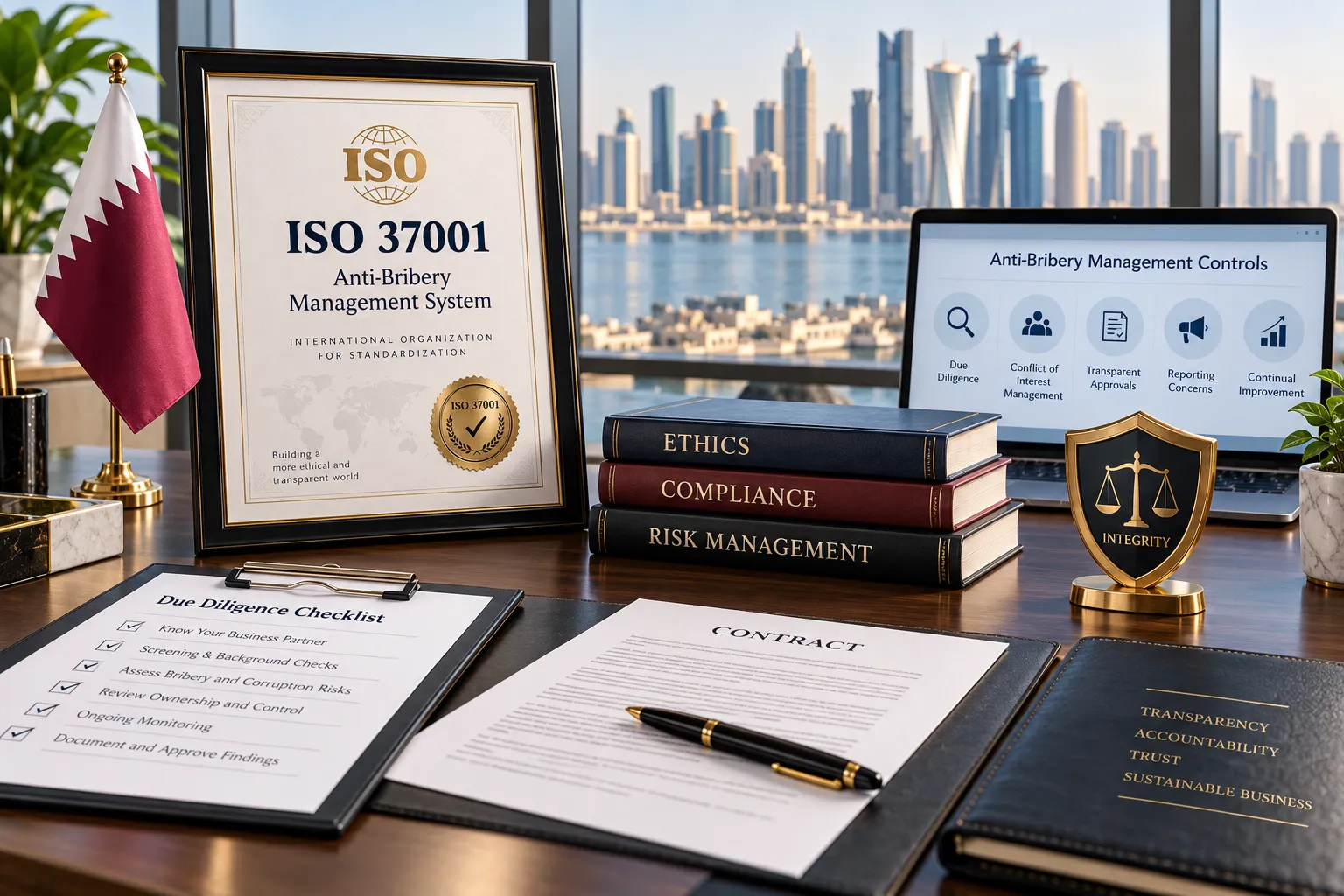
Benefits of ISO 37001 Certification
A well-implemented Anti-Bribery Management System can help businesses:
- Reduce Bribery Risks: Identify and manage bribery risks related to purchasing, contracts, intermediaries, and business relationships.
- Strengthen Ethical Governance: Set clear anti-bribery policies, define management responsibilities, and make accountability easier to maintain.
- Support Legal Compliance: Understand the anti-bribery rules that apply to the business and put suitable preventive measures in place.
- Build Business Partner Confidence: Show that the organisation’s anti-bribery practices have been independently assessed.
- Support Tender and Supplier Requirements: Provide certification evidence when customers or procurement authorities ask for it.
- Promote Transparency and Accountability: Improve how the business handles conflicts of interest, reports concerns, investigates suspected bribery, and makes ongoing improvements.
ISO 37001 certification shows that an organisation meets the applicable anti-bribery management requirements. However, it cannot guarantee that bribery will never happen or protect an organisation from legal action.
Why ISO 37001 Certification Is Important for Businesses in Qatar
Businesses in Qatar’s construction, energy, finance, trading, healthcare, and professional services sectors often work with suppliers, contractors, intermediaries, and government-related customers. These business relationships can involve bribery risks during purchasing decisions, contract negotiations, gifts and hospitality, conflicts of interest, payments to third parties, and business approvals. ISO 37001 gives businesses a structured way to manage these risks. This includes checking business partners based on their risk level, maintaining financial controls, training employees, providing confidential reporting channels, and regularly reviewing anti-bribery measures. For organisations working on major projects or as part of international supply chains, accredited certification may also help demonstrate their anti-bribery practices during supplier assessments and customer evaluations.
Supporting Qatar National Vision 2030 and the National Integrity Strategy
Qatar National Vision 2030 promotes sustainable development, good governance, and accountability across institutions. On 8 October 2025, Qatar’s Administrative Control and Transparency Authority (ACTA) launched the National Strategy to Promote Integrity, Transparency and Corruption Prevention 2025–2030. The strategy aims to promote transparency, accountability, and the prevention of corruption across both the public and private sectors.
ISO 37001 supports these goals by helping organisations set anti-bribery policies, manage conflicts of interest, check business partners, and build a culture of ethical business conduct. ISO 37001 certification is not mandatory under Qatar National Vision 2030 or the National Integrity Strategy. Its value lies in helping businesses follow responsible practices and prevent corruption.
Industries That Benefit from ISO 37001 Certification in Qatar
ISO 37001 is suitable for organisations of different sizes and across different industries. It is especially useful for businesses involved in purchasing, working with third parties, making commercial decisions, or handling activities that may carry bribery risks.
- Construction, Engineering and Infrastructure: Contractors, MEP companies, and engineering firms can use ISO 37001 to promote fair tendering, check subcontractors, manage purchasing approvals, and handle conflicts of interest.
- Oil, Gas and Energy: Engineering contractors, suppliers, maintenance providers, and energy-related businesses can use anti-bribery controls to manage intermediaries, supplier relationships, contract approvals, and purchasing risks.
- Banking, Finance and Professional Services: Financial institutions, consulting firms, and professional service providers can use ISO 37001 to improve ethical business practices, manage business relationships, and put anti-bribery controls in place.
- Trading, Logistics and Supply Chain: Importers, distributors, and logistics providers can use ISO 37001 to check suppliers, manage intermediaries, monitor commercial payments, and maintain transparency in purchasing.
- Healthcare and Medical Services: Hospitals, clinics, laboratories, and medical suppliers can use ISO 37001 to manage purchasing decisions, supplier relationships, gifts and hospitality, and potential conflicts of interest.
- Education and Training Institutions: Schools, universities, colleges, and training centres can use ISO 37001 to make purchasing more transparent, manage supplier relationships, address conflicts of interest, and promote ethical administration.
The certification scope depends on the organisation’s activities, business relationships, exposure to bribery risks, and the boundaries of its Anti-Bribery Management System.
Request a Quote
Request a Quote
Is ISO 37001 Certification Mandatory in Qatar?
ISO 37001 certification is generally voluntary for businesses operating in Qatar. However, organisations must follow the anti-bribery laws that apply to them. Some customers, contracts, or supplier evaluation processes may also ask for documented anti-bribery controls or independent certification.
ISO 37001 helps businesses manage bribery risks in a structured way, but certification does not replace legal obligations or guarantee that an organisation will qualify for government contracts.
1. Qatar Penal Code and Anti-Bribery Requirements
Qatar Penal Code No. 11 of 2004, particularly Articles 140–147, includes provisions dealing with bribery involving public officials, intermediaries, and certain employment-related situations. These provisions cover different bribery-related offences, including requesting, offering, promising, or accepting improper benefits in situations covered by the law. The legal consequences depend on the specific offence and the circumstances. For businesses, these requirements highlight the importance of preventing improper payments, managing interactions with public officials, keeping third-party relationships under control, and responding appropriately to suspected bribery.
ISO 37001 helps organizations put preventive measures in place through bribery risk assessments, checks on business partners, financial controls, conflict-of-interest procedures, and reporting channels. An ISO 37001 certificate does not replace compliance with Qatar’s Penal Code or protect an organization from investigation or prosecution.
2. ISO 37001 Requirements for Qatar Government Tenders
Qatar’s Tenders and Auctions Law No. 24 of 2015, as amended, sets out procurement rules for government contracts covered by the law. Under Article 23, a covered government contract is considered rescinded when specified fraud or manipulation is proven, or when a contractor attempts to bribe a state employee or colludes with one in a way that harms the contracting government authority. These provisions highlight why businesses need transparent purchasing practices, proper approval procedures, and effective measures to manage bribery risks during tendering and contract execution.
ISO 37001 can help businesses demonstrate that they have structured anti-bribery controls in place when this evidence is relevant to supplier assessments. However, ISO 37001 certification is not required for every government tender in Qatar. Businesses should check the applicable procurement legislation and the requirements of each tender.
3. ISO 37001 and QatarEnergy Supplier Integrity Requirements
QatarEnergy sets out its expectations for ethical business conduct in its published Supplier Principles of Conduct. These principles cover responsible business practices, integrity, corruption prevention, conflicts of interest, and ethical relationships with suppliers and other business partners. QatarEnergy also has an anti-bribery and corruption policy that addresses improper advantages, facilitation payments, and the reporting of concerns.
ISO 37001 can help businesses meet these expectations by putting procedures in place to check business partners, prevent bribery, report concerns, and maintain relevant compliance records. However, QatarEnergy’s supplier principles do not require every supplier to hold ISO 37001 certification.
4. ISO 37001 and Qatar Airways Supplier Requirements
Qatar Airways publishes a Supplier Code of Conduct that explains its expectations for ethical business practices and anti-bribery measures. The code requires suppliers to declare that they have documented anti-bribery and anti-corruption policies, a code of conduct, and related compliance programes in place throughout the relevant contract. It also covers conflicts of interest, gifts and hospitality, bribery, collusion, and attempts to improperly influence purchasing decisions.
ISO 37001 can help businesses establish and maintain anti-bribery controls that support these supplier requirements. However, the supplier code does not make ISO 37001 certification mandatory for every Qatar Airways supplier.
ISO 37001 Certification Requirements and Documentation
To obtain ISO 37001 certification, an organization must establish, put into practice, maintain, and continually improve an Anti-Bribery Management System (ABMS) that meets the applicable ISO 37001 requirements. The system should match the organization’s activities, business relationships, bribery risks, legal obligations, and the controls it uses in daily operations.
Key ISO 37001 Requirements include:
- Understanding the Organization: Identifying relevant internal and external issues, the needs of interested parties, and the scope of the Anti-Bribery Management System.
- Leadership and Anti-Bribery Policy: Showing management commitment, assigning clear responsibilities, promoting ethical conduct, and setting measurable objectives.
- Bribery Risk Assessment: Identifying and assessing bribery risks linked to transactions, projects, business partners, and the environments in which the organization operates.
- Anti-Bribery Function: Assigning suitable responsibilities and authority to oversee the organization’s anti-bribery measures.
- Checking Business Partners: Carrying out risk-based checks on relevant personnel, suppliers, contractors, intermediaries, and other business partners.
- Financial and Non-Financial Controls: Setting controls for payments, purchasing, approvals, gifts, hospitality, donations, and other relevant transactions.
- Reporting and Investigation: Providing suitable ways to report concerns and procedures for dealing with suspected bribery.
- Performance Evaluation and Improvement: Checking whether the system is working, conducting internal audits, reviewing management performance, and addressing any identified issues.
Organizations must show that these requirements are followed in practice and supported by appropriate records. Having written anti-bribery policies alone is not enough.
Documents Required for ISO 37001 Certification
The documents required depend on the organization’s size, business activities, bribery risks, and the scope of its Anti-Bribery Management System. Common documents and records include the anti-bribery policy, system scope, bribery risk assessments, business partner checks, conflict-of-interest declarations, gifts and hospitality registers, financial control procedures, employee training records, and procedures for reporting and investigating concerns. Internal audit reports, management review records, reviews by the anti-bribery function, and records of corrective actions are also important for showing that the system is working effectively.
For example, auditors may check supplier screening records, approvals for higher-risk payments, employee conflict-of-interest declarations, or records showing how reported concerns were reviewed. When applying for certification, Guardian may ask for company registration details, employee numbers, business activities, operating locations, and the proposed certification scope.
How to Obtain ISO 37001 Certification in Qatar
The ISO 37001 certification process in Qatar follows a structured audit process recognized internationally. If you are looking into how to get ISO 37001 certification, your organization’s Anti-Bribery Management System will need to be independently assessed against the current ISO 37001:2025 requirements.
The certification process involves six key steps:
- Application – Share your organization’s details, including business activities, employee numbers, operating locations, business partner relationships, and the proposed scope of your Anti-Bribery Management System.
- Stage 1 Audit – The auditor reviews your system documents, bribery risk assessments, anti-bribery policies, business partner checks, and readiness for certification.
- Stage 2 Audit – The auditor checks how well the system is being used and whether it works effectively. This may involve speaking with employees, reviewing processes, and checking operational controls and records.
- Certification Decision – The authorized certification body independently reviews the audit findings and evidence of corrective actions, where required, before making a certification decision.
- Certificate Issuance – If the certification decision is positive, the certification body issues the ISO 37001:2025 certificate for the applicable certification cycle.
- Surveillance & Recertification – Regular surveillance audits, normally conducted annually, check that the organization continues to meet the requirements. Recertification is required before the three-year certification cycle ends.
How long does ISO 37001 certification take?
The time needed depends on how ready your organization’s Anti-Bribery Management System is, the certification scope, the level of bribery risk, and whether any issues need to be corrected. Businesses with an established system may complete the certification assessment within several weeks, while those needing more preparation may take longer.
This process follows ISO/IEC 17021-1 and ISO/IEC TS 17021-9 requirements, which support impartial, competent, and consistent third-party certification of Anti-Bribery Management Systems.
ISO 37001 Certification Cost in Qatar
The ISO 37001 certification cost in Qatar depends on the organization’s size, business activities, bribery risks, number of operating locations, and the time needed to complete the audit. There is no single fixed certification fee for every business. To provide an accurate quotation, the organization’s Anti-Bribery Management System, business relationships, and proposed certification scope need to be reviewed.
What Factors Affect ISO 37001 Certification Cost?
- Company Size and Number of Personnel: Audit planning takes into account the number of employees and the activities covered by the system.
- Bribery Risk Profile: Higher-risk transactions, complex purchasing arrangements, and a large number of business partners may require more audit time.
- Certification Scope: The departments, business activities, processes, and parts of the organization covered by the system affect audit planning.
- Number of Operational Locations: Businesses operating across multiple sites or locations may need additional audit arrangements.
- Initial Certification or Recertification: Initial certification, surveillance, recertification, and transition audits have different requirements.
The quotation covers the relevant audit and certification activities. Organizations should also plan for surveillance and recertification costs throughout the three-year certification cycle. The cost of setting up the Anti-Bribery Management System, training employees, and making operational improvements is separate from Guardian’s independent certification services.
Why Choose Guardian Middle East for ISO 37001 Certification?
Guardian Middle East LLC coordinates ISO 37001 certification services in Qatar through Guardian Assessment UK Ltd, a United Kingdom–based certification body, a certification body accredited by the International Accreditation Service (IAS). Our certification services are supported by:
- IAS Accreditation (MSCB-366): Guardian Assessment UK Ltd is accredited for ISO 37001 within its published accreditation scope.
- International Certification Framework: Certification activities follow ISO/IEC 17021-1 and ISO/IEC TS 17021-9 requirements.
- QFC-Licensed Organization: Guardian Middle East LLC operates under published License No. 03870.
- Local Presence in Doha: Local support for certification enquiries, applications, and audits.
- Independent Auditing: Impartial assessments of Anti-Bribery Management Systems and independent certification decisions by the issuing certification body.
Guardian does not provide Anti-Bribery Management System consultancy or implementation services to organizations it certifies. This helps maintain the independence and impartiality of the certification process. For accreditation details and independent verification, visit our Accreditation and Recognition Page
Guardian Middle East LLC | Serving Qatar and the Middle East
Location: Abo Hamour Area, Doha, Qatar
P.O. Box: 23277, Doha, Qatar
Phone: +974 7770 2602 | +974 7213 7770
Email: info@guardian.qa
Contact Guardian Middle East LLC today to discuss your ISO 237001 certification requirements and receive a quotation tailored to your organization’s needs.
Let’s discuss your Iso Certification needs—reach out today
Frequently Asked Questions
Organisations of different sizes and across different industries can apply. These include construction contractors, engineering firms, energy suppliers, trading companies, financial service providers, healthcare organisations, and educational institutions.
The cost depends on the organisation's size, system scope, bribery risks, and audit requirements. A quotation can be prepared after reviewing the application details.
Yes. Organisations can use an Integrated Management System to manage anti-bribery, quality, and compliance requirements together. Combined audits depend on the relevant certification and accreditation arrangements.
Accredited certification normally follows a three-year cycle, provided the organisation continues to meet the requirements and completes the required surveillance audits. Recertification is needed before the cycle expires.