

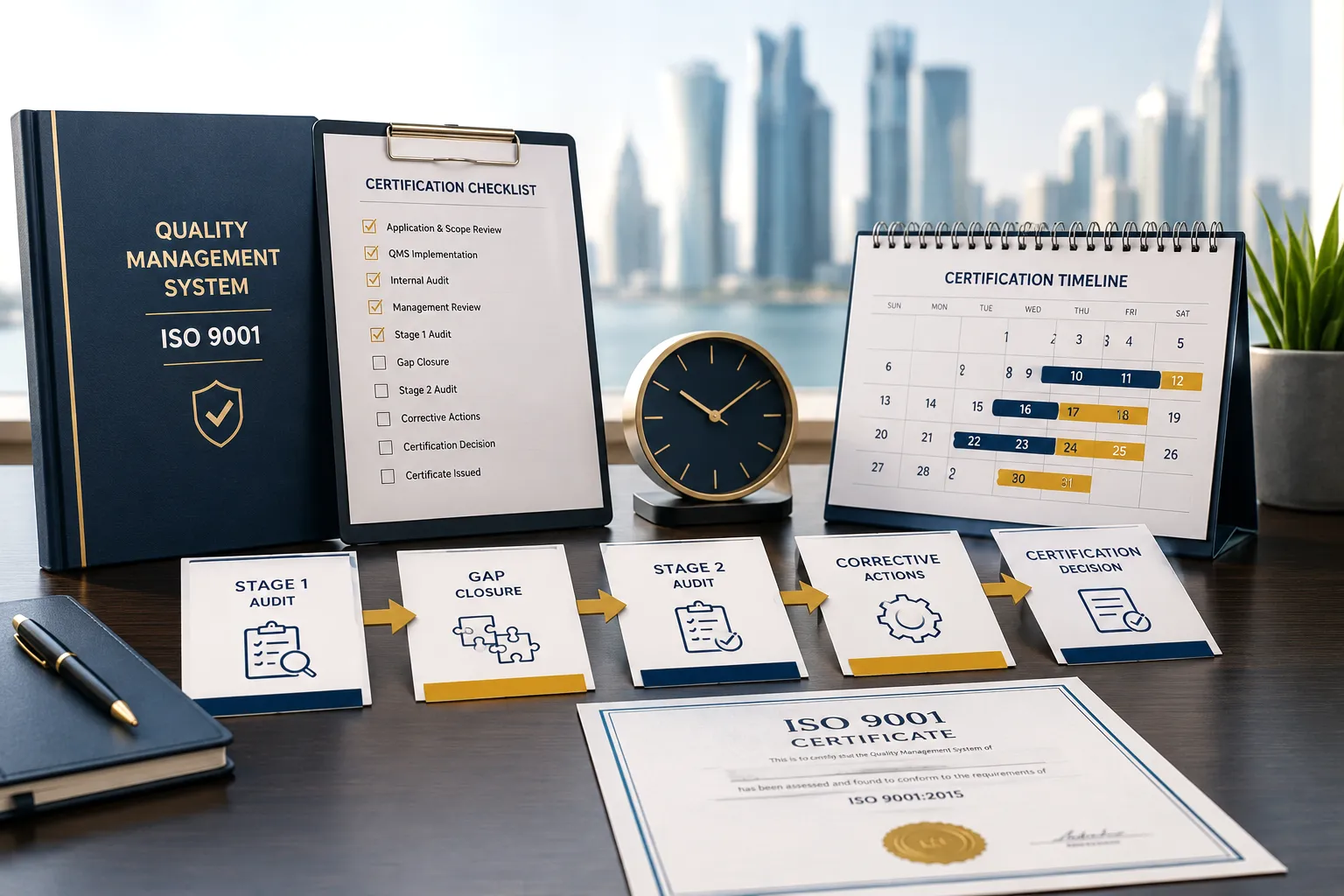
If your company is planning ISO 9001 certification in Qatar, one of the first practical questions is: how long will it take? This becomes even more important when certification is connected to a customer request, supplier approval, project prequalification, or an upcoming tender.
There is no single ISO-mandated calendar timeline for every business. The total time depends mainly on your Quality Management System (QMS) readiness, certification scope, number of sites, required audit time, and whether findings need to be corrected before certification.
How Long Does ISO 9001 Certification Take in Qatar?
For many businesses, a realistic end-to-end ISO 9001 certification timeline in Qatar is around 3 to 6 months when the QMS still needs to be developed or strengthened.
A company with a mature, implemented, and audit-ready QMS may move through the external certification phase within a few weeks, depending on audit availability and findings. Larger, complex, or multi-site organizations should often plan for 6 to 12 months or more.
These are planning ranges, not timelines prescribed by ISO. NQA currently describes 3–12 months as a typical overall range, with smaller or well-prepared organizations often taking 3–6 months and larger or multi-site organizations 6–12 months. DQS similarly notes that many organizations complete certification within 3–6 months once their QMS has been fully implemented.
| Business Situation | Practical Planning Range | Main Reason |
| QMS already implemented and audit-ready | A few weeks to around 2 months | Mainly audit scheduling, Stage 1, Stage 2, and certification decision |
| Small/medium business building or strengthening its QMS | Around 3–6 months | Implementation and generation of sufficient evidence |
| Large, complex, or multi-site organization | Around 6–12 months or more | Wider scope, more processes, locations, and audit coverage |
These are indicative planning ranges, not guaranteed or ISO-prescribed deadlines.
A Practical ISO 9001 Certification Timeline
While every organization is different, a typical certification journey may look like this:
- Month 1: Application, certification scope review, QMS gap assessment, and preparation planning.
- Months 1–3: QMS implementation, process documentation, employee awareness, record generation, and system monitoring.
- Months 2–4: Internal audit and management review, followed by corrective action where required.
- Months 3–5: Stage 1 audit and preparation for Stage 2.
- Months 3–6: Stage 2 audit, corrective actions where applicable, certification review and decision.
This is an indicative planning sequence rather than a fixed ISO requirement. Organizations with an established and effectively implemented QMS may complete the process faster, while larger, more complex, or multi-site organizations may require considerably more time.
Certification Time Is Not the Same as Audit Time
This is where many businesses get confused.
A company may be told that its certification audit requires only three or four audit days, but that does not mean it can become ISO 9001 certified in three or four days.
Before the audit, the QMS must be implemented and operating. After the audit, findings may need to be closed, and the certification body must complete its certification review and decision. Audit duration is therefore only one part of the full ISO 9001 certification timeline.
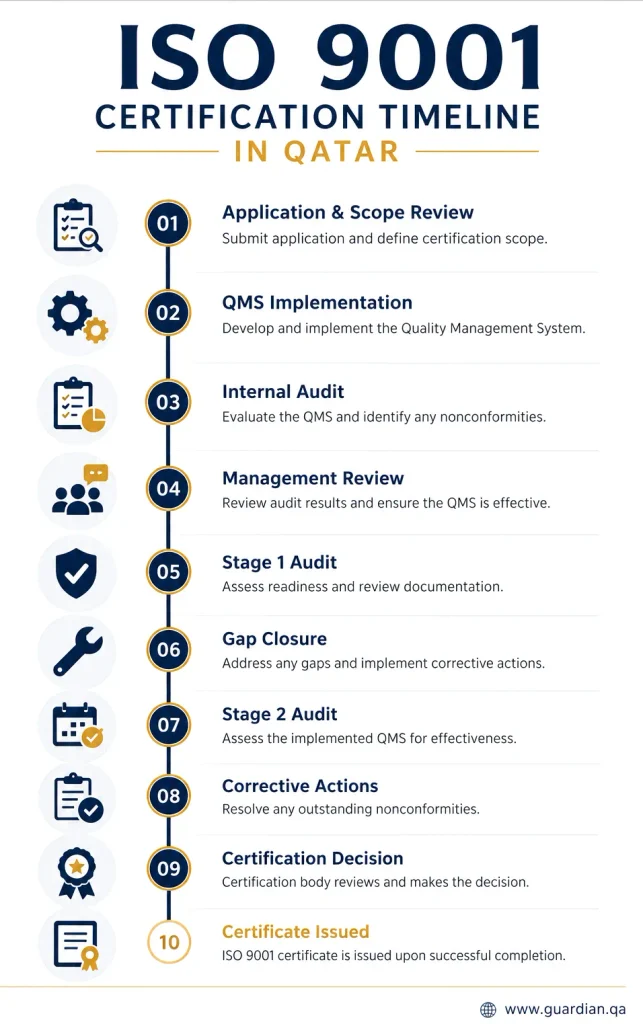
What Makes Up the ISO 9001 Certification Timeline?
1. Application and Scope Review
The certification body first reviews information such as your activities, locations, employee numbers, shifts, outsourced processes, and proposed certification scope.
This information helps determine what needs to be audited and how much audit time is required.
2. QMS Implementation and Readiness
This is often the biggest variable.
A company with established process controls, measurable objectives, responsibilities, records, and internal monitoring usually needs less preparation than a business starting from zero.
The important question is not:
“How quickly can we write the procedures?”
It is:
“Have these processes actually been implemented, and can we show evidence that they work?”
3. Internal Audit and Management Review
Before moving into the full ISO 9001 certification audit, the organization should have conducted its internal audit and management review.
ISO/IAF guidance for two-stage ISO 9001 certification specifically identifies internal audits, management reviews, system implementation, scope, processes, and locations as important areas considered when determining readiness for Stage 2.
4. Stage 1 Audit
Stage 1 is mainly about understanding your QMS and determining whether the organization is ready for Stage 2.
If significant gaps are found, more time may be needed to correct them before the certification audit proceeds.
5. Stage 2 Audit
Stage 2 checks whether the QMS is actually implemented and effective.
Auditors review records, interview relevant employees, follow processes, and collect objective evidence across the agreed certification scope.
6. Corrective Actions and Certification Decision
Completing Stage 2 does not automatically mean a certificate is issued that day.
Relevant nonconformities must be addressed, after which the certification body completes its ISO 9001 certification review and decision process. ISO/IEC 17021-1 requires the certification decision to be based on the audit information, nonconformity responses, corrective actions where applicable, and the audit team’s recommendation.
How Long Does the ISO 9001 Audit Itself Take?
The external audit is only one part of the process.
For accredited ISO 9001 certification, IAF MD 5:2023 provides a framework for determining audit time. The effective number of personnel is used as a starting point, while factors such as risk, process complexity, locations, outsourced activities, and logistics are also considered.
The figures below are starting points for audit-time calculation, not a fixed quotation or the total calendar time required to achieve certification. The certification body must determine and justify the final audit duration for each organization based on the applicable requirements and the organization’s circumstances.
| Effective Number of Personnel | IAF Starting Point: Stage 1 + Stage 2 |
| 1–5 | 1.5 audit days |
| 6–10 | 2 audit days |
| 11–15 | 2.5 audit days |
| 16–25 | 3 audit days |
| 26–45 | 4 audit days |
| 46–65 | 5 audit days |
| 66–85 | 6 audit days |
| 86–125 | 7 audit days |
| 126–175 | 8 audit days |
These figures are starting points for audit time, not the total calendar time needed to become certified. The certification body must determine and justify the final audit duration for each organization.
What Determines How Long ISO 9001 Certification Takes?
Your Current QMS Readiness
A company already controlling documents, objectives, suppliers, training records, customer feedback, and corrective actions has a very different starting point from a company that has only recently created its QMS.
Scope and Process Complexity
Consider these two businesses:
A small consultancy operating from one Doha office may have a relatively straightforward certification scope.
A construction or engineering company covering design, procurement, installation, project management, and maintenance may require broader audit coverage even if its employee numbers are similar.
Number of Sites
Multiple locations can add audit planning and time.
IAF MD 1 allows multi-site sampling only under defined conditions. For example, sampling may be appropriate where sites operate under one management system and perform very similar processes. It cannot simply be assumed that every multi-site company qualifies for sampling.
Availability of Records and Evidence
A procedure written yesterday does not automatically prove that a process is working.
Auditors need evidence that activities have actually happened—such as performance monitoring, training records, supplier evaluations, corrective actions, internal audits, or other records relevant to the QMS.
Findings From Stage 1 or Stage 2
Audit findings can significantly change the timeline.
For a major nonconformity, ISO/IEC 17021-1 provides an important limit: if the certification body cannot verify effective correction and corrective action within six months after the last day of Stage 2, another Stage 2 audit is required before initial certification can be recommended.
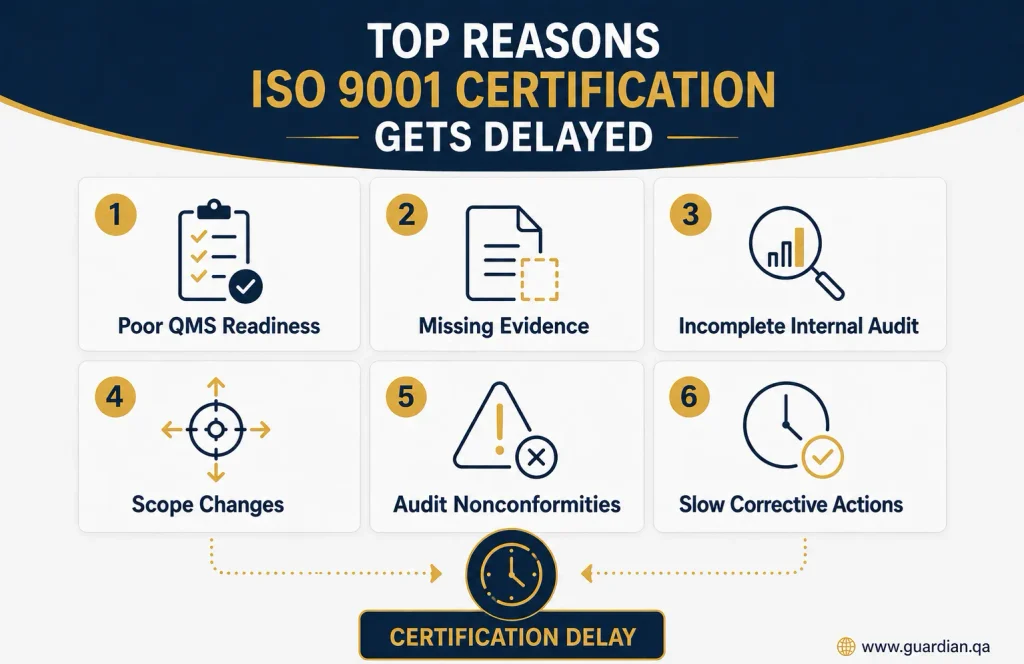
Why ISO 9001 Certification Gets Delayed
Most delays are not caused by the ISO standard itself. They usually come from preparation or coordination problems such as:
- procedures that do not match actual operations;
- incomplete internal audits or management reviews;
- missing or weak records;
- unclear or changing certification scope;
- adding sites or activities late in the process;
- key employees being unavailable;
- weak corrective actions;
- waiting too long to schedule the certification audit.
Qatar Example: Why “Three Months” and “A Few Weeks” Can Both Be Correct
Qatar University provides a useful local example.
Its published ISO 9001 implementation guideline states that QMS procedures should be effectively running for at least three months before certification. This is an organization-specific implementation guideline, not a universal ISO 9001 certification rule for every business in Qatar.
Its internal timetable then separately allows time for Stage 1, corrective actions, Stage 2, and certificate issuance.
This example demonstrates an important distinction:
Implementation time and certification-audit time are different.
A mature business may already have months or years of usable records and only need to complete the external certification stages. A business starting from scratch first needs enough real evidence to demonstrate that its system is operating.
Can ISO 9001 Be Completed Quickly for a Tender?
Sometimes—but only when the organization is genuinely ready.
This is particularly relevant in Qatar because some procurement and prequalification routes explicitly request current ISO certification.
For example: Ashghal’s current subcontractor renewal checklist requires an updated, valid, and traceable ISO 9001:2015 certificate issued by an accredited certification body, showing the subcontractor name and relevant scope of work.
If your deadline is close:
- Confirm exactly which certificate, scope, and accreditation the buyer requires.
- Check whether your QMS is already implemented.
- Complete the internal audit and management review.
- Contact the certification body early to check audit availability.
- Keep the certification scope stable and records ready.
- Respond promptly and properly to audit findings.
If the system is not ready, ISO 9001 certification should not be treated as an instant certificate purchase.
How to Avoid Unnecessary Certification Delays
The fastest legitimate route is usually better preparation—not skipping steps.
Before scheduling certification, confirm that:
- your certification scope is clear and accurate;
- processes are actually being followed;
- quality objectives are being measured;
- competence and training records are available;
- internal audit and management review are complete;
- identified gaps have been corrected;
- key process owners will be available;
- records can be retrieved quickly during the audit.
From a certification-body perspective, one of the clearest signs of readiness is consistency:
What your procedures say, what your employees explain, and what your records show should tell the same story.
When Should a Business Start ISO 9001 Certification?
The right starting point depends on your current QMS status and why you need certification.
No Immediate Deadline
If there is no immediate customer or tender requirement, allow enough time to implement the QMS properly, generate records, and verify that processes are working before the certification audit.
Customer or Vendor Requirement
If a customer or supplier requires ISO 9001 certification, confirm the required certificate, scope, and accreditation requirements first. Then assess how much of your QMS is already implemented and plan the remaining work accordingly.
Tender Deadline Approaching
If certification is required for an upcoming tender, start as early as possible. Confirm the buyer’s exact requirements and discuss audit availability with the certification body before committing to a certification date. Do not assume that accredited ISO 9001 certification can automatically be completed within 30 days.
Mature QMS Already in Place
If your organization already has a functioning QMS with sufficient records, internal audit results, and management review evidence, the preparation period may be shorter. However, audit scheduling, Stage 1, Stage 2, findings, and the certification decision can still affect the completion date.
The earlier you assess your actual QMS readiness, the more accurately you can plan your ISO 9001 certification timeline.
How to Get an Accurate ISO 9001 Timeline for Your Company
An accurate certification timeline cannot be calculated from employee count alone. The certification body normally needs information about your organization, including:
- effective number of personnel;
- products, services and processes;
- proposed certification scope;
- number of sites and temporary locations;
- shifts;
- outsourced processes; and
- current QMS status.
Need an ISO 9001 Certification Timeline in Qatar?
Guardian Middle East LLC represents Guardian Assessment UK Ltd, a United Kingdom–based certification body recognized by UAF (United Accreditation Foundation) and IAS (International Accreditation Service, USA), and is a QGOS-approved ISO certification body in Qatar. We can review your organization’s certification requirements, QMS status, and proposed scope to help determine the appropriate audit-time requirements and certification process.
If you are planning ISO 9001 certification in Qatar for a customer requirement, supplier approval, project prequalification, or tender, our certification team can help you understand the applicable certification process, audit requirements, and expected timeline.
Contact Guardian Middle East LLC to discuss your requirements | Serving the Middle East
Location: Abo Hamour Area, Doha, Qatar
P.O. Box: 23277, Doha, Qatar
Mobile: +974 7770 2602 | +974 7213 7770
Email: info@guardian.qa
Website: www.guardian.qa
Request an ISO 9001 Certification Quote
Final Takeaway
ISO 9001 certification in Qatar does not have one fixed timeline for every business. The biggest factor is not how quickly you can create documents, but how ready the organization is to demonstrate a functioning Quality Management System.
For many organizations, 3–6 months is a practical end-to-end planning range. Larger or multi-site businesses may need longer, while an already audit-ready organization can move faster.
Clear scope, reliable records, completed internal checks, and timely corrective action are usually the most effective ways to keep the certification process moving without compromising its credibility.
Frequently Asked Questions
2. Can ISO 9001 certification be completed in 30 days?
It may be possible where a mature, fully implemented QMS already exists and suitable audit dates are available. For an organization starting from scratch, 30 days is generally not a realistic planning assumption.
3. How much time is required between Stage 1 and Stage 2?
There is no single universal interval. Stage 1 is used to determine readiness and help plan Stage 2. Enough time should be allowed to address relevant Stage 1 concerns before proceeding.
4. How long do Stage 1 and Stage 2 audits take?
Audit duration depends on effective personnel, risk, scope, processes, and complexity. IAF MD 5 provides starting points, but the certification body must calculate the appropriate duration for each client.
5. How long after Stage 2 is the ISO 9001 certificate issued?
There is no universal ISO rule such as three or seven days. Timing depends on audit results, corrective-action review where applicable, and completion of the independent certification decision.
6. Do multiple locations increase the certification timeline?
They can. Multi-site organizations require additional planning, and site sampling is permitted only where applicable IAF requirements are satisfied.
7. What is the fastest legitimate way to get ISO 9001 certified?
Run a real QMS before the audit, define the scope correctly, complete internal audits and management reviews, keep evidence accessible, schedule the certification body early, and close findings promptly.
Comments are closed