

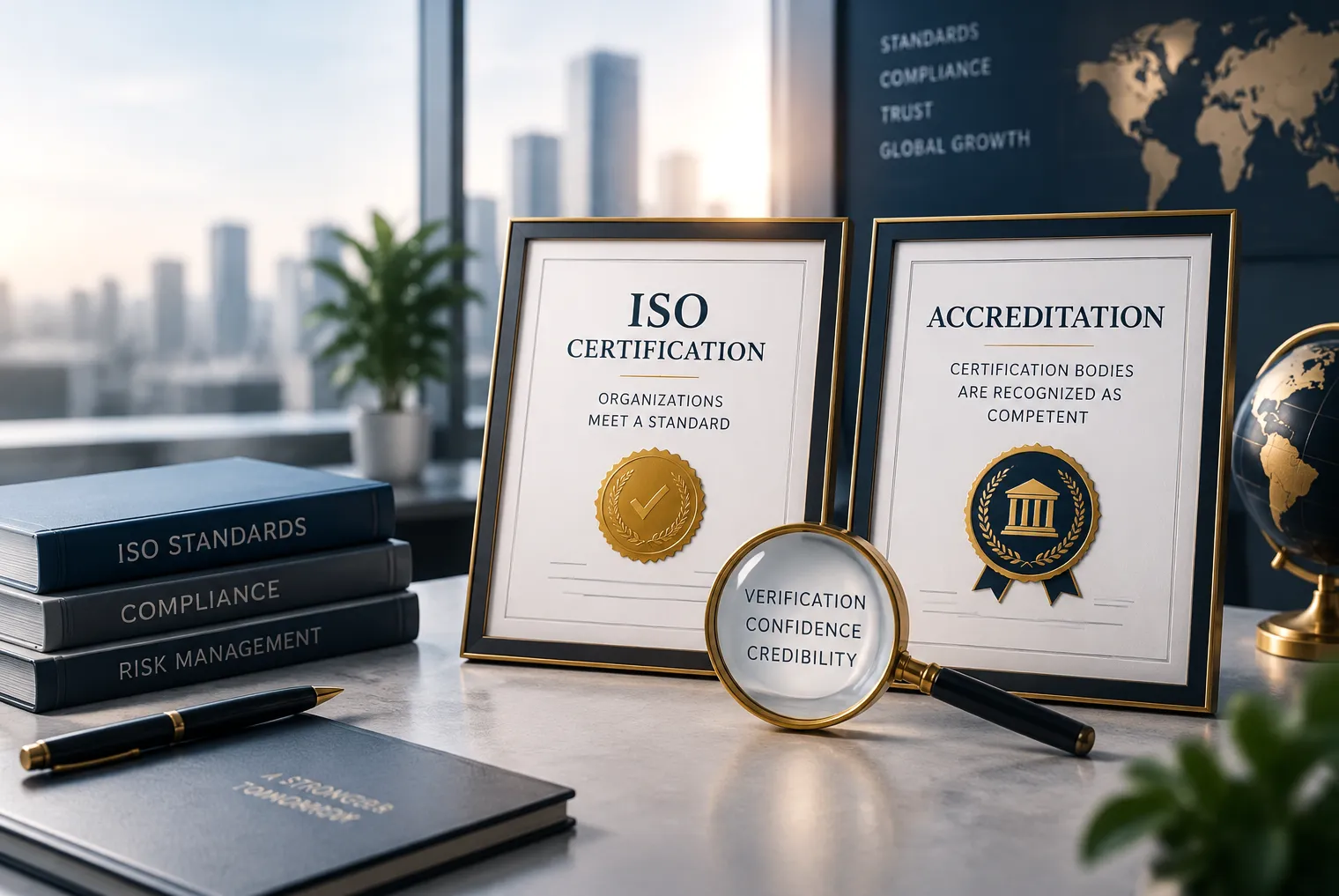
A certificate says a company meets a standard. But who confirms that the organization issuing that certificate is competent to make that decision?
This is where many businesses confuse two important terms: ISO certification and accreditation.
Although they are often mentioned together, they serve completely different purposes. Certification demonstrates that an organization’s management system has been assessed against a specific ISO standard, while accreditation provides confidence that the certification body performing that assessment is competent and operates according to recognized requirements.
Understanding this difference is important when choosing a certification body, meeting customer requirements, preparing for supplier approval, or submitting ISO certificates for tenders.
ISO develops international standards such as ISO 9001 and ISO 14001, but it does not certify organizations or issue certificates. Independent certification bodies perform the assessments, while accreditation bodies evaluate the competence of those certification bodies.
ISO Certification vs Accreditation
ISO body confirms that an organization’s management system, product, process, or service meets specified requirements. Accreditation, on the other hand, is formal recognition that a certification body is competent to perform certification activities according to applicable international requirements. In simple terms, businesses are certified, while certification bodies are accredited.
ISO Certification vs Accreditation at a Glance
| Point | ISO Certification | Accreditation |
| Who it applies to | Businesses and other organizations | Certification bodies |
| Who performs it | Independent certification body | Accreditation body |
| Purpose | Confirm conformity with specified requirements | Confirm competence of the certification body |
| Outcome | Certification/certificate | Accreditation recognition |
| Example | A company is certified to ISO 9001 | A certification body is accredited to certify management systems |
The easiest way to remember the distinction is:
Your company gets certified. The certification body that audits your company may be accredited.
What Do Certification and Accreditation Actually Mean?
What Is ISO Certification?
Certification is a third-party conformity assessment. An independent certification body assesses whether an organization meets the requirements of the applicable standard.
For example:
- a company may be certified to ISO 9001 for its Quality Management System;
- an organization may be certified to ISO 14001 for its Environmental Management System;
- a business may obtain certification to ISO 45001 for its Occupational Health and Safety Management System.
If the applicable requirements are met and the certification body’s decision process is successfully completed, certification can be granted.
One important wording point is worth understanding: a company is certified to an ISO standard, not “certified by ISO.” ISO develops the standards but does not provide the certification service.
What Is Accreditation?
Accreditation happens at a different level.
An accreditation body evaluates whether a certification body operates according to applicable international requirements and has the necessary competence, impartiality, resources, and processes to carry out certification work.
ISO explains accreditation as formal recognition by an independent accreditation body that a certification body meets the required international standards. In simple terms, accreditation provides independent confirmation that the certification body is competent to carry out certification activities.
So the distinction is straightforward:
Organizations are certified. Certification bodies are accredited.
How Do ISO, Accreditation Bodies, Certification Bodies and Businesses Connect?
The certification system becomes much easier to understand when each party’s role is separated.
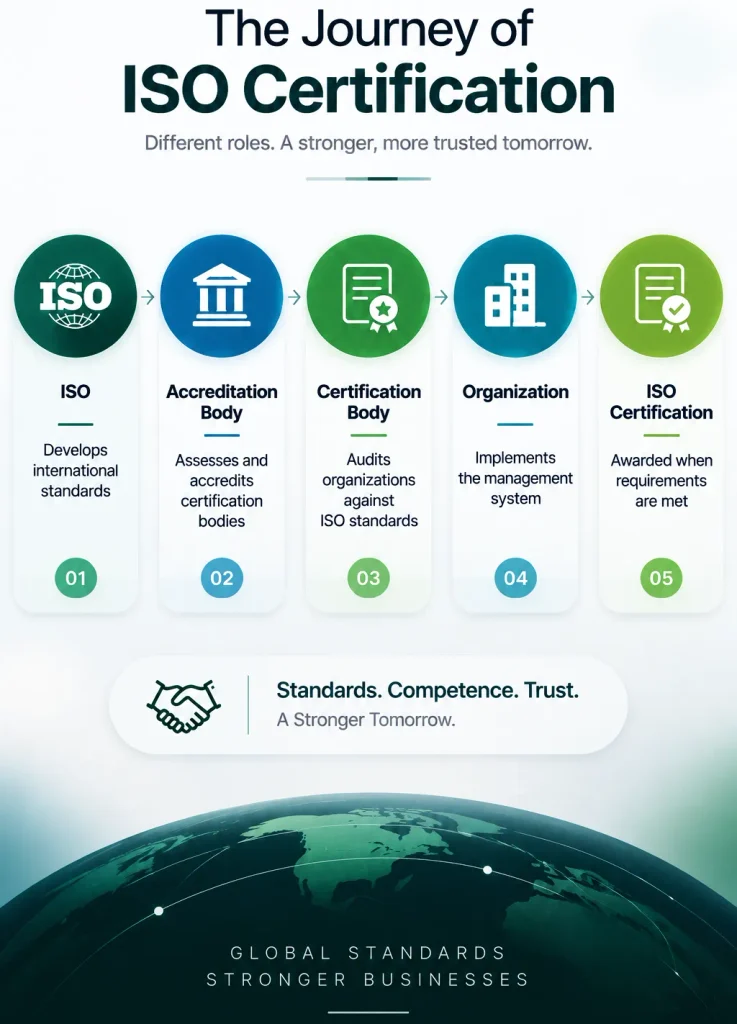
ISO develops and publishes the standard. An accreditation body assesses the competence of certification bodies against relevant conformity-assessment requirements. A certification body independently audits the organization against the selected ISO standard.
The organization implements the management system and, after successful assessment and certification decision, receives certification.
The relationship can therefore be understood like this:
ISO develops the standard → Accreditation body assesses the certification body → Certification body audits the organization → Organization receives certification
ISO’s conformity assessment framework helps maintain consistency and confidence in the certification process. Under the current international structure, Global Accreditation Cooperation Incorporated (Global ACI) provides the international framework for accreditation cooperation and has taken over the roles previously performed by IAF and ILAC.
Why Does Accreditation Matter When Choosing a Certification Body?
For a business buying certification services, accreditation is not just a logo on a certificate. It provides independent assurance that the certification body itself has been assessed for competence.
This matters because certification may later be relied upon by:
- customers and major buyers;
- supply-chain partners;
- government or private tender authorities;
- vendor-registration teams;
- international clients;
- organizations conducting supplier due diligence.
Accreditation can strengthen confidence that the certification process is being carried out using recognized requirements for competence, impartiality, audit practices, and certification decision-making.
ISO specifically advises organizations choosing a certification body to check whether it is accredited, while noting that accreditation provides independent confirmation of competence.
From a practical business perspective, the question should therefore not be only:
“Can this provider issue an ISO certificate?”
A better question is:
“Who has assessed this certification body, what is it accredited for, and will that certification route meet my customer’s, buyer’s, or tender’s requirements?” That distinction becomes particularly important when ISO certification is being obtained for a commercial purpose rather than simply for internal management-system improvement.
Does Every ISO Certificate Have to Be Accredited?
No. Accreditation is not compulsory in every case.
ISO itself states that accreditation is not mandatory and that a certification body being non-accredited does not automatically mean it is disreputable. However, accreditation provides independent confirmation of the certification body’s competence. This distinction is important because the actual requirement may come from somewhere else.
For example, an organization may need accredited certification because it is specified by:
- a customer contract;
- a government or private tender;
- a supplier-approval programme;
- an industry scheme;
- an international buyer;
- another contractual or regulatory requirement.
So a business should never assume that “any ISO certificate will be accepted.”
Before purchasing certification, check what the party requesting the certificate actually requires. If the requirement says that certification must come from an accredited certification body, the accreditation route, scope, and recognition become important parts of your decision.
Equally, it is inaccurate to label every non-accredited certificate as “fake” simply because accreditation is absent. The correct question is whether the certification is credible, appropriately issued, verifiable, and suitable for the purpose for which your business needs it.
How Can You Verify an Accredited ISO Certification Body?
Before choosing a certification body, do not rely only on its website, logo, or a sample certificate. Verify the accreditation claim independently.
A practical check should include:
- Accreditation body: Identify which body accredited the certification body.
- Current accreditation status: Confirm that the accreditation is active.
- Accreditation scope: Check whether the certification body is accredited for the ISO standard you need.
- Certification scope: Make sure the final certificate will accurately cover your organization’s relevant activities.
- Verification facility: Confirm that the certification body and certificate can be traced through an appropriate official directory or verification system.
How to Verify a Certification Body’s Accreditation
Before choosing a certification body, it is important to verify its accreditation independently through the relevant accreditation body’s official directory.
For example, if you want to verify whether a certification body is accredited by the United Accreditation Foundation (UAF), you can check its accreditation through the official UAF directory by following these steps:
Step 1: Visit the official UAF website
Go to the UAF website.
Step 2: Open the Directory
Click “Directory” from the main navigation menu.
Step 3: Select “List of Accredited CABs”
Open the list of UAF-accredited conformity assessment bodies.
Step 4: Search for the Certification Body
Use “Search by company or short code” and enter the certification body’s name.
Step 5: Check the Accreditation Details
Review the certification body’s listing, accreditation status, and applicable standards or certification schemes.
Step 6: Confirm the Scope
Make sure the required ISO standard or certification activity is covered within the certification body’s accreditation scope.
Tip: Always verify accreditation through the official accreditation body directory rather than relying only on a certification body’s website, certificate, or accreditation logo.
What to Check Before Choosing an ISO Certification Body
| Check | What You Are Confirming |
| Accreditation body | Who independently assessed the certification body |
| Accreditation status | Whether the accreditation is currently valid |
| Accreditation scope | Whether the required ISO standard is covered |
| Certification scope | Whether your actual business activities will be correctly represented |
| Certificate verification | Whether customers or buyers can independently verify the certification |
One important distinction is that accreditation scope and certification scope are not the same thing. The accreditation scope relates to what the certification body is recognized to certify, while the certification scope describes the activities of the organization that has been certified.
Practical Example: Why the Difference Matters
Consider an illustrative example of a contractor in Qatar that needs ISO 9001 certification for supplier approval.
Two certification providers make offers.
Provider A clearly identifies its accreditation body, applicable accreditation, certification process, and a way to verify issued certificates.
Provider B offers a certificate quickly but provides no clear accreditation information or reliable verification route.
The contractor should not choose purely based on price or speed. It should first determine what its customer requires and verify whether the proposed certification will be suitable for that purpose.
This becomes particularly important when a certificate will be submitted for a tender, vendor registration, international contract, or customer approval.
How Guardian Middle East LLC Approaches Accredited ISO Certification
Guardian Middle East LLC represents Guardian Assessment UK Ltd, a United Kingdom-based certification body recognized by UAF (United Accreditation Foundation) and IAS (International Accreditation Service, USA).
We support organizations across Qatar and the Middle East with a structured, audit-based certification approach that focuses on understanding your business activities, certification scope, applicable ISO standard, and management system readiness.
Whether your goal is customer approval, supplier registration, tender participation, project requirements, or strengthening business credibility, our team helps you understand the certification requirements and follow a transparent certification process.
Official Authority Details
- Location: Abo-Hamour Area, opposite the Medical Commission
- P.O. Box: 23277, Doha, Qatar
- Mobile: +974 7770 2602 | +974 7213 7770
- Email: info@guardian.qa
- Website: www.guardian.qa
Before starting your certification journey, ensure that the certification scope, accreditation requirements, and customer expectations are clearly understood to select the right certification approach for your organization.
Final Takeaway
The easiest way to understand ISO certification vs accreditation is this:
Certification demonstrates that an organization has been assessed against specified requirements. Accreditation provides independent recognition of the competence of the certification body carrying out that certification.
Before choosing a certification provider, businesses should therefore check not only the certificate being offered, but also who will issue it, the applicable accreditation, its scope, and whether the certification will meet the requirements of the customer, buyer, or tender for which it is needed.
Frequently Asked Questions
2. Is ISO certification the same as accreditation?
No. Organizations are certified, while certification bodies may be accredited.
3. Who accredits ISO certification bodies?
Certification bodies are assessed by accreditation bodies against applicable international conformity-assessment requirements. ISO itself does not accredit or certify organizations.
4. Does every ISO certificate need to be accredited?
No. Accreditation is not universally compulsory. However, customers, tenders, contracts, or industry schemes may specifically require certification from an accredited certification body.
5. How can I verify whether a certification body is accredited?
Check the accreditation body's official directory and confirm the certification body's current status and applicable scope. ISO also points users to recognized international certification-verification routes for accredited certification.
Comments are closed