

ISO 14001 certification in Qatar can help an organization manage environmental responsibilities in a more controlled, measurable, and repeatable way. Practical benefits may include stronger management of legal obligations, lower environmental risk, improved resource use, better waste control, clearer responsibilities, and greater confidence from customers and supply-chain partners.
The certificate itself does not create these results. The value comes from operating an effective environmental management system (EMS), measuring performance and continually improving it. The current edition, ISO 14001:2026, provides the internationally recognized framework for doing this.
In Qatar, environmental sustainability is also part of the country’s broader national development direction under Qatar National Vision 2030. Businesses may therefore encounter increasing environmental expectations from regulators, customers, project owners, and supply-chain partners. ISO 14001 Certification provides a structured framework for organizations to identify their environmental impacts, manage applicable obligations, establish controls, monitor performance, and pursue continual improvement.
Why ISO 14001 Matters to Businesses in Qatar
Environmental management is increasingly connected with how organizations operate and manage risk in Qatar. Under the Third Qatar National Development Strategy 2024–2030, environmental sustainability is a national outcome. Qatar targets a 25% reduction in greenhouse gas emissions against the business-as-usual scenario by 2030 and is promoting circular-economy and resource-efficient practices across sectors and industrial cities.
This does not make ISO 14001 automatically mandatory. It does make environmental performance more relevant to operational planning, regulatory oversight, procurement expectations, and long-term efficiency.
ISO 14001 turns broad environmental commitments into controlled activities: identify impacts, understand obligations, set objectives, establish controls, measure performance, and improve.
What Are the Main Benefits of ISO 14001 Certification in Qatar?
1. More Systematic Management of Environmental Compliance
Qatar’s environmental framework includes Environmental Protection Law No. 30 of 2002 and its executive bylaw under Resolution No. 4 of 2005. Depending on an organization’s activities, permits, approvals or operating requirements may also apply.
An ISO 14001 EMS requires the organization to determine applicable compliance obligations, understand how they relate to its activities, and periodically evaluate compliance. In practice, this replaces reliance on one employee “knowing what is required” with assigned responsibilities, monitoring, and evidence.
Certification does not guarantee legal compliance. It provides a framework that makes obligations easier to identify, monitor, and act on.
2. Better Control of Environmental Risks
Environmental problems often become expensive when identified too late. ISO 14001 requires organizations to understand environmental aspects and impacts and determine which need stronger control.
For a manufacturing facility, these may include chemical storage, waste, emissions, wastewater, energy consumption or spill risk. For a contractor, they may include fuel, dust, noise and site waste.
Once significant issues are identified, the organization can establish controls, responsibilities and emergency arrangements instead of relying mainly on reactive action.
3. Reduced Waste and Better Use of Resources
ISO 14001 encourages businesses to move from assumptions to measurable performance. That can expose inefficient use of materials, water, energy, or other resources.
For example, a production company tracking raw-material loss by process may discover that one stage creates excessive scrap. ISO 14001 does not prescribe the engineering solution, but the EMS provides a way to investigate the issue, set an objective, assign responsibility and monitor the result.
This is how ISO 14001 waste reduction and resource efficiency become practical rather than just environmental statements. ISO also identifies waste reduction and more efficient use of energy and resources among the potential benefits of the standard.
4. Potential Reduction in Operating Costs
Cost savings are possible, but never automatic.
They usually come from issues the EMS helps identify: excessive material consumption, inefficient energy or water use, avoidable disposal costs, rework, leaks, incidents or poorly controlled processes.
If material loss falls from 5% to 3%, for example, the financial benefit comes from the process improvement—not from owning a certificate. ISO 14001 provides the discipline that helps identify, measure, and sustain the improvement.
5. Clearer Environmental Responsibilities
A common weakness is unclear ownership. Everyone may agree that waste, chemicals, emissions or resource use should be controlled, but nobody has clear responsibility for monitoring them.
ISO 14001 requires roles and responsibilities to be established and supported by competence and awareness. This is especially useful in large organizations, multi-site businesses, and companies using contractors.
Done properly, it means employees know what they control, managers know what must be monitored, and leadership receives better information for decisions.
6. Better Data for Environmental Decisions
A mature EMS turns environmental performance into something management can review.
Relevant indicators may include:
- waste generated by type or process;
- water, fuel, electricity or material consumption;
- environmental incidents and complaints;
- recycling or recovery rates;
- achievement against environmental objectives;
- compliance-evaluation results;
- audit findings and corrective-action trends.
This helps management distinguish between planned environmental activities and measurable performance.
7. Stronger Customer and Supply-Chain Confidence
Some customers and supply chains want more than an environmental policy. They want evidence that environmental risks are managed through a recognized system.
Third-party ISO 14001 certification provides independent confirmation that the EMS has been assessed against the standard’s requirements. This can support supplier qualification, customer assurance, and business relationships where environmental credentials matter. ISO also identifies stakeholder trust and participation in global markets and supply chains among the potential benefits of ISO 14001.
It is not a guarantee of superior environmental performance; it provides confidence in the management system used to control and improve that performance.
8. Potential Support in Tender and Contractor Qualification
The commercial value of ISO 14001 depends on the buyer and contract, so businesses should check exact tender requirements rather than assume certification is mandatory.
A useful Qatar example is QatarEnergy’s Corporate Standard for Managing HSE in Contracts. It requires contractors to have an HSE management system appropriate to the work and states that certification to an internationally recognized standard is preferable, citing ISO 14001 as an environmental example.
That does not mean ISO 14001 is required for every Qatar tender. It shows why certification can matter where clients place formal environmental requirements on contractors and suppliers.
9. A Framework for Continual Improvement
Environmental management does not finish when the certificate is issued.
Objectives are monitored, audits identify weaknesses, nonconformities are corrected and management reviews whether the EMS remains suitable and effective. This creates a cycle of planning, operating, checking and improving. Continual improvement remains a central part of the ISO 14001 framework.
For organizations that use the system properly, certification is a checkpoint within an ongoing management process—not the final goal.
How ISO 14001 Creates Practical Business Benefits
| Business area | What the EMS introduces | Possible practical benefit | Example measure |
| Waste | Controls and objectives | Less waste and better handling | Waste generated per month |
| Resources | Monitoring and targets | More efficient consumption | Water, fuel or material use |
| Environmental risk | Aspect assessment and controls | Fewer uncontrolled events | Incident frequency |
| Compliance | Identification and evaluation of obligations | Better oversight | Evaluation results |
| Operations | Defined responsibilities | More consistent practices | Audit findings |
| Improvement | Objectives, audits and management review | Ongoing improvement | Objective completion rate |
Considering ISO 14001 Certification for Your Business?
If your organization wants to strengthen its environmental management system or understand what ISO 14001 certification would involve in Qatar, speak with our certification team about the requirements and next steps.
Discuss Your ISO 14001 Requirements
Do Small and Large Businesses Get the Same ISO 14001 Benefits?
The framework is the same, but the value can look different.
For a small business, ISO 14001 can bring structure to environmental activities that were previously informal. One person may handle purchasing, waste, facilities and compliance, so simple controls, objectives and monitoring can make responsibilities clearer.
A large organization may gain more from consistency across sites, departments and contractors. Environmental data can be consolidated, responsibilities standardized and performance compared across operations.
ISO 14001 is not only for large industrial companies. ISO states that the framework is suitable for organizations of different sizes and sectors. The system should be proportionate to the organization’s activities, context, and environmental impacts.
How Do the Benefits Differ Between Manufacturing and Other Industries?
The standard stays the same, but the environmental aspects being controlled can be very different.
ISO 14001 Benefits by Business Type
| Business type | Typical environmental priorities | Practical ISO 14001 value |
| Small business | Waste, utilities, purchasing | Clearer controls and measurable objectives |
| Large/multi-site organization | Governance, data, contractors | Common framework across operations |
| Manufacturing | Materials, chemicals, waste, emissions | Stronger controls and resource monitoring |
| Construction | Site waste, fuel, dust, noise | Consistent site environmental controls |
| Logistics | Fuel, transport impacts, spills | Structured control of significant impacts |
| Office/service company | Energy, procurement, travel, waste | Proportionate management of relevant impacts |
A service company does not need to imitate a factory. Its EMS may focus more on procurement, electricity, travel, waste and supplier decisions. A manufacturer may need detailed controls for processes, chemicals, emissions and waste streams.
The benefit comes from applying ISO 14001 to the organization’s real environmental impacts—not creating controls merely to satisfy an audit.
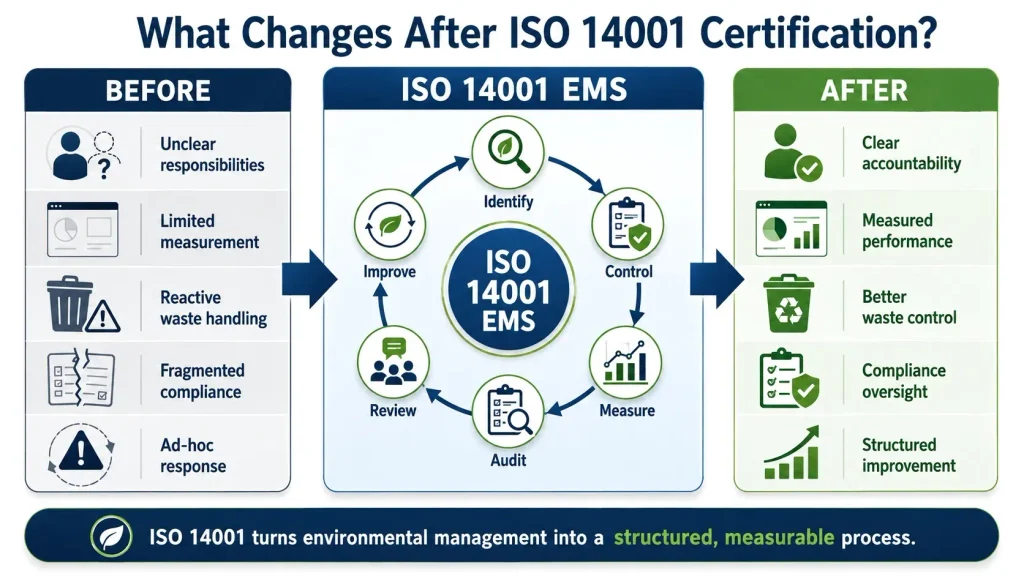
What Actually Changes After ISO 14001 Certification?
The biggest change should be visible in how environmental matters are managed day-to-day.
Environmental aspects are reviewed rather than discussed only after an incident. Objectives have owners and measures. Controls are built into operations. Employees understand relevant responsibilities. Internal audits test whether the system is functioning, and management reviews performance using evidence.
When something goes wrong, the organization should consider the cause, take corrective action where required, and check whether the same weakness could exist elsewhere.
That is the practical difference between possessing a certificate and operating an effective EMS.
Before and After ISO 14001 Implementation
| Area | Common Situation Before | Typical Situation With an Effective EMS |
| Environmental responsibilities | Ownership may be unclear | Responsibilities are assigned |
| Resource use | Limited measurement | Consumption is monitored |
| Waste management | Reactive handling | Reduction and control objectives |
| Compliance | Requirements may be fragmented | Obligations are identified and reviewed |
| Incident response | Ad-hoc reactions | Procedures and responsibilities are established |
What ISO 14001 Certification Does Not Automatically Guarantee
Certification does not automatically guarantee:
- zero environmental incidents;
- complete legal compliance at all times;
- immediate cost savings;
- zero waste or emissions;
- success in a tender;
- perfect environmental performance.
ISO 14001 provides a structured management framework. Results depend on leadership, objectives, resources, operational controls, monitoring, and willingness to act on what the system reveals.
A well-run EMS can create business value; a system maintained mainly for the certificate is far less likely to do so.
How Can a Business Measure the Benefits of ISO 14001?
Before claiming that ISO 14001 has improved performance, businesses should compare meaningful indicators over time.
A business might track:
- waste per unit produced;
- electricity or water consumption;
- environmental incidents;
- disposal costs;
- recycling rates;
- compliance findings;
- corrective-action closure;
- environmental complaints; or
- achievement of environmental objectives.
The measure should fit the organization’s activities. A logistics company may focus on fuel consumption and spills, while a manufacturer may emphasize material loss, hazardous waste, and process-related resource use.
ISO 14001 encourages organizations to define what improvement means for their own operations and collect evidence to determine whether that improvement is taking place.
Need ISO 14001 Certification in Qatar?
Guardian Middle East LLC represents Guardian Assessment UK Ltd, a United Kingdom–based certification body recognized by UAF (United Accreditation Foundation) and IAS (International Accreditation Service, USA), and is a QGOS-approved ISO certification body in Qatar.
If your organization is planning ISO 14001 certification for a customer requirement, supplier approval, project prequalification, tender, or to establish a structured Environmental Management System, our certification team can help you understand the applicable certification process, audit requirements, certification scope, and next steps.
Contact Guardian Middle East LLC | Serving the Middle East
Location: Abo Hamour Area, Doha, Qatar
P.O. Box: 23277, Doha, Qatar
Mobile: +974 7770 2602 | +974 7213 7770
Email: info@guardian.qa
Website: www.guardian.qa
Frequently Asked Questions
2- What is the main benefit of ISO 14001 certification?
The main benefit is a structured Environmental Management System that helps an organization identify environmental impacts, manage applicable obligations, control significant risks, monitor performance, and continually improve.
3- Can ISO 14001 help reduce business costs?
It can. Cost savings may result when an organization identifies and reduces inefficient use of energy, water, materials, or waste-management resources. However, savings are not guaranteed simply because a company becomes certified.
4- Is ISO 14001 suitable for small businesses?
Yes. ISO 14001 can be applied to organizations of different sizes and sectors. The EMS should be appropriate to the organization's activities, environmental impacts, and operational context.
5- Does ISO 14001 guarantee legal compliance?
No. Certification does not guarantee complete legal compliance at all times. The EMS provides a framework for identifying applicable obligations, evaluating compliance and taking action where necessary.
6- Can ISO 14001 help with tenders in Qatar?
It can support tender or contractor qualification where environmental management or ISO 14001 certification is included in the buyer's requirements. Businesses should always check the specific tender conditions.
7- Does ISO 14001 guarantee better environmental performance?
No. Certification confirms that the organization's EMS has been assessed against the requirements of the standard. Actual environmental performance depends on how effectively the organization implements, monitors, and continually improves its system.
Comments are closed