

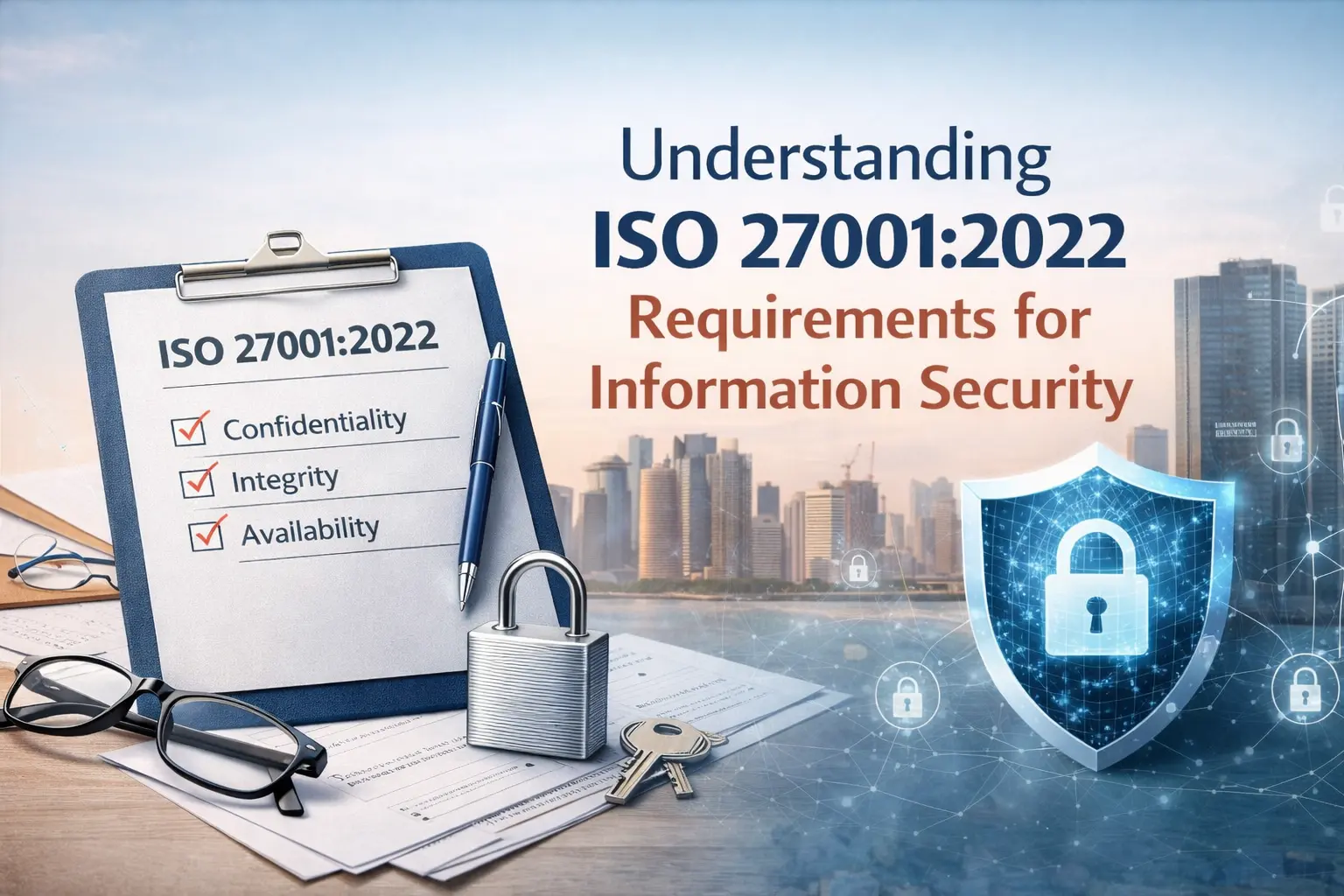
Understanding the ISO 27001:2022 requirements is essential for building a secure Information Security Management System (ISMS). These requirements guide organizations in managing risks and protecting sensitive data. Information security in the modern digital world is not just a technology-based requirement but a business necessity. Protecting the confidentiality, integrity, and availability of information (financial transactions, consumer data, intellectual property) is key to maintaining compliance and trust. ISO 27001 can help with that. It is the international standard for information security management systems (ISMS) that provides a framework for managing, monitoring, and continuously improving information security in any organization. Understanding ISO 27001 accreditation standards is the first step towards creating an environment of safe and reliable information management. In this blog, you’ll learn the key ISO 27001 requirements, the Annex A controls, and what your organization must do to be compliant.
What Is ISO 27001?
ISO/IEC 27001 is an international standard published by the International Organization for Standardization (ISO) and the International Electrotechnical Commission (IEC). It defines the requirements needed to establish, implement, maintain, and continually improve an Information Security Management System (ISMS).
ISO 27001 Helps Organisations To:
- Identify and manage security risks
- Prevent unauthorized access to sensitive data
- Build trust with partners, customers, and regulators
- Ensure compliance with contracts and legal requirements
Being ISO 27001-compliant shows that your firm upholds strong data governance and information security practices.
Essential Conditions for ISO 27001 Compliance
The ISO 27001 standard comprises ten core clauses (Clauses 4–10) and Annex A, which explains the detailed security controls across various domains.
Let’s break down these fundamental requirements:
Clause 4: Understanding the Organization and Its Context
Organizations must identify internal and external factors that can affect information security objectives.
You should:
- Identify stakeholders (customers, employees, regulators, suppliers)
- Define applicable information security requirements
- Establish the boundaries and scope of your ISMS
Clause 5: Leadership
Top management plays a vital role in ISO 27001 implementation. They must:
- Demonstrate commitment to information security
- Establish an information security policy
- Define roles and responsibilities supporting ISMS functionality
Leadership ensures security aligns with overall business objectives.
Clause 6: Planning
This clause focuses on identifying and managing information security risks.
Organizations must:
- Conduct a risk assessment
- Identify risks and opportunities
- Create a risk treatment plan
- Set measurable information security objectives
Clause 7: Support
For an effective ISMS, organizations must ensure awareness, competence, communication, and resources.
This includes:
- Conducting security awareness training
- Ensuring staff understand their roles and responsibilities
- Maintaining organized records, policies, and procedures
Proper document control ensures ISMS documents are current, versioned, and securely stored.
Clause 8: Operation
This clause focuses on the processes needed to achieve ISMS objectives.
Organizations must:
- Execute risk treatment plans
- Control outsourced processes
- Implement operational procedures for secure data handling
Key operational practices include encryption, access control, and incident management.
Clause 9: Performance Evaluation
Continuous performance monitoring ensures the ISMS remains effective.
You must:
- Conduct regular internal audits
- Perform management reviews
- Track metrics (e.g., incidents count, response times, risk scores)
Regular evaluation enables quick vulnerability detection and timely improvements.
Clause 10: Improvement
ISO 27001 encourages continuous improvement.
Organizations must:
- Implement corrective actions
- Identify root causes of issues
- Update ISMS to respond to new risks or technological changes
This ensures the ISMS evolves with your organization and security landscape.
Annex A – Security Controls for Information
The ISO/IEC 27001:2022 revision outlines 93 controls grouped into four key themes:
- Organizational Controls (A.5): Governance, policy, and procedure management
- People Controls (A.6): User access, identity management, and staff awareness
- Physical Controls (A.7): Facility and equipment security
- Technological Controls (A.8): Encryption, malware protection, monitoring, and backups
These controls are based on your risk assessment results and must be documented in the Statement of Applicability (SoA).
Documentation and Records Required for ISO 27001
To demonstrate compliance, organizations must maintain specific documents and records, including:
- ISMS scope statement
- Information security policy
- Risk assessment and treatment methodology
- Statement of Applicability (SoA)
- Internal audit and management review reports
- Corrective action records
- Employee training records
- Supplier evaluation and access control policies
Well-maintained records are key for successful ISO 27001 certification audits.
Benefits of ISO 27001 Compliance
Achieving ISO 27001 certification brings several business benefits:
- Enhanced protection of sensitive data
- Reduced security breaches and incidents
- Increased trust among clients, investors, and partners
- Easier compliance with data protection laws (e.g., GDPR)
- Stronger brand reputation and profitability
By meeting ISO 27001 requirements, you demonstrate a commitment to data protection and business resilience.
How Guardian Certification Helps You Become ISO 27001 Certified
At Guardian Middle East., we support organizations in implementing and certifying ISO 27001. As an independent accredited certification body (accredited by UAF and IAS, both IAF-recognized), our certification process is transparent, efficient, and compliant with all standard requirements.
Our Expert Team Guides You Through:
- Risk assessment and gap analysis
- ISMS documentation and implementation
- Audit preparation and certification support
Why Choose Guardian Certification:
- UAF & IAS (IAF recognized) accredited
- Transparent and competitive pricing
- Auditors with extensive technical expertise
- End-to-end support during the certification journey
Final Thoughts
Getting ISO 27001 certified is about more than compliance — it’s about building a security-first culture that protects your data, customers, and reputation. A robust ISMS helps you withstand cyber threats, operational risks, and evolving business challenges. If your organization is ready to start its ISO 27001 certification journey, contact Guardian Middle East. today. Accredited by UAF & IAS — Your Trusted ISO Certification Partner.
- 📧 Email: info@guardian.qa
- 🌐 Website: www.guardian.qa
Get a Quote
Comments are closed