

Quick Answer: What Is ISO Certification in Qatar?
ISO certification in Qatar helps businesses improve credibility, qualify for tenders, strengthen internal processes, and build trust with clients. It is especially important in sectors such as construction, engineering, oil and gas, IT, healthcare, education, logistics, manufacturing, and facility management. For Indian businesses operating in or supplying to Qatar, ISO certification can also support supplier approvals, contract readiness, and long-term market entry.
Introduction: Why Does ISO Certification Matter in Qatar?
Qatar’s business environment is becoming more competitive, more regulated, and more connected to international markets. From construction and oil and gas to healthcare, logistics, IT, education, and manufacturing, businesses are increasingly expected to show that they can manage quality, safety, compliance, and operational consistency in a structured way.
That is one of the main reasons ISO certification in Qatar has become more than just a business improvement step. In many cases, it is now part of how companies build trust, qualify for projects, and stay competitive. This also fits with Qatar National Vision 2030, which focuses on economic, human, social, and environmental development. As Qatar continues to push for diversification, sustainability, and stronger institutional performance, internationally recognized management systems are becoming more relevant across industries.
Today, many businesses in Qatar pursue ISO certification to:
- improve operational efficiency
- qualify for tenders and vendor registrations
- build credibility with international clients
- reduce operational risks
- improve customer confidence
- meet regulatory and contractual expectations
In sectors such as construction, facility management, oil and gas, engineering, IT services, education, and healthcare, ISO certification is often considered during supplier approvals, tender participation, prequalification, client audits, and project evaluations.
For businesses operating in Qatar, ISO certification is no longer only about getting a certificate. It is about building a system that supports consistency, trust, and long-term growth.
What Is ISO Certification in Qatar?
ISO certification in Qatar is a formal process where a business is audited against an international ISO standard to show that its management system meets recognized requirements.
What Is ISO Certification?
ISO certification is a formal process where a business shows that its management system meets the requirements of an internationally recognized ISO standard. These standards are designed to help organizations manage their operations in a more structured and reliable way.
Depending on the standard, ISO certification can help improve:
- quality management
- environmental performance
- occupational health and safety
- information security
- anti-bribery controls
- educational management systems
- overall operational consistency
An ISO certificate is issued after an independent audit confirms that the organization has the required processes and controls in place and is using them in real operations.
For example:
- ISO 9001 focuses on quality management systems
- ISO 14001 focuses on environmental management systems
- ISO 45001 focuses on occupational health and safety
- ISO 27001 focuses on information security management
- ISO 37001 focuses on anti-bribery management systems
- ISO 21001 focuses on educational organizations management systems
ISO certification is not only about documents. It is about how effectively a company runs its system in day-to-day business.
Why Do Businesses in Qatar Need ISO Certification?
Businesses in Qatar need ISO certification because clients, contractors, government entities, and international partners increasingly expect structured and internationally aligned business systems.
Businesses in Qatar increasingly require ISO certification because clients, contractors, government entities, and international partners now expect organizations to follow globally accepted operational practices.
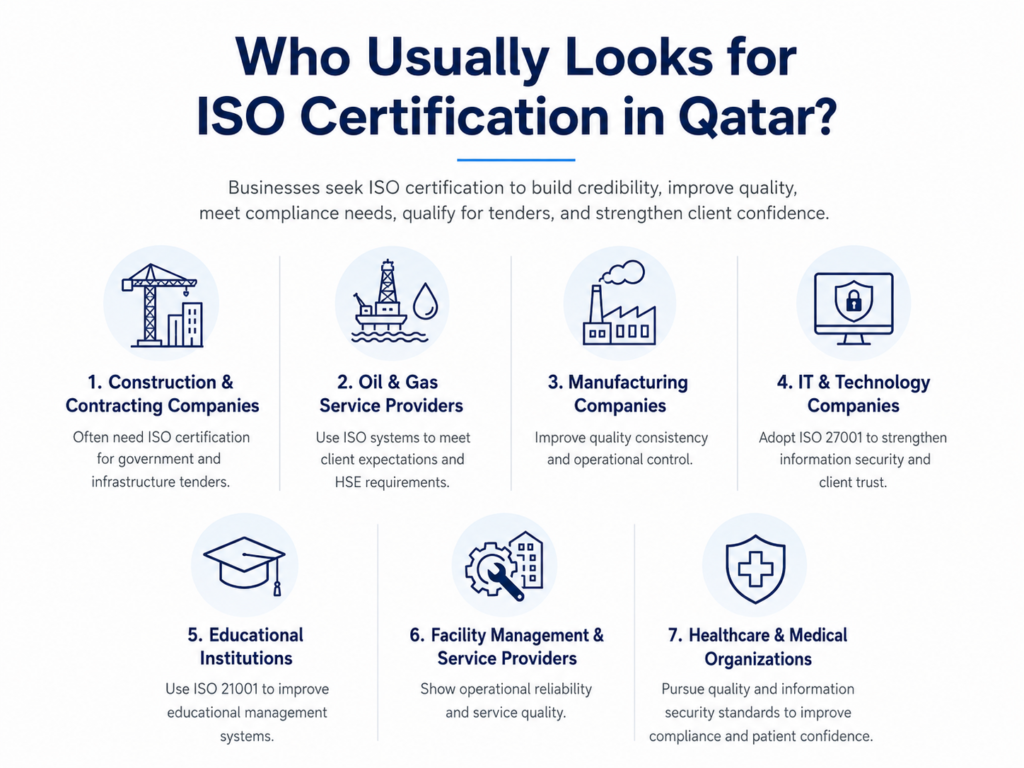
Several industries in Qatar are highly compliance-driven, including:
- construction
- oil and gas
- engineering
- logistics
- facility management
- manufacturing
- healthcare
- information technology
- education
In these sectors, ISO certification helps businesses show that they can consistently deliver products or services while maintaining quality, safety, compliance, and risk management.
A practical Qatar-based example
MEEZA, a major IT and data center company. Public information shows that MEEZA operates five Tier III-certified data centers and has highlighted ISO 9001 and ISO 27001 certifications for its Security Operations Center. This is a strong example of how businesses in Qatar use ISO certification not just for formal compliance, but to strengthen service quality, information security, and client trust in real operations.
Many organizations also pursue ISO certification because it improves internal operations. Companies often experience benefits such as:
- better process standardization
- reduced errors and rework
- improved employee accountability
- stronger documentation control
- better risk identification
- improved customer satisfaction
- more efficient audits and compliance tracking
In Qatar’s competitive market, these operational improvements can directly affect profitability and reputation.
Why Is ISO Certification Important for Businesses in Qatar?
ISO certification is important in Qatar because it supports credibility, tender readiness, process control, and customer trust.
How Does ISO Certification Improve Business Credibility?
One of the biggest advantages of ISO certification is stronger business credibility.
When a company achieves ISO certification, it shows that its operations follow internationally recognized systems and controls. This builds confidence among:
- customers
- investors
- suppliers
- government entities
- international business partners
In competitive markets like Qatar, credibility often influences supplier selection and contract decisions.
A useful Qatar-based example comes from a published Community College of Qatar case study on hybrid learning. The study found that most students, instructors, and administrators responded positively, while also facing operational challenges that required better structure and coordination. This is exactly the type of environment where a standard like ISO 21001 becomes valuable, because it helps educational organizations improve consistency, planning, governance, and learner experience.
How Does ISO Certification Help with Tenders and Supplier Requirements?
Many tenders and supplier registration processes in Qatar either require or strongly prefer ISO-certified companies.
This is especially common in sectors such as:
- construction
- infrastructure
- oil and gas
- engineering
- government projects
- facility management
Organizations seeking vendor approvals are often asked to submit:
- ISO certificates
- audit reports
- HSE documentation
- quality management procedures
Without ISO certification, businesses may face limitations when trying to qualify for larger projects or approved supplier lists.
How Does ISO Certification Improve Process Control and Consistency?
ISO standards help organizations build structured processes instead of depending only on how individual employees prefer to work.
This improves:
- operational consistency
- process monitoring
- documentation control
- corrective action systems
- risk management
- continuous improvement
For example, ISO 9001 encourages organizations to measure performance, identify nonconformities, and take corrective action. Over time, this reduces inefficiencies and improves service reliability.
Many companies see improvements such as:
- reduced customer complaints
- lower operational errors
- better project coordination
- improved audit readiness
- faster onboarding and training
How Does ISO Certification Build Customer Trust and Market Reputation?
Customer trust is one of the strongest long-term benefits of ISO certification.
Clients often prefer working with businesses that can demonstrate:
- structured operations
- compliance systems
- risk management processes
- quality assurance controls
ISO certification helps organizations present themselves as professionally managed and internationally aligned.
This becomes especially important for businesses that:
- work with multinational companies
- export products or services
- participate in international projects
- handle sensitive information
- operate in regulated industries
In Qatar’s fast-moving business environment, trust and reputation can strongly influence growth opportunities.
Which ISO Standards Are Most Common in Qatar?
| ISO Standard | Full Name | Main Purpose | Best For |
| ISO 9001 | Quality Management System | Quality, consistency, customer satisfaction | Construction, manufacturing, logistics, healthcare |
| ISO 14001 | Environmental Management System | Environmental control and sustainability | Construction, industrial operations, manufacturing |
| ISO 45001 | Occupational Health & Safety Management System | Workplace safety and risk reduction | Construction, engineering, oil and gas |
| ISO 27001 | Information Security Management System | Data security and information protection | IT, finance, healthcare, telecom |
| ISO 21001 | Educational Organizations Management System | Learning quality and governance | Schools, universities, training centers |
| ISO 37001 | Anti-Bribery Management System | Ethics, transparency, compliance | Corporate, contracting, international business |
How Does the ISO Certification Process Work in Qatar?
The ISO certification process in Qatar usually involves choosing the right standard, identifying gaps, implementing the system, preparing staff, completing audits, and maintaining compliance.
How Do You Choose the Right ISO Standard?
The first step is identifying which ISO standard matches the organization’s business activities and objectives.
For example:
- ISO 9001 for quality management
- ISO 14001 for environmental management
- ISO 45001 for occupational health and safety
- ISO 27001 for information security
Choosing the correct standard is important because implementation requirements vary depending on industry risks and client expectations.
What Happens During Gap Analysis and Documentation?
A gap analysis helps identify the difference between current practices and ISO standard requirements.
This stage usually includes:
- reviewing existing processes
- evaluating documentation
- identifying compliance gaps
- preparing implementation plans
Organizations then develop the policies, procedures, records, and operational controls needed for the chosen standard.
What Happens During Internal Audit and Management Review?
Before certification audits, organizations conduct internal audits to evaluate system effectiveness.
Internal audits help identify:
- nonconformities
- process weaknesses
- compliance issues
- improvement opportunities
Management review meetings are also conducted to assess overall system performance and readiness.
What Happens During Certification Audit and Approval?
The certification body then conducts external audits.
The audit process generally includes:
- Stage 1 Audit
Review of documentation and management system readiness. - Stage 2 Audit
Evaluation of actual implementation and operational effectiveness.
If the organization successfully meets the requirements, the certification body issues the ISO certificate.
What Does Surveillance and Ongoing Compliance Mean?
ISO certification is not a one-time activity.
Organizations must continue maintaining and improving their systems through:
- surveillance audits
- internal audits
- corrective actions
- performance reviews
- continual improvement activities
Most ISO certifications remain valid for three years, subject to surveillance and continued conformity.
How Do You Choose the Right ISO Certification Body in Qatar?
The right certification body should offer recognized accreditation, relevant audit experience, local support, and clear process coordination.
Why Does Accreditation Matter?
Accreditation is one of the most important factors when choosing a certification body.
An accredited certification body shows that its certification processes have been independently evaluated and are internationally recognized.
Businesses should verify:
- accreditation status
- scope approvals
- industry experience
- international recognition
- audit credibility
This helps make sure the certificate is accepted by clients, regulators, and international partners.
Why Does Local Support in Qatar Matter?
Local support is very important during ISO implementation and certification.
A certification provider with operational presence in Qatar can often provide:
- faster coordination
- a better understanding of local industries
- easier communication
- local audit support
- quicker response times
This becomes especially useful for businesses handling active projects, tenders, or urgent compliance requirements.
What Should Businesses Check Before Applying?
Before choosing an ISO certification provider, organizations should evaluate:
- accreditation and recognition
- audit experience in relevant industries
- local operational support
- certification scope availability
- transparency in process and timelines
- post-certification support
Businesses should also avoid selecting certification services based only on low pricing. The credibility and recognition of the certification body can strongly affect how clients and stakeholders view the certificate.
What Should Indian Businesses Know About ISO Certification in Qatar?
Indian businesses operating in or supplying to Qatar should make sure their ISO certification scope, implementation, and local coordination match the actual Qatar-based operation.
India and Qatar have strong business ties across construction, engineering, oil and gas support services, facility management, manufacturing, logistics, education, IT services, and manpower supply. As more Indian companies expand into Qatar, ISO certification is becoming important not only for compliance, but also for credibility, supplier approval, and contract readiness.
For Indian businesses planning to work with Qatari clients, contractors, or government-linked projects, the real issue is not whether ISO certification matters. It is whether your current systems are strong enough to meet Qatar-based client expectations, project requirements, and vendor evaluation standards.
This section is especially relevant for:
- Indian contractors working on Qatar-based projects
- Indian exporters supplying products to Qatar
- Indian companies opening branches in Qatar
- service providers supporting Qatari clients remotely
- businesses participating in GCC tenders and supplier registrations
If Your Company Is Based in India but Operates in Qatar
Many Indian businesses now work in Qatar through local branches, joint ventures, project-based contracts, vendor partnerships, and subcontracting arrangements. In these situations, ISO certification often becomes part of the operational requirement, not just a business improvement step.
A strong example:
Larsen & Toubro (L&T), which in 2025 won a $4 billion order from QatarEnergy LNG. This shows how deeply Indian companies are involved in major Qatar projects, where structured systems, compliance readiness, and operational credibility matter.
The right ISO standard usually depends on the nature of your work in Qatar:
- ISO 9001 – Quality Management System supports process control, quality assurance, and consistency
- ISO 14001 – Environmental Management System helps businesses manage environmental responsibilities and sustainability expectations
- ISO 45001 – Occupational Health & Safety is especially important for construction, engineering, and site-based operations
- ISO 27001 – Information Security Management is highly relevant for IT, digital services, and businesses handling sensitive client data
- ISO 21001 – Educational Organizations Management supports schools, training centers, and academic institutions
- ISO 37001 – Anti-Bribery Management System helps strengthen governance, ethics, and compliance controls
One common mistake is assuming that a certification built only around domestic operations in India will automatically meet all client expectations in Qatar. In practice, Qatari clients often review scope applicability, certification credibility, industry relevance, operational implementation, and local coordination capability.
That is why businesses with an India-based headquarters and Qatar operations often need local certification coordination in Qatar. It helps ensure that the certification scope, audit planning, site coverage, and implementation support match the actual Qatar operation, not just the head office system.
As operations grow in Qatar, structured management systems become more important for managing:
- multi-site operations
- workforce management
- documentation control
- HSE compliance
- supplier coordination
- audit readiness
Companies that put the right ISO systems in place early usually scale more smoothly in Qatar and across the GCC.
If You Supply to Clients or Projects in Qatar
Many Indian manufacturers, exporters, engineering suppliers, and service providers work with Qatari clients either directly or through procurement contractors. In these cases, ISO certification can directly affect supplier approvals, tender eligibility, procurement evaluations, client confidence, and long-term business opportunities.
A recent example:
Ashok Leyland, which partnered with FAMCO Qatar in 2025 to strengthen its presence in the Qatari market.
Another strong example
Petronet LNG, which signed a long-term LNG supply deal with QatarEnergy in 2024. These examples reflect a broader pattern: Indian companies entering Qatar need stronger operational credibility, structured systems, and local coordination to support long-term growth.
In practice, the required ISO standard often depends on what you supply:
- manufacturers exporting industrial materials may be asked for ISO 9001 during supplier registration
- businesses with environmental obligations may benefit from ISO 14001
- engineering and industrial vendors may need ISO 45001 to support safety expectations
- IT and technology suppliers may need ISO 27001 to strengthen information security confidence
- education-related providers may use ISO 21001 to support structured delivery and governance
- businesses working in compliance-sensitive environments may use ISO 37001 to strengthen ethical controls
Qatari buyers increasingly prefer suppliers with structured management systems because it reduces operational and compliance risk. Large contractors and procurement teams often review:
- documentation systems
- traceability processes
- safety controls
- environmental management practices
- information security practices
- corrective action systems
For Indian businesses, ISO certification can improve not only credibility, but also competitiveness in supplier selection, procurement discussions, and long-term client relationships.
Why Does Local Certification Support Make Coordination Easier?
One of the biggest mistakes some Indian businesses make is trying to manage Qatar-related certification requirements entirely remotely, without understanding local operational expectations.
While remote coordination may work in some cases, businesses operating in Qatar often benefit more from local certification support. This is especially useful for:
- multi-location projects
- urgent tender submissions
- site-based audits
- client inspections
- vendor registration requirements
- regional compliance coordination
- faster communication with project stakeholders
If a company has operations in both India and Qatar, local support can help with:
- audit scheduling
- site visits
- documentation reviews
- employee awareness sessions
- implementation support
- certification maintenance activities
This reduces delays and improves coordination.
Local support also brings a better understanding of sector-specific expectations in Qatar, especially in construction, oil and gas, facility management, government-related procurement, and engineering. For Indian companies entering Qatar for the first time, this can reduce confusion around certification procedures, documentation expectations, audit preparation, compliance timelines, and client-driven requirements.
As competition grows across GCC markets, businesses that combine internationally recognized ISO standards with strong local support usually perform better during vendor assessments, project onboarding, and client audits.
Common Mistakes Businesses Make When Applying for ISO Certification
| Mistake | What It Causes | Better Approach |
| Choosing the wrong ISO standard | Low business value, weak relevance, and poor return on effort | Match the ISO standard to your industry, business risks, client expectations, and tender requirements |
| Focusing only on paperwork | Weak implementation and a system that looks good on paper but does not work in practice | Build a practical system that reflects real operations and is followed by the team daily |
| Copy-paste documentation | Generic procedures that do not match actual business processes | Create documentation based on how your business really works |
| Over-documenting the system | Too much paperwork, confusion, and poor usability for employees | Keep documentation simple, clear, and only as detailed as necessary |
| Under-documenting important processes | Missing controls, audit gaps, and inconsistent operations | Properly document key processes, responsibilities, records, and controls |
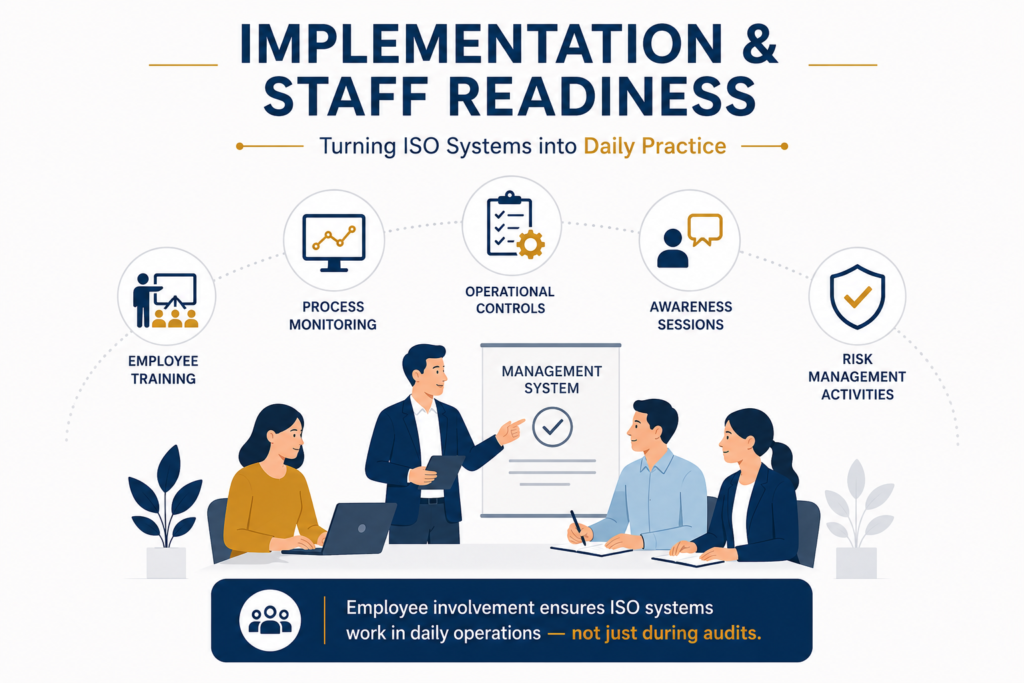
| Lack of employee awareness | Staff do not follow procedures correctly, causing implementation gaps | Train employees so they understand their roles, procedures, and quality responsibilities |
| Ignoring internal audits | Problems remain hidden until the certification audit | Conduct internal audits regularly to identify and fix gaps early |
| Weak management involvement | Poor direction, low accountability, and ineffective system performance | Ensure top management actively supports, reviews, and improves the system |
| Poor document control | Outdated documents, version confusion, and incorrect use of procedures | Use proper document control for approval, revision, access, and updates |
| Treating certification as a one-time task | Short-term compliance without long-term improvement | Treat ISO certification as an ongoing system for control, improvement, and business growth |
Why Is Guardian Middle East LLC a Trusted Partner for ISO Certification in Qatar?
Guardian Middle East LLC supports businesses in Qatar with local coordination, major ISO standard support, QS-recognized positioning, and internationally recognized accreditation-backed certification structures.
Choosing the right certification partner matters because businesses today are not only looking for a certificate. They are looking for credibility, local support, and a process they can trust.
Guardian Middle East LLC supports businesses in Qatar with practical certification guidance, local coordination, and internationally recognized certification structures. This helps organizations move through the certification process with more clarity and confidence.
Local Presence in Qatar
Guardian Middle East LLC has a local presence in Doha, which makes coordination easier for businesses operating in Qatar. This is especially useful for companies that need support with audit planning, documentation reviews, site coordination, and certification timelines.
For businesses handling active projects, tenders, or multiple locations, local support can make the process faster and more manageable.
Support Across Major ISO Standards
Guardian Middle East LLC supports certification across major ISO management system standards, including:
- ISO 9001 — Quality Management Systems
- ISO 14001 — Environmental Management Systems
- ISO 45001 — Occupational Health & Safety Management Systems
- ISO 21001 — Educational Organizations Management Systems
- ISO 27001 — Information Security Management Systems
- ISO 37001 — Anti-Bribery Management Systems
This is valuable for businesses that need one certification or multiple standards together, depending on their industry, client expectations, and tender requirements.
QS-Approved Positioning
- Guardian Middle East LLC operates through a QS-recognized structure in Qatar.
- According to the official recognition information published by Guardian Middle East LLC Recognition Page, the organization is registered with the Qatar General Organisation for Standardisation (QS).
- The registration is under Qatar Ministerial Decree No. 363/2018.
- QS Registration Number: RB066-26
- QFC Registration: QFC 03870
This is important for businesses that want certification support with stronger local regulatory credibility, especially when dealing with tenders, supplier approvals, and government-linked work. In competitive sectors, this kind of local recognition helps build confidence in the certification process.
Internationally Recognized Accreditation Support
Guardian Middle East LLC, based in Doha, represents Guardian Assessment UK Ltd, a United Kingdom-based certification body, with certification support recognized by:
- UAF (United Accreditation Foundation)
- IAS (International Accreditation Service, USA)
This gives businesses stronger trust, better certificate acceptance, and more confidence when working with clients, procurement teams, and international partners.
Key Takeaways
- ISO certification in Qatar helps businesses improve credibility, process control, and tender readiness.
- Common standards include ISO 9001, ISO 14001, ISO 45001, ISO 27001, ISO 21001, and ISO 37001.
- Businesses in Qatar use ISO certification to strengthen trust, compliance, and operational consistency.
- Indian companies operating in or supplying to Qatar should align certification scope with actual Qatar-based operations.
- Local certification coordination in Qatar can make audits, implementation, and client approvals easier.
Start Your ISO Certification Journey in Qatar with Confidence
If your business is planning to get ISO certified in Qatar, the right support can make the process much easier. ISO certification can help you improve your internal systems, build more trust with clients, support tender participation, and strengthen your business in a competitive market.
At Guardian Middle East LLC, we support businesses in Qatar with practical guidance, local coordination, and certification support across major ISO standards. With our presence in Doha, QS-recognized positioning, and internationally recognized accreditation-backed structure, we help make the certification process clearer, smoother, and more manageable for your team.
Whether you are a company based in Qatar, an Indian business working in the GCC, or an international business expanding into the region, we can help you move forward with the right ISO certification approach for your business needs.
Contact Guardian Middle East LLC (Doha) | Serving the Middle East
- Location: Abo Hamour Area, Doha, Qatar
- P.O. Box: 23277, Doha, Qatar
- Mobile: +974 7770 2602 | +974 7213 7770
- Email: info@guardian.qa
- Website: www.guardian.qa
Frequently Asked Questions
Will an ISO certificate from India be enough for clients in Qatar?
Not always. Many clients in Qatar also check whether the certification scope, implementation, and operational coverage match the work being done locally.
Why do Indian businesses need local certification support in Qatar?
Local support helps with audit planning, site coordination, documentation reviews, tender timelines, and client expectations in Qatar. This is especially useful when the head office is in India but operations are in Qatar.
Which ISO standard is most useful for Indian companies working in Qatar?
It depends on the business type. ISO 9001 is common for quality management, ISO 45001 for health and safety, ISO 14001 for environmental management, ISO 27001 for information security, ISO 21001 for educational organisations, and ISO 37001 for anti-bribery management.
Can ISO certification help Indian exporters supply to Qatar more easily?
Yes. ISO certification can improve supplier credibility, support vendor registration, and strengthen trust during procurement reviews in Qatar.
Do Indian contractors need ISO certification before working on projects in Qatar?
In many cases, yes. ISO certification can become important during vendor approvals, subcontractor evaluations, prequalification, and tender participation, especially in construction, engineering, oil and gas, and facility management.
What do Qatari clients usually check before accepting an Indian supplier’s ISO certification?
They often check the certification scope, relevance to the business activity, implementation quality, certification body credibility, and whether the system matches the actual work being done in Qatar.
What is the biggest mistake Indian companies make when trying to use ISO certification in Qatar?
One common mistake is assuming that a certificate built only around domestic operations in India will automatically meet all client requirements in Qatar. In practice, local scope, implementation, and coordination matter a lot.
Can an India-based headquarters manage Qatar certification remotely?
It can manage part of the process remotely, but full remote handling is not always enough. Qatar operations often need local coordination for audits, site coverage, documentation checks, and client-facing requirements.
How can Indian businesses choose the right ISO certification support for Qatar?
They should look for local support in Qatar, relevant ISO standard experience, clear audit coordination, recognized certification structures, and a process that matches both India-based management and Qatar-based operations.
Comments are closed