

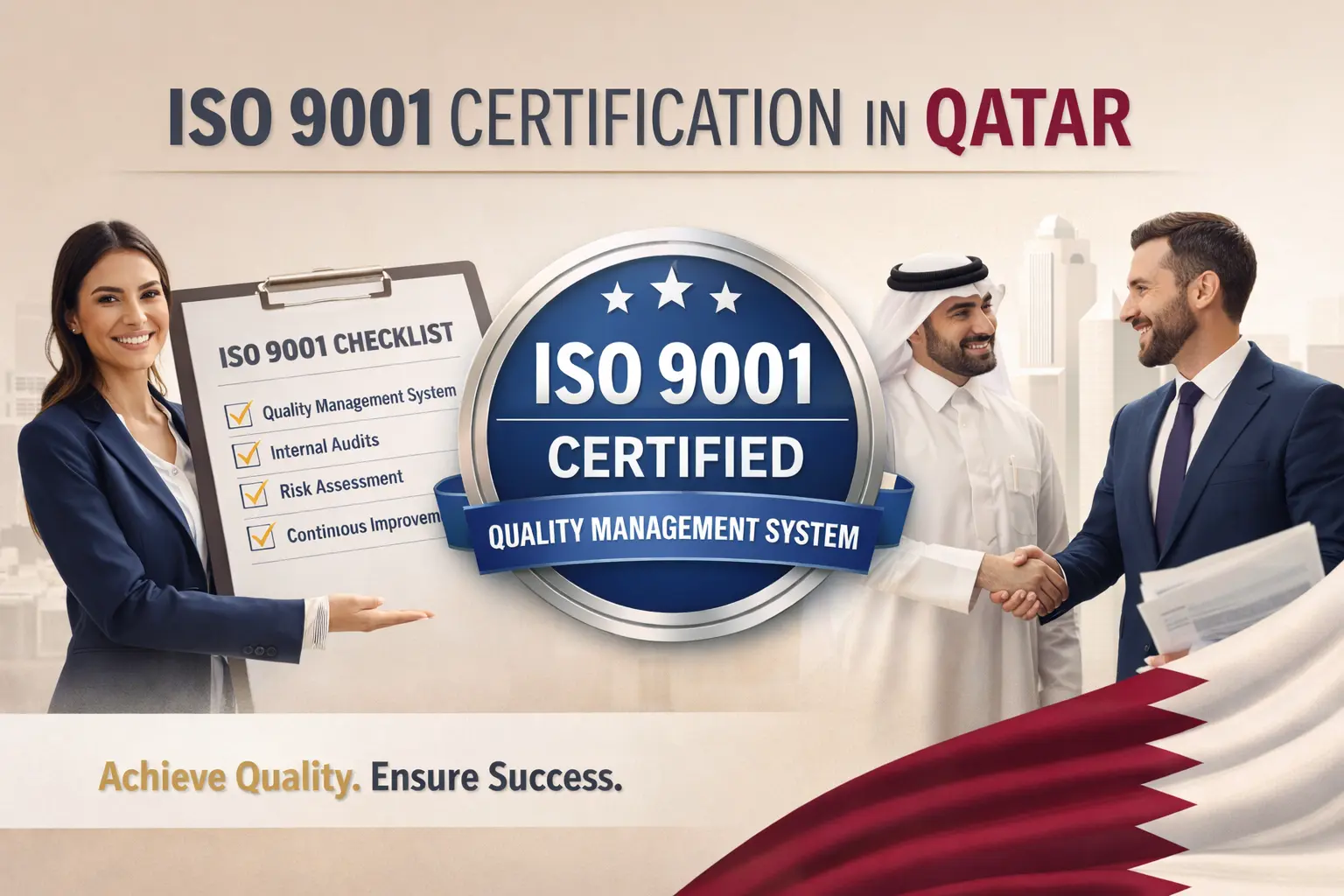
What Are ISO 9001 Requirements?
ISO 9001 requirements are a set of internationally recognized guidelines that help organizations establish a structured Quality Management System (QMS). These requirements ensure consistent operations, improved quality, and continuous business improvement across all processes, especially for businesses pursuing ISO 9001 Certification in Qatar.
Understanding ISO 9001 Requirements: What Most Businesses Get Wrong
Many organizations approach ISO 9001 Certification in Qatar as a documentation exercise. They believe creating a few policies and procedures is enough to achieve compliance.
In reality, ISO 9001 is about how your business operates daily—not just what is written on paper.
The most common mistake businesses make is focusing only on “getting certified” instead of building a system that genuinely improves quality and performance while preparing for ISO 9001 Certification in Qatar.
In Practice
A service company implemented ISO 9001 by copying templates without aligning them to real processes. During the audit, employees were unaware of procedures, leading to non-conformities.
Key Insight
Organizations that focus on actual process improvement—not just certification—experience 20–30% efficiency gains and significantly better audit outcomes when pursuing ISO 9001 Certification in Qatar.
According to industry audit observations, most non-conformities occur due to poor implementation rather than lack of documentation, highlighting the importance of practical execution.
The Complete ISO 9001 Requirements Checklist (2026)
To meet ISO 9001 requirements and successfully achieve ISO 9001 Certification in Qatar, your organization must establish a structured Quality Management System (QMS) that covers all core business functions.
Core ISO 9001 Checklist
- Define organizational context and stakeholder expectations
- Establish a quality policy and measurable objectives
- Implement risk-based thinking across processes
- Ensure employee competence and training
- Maintain documented information (procedures and records)
- Control operational processes
- Monitor and measure performance (KPIs)
- Conduct internal audits
- Implement corrective actions and continuous improvement
This checklist forms the foundation of ISO 9001 compliance and ensures your organization operates consistently and efficiently while preparing for ISO 9001 Certification in Qatar.
In Practice
A logistics company aligned its processes with these requirements and reduced delivery delays by standardizing workflows and monitoring performance metrics.
ISO 9001 Requirements Summary (Quick Recap)
If you want a quick overview, ISO 9001 requirements focus on five core areas essential for ISO 9001 Certification in Qatar:
- Defining clear processes and responsibilities
- Managing risks and opportunities
- Ensuring employee competence and awareness
- Monitoring performance and conducting audits
- Continuously improving business operations
This summary helps businesses quickly understand what auditors look for during certification.
ISO 9001 Certification Readiness Checklist (2026)
Assess Your Organization Before the Audit
Want a practical way to apply these ISO 9001 requirements in your organization?
Download our ISO 9001 Certification Readiness Checklist (2026) to assess your current system and identify gaps before your audit for ISO 9001 Certification in Qatar.
Why Use This Checklist?
To help you implement these requirements effectively, we’ve created a structured checklist that you can use internally to:
- Evaluate your current quality management system
- Identify gaps before the certification audit
- Ensure compliance with ISO 9001 requirements
- Improve overall process efficiency
Download Your Free Checklist
👉 Download the ISO 9001 Certification Readiness Checklist (Free PDF)
ISO 9001 Clauses Explained (Simplified for Practical Use)
ISO 9001 is structured into clauses that guide how a QMS should be implemented in real business environments, especially for organizations targeting ISO 9001 Certification in Qatar.
Clause 4: Context of the Organization
You must understand:
- Internal and external factors affecting your business
- Needs of customers and stakeholders
In Practice:
A construction company identified regulatory risks and supplier dependencies, improving project planning accuracy.
Clause 5: Leadership and Commitment
Top management must:
- Define the quality policy
- Ensure accountability
- Promote a quality-driven culture
Key Insight:
Strong leadership involvement leads to up to 40% higher implementation success rates in ISO 9001 Certification in Qatar.
Clause 6: Planning
Focus areas include:
- Risk identification and mitigation
- Setting measurable quality objectives
In Practice:
A manufacturing firm identified production bottlenecks and introduced preventive measures, reducing downtime.
Clause 7: Support
Includes:
- Resources
- Training
- Documentation
In Practice:
Employee training on SOPs improved process consistency and reduced operational errors.
Clause 8: Operation
Ensures:
- Controlled processes
- Consistent product or service delivery
Key Insight:
Process standardization can reduce defects by 20–25%.
Clause 9: Performance Evaluation
Organizations must:
- Monitor KPIs
- Conduct internal audits
In Practice:
Tracking customer complaints helped identify service gaps and improve satisfaction.
Clause 10: Improvement
Focus on:
- Corrective actions
- Continuous improvement
Key Insight:
Continuous improvement leads to long-term cost savings and operational stability.
According to certification body insights, organizations that actively track improvements achieve stronger audit performance and long-term system effectiveness.
ISO 9001 Documentation Checklist (Must-Have Documents)
Documentation is a critical part of ISO 9001 compliance and ISO 9001 Certification in Qatar.
Essential Documents Include:
- Quality policy
- Quality objectives
- Scope of QMS
- Process procedures (SOPs)
- Risk assessment records
- Training and competency records
- Internal audit reports
- Corrective action records
In Practice
Organizations with well-structured documentation pass audits faster and reduce rework during certification.
Common ISO 9001 Compliance Gaps (And How to Avoid Them)
Even well-prepared organizations face challenges during ISO 9001 Certification in Qatar.
Common Gaps:
- Poor documentation control
- Lack of employee awareness
- Inconsistent process implementation
- Weak internal audits
In Practice
A company failed its first audit because employees were not following procedures—even though documentation was complete.
Key Insight
Over 60% of audit non-conformities are linked to poor implementation—not missing documents.
How to Prepare for an ISO 9001 Audit (Step-by-Step)
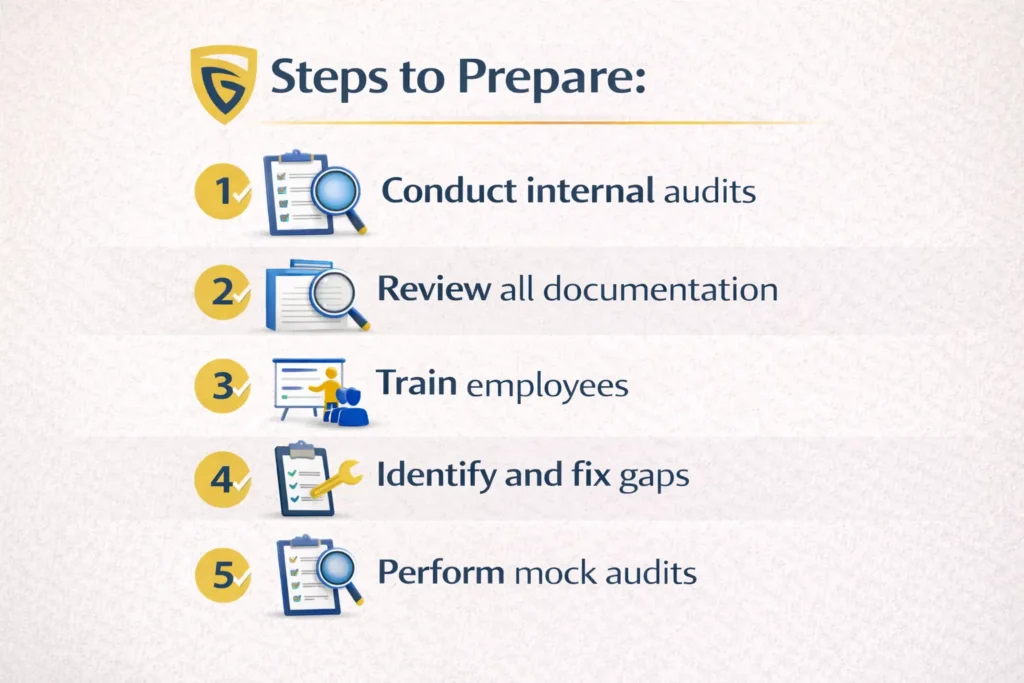
Audit preparation is critical for successful ISO 9001 Certification in Qatar.
In Practice
Organizations that conduct mock audits significantly reduce audit findings.
Key Insight
Pre-audit preparation can improve success rates by 30–40%.
ISO 9001 Self-Assessment Checklist: Are You Ready?
Use this quick checklist to evaluate your readiness for ISO 9001 Certification in Qatar:
- Do you have clearly defined processes?
- Are employees aware of procedures?
- Are risks identified and managed?
- Is performance monitored regularly?
- Are improvements documented?
If most answers are “yes,” your organization is on the right track.
In Practice
Companies using self-assessment tools identify gaps early and avoid certification delays.
Real-World Example: ISO 9001 Implementation Success
Case Study: Manufacturing Company
A mid-sized manufacturing firm struggled with defects and inconsistent quality while preparing for ISO 9001 Certification in Qatar.
Implementation Steps:
- Standardized processes
- Introduced risk-based planning
- Trained employees
- Implemented internal audits
Results:
- Defects reduced by 25%
- Delivery performance improved by 30%
- Customer complaints decreased significantly
Key Insight
Organizations that integrate ISO 9001 into daily operations achieve measurable improvements within the first year.
Final Thoughts: Turning ISO 9001 Requirements into Business Advantage
ISO 9001 is more than a compliance checklist—it is a strategic framework for improving how your business operates and achieving ISO 9001 Certification in Qatar successfully.
Organizations that implement ISO 9001 effectively benefit from:
- Improved efficiency
- Higher customer satisfaction
- Stronger market credibility
- Better decision-making
The real value of ISO 9001 lies not in achieving certification, but in using the system to continuously improve, adapt to change, and scale your business sustainably in competitive markets.
Need Expert Support for ISO 9001 Implementation in Qatar?
How Guardian Middle East Supports Your ISO 9001 Implementation in Qatar
After understanding the ISO 9001 requirements and checklist, the next step is choosing a partner who can turn that knowledge into real results—and help you move smoothly toward ISO 9001 Certification in Qatar.
Guardian Middle East LLC supports companies in Qatar with ISO 9001 certification by simplifying the entire process for you. We help you interpret requirements clearly, prepare audit-ready documentation, implement the Quality Management System (QMS) in your daily operations, and ensure you are fully prepared for certification audits—without confusion or delays.
As an exclusive representative of Guardian Assessment Pvt. Ltd., India — accredited by the United Accreditation Foundation (UAF) and International Accreditation Service (IAS, USA), we provide a structured and reliable certification pathway. Being based in Doha, we also understand local procurement processes, tender requirements, and client audit expectations—giving your business a practical advantage.
Ready to Strengthen Your Business with ISO 9001?
ISO 9001 is not just a checklist—it’s a system that improves efficiency, builds trust, and positions your business for long-term success.
If your goal is to reduce operational gaps, improve performance, and successfully achieve ISO 9001 Certification in Qatar, the right guidance can make all the difference.
Don’t wait until the audit stage to fix issues. Start now with a clear, structured approach and expert support.
Get in Touch
- Located in: Doha, Qatar | Serving the Middle East
- Mobile: +974 7770 2602 | +974 7213 7770
- Email: info@guardian.qa
- Website: www.guardian.qa
Contact us today to discuss your requirements and take the next step toward ISO 9001 certification with confidence.
Frequently Asked Questions
1. What are the main requirements of ISO 9001?
ISO 9001 requires organizations to establish a Quality Management System (QMS) that includes defined processes, risk management, employee competence, performance monitoring, internal audits, and continuous improvement practices.
2. What is included in an ISO 9001 checklist?
An ISO 9001 checklist typically includes organizational context, quality objectives, risk assessment, documented procedures, operational controls, internal audits, and corrective actions to ensure full compliance.
3. How do I prepare for an ISO 9001 audit?
To prepare for an ISO 9001 audit, organizations should conduct internal audits, review documentation, train employees, identify gaps, and perform mock audits to ensure all processes are effectively implemented.
4. What documents are required for ISO 9001 certification?
Key documents include a quality policy, quality objectives, scope of QMS, standard operating procedures (SOPs), risk assessment records, training records, internal audit reports, and corrective action reports.
5. How long does it take to get ISO 9001 certification?
The certification timeline usually ranges from 1 to 6 months, depending on the organization’s size, complexity, and level of preparedness before the audit.
6. What are the most common ISO 9001 audit findings?
Common audit findings include poor process implementation, lack of employee awareness, incomplete documentation control, and ineffective internal audits.
7. Is ISO 9001 certification mandatory for businesses?
No, ISO 9001 certification is not legally mandatory, but it is often required for tenders, contracts, and improving credibility in competitive markets.
8. How does ISO 9001 improve business performance?
ISO 9001 improves performance by standardizing processes, reducing errors, increasing efficiency, improving customer satisfaction, and enabling data-driven decision-making.
9. What is the difference between ISO 9001 requirements and certification?
ISO 9001 requirements define what a company must implement, while certification is the formal recognition given after a successful audit by an accredited certification body.
10. Can small businesses implement ISO 9001 easily?
Yes, small businesses can implement ISO 9001 effectively by simplifying processes, focusing on core operations, and using structured checklists to ensure compliance without unnecessary complexity.
Comments are closed