


Many organizations across the Gulf still treat data protection as a single regional exercise. That approach creates real risk when Qatar’s Personal Data Privacy Protection Law comes into play.
Law No. 13 of 2016, known as the PDPPL, is enforced by the National Cybersecurity Agency (NCSA). It applies to the personal data of individuals residing in Qatar and carries specific operational demands that differ from both the GDPR and other GCC frameworks. The requirements around consent, data subject rights, security precautions, and cross-border data handling mean that companies serving Qatari customers or processing personal data in Qatar cannot simply assume that an existing GDPR or regional privacy programme will meet every PDPPL requirement.
As an ISO certification body that has worked with organizations on information security and privacy management systems for more than decades, we see the same pattern repeatedly: companies discover the gaps only when a subject access request arrives or when a contract requires evidence of compliance. This guide explains what the law actually requires and how to build a practical response.
What the Qatar PDPPL Covers and Who Must Comply
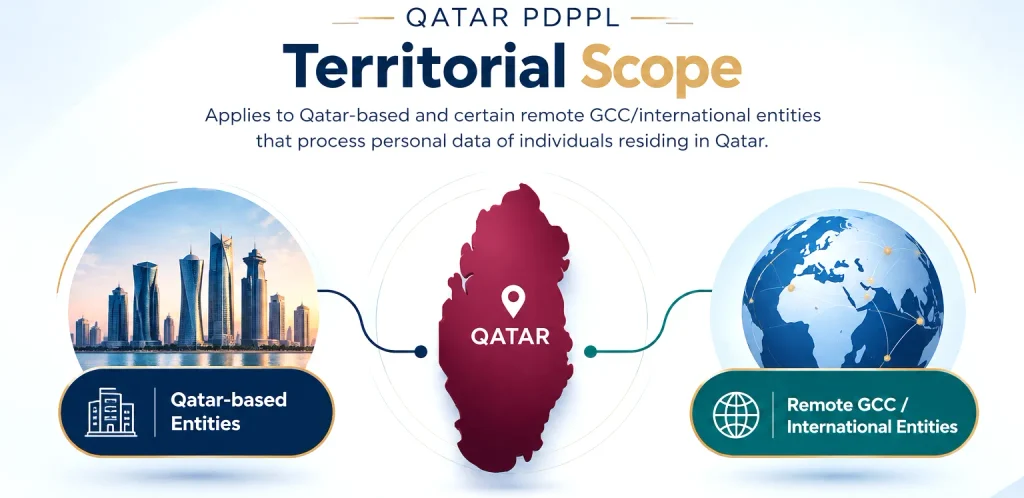
The PDPPL applies to any entity that processes personal data of individuals residing in Qatar, whether the processing takes place inside or outside the country. The law covers both automated and structured non-automated filing systems.
This extraterritorial scope is important. A company headquartered in Dubai, Riyadh or further afield can still fall under the PDPPL if it offers goods or services to people in Qatar or monitors their behaviour there. Qatar-based organizations face additional formal requirements, including registration with the NCSA and, in certain cases, the appointment of a data protection officer under the 2021 Regulatory Framework.
Processing that is truly anonymized and irreversible falls outside the law. In practice, however, many data sets that organizations consider anonymized still allow re-identification and therefore remain in scope.
Core Obligations That Drive Day-to-Day Compliance
Four areas create the most operational pressure.
1. Consent and Lawful Basis
Consent is a central requirement under the PDPPL. Article 4 generally requires the individual’s consent before processing personal data, unless the processing is necessary to achieve a lawful purpose. The regulatory framework provides additional context for specific processing situations.
Consent must be freely given, specific, informed, and unambiguous. The 2021 Regulatory Framework introduced limited additional grounds such as contractual necessity and legal obligation, but these remain narrower than the six bases available under the GDPR.
Organizations should treat explicit consent as the default for most processing activities. Pre-ticked boxes and implied acceptance do not meet the standard. Data subjects can withdraw consent at any time, and the organization must be able to stop the related processing.
2. Data Minimisation and Purpose Limitation
Controllers may collect only the personal data that is adequate, relevant and limited to what is necessary for the stated purpose.
Any later use for a different purpose generally requires fresh consent. This creates friction for analytics, marketing and AI training activities that rely on secondary use of customer data.
3. Data Subject Rights and the 30-Day Response Period
Qatar’s PDPPL gives individuals several rights concerning their personal data, including the ability to:
- Withdraw consent.
- Object to certain processing.
- Request deletion or correction.
- Access their personal data.
The law also requires controllers to establish internal systems for receiving and handling complaints and requests relating to access, correction and deletion.
The NCSA’s Individuals’ Rights Guidelines state that controllers should respond to individual rights requests within 30 calendar days. Organizations therefore need practical procedures for:
- Receiving requests.
- Verifying the individual’s identity.
- Locating relevant personal data.
- Coordinating with processors.
- Documenting the response.
This makes data mapping and clear internal ownership important. A privacy policy alone is not enough if an organisation cannot identify where an individual’s personal data is stored or establish who is responsible for responding to the request.
4. Security Precautions
The law requires appropriate administrative, technical and financial precautions to protect personal data. These measures must be proportionate to the risk and must be maintained over time.
Qatar PDPPL vs GDPR – Key Operational Differences
Although the two regimes share similar goals, the operational differences matter for any organisation that operates under both.
| Requirement | Qatar PDPPL | GDPR | Practical Impact for GCC Teams |
| Primary lawful basis | Consent, with limited alternatives | Six bases including legitimate interest | Higher reliance on consent and careful assessment of applicable lawful grounds |
| Subject access response time | 30 calendar days | 1 month, generally extendable in certain circumstances | Organisations need a defined process for identifying, reviewing and responding to requests |
| Cross-border transfers | Subject to PDPPL requirements and applicable safeguards | Adequacy, SCCs, BCRs or derogations | Organisations need to assess transfer arrangements and applicable safeguards |
| Maximum fine | Up to QAR 5 million for specified violations | €20 million or 4% of global annual turnover, whichever is higher | Different penalty structures, but both can create material compliance exposure |
| Security measures | Appropriate technical and organisational precautions | Appropriate technical and organisational measures | ISO frameworks provide useful structure for managing security controls |
A GDPR-aligned programme cannot simply be rolled out unchanged in Qatar. Differences in lawful processing requirements, consent practices and operational procedures require specific adjustments for the Qatar context.
How ISO 27001 and ISO/IEC 27701 Support PDPPL Compliance
The PDPPL does not prescribe a particular control framework. It requires appropriate precautions. In practice, organizations that already operate a structured management system adapt more quickly.
ISO/IEC 27001: Information Security Management
ISO/IEC 27001 provides an information security management system that addresses the technical and organisational measures expected under the law, including:
- Access control.
- Encryption.
- Logging.
- Supplier management.
- Incident response.
It creates a documented and auditable foundation for managing information security risks.
ISO/IEC 27701: Privacy Information Management
ISO/IEC 27701 provides a Privacy Information Management System framework for organisations that process personally identifiable information. It adds privacy-focused requirements and processes covering areas such as:
- Consent management.
- Data subject rights.
- Purpose limitation.
- Privacy governance.
- Accountability.
- Personal data processing activities.
These areas can map more closely to the privacy-specific obligations that organizations need to address under the PDPPL.
From the perspective of a certification body, the combination works well. Organisations that hold or are preparing for ISO 27001 certification already have many of the security controls in place. Adding the privacy controls and processes addressed by ISO 27701 gives them a coherent way to demonstrate systematic handling of personal data.
Neither standard replaces the legal work of selecting lawful bases or assessing transfers, but both provide evidence of structured processes that regulators and counterparties value.
Need to assess your organisation’s information security and privacy management systems?
Speak with Guardian’s certification team about ISO/IEC 27001 and ISO/IEC 27701 certification.
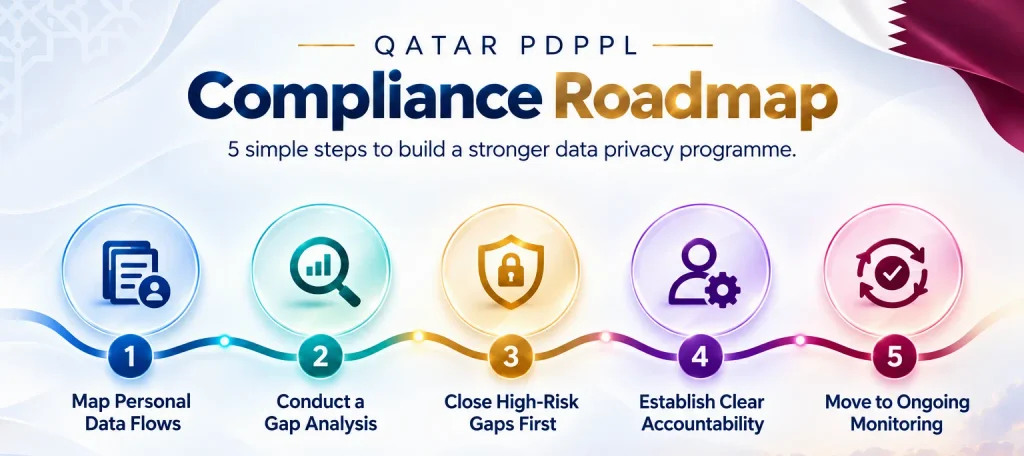
A Step-by-Step Compliance Process That Works
Experience across the region shows that a sequenced approach reduces both risk and wasted effort.
1. Map Personal Data Flows
Identify:
- Collection points.
- Storage locations.
- Processing purposes.
- Third-party sharing.
- Cross-border movements.
Include structured systems and unstructured sources.
2. Conduct a Gap Analysis
Conduct a gap analysis against the PDPPL’s core requirements, including:
- Consent mechanisms.
- Purpose limitation.
- Data subject rights handling.
- Breach notification.
- Transfer safeguards.
- Record-keeping.
3. Close the Highest-Risk Gaps First
These usually involve:
- Redesigning consent processes.
- Establishing a process capable of responding to data subject requests within the applicable 30-calendar-day timeframe.
- Strengthening breach detection and notification.
- Reviewing controls over sensitive data.
4. Establish Clear Accountability
Certain controllers must appoint a data protection officer and register with the NCSA. Even where not mandatory, named ownership improves consistency.
5. Move to Ongoing Monitoring
Annual training, periodic internal reviews and continuous adjustment to new NCSA guidance keep the programme current.
Technical measures such as encryption, access controls and logging support these steps. Organizations that already maintain an ISO 27001 system can reuse many of those controls and evidence.
Cross-Border Transfers, Breach Notification and Penalties
The original 2016 law took a restrictive view of transfers outside Qatar. The 2021 Regulatory Framework provides additional context for international transfers, including the use of adequate protection or appropriate safeguards. Sensitive personal data attracts stricter expectations, and organisations should assess applicable transfer and localisation requirements based on the specific processing activity.
Personal Data Breach Notification
Controllers must assess personal data breaches and determine whether they may cause damage to individuals’ personal data or privacy.
NCSA breach notification guidance states that where a breach could cause damage to individuals’ personal data or privacy, controllers should report it to the relevant authority without delay and within 72 hours of becoming aware of the breach.
Where a breach is likely to cause serious damage to individuals’ personal data or privacy, affected individuals should also be notified without delay and within 72 hours.
Organisations therefore need a documented breach response process that allows them to:
- Detect and assess breaches.
- Contain the incident.
- Assess potential harm to individuals.
- Determine notification requirements.
- Notify the relevant authority within the applicable timeframe.
- Notify affected individuals where required.
- Maintain appropriate records of the incident and response.
Penalties Under the PDPPL
The PDPPL provides different maximum penalties depending on the provisions that have been violated.
| Violation Category | Maximum Penalty Under the Law | Relevant Provision |
| Violations of specified provisions, including consent, internal systems, disclosure, cross-border processing and direct marketing requirements | Up to QAR 1 million | Article 23 |
| Violations relating to specified security precautions and certain special-nature data requirements | Up to QAR 5 m1illion | Article 24 |
| Penalty applicable to a violating legal person where an offence is committed in its name or for its benefit | Up to QAR 1 million | Article 25 |
Financial penalties are only part of the picture. A public finding of non-compliance can affect the ability to win government or regulated-sector contracts in Qatar.
Common Gaps We Still See in GCC Organisations
Three issues appear repeatedly in assessments.
1. Assuming GDPR Compliance Is Enough
Organisations assume that a GDPR programme already satisfies the PDPPL. Differences in lawful processing requirements, consent practices and operational procedures mean that a GDPR programme may require specific adjustments for the Qatar context.
2. Incomplete Data Mapping
Data maps remain incomplete. Without knowing where personal data is stored and processed, organisations can struggle to identify, review and respond to data subject requests within the applicable timeframe or demonstrate that personal data is being handled for appropriate purposes.
3. Security Controls Not Linked to Privacy Processes
Security controls exist on paper but are not linked to privacy processes. An ISO 27001 system that is not appropriately connected to personal-data handling can leave gaps in consent management, data subject rights fulfilment, and privacy accountability.
These gaps are solvable, but they require deliberate attention rather than assumptions.
Not sure where your organisation stands with Qatar PDPPL requirements?
A focused gap analysis can help identify gaps in consent, data mapping, security controls, data subject rights and breach response.
[Request a Compliance Assessment]
Conclusion
The Qatar PDPPL is no longer a new law. Its operational requirements — particularly around consent, individual rights, data security, breach management and data transfers — require organisations to maintain practical processes rather than relying on policy documents alone.
Organisations that treat the PDPPL as a checklist exercise tend to discover problems under pressure. Those that invest in accurate data mapping, workable consent processes, realistic response capabilities and a structured management system are better placed to meet the requirements and demonstrate accountability when asked.
For many GCC businesses, the practical next step is to complete a focused gap analysis against the PDPPL, then decide whether an ISO 27001 foundation and the privacy management framework provided by ISO 27701 can provide the systematic approach the law expects.
The cost of building that foundation in advance remains lower than the cost of remediation after a breach or regulatory inquiry.
Your Partner for Information Security & Privacy Certification
Guardian Middle East LLC represents Guardian Assessment UK Ltd, a United Kingdom-based certification body recognized by UAF (United Accreditation Foundation) and IAS (International Accreditation Service, USA).
For organizations looking for a structured approach to information security and privacy management, Guardian supports certification services related to ISO/IEC 27001 and ISO/IEC 27701, helping businesses strengthen their management systems and demonstrate a systematic approach to security and privacy requirements.
Guardian Middle East LLC – Contact Details
- Location: Abo-Hamour Area, opposite the Medical Commission, Doha, Qatar
- P.O. Box: 23277, Doha, Qatar
- Mobile: +974 7770 2602 | +974 7213 7770
- Email: info@guardian.qa
- Website: www.guardian.qa
Frequently Asked Questions
2: Who needs to comply with the Qatar PDPPL?
The PDPPL applies to entities that process personal data of individuals residing in Qatar, including organisations processing such data inside or outside Qatar where the law applies.
3: Does the Qatar PDPPL apply to companies outside Qatar?
It can. Organisations outside Qatar may fall within the scope of the PDPPL when they process personal data of individuals residing in Qatar, depending on the nature and circumstances of the processing.
4: How long does an organization have to respond to a data subject rights request in Qatar?
The NCSA Individuals' Rights Guidelines state that controllers should respond to individual rights requests within 30 calendar days.
5: Does ISO 27001 ensure PDPPL compliance?
No. ISO/IEC 27001 does not automatically make an organisation legally compliant with the PDPPL. It provides a structured information security management system that can support the security, risk management, and accountability measures required for effective privacy compliance.
6: How does ISO 27701 support Qatar PDPPL compliance?
ISO/IEC 27701 provides a Privacy Information Management System framework that helps organisations establish structured processes for managing personally identifiable information, privacy responsibilities, data subject rights, and accountability.
7: Does ISO 27701 certification mean an organization is fully compliant with the PDPPL?
No. ISO/IEC 27701 certification does not replace legal assessment of the PDPPL. Organisations still need to assess applicable legal requirements, lawful processing grounds, transfer requirements, and other Qatar-specific obligations.
Comments are closed