
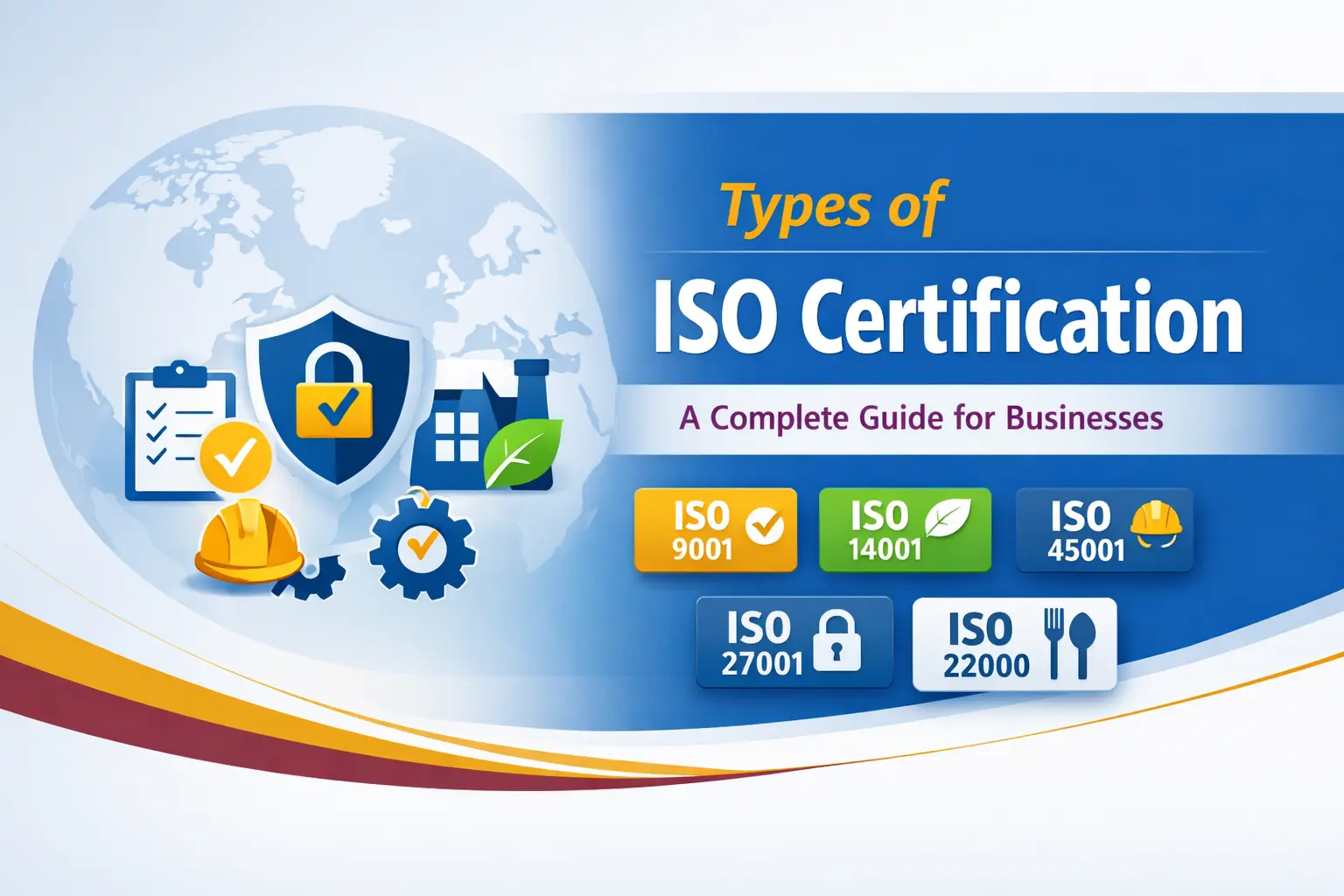
ISO certification helps organizations demonstrate that their management systems meet internationally recognized standards for quality, safety, environmental responsibility, information security, and other critical business areas. With multiple standards available, understanding the different types of ISO certification can help businesses choose the most suitable framework for their industry, operational needs, and long-term objectives.
What Are the Different Types of ISO Certification?
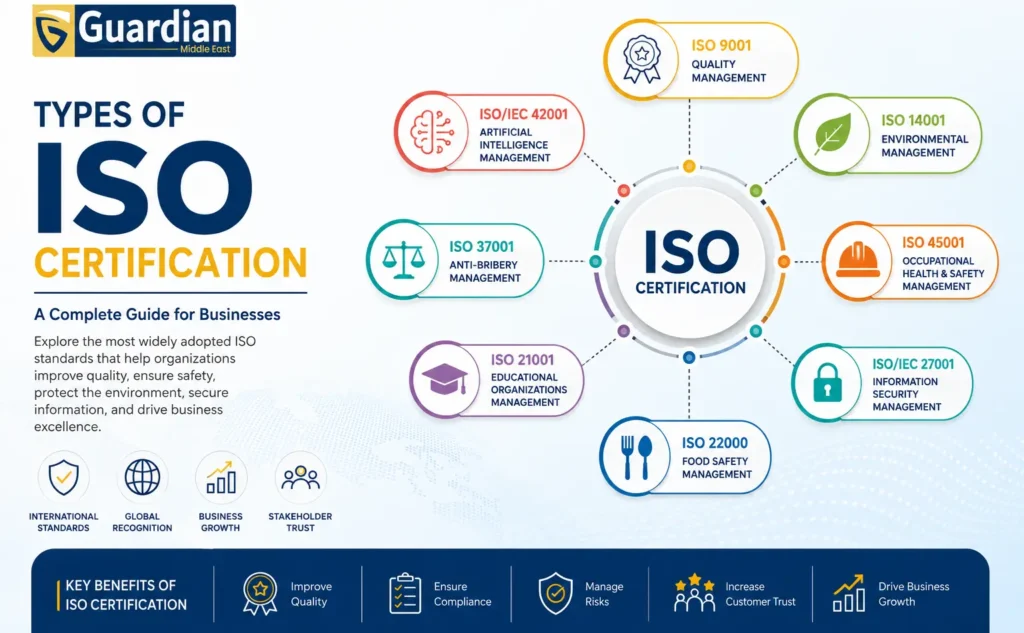
The most common types of ISO certification include ISO 9001 (Quality Management), ISO 14001 (Environmental Management), ISO 45001 (Occupational Health and Safety), ISO/IEC 27001 (Information Security), ISO 22000 (Food Safety), ISO 21001 (Educational Organizations Management), ISO 37001 (Anti-Bribery), and ISO/IEC 42001 (Artificial Intelligence Management). Each standard is designed to address a specific business challenge, and organizations may implement one or multiple standards depending on their requirements.
What Is ISO Certification?
ISO (International Organization for Standardization) is an independent, non-governmental international body that develops and publishes standards. These standards define best practices for management systems, products, processes, and services.
When a business achieves ISO certification, it means an accredited, independent certification body has audited the organisation and confirmed it meets the requirements of a specific ISO standard.
Key Points:
- Certification provides external verification
- It ensures credibility and global recognition
- Applicable to any organisation, regardless of size, industry, or country
Choosing the right type of ISO certification depends on:
- Industry sector
- Customer expectations
- Regulatory requirements
- Business goals
Why Businesses Pursue ISO Certification
Organizations pursue ISO certification for a variety of reasons beyond simple compliance.
Common objectives include:
- Improving operational efficiency
- Enhancing customer satisfaction
- Strengthening risk management
- Qualifying for tenders and contracts
- Demonstrating regulatory compliance
- Improving brand reputation
- Supporting business growth and expansion
- Creating a culture of continual improvement
For many organizations in Qatar and across the Middle East, ISO certification has become an important requirement for participating in major projects, government tenders, and international business opportunities.
Most Popular Types of ISO Certification
The table below provides a quick overview of the most widely adopted ISO standards.
| ISO Standard | Focus Area | Best For |
|---|---|---|
| ISO 9001 | Quality Management | All industries |
| ISO 14001 | Environmental Management | Manufacturing, Construction |
| ISO 45001 | Occupational Health & Safety | Construction, Oil & Gas |
| ISO/IEC 27001 | Information Security | IT, Finance, Healthcare |
| ISO 22000 | Food Safety | Food Industry |
| ISO 21001 | Education Management | Schools and Universities |
| ISO 37001 | Anti-Bribery Management | Government Contractors |
| ISO/IEC 42001 | Artificial Intelligence Management | Technology Organizations |
Need Help Choosing the Right ISO Certification?
Guardian Middle East LLC helps organizations in Qatar and the Middle East choose the right ISO standard for their needs.
👉 Contact our team today for expert guidance.
The Main Types of ISO Certification
Below is an overview of the most widely adopted standards and how different Types of ISO Certification support businesses across industries.
ISO 9001:2015 — Quality Management System (QMS)
ISO 9001 is the most widely adopted quality standard in the world. Among the different Types of ISO Certification, it is considered the foundation for operational consistency and customer satisfaction.
It provides a framework for delivering products and services that consistently meet customer expectations and regulatory requirements.
Best For
- Manufacturing
- Construction
- Healthcare
- Professional services
- Retail
- Logistics
- Almost any industry sector
Key Benefits
- Improved operational consistency
- Enhanced customer satisfaction
- Better process control
- Stronger customer trust
- Increased eligibility for quality-focused tenders
ISO 14001:2015 — Environmental Management System (EMS)
ISO 14001 focuses on environmental performance. It helps organizations manage environmental responsibilities systematically and reduce environmental risks.
Many environmentally focused Types of ISO Certification are becoming increasingly important in regions prioritising sustainability goals.
Best For
- Construction
- Oil and gas
- Manufacturing
- Logistics
- Utilities
Key Benefits
- Improved environmental performance
- Reduced environmental risks
- Better regulatory compliance
- Enhanced sustainability reputation
- More efficient resource utilization
ISO 45001:2018 — Occupational Health and Safety Management System
ISO 45001 provides a framework for identifying hazards and reducing workplace risks. It strengthens leadership involvement and worker participation in safety systems.
Safety-focused Types of ISO Certification, like ISO 45001, are especially important in high-risk industries.
Best For
- Oil and gas
- Construction
- Manufacturing
- Mining
- Transportation
Key Benefits
- Reduced workplace incidents
- Improved safety culture
- Better legal compliance
- Enhanced employee confidence
- Lower operational disruptions
ISO/IEC 27001:2022 — Information Security Management System
ISO/IEC 27001 addresses information security and cyber risk. It ensures that sensitive company and customer information is protected through structured controls.
Among modern Types of ISO Certification, this standard has become critical due to rising cybersecurity threats and data privacy expectations.
Best For
- IT services
- Financial institutions
- Healthcare organizations
- Telecommunications providers
- E-commerce businesses
Key Benefits
- Reduced cybersecurity risks
- Improved data protection
- Enhanced customer confidence
- Better compliance with security requirements
- Stronger business resilience
ISO 22000:2018 — Food Safety Management System
ISO 22000 applies to organizations across the food chain. It integrates food safety principles with a structured management system control.
Sector-specific Types of ISO Certification, like ISO 22000, are essential where product safety directly impacts consumers.
Best For
- Food manufacturers
- Restaurants
- Hotels
- Catering companies
- Food importers and distributors
Key Benefits
- Stronger food safety controls
- Improved customer trust
- Better regulatory compliance
- Enhanced market acceptance
- Reduced food safety risks
ISO 21001:2018 — Educational Organisations Management System
ISO 21001 is designed specifically for educational institutions. It focuses on improving learning outcomes, learner satisfaction, and institutional performance.
This is one of the specialised Types of ISO Certification tailored to a specific sector.
Best For
- Schools
- Universities
- Colleges
- Training centers
- Educational institutions
Key Benefits
- Improved educational quality
- Enhanced learner satisfaction
- Better institutional performance
- Stronger credibility and reputation
ISO 37001:2016 — Anti-Bribery Management System
ISO 37001 helps organizations prevent and manage bribery risks. It supports stronger governance and ethical business practices.
Governance-related Types of ISO Certification, like this, are especially relevant for companies involved in public procurement or international contracts.
Best For
- Construction companies
- Government contractors
- Financial organizations
- Real estate businesses
- Multinational corporations
Key Benefits
- Reduced legal and compliance risks
- Improved corporate governance
- Enhanced stakeholder confidence
- Stronger ethical culture
ISO/IEC 42001:2023 — Artificial Intelligence Management System
ISO/IEC 42001 is the first international AI management standard. It provides a framework for responsible AI development and deployment.
Emerging Types of ISO Certification, such as this, help organizations align with evolving regulatory and ethical expectations in technology.
Best For
- Technology companies
- AI developers
- Software providers
- Digital transformation projects
Key Benefits
- Demonstrates responsible AI governance
- Supports regulatory readiness
- Enhances transparency and accountability
- Builds stakeholder trust
Integrated Management Systems
Many organisations choose to combine multiple standards into one unified management system. Because several Types of ISO Certification share a common structure, they can be implemented and audited together efficiently.
Common Combinations:
- ISO 9001 + ISO 14001 + ISO 45001
- ISO 9001 + ISO/IEC 27001
- ISO 9001 + ISO 22000
Benefits of Integration
- Reduced duplication of processes
- Improved operational efficiency
- Simplified documentation
- Better resource utilization
- Stronger management control
- Lower audit costs
How to Choose the Right ISO Standard
Selecting the right ISO certification depends on your organization’s priorities, industry requirements, and business goals.
Key Considerations
- Industry sector
- Customer expectations
- Regulatory obligations
- Strategic objectives
- Operational risks
- Market requirements
Final Thoughts
The various types of ISO certification help organizations improve quality, safety, environmental performance, information security, governance, and operational effectiveness.
While ISO 9001 remains the most widely adopted standard worldwide, many organizations now combine multiple certifications to meet customer expectations, regulatory requirements, and strategic growth objectives.
The right certification depends on your industry, operational risks, customer requirements, and long-term business goals. Whether your focus is quality, environmental responsibility, workplace safety, information security, food safety, or emerging technologies such as artificial intelligence, there is an ISO standard designed to support your objectives.
At Guardian Middle East LLC, we help organizations across Qatar and the Middle East identify, implement, and achieve the most suitable ISO certifications for their business needs.
As the regional representative of Guardian Assessment UK Ltd., a United Kingdom-based accredited ISO certification body recognized by:
- UAF (United Accreditation Foundation)
- IAS (International Accreditation Service, USA)
Contact Guardian Middle East LLC
If you are evaluating the different types of ISO certification and would like guidance on selecting the most suitable standard for your organization, our team can help.
Guardian Middle East LLC | Serving Qatar and the Middle East
Location: Abo Hamour Area, Doha, Qatar
P.O. Box: 23277, Doha, Qatar
Mobile: +974 7770 2602 | +974 7213 7770
Email: info@guardian.qa
Website: www.guardian.qa
Whether you are pursuing ISO 9001, ISO 14001, ISO 45001, ISO/IEC 27001, ISO 22000, ISO 37001, ISO 21001, or ISO/IEC 42001, our experts can help you understand the requirements, prepare for certification, and implement a management system that delivers measurable business value.
Ready to take the next step? Contact Guardian Middle East LLC today to discuss your certification goals and discover the ISO standard that best supports your organization’s growth, compliance, and long-term success.
Frequently Asked Questions
2. What is the most widely used ISO certification?
ISO 9001:2015 is the most widely adopted ISO standard globally. It focuses on quality management and can be implemented by organizations of any size and industry to improve customer satisfaction and operational efficiency.
3. Can a company have more than one ISO certification?
Yes. Many organizations implement multiple ISO standards through an Integrated Management System (IMS). Common combinations include ISO 9001, ISO 14001, and ISO 45001, allowing businesses to manage quality, environmental performance, and workplace safety within a single framework.
4. Is ISO certification mandatory?
ISO certification is generally voluntary. However, some industries, government contracts, tenders, customers, and regulatory bodies may require specific ISO certifications as part of their qualification or compliance requirements.
5. How long does it take to get ISO certified?
The certification timeline depends on factors such as organization size, complexity, existing processes, and the chosen standard. Small businesses may achieve certification within a few months, while larger organizations may require a longer implementation period.
6. Which ISO certification is best for information security?
ISO/IEC 27001 is the internationally recognized standard for Information Security Management Systems (ISMS). It helps organizations identify, manage, and reduce information security and cybersecurity risks while protecting sensitive data.
7. What is the difference between ISO 9001 and ISO 14001?
ISO 9001 focuses on quality management and customer satisfaction, while ISO 14001 focuses on environmental management and reducing environmental impact. Organizations often implement both standards together to improve overall business performance and sustainability.
8. Which ISO certification is suitable for food businesses?
ISO 22000 is specifically designed for organizations involved in the food supply chain, including food manufacturers, restaurants, hotels, catering companies, and food distributors. It helps ensure food safety and regulatory compliance.
9. How often does an ISO certification need to be renewed?
Most ISO certifications are valid for three years. During this period, organizations typically undergo annual surveillance audits to ensure continued compliance. A recertification audit is conducted before the certificate expires.
10. What are the benefits of implementing multiple ISO standards?
Implementing multiple ISO standards can help organizations improve efficiency, reduce duplication, strengthen risk management, simplify compliance efforts, and enhance credibility with customers and stakeholders. Integrated management systems often provide greater long-term value than implementing individual standards separately.
11. How do I choose the right ISO certification in Qatar?
Organizations in Qatar should consider their industry requirements, customer expectations, regulatory obligations, operational risks, and strategic goals when selecting an ISO standard. Consulting with an experienced certification provider can help identify the most suitable certification pathway and implementation approach
Comments are closed