

ISO 14001 is not satisfied by having an environmental policy and a few records. ISO 14001:2026 expects a functioning Environmental Management System (EMS) that identifies environmental responsibilities, controls significant impacts, evaluates compliance, measures performance, and improves over time.
For a business preparing for certification, the ISO 14001 Certification Requirement is therefore about how environmental management works in practice. ISO published ISO 14001:2026 Certification on 15 April 2026 as the fourth edition; more than 670,000 organizations were certified worldwide according to the 2024 ISO Survey.
What Are ISO 14001 Certification Requirements?
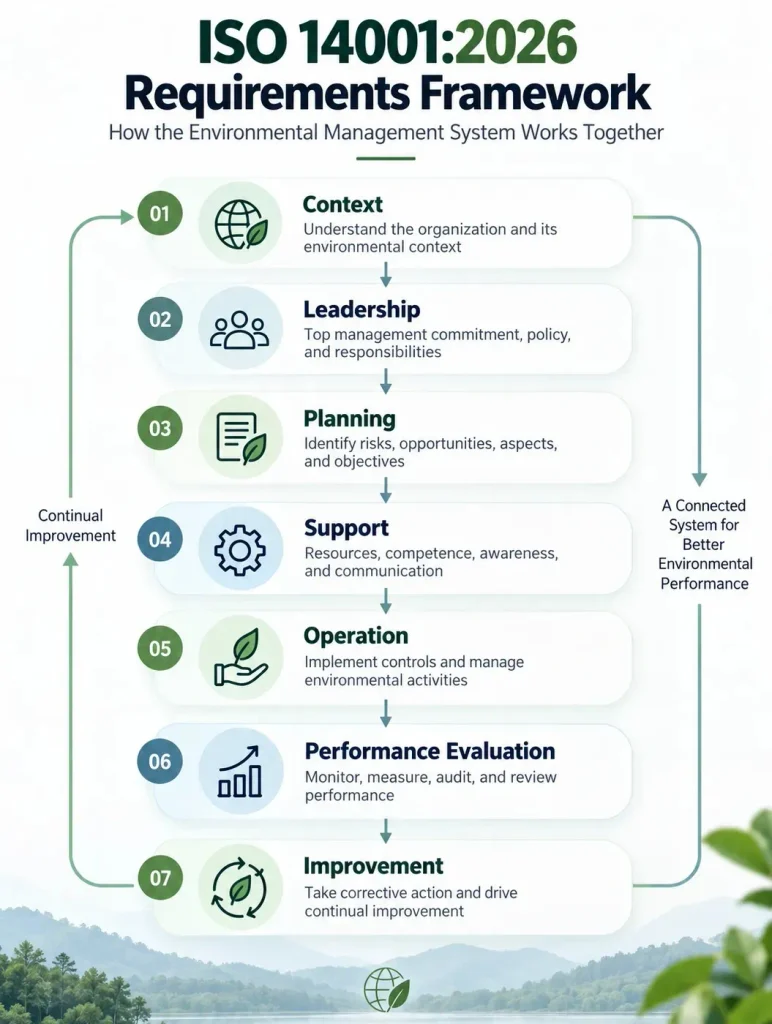
The requirements sit in Clauses 4 to 10: context, leadership, planning, support, operation, performance evaluation, and improvement.
In practical terms, the ISO 14001 certification requirements mean an organization should understand its environmental aspects, compliance obligations, risks and opportunities, operational controls, objectives and results—and manage them as part of normal business activity.
What Is ISO 14001:2026?
ISO 14001:2026 is the current international standard for environmental management systems. An EMS is the part of the management system used to manage environmental aspects, meet compliance obligations, and address risks and opportunities.
Its intended outcomes are straightforward: improve environmental performance, meet compliance obligations, and achieve environmental objectives. The standard can be applied to organizations regardless of their size, type, or nature.
What Changed in ISO 14001:2026?
The 2026 edition keeps the established structure but sharpens several expectations. ISO highlights stronger consideration of environmental conditions such as climate change, biodiversity, pollution, and resource availability, clearer leadership accountability, and a stronger link between environmental actions and measurable outcomes.
It also clarifies planning for change, risks and opportunities, and oversight of externally provided processes, products and services.
ISO 14001 Certification Requirements vs Certification Requirements
These terms are related but different:
- ISO 14001 certification requirements describe what the EMS must meet.
- Certification is independent confirmation that the implemented EMS conforms to those requirements.
ISO states that certification is voluntary and that ISO itself does not certify organizations. Certification may still be requested by customers, tenders, project owners or supply chains.
So, meeting the ISO 14001 Certification Requirement begins with effective implementation; certification is the external confirmation.
What Are the Main ISO 14001:2026 Requirements?
The requirements operate as one connected management system rather than seven separate activities.
| Clause | Main requirement | Practical meaning |
| 4 – Context | Context, interested parties and EMS scope | Know the environmental conditions and stakeholder needs relevant to the business |
| 5 – Leadership | Policy, leadership and responsibilities | Top management owns the EMS and provides direction and resources |
| 6 – Planning | Aspects, obligations, risks, opportunities and objectives | Decide what matters, what applies and what needs action |
| 7 – Support | Resources, competence, communication and information | Give people the capability and information to operate the EMS |
| 8 – Operation | Operational control and emergency preparedness | Control activities that can create significant impacts |
| 9 – Evaluation | Monitoring, compliance evaluation, internal audit and management review | Check whether controls and the EMS are working |
| 10 – Improvement | Corrective action and continual improvement | Fix causes of problems and improve performance |
Clauses 4 and 5 – Context and Leadership
The organization identifies relevant issues, environmental conditions, interested parties and the boundaries of its EMS. Top management then provides policy direction, responsibilities and resources.
Environmental management should not sit only with an HSE or sustainability department. Leadership needs to make it part of normal organizational decision-making.
Clause 6 – Planning
The organization identifies environmental aspects, compliance obligations, risks and opportunities, then establishes environmental objectives and plans action.
For example, if chemical storage creates a spill risk, planning should connect that environmental aspect with applicable requirements, preventive controls, emergency arrangements and monitoring.
Clauses 7 and 8 – Support and Operation
People need suitable competence, awareness, communication and controlled information.
Operational controls then turn plans into practice. Depending on the organization, these may include waste segregation and disposal controls, chemical storage requirements, inspection and maintenance schedules, contractor environmental instructions, procurement controls, wastewater management or emergency response arrangements.
ISO 14001 also uses a life-cycle perspective, meaning organizations should consider environmental impacts at relevant stages they can control or influence.
Clauses 9 and 10 – Evaluation and Improvement
The organization monitors relevant environmental performance, evaluates compliance, conducts internal audits and management reviews, and acts on nonconformities.
Data should lead to decisions and improvement rather than simply being collected and filed.
Environmental Aspects, Risks and Compliance Obligations
These areas are central to the ISO 14001 Certification Requirement.
Environmental Aspects and Impacts
An environmental aspect is something in an activity, product or service that interacts with the environment; the impact is the resulting environmental change.
Examples can include:
- emissions;
- water consumption;
- wastewater;
- hazardous waste;
- dust;
- energy or fuel use; and
- consumption of materials.
Organizations use defined criteria to determine which environmental aspects are significant.
Risks and Opportunities
Risks and opportunities can arise from environmental conditions, significant aspects, compliance obligations and business change. They influence which issues need stronger controls, resources or objectives.
An environmental aspect relates to how an organization’s activities, products or services interact with the environment, while risks and opportunities consider conditions that could affect the EMS, environmental performance or the achievement of its intended outcomes. They are related, but they are not the same assessment.
Compliance Obligations
Compliance obligations include applicable legal requirements and other requirements the organization has to or chooses to meet. ISO 14001 also recognizes the term “legal requirements and other requirements.”
A legal register can help, but a list alone is not enough. Applicable obligations must translate into responsibilities, controls, monitoring, and periodic evaluation.
What Documented Information Is Needed for ISO 14001?
ISO 14001 documentation requirements are not a universal “one-folder” checklist. Documented information should reflect the organization’s activities, risks, and complexity.
ISO 14001 does not prescribe a fixed set of named procedures that every organization must maintain. The documented information should be appropriate to the organization’s activities, environmental aspects, compliance obligations, risks and operational complexity.
| Requirement area | Typical documented information |
| EMS scope and policy | Scope statement and approved environmental policy |
| Aspects and impacts | Aspect/impact evaluation and significance criteria |
| Compliance obligations | Applicable legal and other requirements |
| Objectives | Targets, indicators, responsibilities and action plans |
| Operational control | Procedures, inspections and emergency controls |
| Competence | Training or qualification evidence |
| Performance | Monitoring and measurement records |
| Evaluation | Compliance evaluations, internal audits and management reviews |
| Improvement | Nonconformity and corrective-action records |
Documented information can exist in different formats and media; ISO defines it as information that an organization is required to control and maintain.
The ISO 14001 Certification Requirement is not met by producing records shortly before certification. They should reflect what actually happens in the business.
How Do ISO 14001 Certification Requirements Work Together in Practice?
Consider a facility that generates hazardous waste.
It first identifies the waste as an environmental aspect and assesses its significance. It then determines applicable handling and disposal obligations, establishes controls for storage and transfer, trains relevant people, keeps appropriate records, and checks whether those controls remain effective.
If a spill or disposal problem occurs, the organization corrects the immediate issue, investigates why it happened, and improves the control to reduce the chance of recurrence.
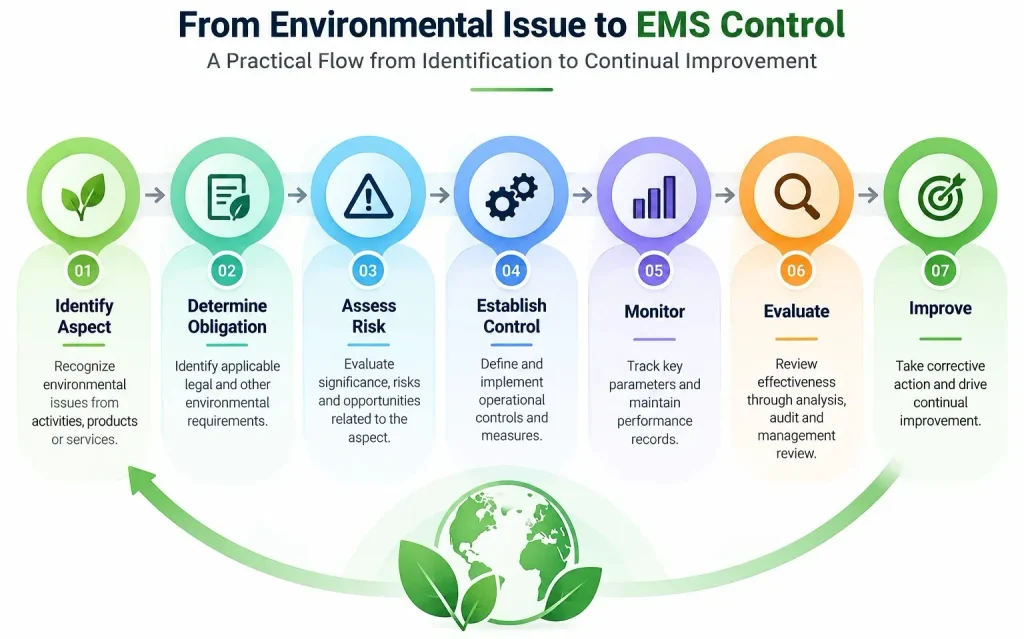
That connected process is what separates a working EMS from a collection of environmental procedures.
How an Auditor Evaluates ISO 14001 Requirements
An ISO 14001 auditor evaluates more than whether an organization has created the required documents. The audit determines whether the Environmental Management System (EMS) conforms to ISO 14001 certification requirements and is effectively implemented.
The auditor reviews objective evidence, which may include documents and records, employee statements, workplace observations and other verifiable information.
During an audit, the auditor may evaluate:
- EMS scope and context: Whether the organization has defined its EMS scope and considered relevant issues and interested parties.
- Environmental aspects and impacts: Whether relevant environmental aspects have been identified and their significance evaluated.
- Compliance obligations: Whether applicable legal and other requirements have been identified and evaluated.
- Environmental objectives: Whether objectives are relevant, measurable where appropriate, monitored and supported by action plans.
- Operational controls: Whether controls for significant environmental aspects are implemented as planned.
- Competence and awareness: Whether relevant employees have the necessary competence and understand their environmental responsibilities.
- Monitoring and measurement: Whether environmental performance is monitored and evaluated.
- Emergency preparedness: Whether relevant environmental emergencies have been identified and response arrangements are maintained.
- Internal audit and management review: Whether the EMS is periodically evaluated and reviewed by management.
- Corrective action: Whether identified problems are addressed and recurrence is prevented.
An auditor may also follow an audit trail across several requirements. For example, if hazardous waste is identified as a significant environmental aspect, the auditor may review applicable obligations, storage controls, employee training, inspection records, and disposal records.
This helps determine whether the EMS operates as a connected system rather than as a collection of separate documents.
A procedure alone does not demonstrate conformity. The organization should be able to show that its controls are implemented and supported by appropriate evidence.
Typical Evidence an Organization Should Be Able to Show
For ISO 14001 certification, an organization should demonstrate that its Environmental Management System is implemented and maintained in practice. The exact evidence depends on its activities, environmental aspects, compliance obligations, and operational complexity.
Typical evidence may include:
| Requirement area | Typical evidence |
| EMS scope and policy | Defined scope, environmental policy and communication |
| Environmental aspects | Aspect-impact evaluation and significance criteria |
| Compliance obligations | Applicable requirements, permits and compliance evaluation records |
| Environmental objectives | Objectives, targets, indicators, action plans and results |
| Operational controls | Procedures, inspections and operational records |
| Competence and awareness | Training, qualification and awareness records |
| Emergency preparedness | Emergency procedures, drills and related records |
| Environmental performance | Monitoring, measurement and performance results |
| Internal audit | Audit programme, reports, findings and follow-up actions |
| Management review | Review records, decisions and assigned actions |
| Corrective action | Nonconformity records, corrective actions and effectiveness evidence |
The evidence should reflect the organization’s actual activities. For example, if hazardous waste is a significant environmental aspect, an auditor may expect more than a written waste-management procedure. Relevant evidence could include storage inspections, disposal records, employee training, and records showing that established controls are being followed.
Similarly, an environmental objective to reduce energy consumption should be supported by monitoring information and evidence of actions taken to achieve the objective.
The purpose of maintaining evidence is not to create records only for an audit. It is to demonstrate that the EMS is operating as intended and that environmental controls and objectives are being evaluated for effectiveness.
Documents and records should therefore develop from the organization’s actual processes, environmental risks, compliance obligations, and performance-monitoring activities.
What Happens If an ISO 14001 Certification Requirement Is Not Met?
If an auditor finds that an ISO 14001 certification requirement has not been fulfilled, the issue may be identified as a nonconformity. Nonconformity means that a requirement has not been fulfilled.
The organization then needs to respond appropriately. A typical response involves:
- Correcting the immediate issue – Take action to control or correct the problem.
- Determining the cause – Investigate why the nonconformity occurred.
- Taking corrective action – Address the cause to help prevent recurrence.
- Implementing the action – Put the corrective action into practice.
- Reviewing effectiveness – Check whether the action has addressed the cause effectively.
For example, suppose an organization has established controls for hazardous-waste storage but an audit finds that waste is being stored outside the designated area.
Moving the waste to the correct location may correct the immediate problem. However, the organization should also determine why the control was not followed. The cause could involve inadequate employee awareness, unclear responsibilities, insufficient supervision or another operational issue.
The corrective action should address the identified cause rather than simply moving the waste and closing the finding.
The effect of a nonconformity on the certification process depends on the nature and extent of the finding and the applicable certification process. The organization may need to provide evidence that appropriate correction and corrective action have been taken before the finding can be closed or the certification decision can proceed.
Nonconformities can also help identify weaknesses in the EMS. An effective management system uses these findings to strengthen controls, prevent recurring problems, and improve environmental performance.
ISO 14001 Requirements and Environmental Compliance in Qatar
ISO 14001 works alongside Qatar’s environmental requirements; it does not replace them. ISO makes clear that International Standards are voluntary and do not override applicable national laws.
Qatar’s Law No. 30 of 2002 on Environmental Protection remains in force. Articles 11–13 address environmental impact assessment and licensing for applicable projects. For specified projects, the law connects licensing with environmental impact assessment and approval requirements.
Hazardous waste provides a practical example. Article 27 requires an establishment producing potentially hazardous waste to maintain records concerning that waste, how it is disposed of, and the contracted parties receiving it.
The Ministry of Environment and Climate Change’s Environmental Assessment and Permit Department performs functions including reviewing environmental permit applications, conducting inspections, setting environmental requirements, assessing EIA studies and issuing operating permits after environmental conditions have been met.
An effective EMS therefore needs to identify the requirements that apply to the organization’s actual operations, permits, approvals and environmental aspects rather than relying on a generic legal checklist.
The specific environmental obligations will also vary according to the organization’s activities. A manufacturing facility, construction contractor, logistics operator and hospitality business may have very different environmental aspects, permits, operational controls and compliance obligations.
Qatar’s national environmental strategy also identifies five priority areas: greenhouse-gas emissions and air quality, biodiversity, water, waste management and circular economy, and land use.
How Are ISO 14001 Requirements Implemented Within a Business?
A practical implementation sequence is:
- Define the EMS scope and understand the business context.
- Identify interested parties and relevant environmental conditions.
- Identify environmental aspects and significant impacts.
- Determine legal and other compliance obligations.
- Assess risks and opportunities.
- Establish policy, objectives and measurable indicators.
- Implement operational and emergency controls.
- Ensure competence, awareness and communication.
- Monitor performance and evaluate compliance.
- Conduct internal audit and management review.
- Correct nonconformities and improve the EMS.
The value is in the connections: objectives come from genuine priorities, controls address identified risks, and monitoring shows whether those controls work.
Common Gaps When Meeting ISO 14001 Requirements
From a certification perspective, serious gaps are usually found between documented intentions and operational reality.
Common examples include:
- environmental aspects that miss relevant activities or abnormal conditions;
- legal registers that have not been checked for applicability;
- environmental objectives with no baseline, measurable target, or responsible owner;
- written controls that are not followed in practice;
- monitoring data collected without analysis; and
- corrective actions that close an issue without addressing its underlying cause.
A mature EMS should allow an environmental issue to be traced through control, evidence, review, and improvement.
ISO 14001 Certification Requirement Checklist
Before considering the system ready, check whether the organization can demonstrate that it has:
- defined an appropriate EMS scope;
- understood its context and interested parties;
- established an environmental policy;
- identified environmental aspects and significant impacts;
- determined applicable compliance obligations;
- evaluated risks and opportunities;
- established measurable environmental objectives;
- implemented operational and emergency controls;
- provided suitable competence and awareness;
- maintained controlled documented information;
- monitored performance and evaluated compliance;
- completed internal audit and management review;
- addressed nonconformities and corrective actions; and
- demonstrated continual improvement.
Need Support With ISO 14001:2026 Certification in Qatar?
Guardian Middle East LLC represents Guardian Assessment UK Ltd, a UK-based certification body recognized by UAF and IAS.
If your organization has implemented the ISO 14001:2026 requirements and is preparing for certification in Qatar, Guardian can provide an independent and structured certification assessment to determine whether your Environmental Management System conforms to the applicable requirements of the standard.
Organizations transitioning from ISO 14001:2015 to ISO 14001:2026 can also approach Guardian for information about the certification and transition process.
Guardian Middle East LLC – Contact Details
- Location: Abo-Hamour Area, opposite the Medical Commission, Doha, Qatar
- P.O. Box: 23277, Doha, Qatar
- Mobile: +974 7770 2602 | +974 7213 7770
- Email: info@guardian.qa
Frequently Asked Questions
2- What documents are required for ISO 14001?
Typical documented information includes the EMS scope, environmental policy, environmental-aspect evaluations, compliance obligations, objectives, operational and monitoring records, internal-audit records, management-review outputs, and corrective actions. The exact documented information required depends on the organization's activities, environmental aspects, risks, compliance obligations and operational complexity.
3- What changed in ISO 14001:2026?
The 2026 edition strengthens environmental-context analysis, leadership accountability, and measurable outcomes while clarifying change planning, risks and opportunities, and oversight of externally provided processes, products, and services.
4- What are compliance obligations under ISO 14001?
They include applicable legal requirements and other requirements the organization has to or chooses to meet. The organization must determine what applies, incorporate those obligations into its operations, and evaluate compliance.
5- Is ISO 14001 certification mandatory in Qatar?
Not as a universal requirement for every organization. Certification is voluntary under ISO's framework, while applicable Qatar environmental laws, approvals, and permit conditions remain mandatory.
Comments are closed