

Is your ISO certificate nearing its expiry date? You may be wondering whether you need to start the certification process again or simply renew the existing certificate. What businesses commonly call ISO certification renewal is generally handled through a recertification audit.
For common ISO management system certifications, organizations usually go through surveillance audits during the certification cycle and a more comprehensive recertification audit before starting the next cycle. ISO describes annual surveillance and recertification around every three years as the usual model for ISO 14001 certification.
For businesses across the Middle East, the practical goal is simple: Schedule recertification early, make sure your management system is still working, close outstanding issues, update any changes in scope or locations, and complete the recertification process before timing becomes a problem.
What Does ISO Certification Renewal Actually Mean?
You will often hear business owners say they need to renew their ISO certificate. In certification terms, the process at the end of the certification cycle is generally called recertification.
Recertification is not just the reprinting of an existing certificate. The certification body needs to assess whether the management system continues to meet the relevant ISO standard and remains effective for the organisation’s current operations.
ISO/IEC 17021-1 sets the requirements for bodies that audit and certify management systems and specifically includes surveillance and recertification among certification-body process requirements. ISO also makes an important distinction: ISO itself does not certify companies. Certification is carried out by independent third-party certification bodies.
How Often Is ISO Certification Renewed?
For many commonly used management system certifications, the normal certification cycle is around three years, with surveillance activities taking place during the cycle and recertification near its end. The exact audit programme can depend on the certification scheme, certification body, organisation, standard, and circumstances.
Surveillance Audit vs Recertification Audit
| Area | Surveillance Audit | Recertification Audit |
| Purpose | Checks continued conformity during the existing certification cycle | Assesses continued conformity and effectiveness before beginning another certification cycle |
| Timing | Usually takes place during the certification cycle | Usually scheduled near the end of the cycle |
| Coverage | Reviews selected areas and important system performance | Provides a broader review of the management system and its performance |
| Main Outcome | Maintains confidence in current certification | Supports the decision on continued certification for the next cycle |
The key difference is simple: surveillance monitors the system during the cycle; recertification looks at whether certification should continue into a new cycle.
A Practical Recertification Preparation Timeline
Do not wait until the final weeks before your certificate reaches the end of its cycle.
Start by reviewing:
- your current certification dates
- previous audit reports
- open findings or corrective actions
- internal audit status
- management review status
- changes in company activities
- changes in scope or locations
- whether the applicable ISO standard has been revised
Starting early gives your certification body enough time to review updated information, plan the audit, allocate competent auditors, and address any changes that could affect audit duration.
When Should You Start ISO Recertification?
- 3–6 months before expiry: Review your certification scope, covered sites, organisational changes, and previous audit findings.
- Before audit planning: Complete the required internal audits and management review.
- Before the current certificate expires: Complete the recertification audit and any required corrective action or certification processes.
- If major changes have occurred: Contact your certification body earlier so changes to scope, sites, or audit planning can be assessed.
For organizations with operations across several Middle Eastern countries, this becomes even more important. New branches, additional sites, changes in employee numbers, acquisitions, or new business activities can affect audit planning.
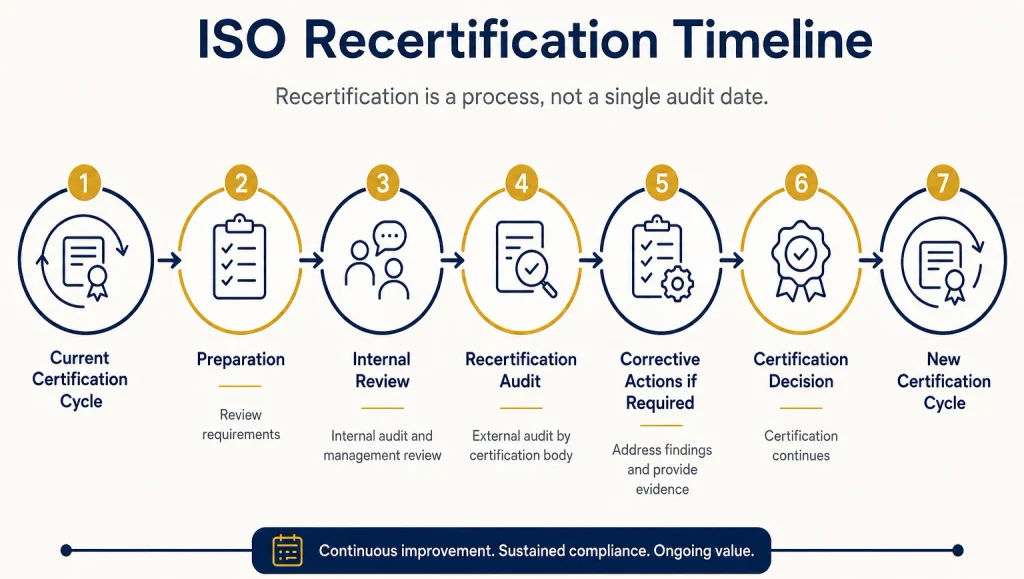
How to Renew ISO Certification: Step-by-Step Recertification Process
Step 1: Review Your Current Certification Details
Start with the certificate you already have.
Check:
- the ISO standard and edition
- certified legal entity
- certification scope
- locations or sites covered
- certificate dates
- current certification status
Make sure the certificate still reflects how the organisation actually operates.
If any certificate details no longer reflect your current operations, note them before moving into the change review in the next step.
Step 2: Review What Has Changed Since the Last Certification Cycle
Recertification should reflect the business as it operates today, not as it looked three years ago.
Consider changes such as:
- new products or services
- new departments
- new sites
- changes in employee numbers
- restructuring
- acquisitions
- new technology
- process changes
- new legal or regulatory obligations
- changes to outsourced activities
Tell the certification body about significant changes early because they may affect scope, competence requirements, site sampling, or audit time.
Step 3: Complete Internal Audits and Management Review
Before recertification, your organisation should be able to demonstrate that the management system has continued to operate.
Internal audits and management review are particularly important because they show that the organisation is evaluating its own system rather than relying only on the external auditor.
ISO’s certification guidance for ISO 14001 identifies implementation, internal audits, management review, and an independent certification audit as key parts of the certification process.
Step 4: Review Previous Nonconformities and Corrective Actions
Go back through previous surveillance and certification audit reports.
Check whether:
- corrective actions were completed
- actions were effective
- the same problem has returned
- evidence is available to demonstrate closure
A closed corrective-action form is not enough if the underlying problem is still happening.
Recertification gives the auditor a wider view of how the management system has performed across the certification cycle, so repeated problems can become particularly important.
Step 5: Schedule the Recertification Audit
Once the certification body has current information about the organization, it can plan the ISO recertification audit.
Audit duration is not the same for every company.
For quality, environmental, and occupational health and safety management systems, IAF MD 5 requires certification bodies to consider factors such as effective personnel, risk or complexity, locations, and organizational changes when determining audit time. For ISO recertification, the audit time is normally calculated from updated client information and is typically around two-thirds of the time that would be required for a new initial certification audit at that point.
Step 6: Complete the Recertification Audit
During the audit, the ISO certification body is looking at more than whether documents exist.
The audit may consider:
- continued conformity with the standard
- effectiveness of the management system
- performance during the certification cycle
- internal audits
- management reviews
- objectives and results
- corrective actions
- changes in the organisation
- continued suitability of the certification scope
The exact emphasis will depend on the management system standard and the organisation.
Step 7: Close Findings and Complete the Certification Decision
If the audit identifies nonconformities, corrective action may be required before certification can continue.
The certification body then completes its review and certification decision.
This distinction matters:
Completing the audit does not automatically mean the certification decision has already been made.
Management system certification is a third-party conformity assessment activity, and certification bodies are expected to operate competent, consistent, and impartial certification processes.
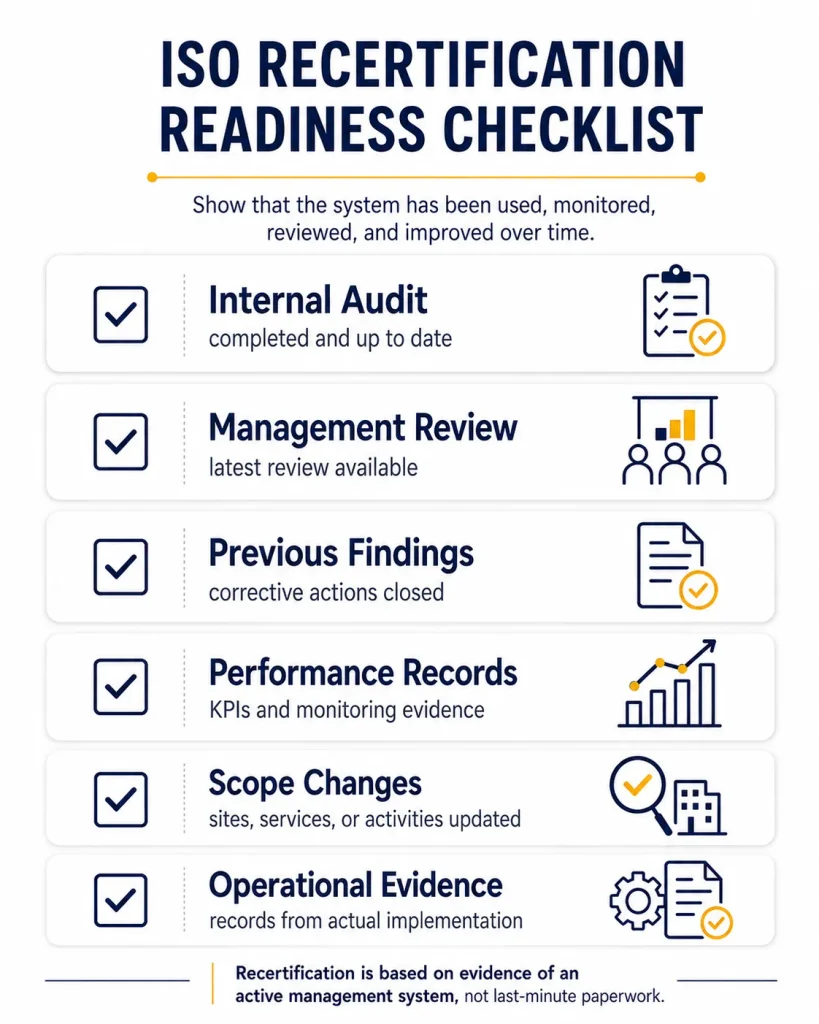
What Should You Prepare Before the Recertification Audit?
A useful way to prepare is to ask:
Can we demonstrate how our management system has actually performed since the last ISO certification cycle?
Typical evidence may include:
- current policies and procedures
- internal audit reports
- management review records
- objectives and KPI results
- previous audit findings
- corrective-action records
- customer complaints and feedback
- risk and opportunity records
- operational monitoring records
- competence or training records where applicable
- legal and regulatory evaluation where relevant
- changes in scope, sites, activities, or organizational structure
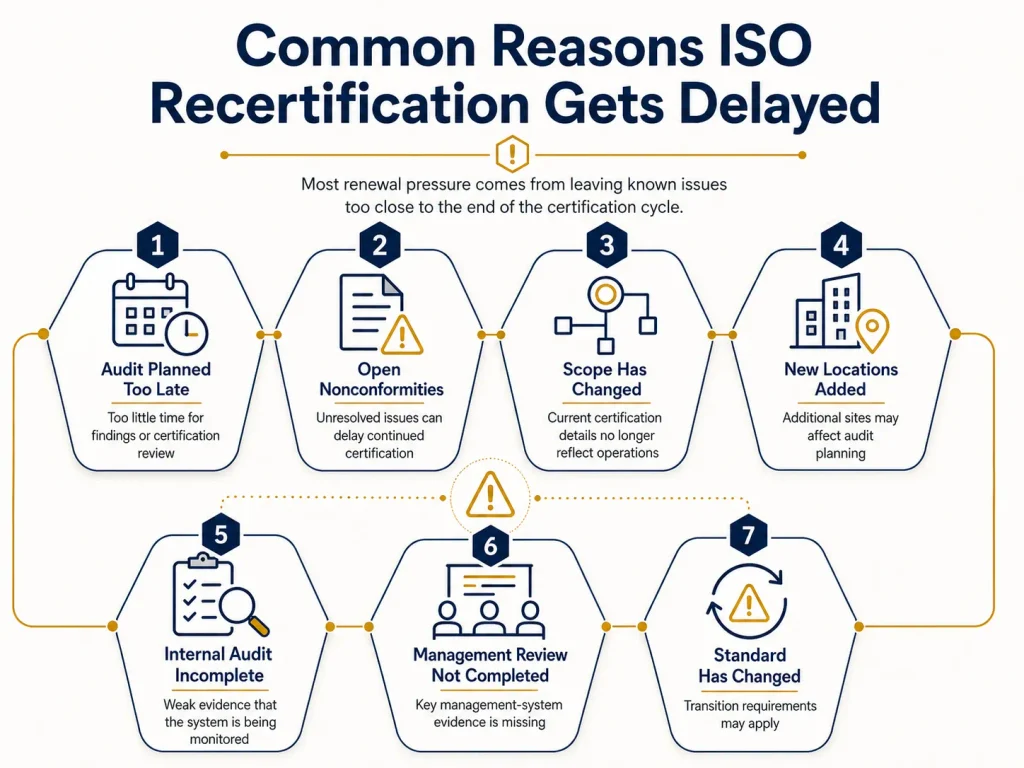
What Can Delay ISO Certification Renewal?
Many recertification problems can be avoided with earlier preparation.
| Common Problem | Why It Matters | Practical Action |
| Audit planned too late | Leaves little time to address findings or complete the certification decision | Schedule recertification early |
| Open nonconformities | Unresolved issues can affect continued certification | Complete corrective actions and retain evidence |
| Certification scope has changed | Existing ISO certification information may no longer reflect current operations | Inform the certification body before audit planning |
| New locations have been added | Additional sites may affect audit planning and duration | Provide updated location details early |
| Internal audit is incomplete | Weakens evidence that the organisation is monitoring its own system | Complete the planned internal audit programme |
| Management review has not been completed | Removes an important piece of evidence about management-system performance | Conduct and document management review |
| The ISO standard has changed | Transition requirements may apply | Confirm the applicable edition and transition arrangements |
What Happens During the ISO Recertification Audit?
A recertification audit is designed to look at the continuing performance and effectiveness of the management system.
The auditor may review how effectively the organisation has:
- met the requirements of the applicable ISO standard
- achieved management-system objectives
- responded to previous nonconformities
- completed internal audits
- conducted management reviews
- controlled operational processes
- responded to customer or stakeholder issues
- managed changes
- maintained the suitability of the ISO certification scope
This is why recertification should not be treated as a paperwork exercise.
If your procedures look perfect but do not reflect what teams actually do, the audit can expose that gap very quickly.
A healthy management system should therefore be visible in normal day-to-day operations, not switched on only when an external audit approaches.
What Happens After the Recertification Audit?
Once the audit is complete, the process normally moves through several stages:
Audit completed → findings reviewed → corrective action where required → certification review → certification decision → next certification cycle
If corrective actions are required, your organization may need to provide evidence before the ISO certification body can complete the process.
The ISO certification decision is handled through the ISO certification body’s independent process. This independence is central to ISO/IEC 17021-1, which establishes competence, consistency, and impartiality requirements for management-system certification bodies.
That is why a ISO certification body should not promise a renewed certificate simply because the organization has booked or completed an audit.
What If Your ISO Standard Has Been Revised?
ISO standards are periodically reviewed and revised, so recertification can sometimes overlap with a transition to a new edition.
A current example is ISO 14001:2026, published in April 2026. ISO 14001:2015 has now been withdrawn, and organizations certified to the 2015 edition are advised to speak with their ISO certification body about transition arrangements.
If your standard has been revised, check:
- which edition your current certificate references
- which edition will apply at the next audit
- the applicable transition deadline
- what changes your management system needs
- whether the transition can be combined with a planned surveillance or recertification audit
Do not assume a new edition means your existing certificate becomes invalid immediately. Transition arrangements need to be confirmed for the specific standard and certification programme.
Can You Change Certification Bodies When Your ISO Certificate Is Due for Renewal?
Yes, transfer of an existing accredited management-system certification can be possible, but it should be handled carefully.
IAF MD 2 defines certification transfer as the recognition of an existing and valid accredited ISO certification by another accredited certification body for the purpose of issuing its own certification. The accepting body reviews matters such as the existing certificate, recent audit reports, outstanding nonconformities, complaints, and the reason for transfer.
If you are considering a transfer near recertification time, do not wait until the existing certificate has already become problematic.
Speak with the proposed certification body early so your current certification status, audit history, findings, scope, and timing can be reviewed properly.
ISO Recertification Checklist Before You Book the Audit
Before scheduling the recertification audit, check:
- Current ISO certificate dates and status
- Certification scope
- Legal entity and site information
- Internal audit programme completed
- Management review completed
- Previous audit findings reviewed
- Corrective actions closed and checked for effectiveness
- Objectives and performance results available
- Major organisational changes communicated
- New sites or activities identified
- Applicable ISO standard edition confirmed
- Certification body contacted early enough to plan the audit properly
Final Takeaway
ISO certification renewal should not be treated as an administrative task completed just before the certificate reaches the end of its cycle.
A successful recertification starts with a management system that has remained active throughout the certification period. Review your scope, complete internal audits and management review, close outstanding findings, communicate business changes, and schedule the recertification audit early.
The better prepared your organisation is, the smoother the transition into the next certification cycle is likely to be.
ISO Recertification Coming Up? Plan It Before It Becomes Urgent
If your organization in the Middle East is approaching the end of its ISO certification cycle, start the recertification discussion early.
Guardian Middle East LLC we represent Guardian Assessment UK Ltd, a United Kingdom–based certification body, recognized by UAF (United Accreditation Foundation) and IAS (International Accreditation Service, USA) which works with organizations across the region seeking certification to major ISO management system standards. Our certification team can review the information needed to establish the appropriate certification scope and audit programes and explain the next steps in the recertification process.
Middle East Enquiries
Regional Contact Office: Abo Hamour Area, Doha, Qatar
P.O. Box: 23277, Doha, Qatar
Mobile: +974 7770 2602 | +974 7213 7770
Email: info@guardian.qa
Website: www.guardian.qa
Frequently Asked Questions
2. Is ISO renewal the same as recertification?
Businesses often use the term ISO renewal, while certification bodies generally refer to the end-of-cycle assessment as recertification. The purpose is to assess whether the organisation continues to meet the applicable standard and can move into a new certification cycle.
3. How long does an ISO recertification audit take?
There is no single audit duration for every organisation. Audit time can depend on the management system standard, employee numbers, risk and complexity, locations, scope, and changes in the organisation. For QMS, EMS, and OH&S systems, IAF MD 5 provides specific principles for determining recertification audit time.
4. What documents are required for ISO recertification?
Typical evidence can include internal audit results, management review records, objectives and performance data, corrective actions, previous audit findings, operational records, risk information, and updated details about company scope or sites. The exact evidence depends on the ISO standard and organisation.
5. Is a recertification audit different from a surveillance audit?
Yes. Surveillance audits are used during the certification cycle to monitor continued conformity, while recertification is a broader assessment near the end of the cycle that supports the decision on continued certification for the next cycle.
6. What happens if nonconformities are found during recertification?
The organisation may need to correct the issue, determine the cause, implement corrective action, and provide evidence as required by the certification body. Significant unresolved findings can affect completion of the certification process.
7. Can ISO certification be renewed after the certificate has expired?
The answer depends on the certification status, timing, applicable certification rules, and circumstances. If the certificate has already expired, contact the certification body immediately rather than assuming the normal recertification process can simply continue unchanged.
8. Can I change my certification body at renewal time?
A transfer may be possible for a valid accredited management-system certification. The accepting certification body normally reviews the current certificate, recent audit reports, outstanding findings, complaints, scope, and other certification information before accepting the transfer.
9. Do I need to update my ISO certificate if my company scope changes?
Potentially, yes. If activities, services, locations, or other factors affecting the certification scope have changed, inform the certification body. The change may need to be reviewed and could affect audit planning or the scope shown on the certificate.
10. What happens if a new version of the ISO standard is published?
A transition period or specific transition arrangement may apply. Check which edition your current certificate references and ask your certification body which requirements and deadlines apply before your next surveillance or recertification audit.
Comments are closed