


Let’s keep it simple and real: not every Saudi government tender asks for ISO certification. If you are reviewing ISO certification in Saudi Arabia for government tenders, the requirement will depend on the project, the government entity, the industry, and the type of work you are bidding for.
If you check the Etimad platform, you will notice something important. Some tenders clearly request standards such as ISO 9001 or ISO 45001, while others reference ISO standards as part of how the work should be performed rather than as a strict eligibility condition.
So here is the golden rule for ISO certification tender requirements in Saudi Arabia:
Do not simply attach your ISO certificate and assume you are covered.
Read the tender carefully and understand exactly what is being requested, whether certification is required for qualification or forms part of the technical expectations.
Do Saudi Government Tenders Always Require ISO Certification?
Short answer: No, not always.
Saudi Arabia’s government procurement system covers many different types of projects, so ISO certification requirements are not identical across every tender. One procurement may make certification an important qualification condition, while another may not mention ISO at all.
This is why ISO certification in Saudi Arabia for government contracts needs to be considered against the specific procurement documents rather than treated as one universal requirement.
How ISO Requirements Can Appear in a Saudi Government Tender
| How ISO Appears | What It Usually Means | What the Bidder Should Check |
| Mandatory Requirement | The tender clearly requires a specific ISO certification as a condition of participation or eligibility. | Confirm the exact standard, certificate validity, scope, and any accreditation conditions. |
| Supplier Qualification Requirement | ISO certification is used as evidence that the supplier has an appropriate management system or organizational capability. | Check whether the certificate must be submitted during prequalification or with the main bid. |
| Technical Requirement | The project, service, or delivery method may be required to follow a specific ISO standard or recognized management framework. | Determine whether the bidder must hold certification or whether the requirement applies to how the work is performed. |
| Supporting Evidence / Preference | ISO certification may strengthen the supplier’s evidence of structured management practices but may not be a mandatory entry condition. | Read the evaluation criteria carefully to understand whether and how it affects assessment. |
For example, some major Etimad listings, including electrical operation and maintenance projects at the Grand Mosque and Prophet’s Mosque, reference ISO 9001 and ISO 45001 as part of safety and quality expectations. It is a useful example of why ISO Certification requirements for government tenders in Saudi Arabia can become more important where operational and safety risks are higher.
Why ISO Requirements Change From Tender to Tender
One point many bidders miss is that not all projects carry the same risks, responsibilities, or operational complexity. That is why the ISO standard mentioned in one tender may be completely different from the standard referenced in another.
Common ISO Standards You May See in Different Saudi Tender Types
| ISO Standard | Main Area | Where It May Be Relevant |
| ISO 9001 | Quality management | Construction, maintenance, engineering, manufacturing, professional services, and other contracts where consistent quality and process control matter |
| ISO 45001 | Occupational health and safety | Construction, maintenance, facilities management, industrial, and field-based projects with significant worker-safety risks |
| ISO/IEC 27001 | Information security management | IT, cybersecurity, cloud, digital services, and projects involving sensitive information or information systems |
| ISO 22000 | Food safety management | Catering, food production, food supply, and other contracts involving food-safety controls |
This does not mean every tender in these sectors will require these standards. The individual tender documents determine the actual certification requirement.
For example, a recent cybersecurity-related Etimad tender did not simply reference ISO/IEC 27001. It also referred to Saudi NCA controls, NIST, CIS, and OWASP frameworks, showing how technical requirements can become layered when the project involves information-security risks.
Where Should You Look for ISO Requirements in a Saudi Tender?
One of the easiest mistakes is searching the tender for the word “ISO certification,” finding one reference, and assuming you have understood the complete requirement.
In practice, Etimad ISO certification requirements may appear in different parts of the procurement package. Saudi tender documents can contain technical specifications, supplier qualification conditions, evaluation criteria, contract requirements, and supporting attachments.
That means bidders should check more than one section.
Supplier Qualification Requirements
Start here if the tender asks suppliers to demonstrate that they have the systems and organisational capability needed for the project.
An ISO certificate may be listed alongside other qualification documents. If certification appears as a qualification condition, check whether the wording makes it mandatory and whether a specific standard is named.
Technical Specifications
Sometimes the tender does not require the bidder itself to hold a particular certificate. Instead, the work, service, process, or management approach may be expected to follow a recognised standard.
This distinction matters.
“The bidder must be ISO 9001 certified” and “the work shall be performed in accordance with ISO 9001 principles” do not necessarily create the same requirement.
Eligibility and Evaluation Criteria
Next, check how the contracting authority intends to assess the bid.
A requirement may determine whether you qualify to participate, while another may form part of the technical evaluation.
Do not only ask: “Is ISO mentioned?”
Also ask:
- Is ISO certification required to qualify?
- Will it form part of the technical evaluation?
- Is a particular ISO standard specified?
- Does the tender explain what evidence must be submitted?
- Are any accreditation conditions included?
Tender Attachments and Contract Conditions
Finally, review the annexures, scope of work, schedules, technical forms, supporting documents, and contract conditions.
Important wording related to ISO certification on Etimad in Saudi Arabia may sit deeper inside these documents rather than appearing on the main tender summary.
The safest approach is simple: review the complete tender package before deciding what your ISO certificate needs to prove.
Where ISO Requirements May Appear in a Saudi Tender
ISO certification related requirements can appear in supplier qualification criteria, technical specifications, evaluation criteria, contract conditions, and supporting documents.
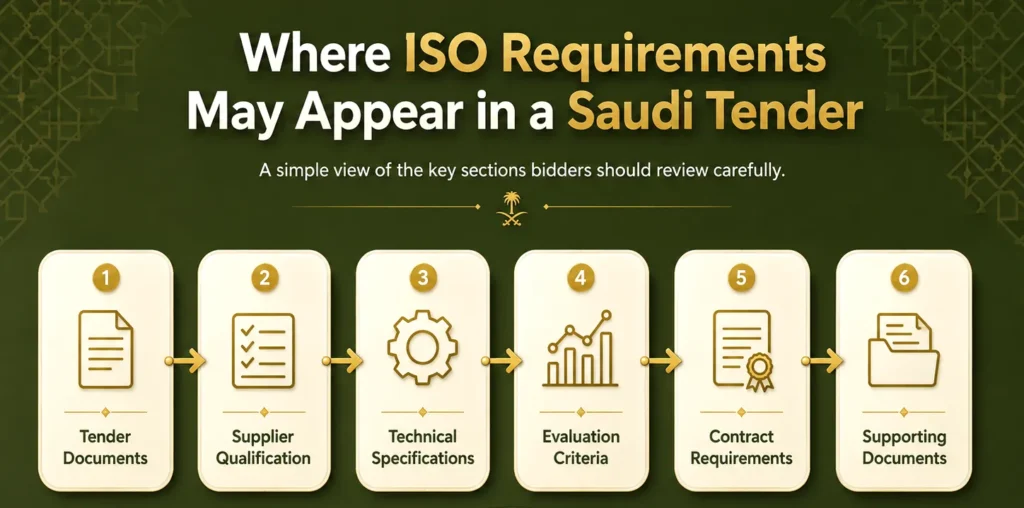
The important point is that the ISO certification requirement is not always placed in one fixed section. Review the full tender package carefully because important conditions may appear deeper in the technical, qualification, or contractual documents.
5 Things to Check on Your ISO Certificate Before You Submit the Bid
Having an ISO certificate is one thing. Having the right ISO certificate for the tender is another.
Before uploading it with your bid, check what the certificate actually says and compare it directly with the tender requirement.
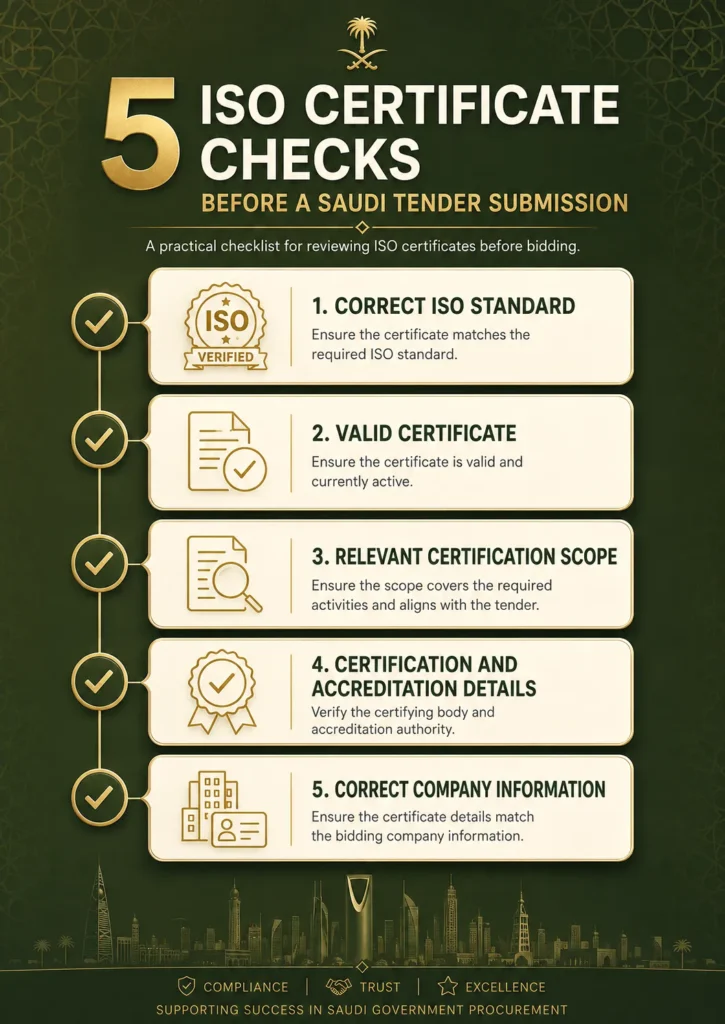
1. Is It the ISO Standard Requested in the Tender?
Start with the most basic check: does your certificate cover the standard being requested?
ISO management system standards address different areas. ISO 9001 deals with quality management, while ISO 45001 focuses on occupational health and safety. Holding certification to one does not automatically mean you meet a requirement for the other.
For example, if a tender specifically asks for ISO 45001 and your company only holds ISO 9001, do not assume the existing certificate satisfies the requirement simply because both are ISO standards.
2. Is the Certificate Currently Valid?
Check the certificate dates and current certification status before submitting it.
This sounds obvious, but it can easily be overlooked when a tender team is working against a deadline. If the procurement asks for a valid certificate, an expired or withdrawn certificate may not provide the evidence the contracting authority requested.
Where verification is necessary, check the certification status through the relevant certification body, accreditation information, or recognized certification database.
The practical rule is simple: do not wait for the evaluator to discover a certificate-status problem that your own team could have identified before submission.
3. Does the Certification Scope Match the Work You Are Bidding For?
This is one of the most important checks.
The certification scope describes the activities, services, operations, or parts of the organisation covered by the certified management system. It gives context to what the certificate actually applies to.
Imagine a company bidding for facilities-management work. It holds ISO 9001, but the certification scope only covers IT support services.
The standard may be correct, but an obvious question remains:
Does the certificate actually relate to the activity being offered in the tender?
That is why checking only the words “ISO 9001 certified” is not enough. Read the scope shown on the certificate and compare it with the work you are bidding for.
4. Are the Certification Body and Accreditation Details Clear?
Look at who issued the certificate and what accreditation information is shown.
Certification is performed by an independent certification body, while accreditation provides independent recognition of the certification body’s competence against applicable requirements.
If the tender specifically asks for accredited certification or includes particular recognition conditions, confirm that your certificate and accreditation information support that requirement rather than assuming any ISO certificate will be accepted.
5. Do the Company Details Match the Bidder?
Finally, compare the certificate with the company information being used in the tender submission.
Check:
- legal or company name
- relevant location or site, where applicable
- certification scope
- certificate number
- issue and expiry dates
- ISO standard and edition
- any additional information specifically requested in the tender
The certificate should clearly relate to the organisation submitting it. If company names, sites, or other important details have changed, resolve those differences before relying on the certificate as tender evidence.
What Does “ISO 9001 or Equivalent” Mean in a Saudi Tender?
When a Saudi tender says “ISO 9001 or equivalent,” do not interpret that as “any quality certificate will do.”
The important word is equivalent.
What qualifies as equivalent depends on the wording and evaluation criteria of that particular procurement. The bidder needs to understand what management system, evidence, outcome, or level of assurance the contracting authority expects.
Suppose a tender requests ISO 9001 or equivalent and your company holds a different certificate related to another management area. That does not automatically make the other certification equivalent to a quality management system certification.
If the tender documents do not make the requirement clear, the safer approach is to seek clarification through the official procurement process rather than making your own interpretation.
In short, “or equivalent” allows an alternative only where that alternative genuinely satisfies what the contracting authority is asking for.
Real Saudi Tender Example: How an ISO Requirement Appears in Practice
A recent Etimad example shows why bidders need to read ISO requirements in context.
What the Tender Was For
In 2026, the General Authority for the Care of the Affairs of the Grand Mosque and the Prophet’s Mosque published an approved supplier-qualification list for companies capable of operating and maintaining electrical systems at the two holy mosques.
The work covered electrical distribution networks, panels, lighting, power systems, and related activities in highly sensitive operating environments.
Which ISO Standards Were Referenced
Among the qualification conditions, the list referred to commitment to safety and quality standards such as ISO 45001 and ISO 9001 or equivalent.
Where the Requirement Appeared
The ISO certification reference appeared under the conditions for joining the supplier list. The required attachments also included quality and safety certificates, ISO or equivalent.
This matters because the ISO requirement was not simply a general statement about good practice. It formed part of the supplier-qualification documentation.
What Businesses Can Learn From It
The lesson is not that every electrical or maintenance tender in Saudi Arabia will request the same certifications.
The real lesson is that bidders need to understand where the ISO requirement sits in the procurement process.
If ISO certification appears within supplier qualification, verify the requested standard, certificate status, scope, and supporting documents before assuming your company is ready to bid.
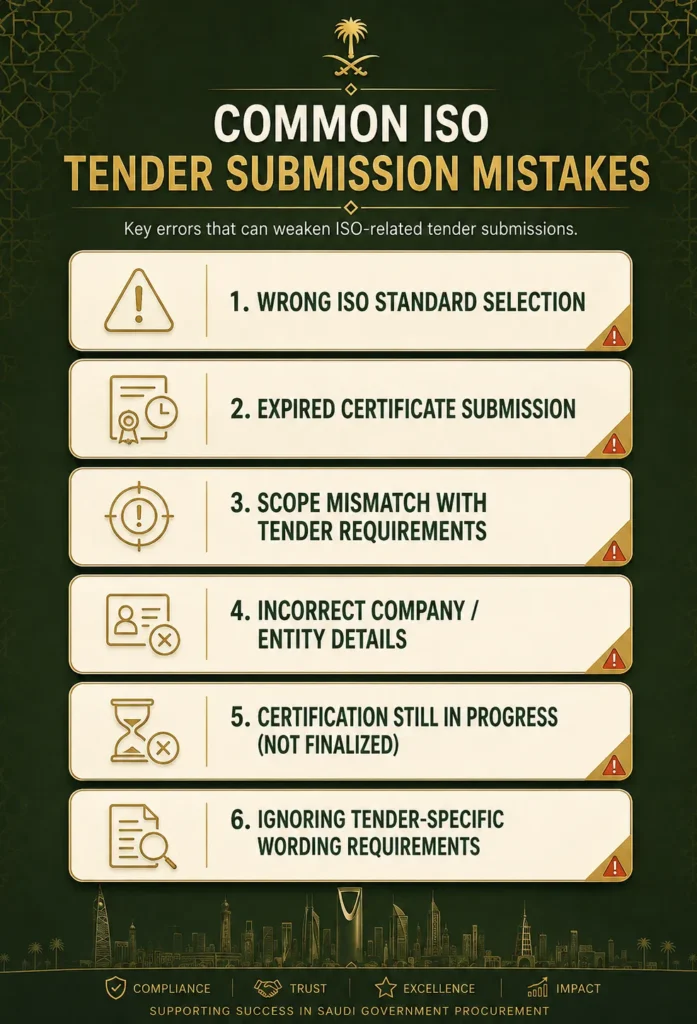
Common ISO Mistakes That Can Cause Problems During Tender Submission
Most ISO-related tender problems are not caused by complicated technical issues. They often result from simple checks being missed before submission.
Watch for these common mistakes:
- Submitting the wrong ISO standard: Holding one ISO certification does not mean you automatically satisfy the standard requested in the tender.
- Attaching an expired certificate: Check the current certification status and dates before using the certificate as evidence.
- Overlooking the certification scope: The certificate may show the correct ISO standard while covering activities unrelated to the work being tendered.
- Using certificate details that do not match the bidding entity: Differences in company name, legal entity, site, or other important details can create unnecessary questions during evaluation.
- Treating an application as certification: Starting the certification process, receiving a quotation, or scheduling an audit is not the same as holding a certificate issued after successful certification.
- Ignoring accreditation requirements: If the tender specifies accreditation or recognition conditions, check them before submission.
- Misreading “ISO 9001 or equivalent”: An alternative should not be treated as equivalent simply because it is another ISO-related document.
- Starting certification too close to the deadline: Certification requires an independent audit process and should not be treated as an instant document that can simply be produced because a tender closing date is approaching.
- Assuming ISO guarantees tender eligibility: Certification may satisfy one requirement, while the tender may also include technical, financial, administrative, legal, staffing, experience, and other qualification criteria.
The best approach is to check the tender first and the certificate second, then compare the two carefully. That simple review can prevent many avoidable submission problems.
Common ISO Tender Submission Mistakes
The Tender Requires ISO Certification, but You Are Not Certified Yet. What Should You Do?
If the tender requires ISO certification and your company is not certified yet, the first step is not to rush into buying a certificate.
First, understand exactly what the tender requires and whether there is enough time to complete a proper certification process.
Management system certification involves an independent audit and certification decision. It is not a document that can simply be issued on request.
Step 1: Confirm the Exact Tender Requirement
Read the tender wording carefully. Check whether certification is mandatory, which standard is requested, whether “or equivalent” is allowed, and whether any accreditation conditions are stated.
Step 2: Identify the Required Standard and Scope
Understand both the ISO standard and the activities that need to be covered. The certification scope should reflect what your organization actually does and, where relevant, the activity being tendered.
Step 3: Assess Whether Your Management System Is Ready
Certification requires more than written procedures. Your management system should be implemented, supported by records, and ready to be evaluated through an audit.
Step 4: Contact a Certification Body Early
Speak with a certification body as soon as the requirement is identified. Share accurate information about your organisation, including scope, locations, employee numbers, activities, and the standard required.
Step 5: Work With a Realistic Certification Timeline
Do not assume certification can be guaranteed before a tender deadline.
The process includes audit planning, assessment, findings where applicable, and a certification decision.
If the closing date is very close, base your bid decision on the actual tender requirement and your current certification status, not on an assumption that certification will be completed in time.
Final ISO Check Before You Submit Your Saudi Government Tender
Before uploading your ISO certificate with a Saudi government bid, carry out one final review:
- The correct ISO standard is being submitted.
- The certificate is currently valid.
- The certification scope matches the relevant activity.
- The company name and other details match the bidding entity.
- Certification body and accreditation information have been checked where required.
- The tender’s exact ISO wording has been reviewed.
- All supporting documents requested by the contracting authority are included.
- Any unclear requirement has been addressed through the appropriate procurement clarification process.
When dealing with ISO certification through Etimad in Saudi Arabia, rely on the official tender documents and procurement process for the requirements that apply to your specific bid.
A five-minute check before submission can prevent a much bigger problem during technical or qualification review.
Final Takeaway
An ISO certificate should never be treated as a generic attachment added at the end of a tender submission.
The certificate needs to match what the contracting authority actually requested, including the standard, scope, validity, bidder details, and any certification or accreditation conditions.
If your company still needs certification for an upcoming tender, begin the process early. That gives you time to understand the audit requirements and work with a realistic certification timeline rather than trying to solve the issue days before the bid closes.
Tender Deadline Ahead? Get Your ISO Certification on the Right Track
If an upcoming Saudi government tender requires ISO certification, the best time to understand the requirement is before the submission deadline starts putting pressure on your team.
The right approach begins with confirming the required standard, defining the correct certification scope, and allowing enough time for the audit and certification process.
Guardian Middle East LLC we represent Guardian Assessment UK Ltd, a United Kingdom–based certification body, recognized by UAF (United Accreditation Foundation) and IAS (International Accreditation Service, USA). supports ISO certification enquiries from business owners across Saudi Arabia and the wider Middle East through our regional office in Doha, Qatar. Our team can help you understand the certification process, identify the information required for your audit scope, and plan the next steps based on your organization and the standard required.
Saudi Arabia & Middle East Enquiries
Regional Contact Office: Abo Hamour Area, Doha, Qatar
P.O. Box: 23277, Doha, Qatar
Mobile: +974 7770 2602 | +974 7213 7770
Email: info@guardian.qa
Website: www.guardian.qa
2. Is ISO 9001 mandatory for government tenders in Saudi Arabia?
Not in every case. Some Saudi tenders may specifically request ISO 9001, particularly where quality management is important, while others may ask for different standards or no ISO certification at all. The requirement should be confirmed from the actual tender conditions and technical specifications.
3. What does “ISO 9001 or equivalent” mean in a Saudi tender?
It means the contracting authority may accept an alternative that meets the level or purpose described in the tender. However, “equivalent” does not mean any ISO certificate is automatically acceptable. The tender documentation and evaluation criteria determine what will be considered equivalent.
4. Can I submit an expired ISO certificate with a government tender?
If the tender requires a valid ISO certificate, an expired certificate may not satisfy that requirement. Check the certificate status and validity dates before submission. If the tender wording is unclear about validity, use the official clarification process rather than assuming an expired certificate will be accepted.
5. Does the scope written on my ISO certificate matter for a tender?
Yes, it can matter significantly. The certification scope shows the activities or services covered by your management system. If the tendered activity is very different from the scope shown on the certificate, the contracting authority may question whether the certification is relevant to the work being offered.
6. Can I bid if my ISO certification is still in progress?
That depends entirely on the tender conditions. Being in the certification process is not the same as being certified. An application, quotation, scheduled audit, or completed Stage 1 audit should not be presented as a final ISO certificate. Check whether the tender specifically requires certification to be completed at the time of submission.
7. How can I check whether an ISO certificate is genuine and valid?
Start by checking the certificate number, certification body, standard, scope, company details, and validity dates. Where verification is required, confirm the certification status through the certification body, relevant accreditation information, or an appropriate recognised certification database. Do not rely only on how professional the certificate looks.
8. Does having an accredited ISO certificate guarantee that my tender will be accepted?
No. ISO certification may satisfy one specific requirement, but tender evaluation can also include technical capability, financial requirements, previous experience, legal documents, pricing, staffing, and other conditions. Holding the correct ISO certificate does not automatically make a company eligible for the entire contract.
9. What should I do if the ISO requirement in the tender is unclear?
Do not guess. Review the full tender package, including qualification conditions, technical specifications, attachments, evaluation criteria, and contract requirements. If the wording is still unclear, use the official procurement clarification process for that tender before making decisions about certification or submitting supporting documents.
10. What should I check before uploading my ISO certificate with a Saudi government bid?
Before submission, confirm five things: the correct ISO standard, current certificate validity, relevant certification scope, accurate bidder/company details, and any certification or accreditation conditions stated in the tender. Then compare the certificate with the tender wording one final time before uploading it.
Comments are closed