

Introduction
ISO 14001 certification is getting more attention in Qatar because businesses are under more pressure to manage waste, pollution, energy use, and environmental risks properly. It is no longer seen as only an environmental document. It is becoming a practical business system that helps companies stay organized, reduce risk, improve efficiency, and build trust with clients and buyers.
In simple terms, many businesses in Qatar are realizing that environmental performance now affects reputation, project opportunities, and long-term growth. That is why ISO 14001 certification in Qatar is being adopted faster, especially by companies that want to stay ready for future expectations.
Industry Snapshot
| Metric | Value |
| Organizations Certified Worldwide | 420,000+ |
| Countries with ISO 14001 Adoption | 170+ |
| Standard Type | Environmental Management System (EMS) |
| Focus Areas | Waste, Energy, Water, Emissions, Compliance |
| Current Version Mentioned in Blog | ISO 14001:2026 |
What Is ISO 14001 Certification?
What ISO 14001 means in simple terms
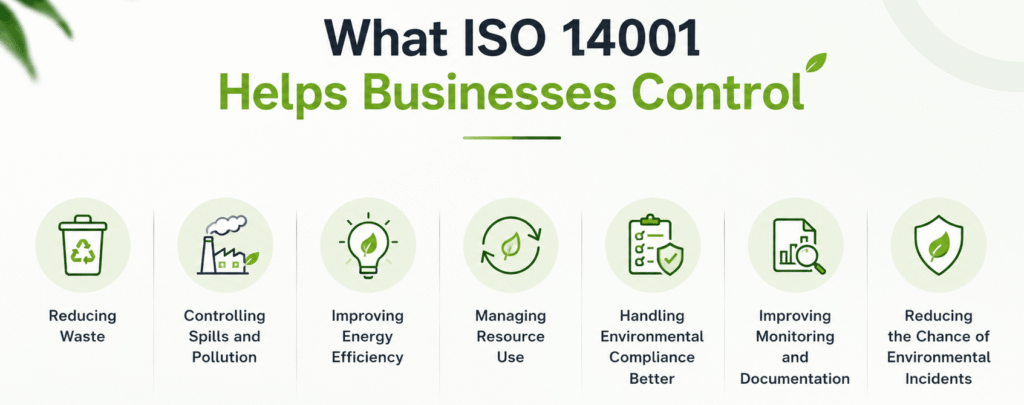
ISO 14001 certification is an international standard for environmental management. It helps a business create a structured system for managing how its activities affect the environment.
This includes things like:
- waste
- energy use
- water use
- emissions
- pollution risks
- legal and environmental responsibilities
A simple way to understand ISO 14001 certification is this:
it helps a company control its environmental impact in a more organized and responsible way.
What an environmental management system does
An environmental management system, often called an EMS, is the working system a company uses to manage environmental issues in daily operations.
It helps a business:
- identify environmental risks
- set environmental goals
- create rules and controls
- monitor performance
- keep records
- take corrective action when needed
- improve over time
So instead of handling environmental issues randomly, the business follows a clear system.
Why ISO 14001 Matters More in Qatar in 2026
In 2026, ISO 14001 certification in Qatar matters more because environmental performance is becoming a practical business issue, not just a policy topic. Businesses are under more pressure to show that they can control waste, pollution risks, resource use, and environmental responsibilities in a structured way.
Qatar’s direction makes environmental management more important
- Qatar National Vision 2030 includes environmental development as one of the country’s main long-term priorities.
- This means businesses are operating in a market where environmental control is becoming more relevant to growth, project work, and business credibility.
- Companies are expected to take environmental performance more seriously, especially in sectors that use large amounts of energy, water, materials, transport, or industrial processes.
Environmental issues are now more connected to business decisions
- ISO 14001 certification in Qatar is no longer important only for companies that want to look environmentally responsible.
- It now matters because environmental risks can affect operations, project approvals, supplier review, buyer confidence, and long-term reputation.
- Businesses that manage environmental issues properly are often seen as more organized, lower-risk, and better prepared for future expectations.
Government and regulatory direction is increasing the pressure
- Qatar created a dedicated Ministry of Environment and Climate Change to protect the environment and reduce emissions.
- This shows that environmental management is not being treated as a side issue. It is now part of the country’s official policy direction.
- For businesses, this means stronger attention to environmental control, monitoring, and accountability over time.
Tender and supplier review pressure is making ISO 14001 certification more relevant
- In Qatar, this is not only about internal improvement. It is also about market access.
- A strong example is Ashghal’s subcontractor renewal checklist, which requires updated, valid, and traceable ISO 14001 certificates together with other supporting documents.
- This shows that environmental certification can directly affect supplier approval, subcontractor review, and project readiness.
- In practical terms, businesses are adopting ISO 14001 certification faster because they do not want to wait until a client or buyer asks for it at the last minute.
Sustainability is becoming a buyer and contractor issue, not just a CSR issue
- Large buyers, contractors, and project owners now care more about whether suppliers have a real system for managing environmental risks.
- They want more than a certificate. They want confidence that the company has proper controls, records, and implementation.
- That is why ISO 14001 certification is becoming more valuable in buyer review and procurement discussions.
2026 also makes verification and credibility more important
- In 2026, the accreditation and certificate verification environment is also more visible.
- Businesses are expected to present certificates that are valid, traceable, and easy for buyers to verify.
- That means ISO 14001 certification is not only about having a certificate. It is also about having a certificate that stands up to buyer review and verification.
Why businesses in Qatar are adopting ISO 14001 certification faster now
- They want to improve environmental control before problems happen.
- They want to be better prepared for tenders, supplier review, and project requirements.
- They want to reduce waste, improve efficiency, and manage environmental risks in a structured way.
- They want stronger business credibility in a market where environmental responsibility is becoming more visible.
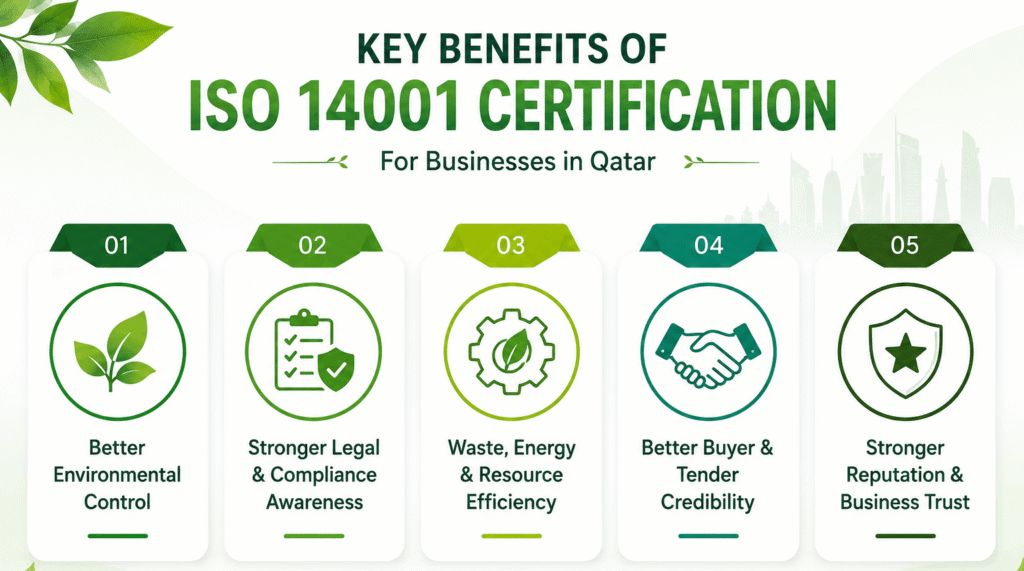
| Benefit | What It Means for Your Business | Why It Matters |
| Better Environmental Control | Helps businesses identify, monitor, and manage environmental risks such as waste, pollution, emissions, and resource consumption. | Reduces the likelihood of environmental incidents and creates a more organized approach to environmental management. |
| Stronger Legal & Compliance Awareness | Encourages businesses to understand and manage their environmental obligations, responsibilities, and operational controls more effectively. | Helps improve compliance management, reduce the risk of non-conformities, and strengthen accountability across the organization. |
| Waste, Energy & Resource Efficiency | Provides a structured framework to identify waste, inefficient resource use, and opportunities for improvement. | Can help reduce operational inefficiencies, optimize resource utilization, and support long-term cost savings. |
| Better Buyer & Tender Credibility | Demonstrates that the business follows a recognized environmental management system and maintains documented controls. | Improves supplier approval readiness, strengthens tender positioning, and increases buyer confidence. |
| Stronger Reputation & Business Trust | Shows commitment to responsible environmental practices through documented systems and continual improvement. | Enhances stakeholder confidence, strengthens brand reputation, and supports long-term business credibility. |
Wondering if ISO 14001 Is the Right Fit for Your Business?
Whether you’re preparing for tenders, improving environmental controls, or planning for future compliance requirements, understanding your current readiness is the first step.
Speak with the ISO experts at Guardian Middle East LLC for practical guidance on ISO 14001 certification in Qatar.
ISO 14001 Certification in Qatar: Future Trends Businesses Should Watch
6.1 More attention on energy, waste, and emissions control
One of the clearest future trends is stronger attention to how businesses manage:
- energy use
- waste
- emissions
- resource efficiency
- pollution-related risks
This fits the wider direction of environmental development and climate-related responsibility in Qatar.
For businesses, this means environmental management will likely become more operational and measurable over time. Companies that already have a structured system will be in a stronger position than those starting from zero.
More scrutiny of environmental records and implementation
Another important trend is that buyers and reviewers are likely to look more closely at implementation, not just certificates.
This means more attention on:
- monitoring records
- inspections
- corrective actions
- environmental objectives
- operational controls
- evidence that the system is actually being used
In other words, the future is not only about having ISO 14001 certification. It is about being able to prove that the system works in real operations.
Stronger integration with ESG and sustainability reporting
A growing trend across business is the move toward broader sustainability and ESG thinking.
For companies in Qatar, ISO 14001 certification can become an important practical base for that because it helps organize the environmental side of performance through systems, controls, and records.
This does not mean ISO 14001 certification replaces ESG reporting. But it can support it by giving businesses a stronger structure for:
- environmental data
- environmental objectives
- monitoring
- accountability
- continual improvement
So in the future, ISO 14001 certification in Qatar is likely to be seen not only as an environmental certificate, but also as a foundation for wider sustainability credibility.
Market Trend
ESG-related requirements are becoming increasingly important across global supply chains, procurement processes, and investment decisions. Many multinational organizations now evaluate suppliers on environmental performance alongside quality, safety, and operational capability. This trend is increasing the value of structured environmental management systems such as ISO 14001 certification.
More demand from supply chains, procurement teams, and large projects
A major future trend is likely to come from buyer pressure.
As large organizations, public bodies, contractors, and project owners become more cautious, they are more likely to expect suppliers to show stronger environmental systems.
That means demand may rise through:
- procurement reviews
- vendor registration
- supply chain screening
- subcontractor approval
- project qualification
This is already visible in Qatar through buyer-side review logic. Over time, that pressure is likely to become stronger, not weaker.
ISO 14001 Transition Update: What Businesses Should Know in 2026
ISO 14001:2026 — Environmental Management Systems — Requirements with guidance for use was published on 15 April 2026, replacing ISO 14001:2015. All ISO 14001:2015-certified organisations must transition to the new edition before the 3-year transition deadline of approximately 15 April 2029.
TRANSITION AT A GLANCE
| Item | Status |
| Previous edition | ISO 14001:2015 + Amendment 1:2024 (Climate Action) |
| Current edition (NEW) | ISO 14001:2026 — published 15 April 2026 |
| ISO publication stage | Stage 60 (Publication) — current edition |
| Publication date | 15 April 2026 |
| Transition deadline | Approximately 15 April 2029 (3-year transition window) |
| Existing 2015 certificates | Valid until ~15 April 2029, OR earlier expiry of 3-year cycle, whichever is sooner |
| Affected organisations | All ISO 14001:2015 certificate holders globally (420,000+) |
| Issuing technical committee | ISO/TC 207/SC 1 — Environmental Management Systems |
| Guardian transition service | Available now — combined audits, standalone transition, and IMS coordination |
| Tier | Tier 1 — QS RB066-26 + UAF/IAS dual accreditation (issued by Guardian Assessment under IAF MLA recognition) |
Global Impact
The ISO 14001 certification transition affects approximately:
- 420,000+ certified organizations worldwide
- Organizations across more than 170 countries
- Thousands of integrated management systems that combine ISO 9001, ISO 14001, and ISO 45001
This helps demonstrate the scale of adoption.
WHO MUST TRANSITION?
The following organizations must complete the transition before approximately 15 April 2029:
- All current ISO 14001:2015 certificate holders globally (~420,000+ certified organizations across 170+ countries)
- Guardian’s Tier 1 ISO 14001 certification clients in Qatar — including organizations holding integrated certifications
- Organizations with ISO 14001 certification referenced in customer contracts — contracts may need updating to reference the 2026 edition
- Organizations with ISO 14001 certification referenced in Qatar government tenders — tendering language likely to be updated to reference the 2026 edition during the transition window
- IMS clients holding ISO 9001 + 14001 + 45001 — coordinated transition recommended (ISO 14001:2026 already published; ISO 9001:2026 anticipated; ISO 45001:2027 in pipeline)
For organizations operating integrated quality, environmental, and occupational health & safety systems, ISO 45001 certification in Qatar is frequently implemented alongside ISO 14001.
If you do NOT transition before the deadline:
- Your ISO 14001:2015 certificate will be withdrawn
- You will need to undergo a full new initial certification audit to ISO 14001:2026
- Continuity of certification status will be lost — affecting tenders, contracts, and ESG disclosure
- Cost of late transition is significantly higher than planned transition
To know more about the ISO 14001:2026 transition must visit -> ISO 14001:2026 transition page
Which Businesses in Qatar Should Prioritize ISO 14001 Now?
| Industry | Common Environmental Challenges | How ISO 14001 Helps |
| Construction & Infrastructure | Construction waste, dust emissions, fuel handling, noise pollution, material storage | Helps manage site environmental risks, improve waste control, maintain compliance, and strengthen project and tender readiness. |
| Oil & Gas Support & Industrial Operations | Chemical handling, spills, hazardous waste, emissions, storage and transfer risks | Provides structured controls for environmental incidents, improves monitoring, and strengthens operational discipline. |
| Manufacturing & Production | Production waste, packaging waste, energy consumption, water usage, emissions | Helps identify inefficiencies, reduce waste, improve resource management, and maintain better environmental records. |
| Logistics & Transport | Fuel consumption, vehicle emissions, warehousing impacts, packaging disposal | Supports environmental monitoring, improves operational controls, and helps meet supplier and customer expectations. |
| Food & Chemical Industries | Waste disposal, water usage, spill prevention, storage conditions, by-product management | Creates a structured system for handling environmental risks and maintaining consistent operational controls. |
| Facility-Heavy & Multi-Site Operations | High resource consumption, waste generation, complex site management, utility usage | Helps standardize environmental practices across locations and improve overall environmental performance. |
What Businesses Need to Do to Get Ready
Once a business sees that ISO 14001 certification is relevant, the next step is preparation. At this stage, the goal is not to collect documents quickly. The goal is to understand whether the business is truly ready to build or strengthen an environmental management system.
Review current environmental risks and controls
Start by looking at how the business currently manages environmental issues.
Ask questions like:
- What environmental risks already exist in our operations?
- Where do we generate waste?
- Where do we use the most energy, water, or materials?
- What incidents or weak points could affect environmental performance?
- What controls already exist, and are they actually followed?
This first review helps the business understand its real starting point.
Check documentation and operational records
After reviewing risks, look at the records and documents already in place.
This may include:
- environmental procedures
- monitoring logs
- inspection records
- waste handling records
- incident records
- training records
- site or operational controls
The purpose here is to see whether the business already has useful evidence or whether most things are still informal and undocumented.
Identify gaps against updated expectations
Once current practice is clear, the next step is to identify what is missing.
Typical gaps include:
- weak documentation
- unclear responsibilities
- poor monitoring
- incomplete records
- weak staff awareness
- inconsistent implementation
- controls that exist on paper but not in operations
This is an important stage because it helps the business plan properly instead of guessing.
Train teams and strengthen implementation
ISO 14001 certification does not work if only management understands it. The people involved in operations need to know what they are responsible for and how the system works in practice.
That is why readiness should include:
- team awareness
- role clarity
- practical training
- better communication of controls
- stronger day-to-day implementation
In many companies, this is where the real improvement starts.
Prepare for audit and transition review
Once the system is clearer, the business should start preparing for external review and future transition requirements.
This means checking whether:
- records are current
- controls are being followed
- objectives are realistic
- audits can be supported with evidence
- teams are ready to answer questions
- transition planning is not being delayed
Businesses that prepare early usually face less pressure later.
Common Mistakes Businesses Make with ISO 14001
Many businesses do not struggle with ISO 14001 certification because the standard is too complex. They struggle because they approach it the wrong way.
Treating it as paperwork only
One of the most common mistakes is treating ISO 14001 as a file-making exercise.
This usually leads to:
- generic procedures
- weak ownership
- poor implementation
- documents that do not reflect actual operations
A business may complete paperwork, but if the system does not work in practice, the value of certification becomes weak.
Focusing on the certificate instead of environmental control
Another common mistake is chasing the certificate without improving actual environmental control.
This happens when businesses focus only on:
- getting audited
- passing review
- showing a certificate to buyers
but do not focus enough on:
- waste control
- monitoring
- staff awareness
- operational discipline
- environmental risk management
The certificate matters, but the real value comes from the system behind it.
Weak staff awareness
Even a well-documented system can fail if the people involved do not understand it.Weak staff awareness often shows up through:
- inconsistent handling
- poor recordkeeping
- missed controls
- unclear responsibilities
- weak response during audit or buyer review
If teams do not understand the environmental side of their work, ISO 14001 certification becomes much harder to maintain properly.
Poor monitoring and recordkeeping
Monitoring and records are often weaker than businesses expect.
Common problems include:
- missing records
- incomplete logs
- no trend tracking
- poor follow-up on environmental issues
- weak evidence during review
This becomes a problem because a business may believe it is managing environmental issues well, but without records, it becomes difficult to prove.
Delaying transition planning
A final mistake is waiting too long to prepare for future changes or updated expectations.
Businesses sometimes delay because they assume there is still time. But late preparation usually creates pressure, rushed decisions, and weaker implementation.
Companies that start early are usually in a better position because they have time to:
- review their current system
- fix gaps properly
- build stronger records
- prepare teams
- make improvements without last-minute stress
How Guardian Middle East LLC Supports ISO 14001 Certification in Qatar
Guardian Middle East LLC helps businesses in Qatar prepare for ISO 14001 certification in a practical way by improving documentation, maintaining audit readiness, strengthening implementation, and presenting certificates in a way that supports buyer verification and supplier approval requirements.
Based in Doha, Guardian Middle East LLC represents Guardian Assessment UK Ltd, a United Kingdom–based certification body recognized by UAF (United Accreditation Foundation) and IAS (International Accreditation Service, USA).
This support is especially useful for businesses that want to:
- improve environmental control
- strengthen tender and supplier approval readiness
- build a more credible management system
- move toward certification with more confidence
Guardian Middle East LLC (Doha) | Serving Qatar and the Middle East
Location: Abo Hamour Area, Doha, Qatar
P.O. Box: 23277, Doha, Qatar
Mobile: +974 7770 2602 | +974 7213 7770
Email: info@guardian.qa
Website: www.guardian.qa
Final Thought
ISO 14001 is becoming increasingly important for businesses operating in Qatar. As environmental expectations continue to grow across government initiatives, procurement processes, supply chains, and major projects, organizations are under greater pressure to demonstrate responsible environmental management.
Beyond certification, ISO 14001 provides a structured framework for controlling environmental risks, improving resource efficiency, strengthening operational discipline, and supporting long-term business credibility.
Businesses that implement ISO 14001 proactively are often better positioned to meet future expectations, improve stakeholder confidence, and remain competitive in an evolving market.
Frequently Asked Questions
Why is ISO 14001 becoming more important in Qatar in 2026?
ISO 14001 is becoming more important in Qatar in 2026 because environmental expectations are rising across policy direction, buyer review, procurement, supply chains, and major projects. Businesses are under more pressure to show that they can manage environmental risks in a structured way.
What are the main benefits of ISO 14001 for businesses in Qatar?
The main benefits include better environmental control, stronger legal and compliance awareness, improved waste and resource efficiency, stronger buyer and tender credibility, and better long-term business trust.
Which industries in Qatar should prioritize ISO 14001?
ISO 14001 is especially relevant for construction, infrastructure, oil and gas support, industrial operations, manufacturing, logistics, food businesses, chemical industries, and other resource-heavy or facility-heavy operations.
Does ISO 14001 help with tenders and supplier approval in Qatar?
Yes. ISO 14001 can help strengthen tender readiness, supplier approval, subcontractor review, and buyer confidence, especially when businesses need to show environmental controls and credible management systems.
Is ISO 14001 only about getting a certificate?
No. The real value of ISO 14001 is not just the certificate. It is the system behind it. It helps businesses control environmental risks, improve records, strengthen implementation, and operate in a more disciplined way.
How does ISO 14001 help reduce environmental risk?
ISO 14001 helps businesses identify environmental risks, put controls in place, monitor performance, keep records, take corrective action, and improve over time. This helps reduce the chance of waste problems, pollution incidents, and weak environmental handling.
Can ISO 14001 improve operational efficiency?
Yes. ISO 14001 can help businesses improve efficiency by identifying waste, weak resource use, poor monitoring, and avoidable environmental mistakes. It supports more controlled and efficient operations.
Why are more businesses in Qatar adopting ISO 14001 faster now?
More businesses are adopting ISO 14001 faster because buyer expectations are rising, environmental performance is becoming more visible, and companies want to prepare before certification becomes a direct project, tender, or supplier requirement.
What future trends are increasing the value of ISO 14001 in Qatar?
Key future trends include more attention on energy, waste, and emissions control, stronger scrutiny of environmental records and implementation, wider ESG-related expectations, and more demand from procurement teams, supply chains, and large projects.
What is the ISO 14001 transition update in 2026?
According to the blog draft, ISO 14001:2026 was published on 15 April 2026, replacing ISO 14001:2015. Organizations certified to ISO 14001:2015 are expected to transition to the new edition within the stated transition window.
What happens if a business delays ISO 14001 transition planning?
If a business delays transition planning, it may face rushed implementation, weak preparation, higher costs, and risk to certification continuity. Early planning usually makes the transition easier and more controlled.
What should a business review before starting ISO 14001?
A business should review its environmental risks, current controls, documentation, records, staff awareness, monitoring practices, and operational gaps before starting or upgrading its ISO 14001 system.
What are the common mistakes businesses make with ISO 14001?
Common mistakes include treating ISO 14001 as paperwork only, focusing on the certificate instead of environmental control, weak staff awareness, poor monitoring and recordkeeping, and delaying transition planning.
How does Guardian Middle East LLC support ISO 14001 certification in Qatar?
Guardian Middle East LLC supports businesses in Qatar by helping them improve documentation, maintain audit readiness, strengthen implementation, and present certification in a way that supports buyer verification and supplier approval requirements.
Is ISO 14001 a good business decision for companies in Qatar?
For many businesses in Qatar, yes. ISO 14001 is becoming a strategic business decision because it supports environmental control, buyer confidence, readiness for future expectations, and stronger long-term credibility.
Comments are closed