

Quick answer: What is ISO certification in Qatar?
ISO certification in Qatar is independent verification that a business runs a management system meeting an international ISO standard (such as ISO 9001, 14001, 45001 or 27001). It is issued by an accredited certification body after an audit — not by ISO itself — and is widely used in Qatar to qualify for tenders, win supplier approvals and build client trust.
What is ISO certification?
International Organization for Standardization (ISO) certification is formal proof that an organization has implemented and maintains a management system that meets the requirements of a specific ISO standard.
ISO (the International Organization for Standardization) writes the standards; independent, accredited certification bodies audit organizations and issue certificates. In other words, your company is certified against an ISO standard — it is never certified “by ISO” directly. The certificate confirms that you follow documented processes, control risks, measure performance and continually improve.
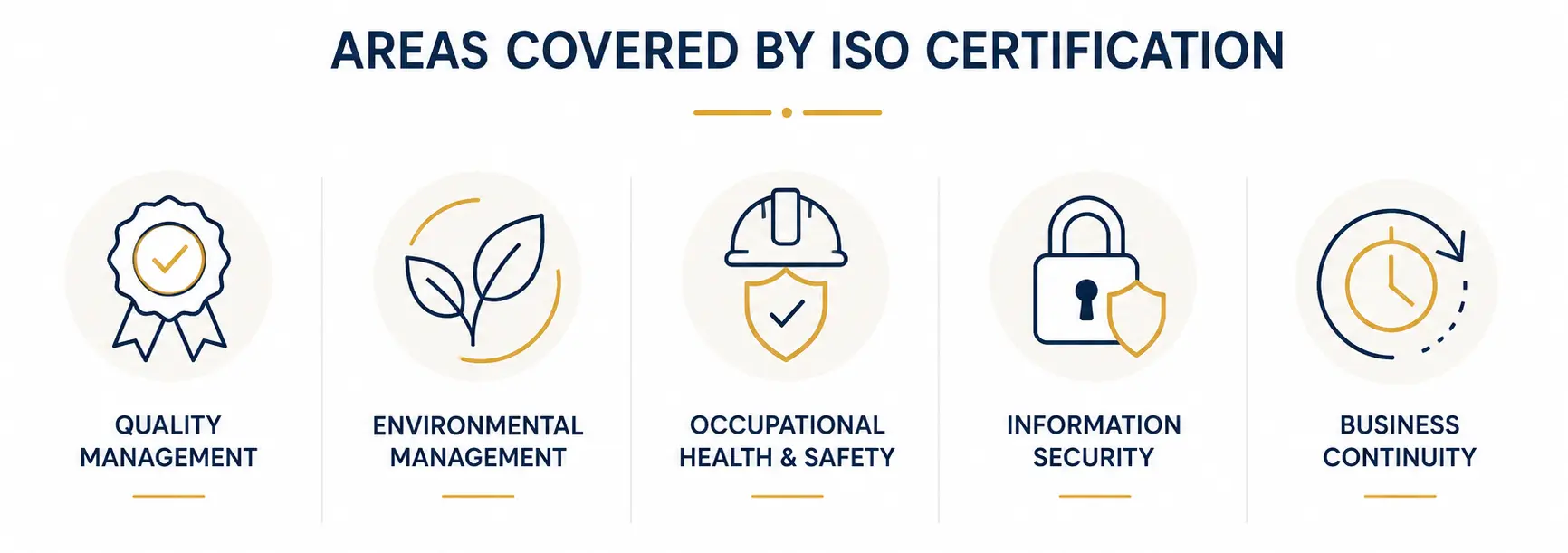
Depending on the standard, certification can cover quality, environmental management, occupational health & safety, information security, business continuity and more.
Why ISO certification matters for businesses in Qatar
ISO certification In Qatar has become a practical requirement for winning work — not just a quality badge.
As Qatar diversifies under Qatar National Vision 2030 — across construction, oil & gas, healthcare, IT, logistics, manufacturing and facilities — clients, government entities and EPC contractors increasingly expect structured, internationally aligned management systems. ISO certification helps Qatar organiszations:
- Qualify for tenders and supplier registration with bodies such as QatarEnergy, Ashghal (Public Works Authority) and Kahramaa.
- Pass contractor pre-qualification and client audits.
- Build credibility with local and international partners.
- Reduce operational and compliance risk.
- Improve consistency, efficiency and customer confidence.
Which ISO standard does your business need?
Start from your business objective, then match it to the right standard:
Business objective | Recommended ISO standard |
Improve quality & consistency | |
Manage environmental impact | |
Improve workplace safety | |
Protect information / data | |
Educational organizations | |
Anti-bribery & compliance | |
Business continuity / resilience | |
Medical devices quality | |
Facility management | |
Energy performance |
Not sure which applies? Guardian can confirm the right standard and scope for your activity, sites and tender requirements — [contact us].
Most popular ISO certifications in Qatar
|
Standard |
Focus |
Common industries |
|
ISO 9001 |
Quality management |
All sectors |
|
ISO 14001 |
Environmental management |
Construction, manufacturing, oil & gas |
|
ISO 45001 |
Occupational health & safety |
Construction, engineering, oil & gas |
|
ISO/IEC 27001 |
Information security |
IT, finance, healthcare, telecom |
|
ISO 21001 |
Educational organizations |
Schools, universities, training |
|
ISO 37001 |
Anti-bribery |
Contractors, corporates, govt suppliers |
|
ISO 22301 |
Business continuity |
Critical-service providers, finance |
|
ISO 13485 |
Medical devices quality |
Medical device firms, distributors |
Each standard links to its dedicated page — e.g. [ISO 9001 certification in Qatar], [ISO 14001…], [ISO 45001…], [ISO 27001…], [ISO 21001…], [ISO 37001…].
How much does ISO certification cost in Qatar?
ISO certification in Qatar typically ranges from about QAR 3,000 for a small, single-standard organization to QAR 40,000+ for large, multi-site or specialized certifications.
Cost depends on the standard, number of employees, number of sites, industry risk, certification scope and how prepared your management system already is. Indicative ranges:
Organization size | Indicative cost (QAR) | Indicative cost (USD) |
Small (1–20 staff) | QAR 3,000 – 15,000 | USD 800 – 4,000 |
Medium (20–100 staff) | QAR 15,000 – 36,000 | USD 4,000 – 10,000 |
Large (100+ staff) | QAR 36,000 – 90,000+ | USD 10,000 – 25,000+ |
What drives the price: the standard (ISO 27001/13485 audits are deeper than ISO 9001), employee count, number of locations, industry risk, scope breadth and existing documentation readiness. Certificates run on a 3-year cycle with annual surveillance audits — budget for the full cycle, not just year one. To know more must read – How much does ISO certification cost in Qatar?: Complete Breakdown & Pricing Guide (2026)
Get an exact figure: Guardian issues a fixed-fee quotation after a short scoping call — [Request a quote]
How long does ISO certification take in Qatar?
Most organisations achieve certification in about 1 to 4 months, depending on size, complexity and readiness.
Organisation type | Typical timeline |
Small business | 4 – 8 weeks |
Medium business | 6 – 12 weeks |
Large organisation | 8 – 16 weeks |
Multi-site organisation | 12 – 24 weeks |
Organisations that already have documented procedures and strong operational controls certify faster. Standards such as ISO 27001 can take longer because of the risk-assessment work involved.
The ISO certification process in Qatar (step by step)
ISO Certification process follows a structured path from gap analysis to a Stage 1 and Stage 2 audit, then ongoing surveillance — governed by ISO/IEC 17021-1.
- Select the right ISO standard for your activity and objectives.
- Gap analysis — compare current practice against the standard’s requirements.
- Documentation — develop the policies, procedures and records the standard needs.
- Implementation — put the system into day-to-day operation and brief staff.
- Internal audit — check the system works and fix gaps.
- Management review — leadership reviews performance, risks and improvements.
- Stage 1 audit (documentation & readiness), then Stage 2 audit (on-site implementation) by the certification body.
- Certificate issued (valid 3 years), maintained through annual surveillance audits.
Stage 1 vs Stage 2 — quick definition
Stage 1 audit: the certification body reviews your documentation and readiness.
Stage 2 audit: the auditor verifies the system is actually implemented and effective on site. The certification decision is made independently of the audit team.
Requirements & documents for ISO certification in Qatar
To achieve ISO certification in Qatar, an organization must establish a management system aligned to the relevant standard, define policies and responsibilities, identify risks and opportunities, keep documented information, run internal audits and management reviews, and close any non-conformities found during the audit. Typical documents include:
- Company trade license and organization char
- Management-system policies and objective
- Standard operating procedures and work instructions
- Risk and opportunity assessments
- Internal audit and management-review records
- Training records and operational/performance records
- Corrective-action records
To know more must read – ISO Mandatory Documentation List: What Your Business Must Have for Compliance (2026 Guide)
What makes an ISO certificate genuinely recognized in Qatar?
Not every ISO certificate carries the same weight. Recognition depends on accreditation, scope and verifiability — not just the certificate itself.
- Accredited certification body — the body should be accredited by an IAF MLA-recognized accreditation body (e.g. UAF, IAS) so the certificate is accepted internationally. Understanding the accreditation chain behind a certificate is essential. You can view our complete accreditation framework to see how accreditation, recognition, and certification issuance are structured.
- QS recognition — for local tenders, recognition by the Qatar General Organization for Standardization (QS) adds national credibility.
- Independent audit — certification follows an impartial third-party audit, not self-declaration.
- Accurate scope — the certificate must state the exact activities, sites and products covered.
- Ongoing surveillance — validity depends on annual surveillance audits and continual improvement.
- Public verifiability — accredited certificates can be verified on the IAF CertSearch register.
How to choose an ISO certification body in Qatar
Choose on accreditation, sector competence and credibility — not on the lowest price.
Factor | What to look for |
Accreditation | Accredited by an IAF MLA member (UAF, IAS); scope covers your standard |
Local recognition | QS-recognized for relevant standards (helps with Qatar tenders) |
Sector experience | Auditors who understand your industry’s risks |
Impartiality | A true certification body — not the same firm that built your system (a consultancy that also ‘certifies’ is a conflict of interest) |
Verifiability | Certificates listed on IAF CertSearch |
Transparency | Clear pricing, timelines and audit requirements |
Local support | On-the-ground presence in Doha for scheduling and audits |
To know more must read – How to choose an ISO certification body
How to Verify an ISO Certificate in Qatar
Before accepting an ISO certificate from a supplier, contractor, or service provider, it is important to verify that the certificate is genuine, accredited, and currently valid. Whether you are evaluating a vendor or pursuing ISO certification in Qatar, verifying certificates helps ensure compliance, credibility, and acceptance for business and tender requirements. An unverified certificate may not meet supplier approval, contractual, or regulatory expectations.
Step 1: Review the Certificate Details
Begin by reviewing the information displayed on the certificate. Make sure the following details are clearly shown:
- Certificate number
- Organization name
- Applicable ISO standard (e.g., ISO 9001, ISO 14001, ISO 45001, ISO/IEC 27001)
- Certification body name
- Accreditation body name
- Issue date and expiry date
- Scope of certification
Missing or unclear information should be treated as a warning sign and investigated further. This is especially important when assessing suppliers that claim to hold ISO certification in Qatar.
Step 2: Verify the Certification Body
Check whether the certification body issuing the certificate is accredited by an accreditation body that is recognized under the International Accreditation Forum (IAF) Multilateral Recognition Arrangement (MLA).
Accreditation provides confidence that the certification body operates according to internationally accepted requirements and that the certificate is more likely to be accepted by clients, regulators, and tendering authorities. For organizations seeking ISO certification in Qatar, choosing an accredited certification body is essential for international recognition.
Step 3: Search the Certificate on IAF CertSearch
Visit the IAF CertSearch public register and search using one of the following:
- Certificate number
- Organization name
- Certification body name
If the certificate is listed, review the information provided and compare it with the details shown on the certificate. This is one of the most reliable ways to verify the authenticity of an ISO certification in Qatar or any other country.
Step 4: Confirm the Certification Scope
Carefully review the scope of certification to ensure that it covers the activities relevant to the supplier, contractor, or service provider.
For example, a company certified for administrative support services may not be certified for engineering, construction, manufacturing, or other activities outside the stated scope. When reviewing ISO certification in Qatar, always ensure that the certified scope aligns with the products or services being offered.
Step 5: Check the Certificate Status
Verify the current status of the certificate. Common statuses include:
- Active
- Suspended
- Withdrawn
- Expired
Only active certificates should be relied upon for supplier approval, contract evaluation, or tender qualification purposes.
Step 6: Verify Validity Dates
Check that the certificate remains within its validity period and has not expired.
Also confirm that required surveillance audits have been maintained throughout the certification cycle, as ongoing compliance is necessary to keep a certificate valid. This is particularly important when evaluating organizations that advertise ISO certification in Qatar for tender participation or supplier qualification.
Following these steps helps ensure that an ISO certificate is genuine, internationally recognized, and suitable for business, tender, and compliance purposes. Proper verification also provides confidence that an organization claiming ISO certification in Qatar holds a valid and accredited certification.
Guardian’s accredited certificates (issued via Guardian Assessment Pvt Ltd and TNV Global Limited) are listed on IAF CertSearch, so any client, regulator or tendering authority can verify them in seconds.
ISO certification for tenders in Qatar
Many Qatar tenders and vendor-registration programs require or prefer ISO-certified suppliers, especially in construction, engineering, oil & gas, facility management, logistics, manufacturing, and healthcare. For businesses seeking ISO certification in Qatar, ISO 9001, ISO 14001, and ISO 45001 are the most commonly requested standards. A QS-recognized, IAF MLA-verifiable certificate is the strongest position for public-sector and EPC supply-chain qualification.
To know more must read – ISO Certification for Tenders in Qatar: Which ISO Standards Matter Most?
Why choose Guardian Middle East LLC
Guardian Middle East LLC is a QFC-licensed certification partner in Doha, delivering internationally accredited ISO certification with local support.
Guardian combines local presence in Qatar with an internationally accredited certification chain — a combination most consultants cannot offer:
Credential | Detail |
QFC licence | Guardian Middle East LLC — QFC Licence 03870, Doha |
Recognised by the Qatar General Organization for Standardization (QS), Registration RB066-26, under Ministerial Decree 363/2018 (valid to 1 April 2027) for ISO 9001, 14001, 45001 | |
International accreditation | Delivered via Guardian Assessment Pvt Ltd (India) under UAF and IAS (USA) accreditation, recognised under the IAF MLA |
Public verification | Accredited certificates listed on IAF CertSearch |
Specialised standards | Delivered via the TNV Global Limited (UAF) partnership |
Local & bilingual | Doha-based coordination; service in English and Arabic |
Standards Guardian supports include ISO 9001, 14001, 45001, 27001, 21001 and 37001, plus specialised standards via partnership. Guardian operates as an impartial certification body and does not provide consultancy to organisations it certifies.
ISO certification across Qatar
Guardian serves clients throughout Qatar — Doha, Lusail, Al Rayyan, Al Wakrah, Al Khor, Mesaieed, Dukhan, Ras Laffan and the Industrial Area — with audits delivered on-site at client locations, and remotely where permitted.
Guardian Middle East LLC | Serving the Middle East
QFC Licence 03870 · Doha, Qatar
Location: Abo Hamour Area, Doha, Qatar
P.O. Box: 23277, Doha, Qatar
Mobile: +974 7770 2602 | +974 7213 7770
Email: info@guardian.qa
Website: www.guardian.qa
Or submit an enquiry: → Contact Us
Frequently Asked Question
No. ISO certification is generally voluntary, but many clients, government projects, EPC contractors and supplier-registration programs require specific ISO certifications — so in practice it is often essential to win work.
Costs typically range from about QAR 3,000 for a small single-standard organization to QAR 40,000+ for large, multi-site or specialized certifications, depending on standard, employees, sites and scope.
Most organizations certify within 1–4 months. Small businesses often take 4–8 weeks; larger or multi-site organizations 12–24 weeks, depending on readiness.
Most accredited ISO certificates are valid for three years, subject to successful annual surveillance audits and continued compliance.
ISO 9001, ISO 14001, ISO 45001 and ISO/IEC 27001 are the most commonly implemented standards in Qatar, often combined as an Integrated Management System.
Yes. ISO standards apply to organizations of all sizes, including startups and SMEs; scope and cost scale with the size of the business.
Accreditation (e.g. UAF, IAS) attests to a certification body’s competence internationally under the IAF MLA. QS recognition is national-level acceptance in Qatar for ISO 9001, 14001 and 45001. Guardian holds both.
Check the certificate number, certification body and accreditation body, then search the IAF CertSearch register at iafcertsearch.org to confirm scope, validity and status.
It does not guarantee a contract, but it strengthens supplier pre-qualification, tender eligibility and client confidence — especially in construction, oil & gas, engineering and facility management.
Yes. Many organizations run an Integrated Management System combining ISO 9001, 14001 and 45001, with a single coordinated audit program that reduces audit time and cost.
Yes — for major non-conformities, missed surveillance audits, or failure to maintain the system. This is why certification is treated as an ongoing management system, not a one-off project.
No. As an impartial certification body, Guardian does not provide consultancy, gap analysis or implementation to clients it certifies; it offers free, generic implementation kits and independent audits only.
Yes. Accredited certificates are issued under UAF and IAS accreditation and recognized under the IAF Multilateral Recognition Arrangement (MLA), and are verifiable on IAF CertSearch.
Typically your trade licence, organization chart, management-system policies and procedures, risk assessments, internal-audit and management-review records, and relevant operational records.
Guardian is based in Doha and serves clients across Qatar — including Lusail, Al Rayyan, Al Wakrah, Al Khor, Mesaieed, Dukhan and the Industrial Area — with on-site audits.