

ISO 45001 certification requirements establish a structured framework for managing occupational health and safety (OH&S) risks, preventing workplace injuries and improving employee safety. Based on 10 main clauses, ISO 45001:2018 outlines the requirements organizations must address when establishing, implementing, maintaining, and continually improving an occupational health and safety management system.
The standard covers organizational context, leadership, hazard identification, risk assessment, operational controls, performance evaluation, and continual improvement. Understanding these requirements helps organizations identify workplace hazards, establish appropriate safety measures, and demonstrate conformity during certification audits.
Whether an organization operates in construction, manufacturing, healthcare, logistics or another industry, ISO 45001 certification provides a systematic approach to managing workplace health and safety responsibilities.
Understanding the 10 Clauses of ISO 45001
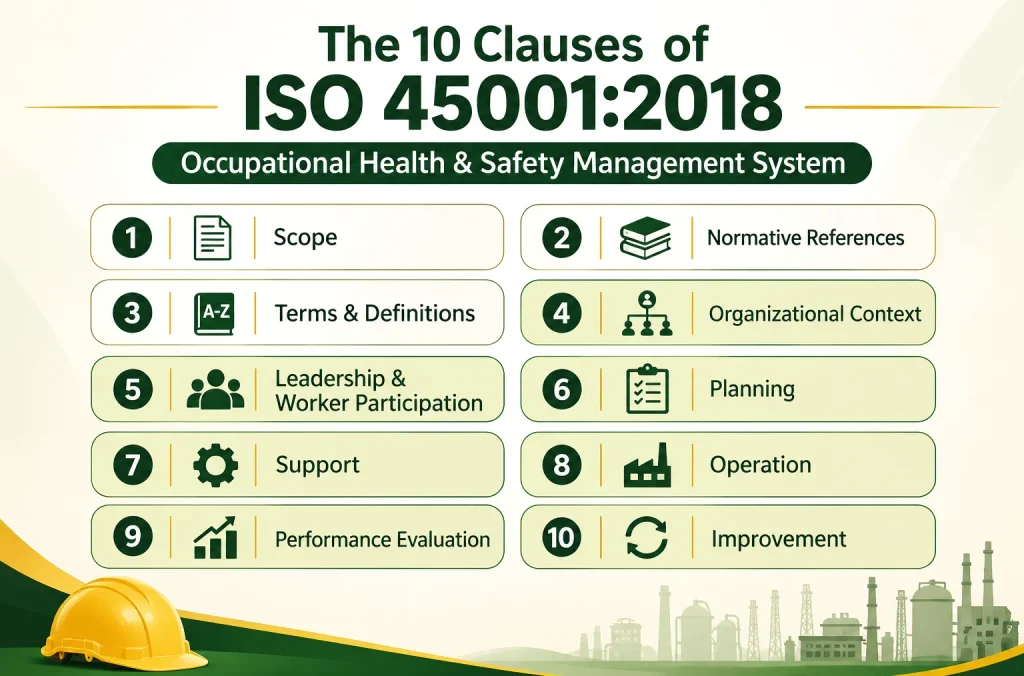
ISO 45001 follows a common High-Level Structure (HLS), organizing its requirements into 10 clauses. The first three clauses introduce the standard, while Clauses 4–10 establish the requirements for an occupational health and safety management system. The 10 clauses are:
| Clause | Title | Main focus |
| 1 | Scope | Purpose and application of the standard |
| 2 | Normative references | Referenced documents |
| 3 | Terms and definitions | Standard terminology |
| 4 | Context of the organization | Internal and external factors |
| 5 | Leadership and worker participation | Management commitment and employee involvement |
| 6 | Planning | Hazards, risks, opportunities and objectives |
| 7 | Support | Resources, competence and documented information |
| 8 | Operation | Operational controls and emergency preparedness |
| 9 | Performance evaluation | Monitoring, audits and management reviews |
| 10 | Improvement | Incident investigation and continual improvement |
Clauses 4–10 contain the requirements against which an organization’s OH&S management system is evaluated.
Understanding the PDCA Cycle in ISO 45001
ISO 45001 follows the Plan-Do-Check-Act (PDCA) methodology, a continuous improvement approach that connects planning, operational activities, performance evaluation, and improvement. The four stages work together:
- Plan: Identify workplace hazards, assess OH&S risks and opportunities, determine applicable requirements and establish safety objectives.
- Do: Provide resources, establish competence and implement planned operational controls.
- Check: Monitor safety performance, evaluate compliance, conduct internal audits and review results.
- Act: Address incidents and nonconformities, implement corrective actions and improve the management system.
The PDCA cycle connects with the main ISO 45001 clauses as follows:
- Plan: Clauses 4, 5 and 6
- Do: Clauses 7 and 8
- Check: Clause 9
- Act: Clause 10
This approach makes occupational health and safety management an ongoing organizational responsibility rather than a one-time compliance activity.
What Are the ISO 45001 Requirements by Clause?
Each of the seven main ISO 45001 requirement clauses addresses a different aspect of occupational health and safety management. Together, they establish the framework organizations must address within their OH&S management systems.
Clause 4: Context of the Organization
Clause 4 requires organizations to understand the factors that influence their occupational health and safety management system. This includes examining internal and external issues, identifying interested parties, and determining the system’s scope. The main requirements include:
1. Understanding the Organization and Its Context (4.1)
Organizations must identify internal and external issues that can affect their OH&S management system and its intended outcomes. Examples include:
- Workplace conditions and operational activities.
- Organizational structure and workforce composition.
- Changes in technology and working methods.
- Environmental and economic conditions affecting workplace safety.
Organizations must also determine whether climate change is a relevant issue for their OH&S management system, as introduced by ISO 45001:2018 Amendment 1:2024.
2. Understanding the Needs and Expectations of Workers and Other Interested Parties (4.2)
Organizations must identify relevant interested parties, such as employees, contractors, suppliers, regulators, and customers, and determine their relevant needs and expectations. They must also determine which of these needs and expectations become legal requirements or other requirements.
The 2024 climate change amendment also highlights that relevant interested parties may have climate-related requirements. Organizations should consider such requirements when determining which expectations are relevant to their OH&S management system.
3. Determining the Scope of the OH&S Management System (4.3)
The scope must define the boundaries and applicability of the management system. Organizations should consider their activities, locations, organizational units, workers, and relevant internal and external issues.
4. Establishing the OH&S Management System (4.4)
Organizations must establish, implement, maintain and continually improve an OH&S management system, including the necessary processes and their interactions.
Clause 5: Leadership and Worker Participation
Clause 5 emphasizes the responsibility of top management in establishing an effective occupational health and safety management system. It also requires meaningful consultation and participation of workers in relevant safety-related decisions. The main requirements include:
1. Leadership and Commitment (5.1)
Top management must demonstrate accountability for the effectiveness of the OH&S management system. This includes:
- Taking overall responsibility for preventing work-related injuries and ill health.
- Ensuring that the OH&S policy and objectives align with organizational direction.
- Providing necessary resources for the management system.
- Integrating OH&S requirements into business processes.
- Supporting workers and encouraging continual improvement.
2. Establishing an OH&S Policy (5.2)
Organizations must establish, implement and maintain an occupational health and safety policy that provides a framework for their safety objectives. The policy must include commitments to:
- Provide safe and healthy working conditions.
- Eliminate hazards and reduce OH&S risks.
- Fulfil applicable legal and other requirements.
- Continually improve the OH&S management system.
- Consult workers and encourage their participation.
3. Organizational Roles, Responsibilities and Authorities (5.3)
Responsibilities and authorities must be assigned and communicated throughout the organization. Top management retains overall accountability for the OH&S management system.
4. Consultation and Participation of Workers (5.4)
Organizations must establish processes for consulting and enabling workers at applicable levels and functions to participate in the development, planning, implementation, performance evaluation, and improvement of the OH&S management system. Examples include:
- Involving workers in hazard identification and risk assessments.
- Conducting workplace safety meetings.
- Encouraging incident and near-miss reporting.
- Consulting employees when developing safety procedures.
- Involving workers in incident investigations.
Organizations must also address barriers to worker participation and provide opportunities for workers to contribute to safety-related decisions.
Clause 6: Planning
Clause 6 focuses on identifying workplace hazards, assessing risks and opportunities, determining applicable requirements and establishing measurable OH&S objectives. It requires organizations to take a proactive approach to preventing workplace injuries and ill health. The main requirements include:
1. Actions to Address Risks and Opportunities (6.1.1)
Organizations must determine the risks and opportunities that need to be addressed to ensure that the OH&S management system achieves its intended outcomes, prevents or reduces undesired effects and supports continual improvement.
This includes considering relevant issues, the needs and expectations of workers and other interested parties, and the scope of the management system.
2. Hazard Identification (6.1.2.1)
Organizations must establish an ongoing and proactive process for identifying hazards. Hazard identification should consider:
- Physical hazards: Noise, heat, moving machinery, and working at heights.
- Chemical hazards: Exposure to hazardous substances.
- Biological hazards: Bacteria, viruses, and other harmful biological agents.
- Ergonomic hazards: Repetitive movements and improper workstation design.
- Psychosocial hazards: Excessive workload, workplace harassment and work-related stress.
- Human factors: Workload, fatigue and individual capabilities.
- Workplace changes: Changes in activities, equipment, processes and working conditions.
For example, a construction company may identify working at heights as a significant hazard. Its risk assessment should consider the likelihood and severity of a fall and determine appropriate control measures.
3. Assessment of OH&S Risks and Other Risks to the OH&S Management System (6.1.2.2)
After identifying hazards, organizations must assess the associated OH&S risks using established methodologies and criteria. Risk assessment generally considers:
- The likelihood of an incident occurring.
- The severity of potential injury or ill health.
- The effectiveness of existing controls.
- The need for additional risk reduction measures.
Organizations must also assess other risks that could affect the establishment, implementation, operation, and maintenance of their OH&S management system.
4. Assessment of OH&S Opportunities and Other Opportunities (6.1.2.3)
Organizations must identify opportunities to improve occupational health and safety performance and the effectiveness of their management system.
These may include improvements to working conditions, processes, equipment, hazard elimination measures, and worker participation.
5. Determination of Legal and Other Requirements (6.1.3)
Organizations must identify and maintain access to applicable occupational health and safety legal requirements and other requirements relevant to their activities.
They must also determine how these requirements apply to their operations and consider them when establishing, implementing and maintaining the OH&S management system.
6. Planning Actions (6.1.4)
Organizations must plan actions to address identified risks, opportunities and applicable legal and other requirements. These actions should be integrated into operational processes and evaluated for effectiveness.
7. OH&S Objectives and Planning to Achieve Them (6.2)
Under Clause 6.2.1, organizations must establish OH&S objectives at relevant functions and levels. Objectives should:
- Be consistent with the OH&S policy.
- Be measurable where practicable.
- Be monitored.
- Be communicated.
- Be updated when necessary.
Clause 6.2.2 requires organizations to plan how they will achieve these objectives. This includes determining the necessary activities, resources, responsibilities, timeframes and methods for evaluating results.
Examples include reducing workplace accidents, improving safety training completion rates and increasing the frequency of workplace inspections.
Clause 7: Support
Clause 7 establishes the resources and supporting processes required to operate an effective OH&S management system. The main requirements include:
1. Resources (7.1)
Organizations must determine and provide the resources needed to establish, implement, maintain, and continually improve their OH&S management system. These may include qualified personnel, infrastructure, equipment, technology, and financial resources.
2. Competence (7.2)
Workers must have the necessary competence to perform their assigned tasks safely. Organizations must determine relevant competence requirements, ensure appropriate training or experience, and evaluate the effectiveness of actions taken to acquire competence.
3. Awareness (7.3)
Workers must understand:
- The OH&S policy and relevant safety objectives.
- Their contribution to the effectiveness of the management system.
- Workplace hazards and associated OH&S risks.
- Relevant incidents and investigation findings.
- The consequences of not following applicable safety requirements.
4. Communication (7.4)
Organizations must establish processes for internal and external communication concerning relevant OH&S matters. Communication arrangements should determine what information is shared, when it is communicated, who receives it, and how communication takes place.
5. Documented Information (7.5)
Organizations must maintain and retain the documented information required by ISO 45001 and any additional information they determine is necessary for the effectiveness of their OH&S management system.
This includes appropriate controls for creating, updating, accessing, protecting, storing, and retaining documented information.
Clause 8: Operation
Clause 8 focuses on controlling workplace activities and managing the risks associated with daily operations. Organizations must establish operational processes that prevent injuries and ill health while maintaining effective safety controls. The main requirements include:
1. Operational Planning and Control (8.1.1)
Organizations must plan, implement, and control processes needed to meet OH&S requirements and implement the actions identified during planning. This includes:
- Establishing operational criteria for workplace activities.
- Implementing controls according to established criteria.
- Maintaining documented information where necessary to demonstrate that processes have been carried out as planned.
- Adapting work to workers where practicable.
2. Eliminating Hazards and Reducing OH&S Risks (8.1.2)
Organizations must apply a hierarchy of controls when eliminating hazards and reducing occupational health and safety risks. The five levels, in order of priority, are:
- Elimination: Physically remove the hazard from the workplace.
- Substitution: Replace the hazardous material, equipment, or process with a safer alternative.
- Engineering controls: Isolate workers from hazards through physical safeguards or protective systems.
- Administrative controls: Introduce safe working procedures, training, supervision, and warning systems.
- Personal protective equipment (PPE): Provide appropriate protective equipment to reduce exposure to remaining hazards.
For example, in a manufacturing facility, replacing a hazardous chemical with a safer alternative is generally preferable to relying only on protective gloves and masks.
3. Management of Change (8.1.3)
Organizations must establish processes for managing planned temporary and permanent changes that can affect OH&S performance. Changes may involve:
- New equipment and technologies.
- Workplace layouts and infrastructure.
- Staffing and work arrangements.
- Products, services and operational processes.
- Legal and other requirements.
Unintended changes must also be reviewed, with appropriate actions taken to address adverse effects.
4. Procurement (8.1.4)
Organizations must establish processes to control the procurement of products and services to ensure they conform to the OH&S management system requirements. This includes:
- Contractors (8.1.4.2): Coordinating relevant OH&S controls with contractors and identifying hazards arising from their activities that may affect workers or other interested parties.
- Outsourcing (8.1.4.3): Ensuring that outsourced functions and processes are controlled and consistent with applicable OH&S management system requirements.
5. Emergency Preparedness and Response (8.2)
Organizations must establish processes to prepare for and respond to potential emergencies. These arrangements may include:
- Fire and evacuation procedures.
- First-aid and medical emergency arrangements.
- Emergency communication systems.
- Procedures for chemical spills and hazardous substance releases.
- Emergency drills and response testing.
Emergency arrangements must be periodically tested where practicable and reviewed after drills or actual emergencies. Organizations must also maintain documented information about their emergency preparedness and response processes and plans.
Clause 9: Performance Evaluation
Clause 9 requires organizations to monitor, measure, analyze and evaluate the effectiveness of their OH&S management system. The main requirements include:
1. Monitoring, Measurement, Analysis and Performance Evaluation (9.1.1)
Organizations must determine what needs to be monitored and measured, the methods to be used, and when performance results will be analyzed and evaluated. Examples include:
- Workplace accident and injury records.
- Near-miss reports.
- Safety inspection results.
- Training and competence records.
- Effectiveness of operational controls.
- Progress towards OH&S objectives.
2. Evaluation of Compliance (9.1.2)
Organizations must establish processes to evaluate whether they meet applicable legal and other requirements. They must determine the frequency and methods of evaluation, take action when necessary, and maintain knowledge of their compliance status. Documented information must be retained as evidence of the compliance evaluation results.
3. Internal Audit (9.2)
Organizations must conduct internal audits at planned intervals to determine whether the OH&S management system:
- Conforms to the organization’s own OH&S management system requirements.
- Meets the requirements of ISO 45001.
- Is effectively implemented and maintained.
An internal audit programme must define relevant arrangements, including audit frequency, methods, responsibilities, planning and reporting. Auditors should be selected to ensure objectivity and impartiality.
4. Management Review (9.3)
Top management must review the OH&S management system at planned intervals to ensure its continuing suitability, adequacy and effectiveness. The review considers matters such as:
- Progress towards OH&S objectives.
- Incident and nonconformity trends.
- Results of internal audits.
- Legal compliance status.
- Changes in internal and external issues.
- Worker consultation and participation.
- Adequacy of resources.
- Opportunities for continual improvement.
The results of management reviews must include relevant decisions and actions concerning the management system. Documented information must be retained as evidence of the review results.
Clause 10: Improvement
Clause 10 focuses on addressing incidents, correcting nonconformities, and continually improving occupational health and safety performance. The main requirements include:
1. General Improvement (10.1)
Organizations must identify opportunities for improvement and implement the necessary actions to achieve the intended outcomes of their OH&S management system.
2. Incidents, Nonconformities and Corrective Actions (10.2)
When an incident or nonconformity occurs, organizations must:
- Respond to the incident or nonconformity and take appropriate action to control and correct it.
- Address the consequences, including mitigating adverse OH&S effects.
- Investigate the incident or review the nonconformity.
- Determine the underlying causes and whether similar situations exist elsewhere.
- Implement appropriate corrective actions.
- Review the effectiveness of corrective actions.
- Update risk assessments and the OH&S management system where necessary.
For example, if a worker is injured because of an unguarded machine, the organization must investigate the incident, identify why the guarding was missing or ineffective, implement corrective action, and check whether similar machinery presents the same risk.
3. Continual Improvement (10.3)
Organizations must continually improve the suitability, adequacy and effectiveness of their OH&S management system.
This includes improving OH&S performance, worker participation, hazard identification processes and the effectiveness of workplace risk controls.
Understanding the Importance of the Hierarchy of Controls
The hierarchy of controls helps organizations prioritize risk reduction measures according to their effectiveness. It encourages organizations to eliminate hazards or replace them with safer alternatives before relying on administrative controls and personal protective equipment.
Where a hazard cannot be eliminated, organizations should select suitable combinations of controls to reduce the remaining OH&S risks.
What Documents and Records Are Required for ISO 45001?
ISO 45001 requires organizations to maintain and retain documented information to demonstrate that their OH&S management system is established, implemented and operating effectively.
The type and extent of documentation depend on the organization’s size, activities, operational complexity and the competence of its workforce.
The following table outlines examples of documented information associated with the standard.
| Document or record | Related clause |
| OH&S management system scope | 4.3 |
| OH&S policy | 5.2 |
| Hazard identification and risk assessment methodology and relevant information | 6.1.2 |
| Legal and other requirements | 6.1.3 |
| OH&S objectives | 6.2.1 |
| Evidence of worker competence | 7.2 |
| Documented information necessary for operational control | 8.1.1 |
| Emergency preparedness and response processes and plans | 8.2 |
| Monitoring and measurement results | 9.1.1 |
| Compliance evaluation results | 9.1.2 |
| Internal audit programme and audit results | 9.2 |
| Management review results | 9.3 |
| Incident, nonconformity and corrective action information | 10.2 |
This is an illustrative documentation checklist, not a requirement to create a separate document for every item. ISO 45001 specifies documented information that must be maintained or retained in particular areas, while allowing organizations to determine suitable formats and levels of documentation.
How Can an Organization Demonstrate Conformity with ISO 45001?
Organizations must demonstrate that their OH&S management system is not only documented but also effectively implemented and maintained. Evidence of conformity may include:
- Workplace evidence: Inspections, equipment safeguards and operational controls.
- Worker involvement: Consultation records, safety meeting minutes and hazard reports.
- Performance results: Incident data, monitoring results and progress towards OH&S objectives.
- Audit evidence: Internal audit findings and follow-up actions.
- Management decisions: Management review results and improvement actions.
- Corrective action records: Incident investigations, identified causes and effectiveness reviews.
Evidence should reflect actual workplace practices and the effectiveness of the management system rather than documentation prepared solely for an audit.
ISO 45001 Requirements Checklist
Organizations can use the following checklist as an initial reference when reviewing their occupational health and safety management systems.
- The OH&S management system scope has been defined.
- Relevant internal and external issues have been identified.
- The relevance of climate change to the OH&S management system has been determined.
- Interested parties and their relevant requirements have been determined.
- An OH&S policy has been established and communicated.
- Management responsibilities and authorities have been assigned.
- Worker consultation and participation processes are in place.
- Workplace hazards have been identified.
- OH&S risks and opportunities have been assessed.
- Applicable legal and other requirements have been identified.
- OH&S objectives and action plans have been established.
- Necessary resources and worker competencies have been determined.
- Communication and documented information are controlled.
- Operational controls have been implemented.
- Emergency preparedness arrangements have been established and tested where practicable.
- OH&S performance is monitored and evaluated.
- Compliance with legal and other requirements is periodically evaluated.
- Internal audits are conducted at planned intervals.
- Management reviews are performed.
- Incidents and nonconformities are investigated and addressed.
- Corrective actions are reviewed for effectiveness.
- Continual improvement opportunities are identified and addressed.
This checklist provides an overview of important requirements. A complete conformity assessment must consider all applicable requirements of ISO 45001.
What Are the Common Challenges in Meeting ISO 45001 Requirements?
Organizations may encounter practical difficulties when maintaining an effective OH&S management system. These challenges often arise when established safety processes are not consistently followed or evaluated.
Common challenges include:
- Incomplete Hazard Identification: Organizations may overlook risks associated with non-routine work, contractors, ergonomic conditions, or psychosocial factors.
- Insufficient Worker Participation: Workers may hesitate to report hazards or may not be sufficiently involved in safety-related decisions, limiting the information available to identify workplace risks.
- Inconsistent Operational Controls: Safety procedures may be established but not consistently followed across departments, work locations, or contractor activities.
- Weak Documentation and Record Management: Outdated assessments, incomplete training evidence, and missing incident records can make it difficult to demonstrate that safety processes are operating effectively.
- Limited Performance Evaluation: Organizations may collect safety data without analysing trends or using the findings to evaluate the effectiveness of existing controls.
- Ineffective Corrective Actions: Similar incidents may recur when investigations address immediate causes but fail to identify and address underlying problems.
Addressing these challenges requires consistent management involvement, worker participation, and regular evaluation of the OH&S management system.
Get ISO 45001 Certification — Contact Guardian Middle East LLC
Meeting ISO 45001 requirements demonstrates an organization’s commitment to establishing a structured occupational health and safety management system, controlling workplace risks and continually improving safety performance. For organizations operating in Qatar and the Middle East, understanding these requirements is an important step towards assessing their OH&S management systems and considering certification.
Guardian Middle East LLC represents Guardian Assessment UK Ltd, a UK-based certification body recognized by the United Accreditation Foundation (UAF) and the International Accreditation Service (IAS), USA. Guardian Middle East LLC is also QS-registered (Registration No. RB066-26) for the applicable certification scope, including ISO 45001.
Guardian Middle East LLC | Serving the Middle East
QFC Licence 03870 · Doha, Qatar
Location: Abo Hamour Area, Doha, Qatar
P.O. Box: 23277, Doha, Qatar
Mobile: +974 7770 2602 | +974 7213 7770
Email: info@guardian.qa
Website: www.guardian.qa
Or submit an enquiry: → Contact
Frequently Asked Questions
Are All 10 Clauses of ISO 45001 Mandatory?
ISO 45001 contains 10 clauses, but the auditable management system requirements are primarily contained in Clauses 4–10. Clauses 1–3 provide the scope, normative references, and terminology. Organizations claiming conformity must fulfil all applicable requirements without excluding requirements that apply to their OH&S management system.
Which ISO 45001 Clauses Are Used for Certification Audits?
Clauses 4–10 contain the requirements assessed during certification audits. Auditors evaluate organizational context, leadership, planning, support, operations, performance evaluation, and improvement to determine whether the OH&S management system conforms to the standard.
Does ISO 45001 Require Documented Procedures?
ISO 45001 requires specific documented information to be maintained and retained, but it does not prescribe a separate documented procedure for every activity. Organizations determine the documentation necessary to support effective processes and demonstrate conformity.
Is Worker Participation Mandatory Under ISO 45001?
Yes. Clause 5.4 requires organizations to establish processes for consultation and participation of workers at applicable levels and functions. This includes their involvement in relevant activities such as hazard identification, risk assessment, incident investigation, and improvement.
How Often Should an ISO 45001 Internal Audit Be Conducted?
ISO 45001 requires internal audits at planned intervals but does not prescribe one fixed frequency for every organization. Audit frequency should be determined based on factors such as the importance of processes, changes affecting the organization, and previous audit results.
Can Small Businesses Implement ISO 45001?
Yes. ISO 45001 can be applied to organizations of different sizes and industries. The scope, processes, and documentation should be appropriate to the organization’s activities, workforce, operational risks, and applicable requirements.
Does ISO 45001 Guarantee That Workplace Accidents Will Not Occur?
No. ISO 45001 provides a framework for preventing work-related injuries and ill health and improving OH&S performance. Certification does not guarantee that accidents or workplace hazards will be eliminated.
What Is the Difference Between ISO 45001 Requirements and ISO 45001 Certification?
ISO 45001 requirements define what an organization’s OH&S management system must address. Certification is the independent conformity assessment process through which an organization demonstrates that its management system meets the applicable requirements of the standard.
Comments are closed