

A company may have safety signs, provide employee training, and give workers protective equipment, yet workplace incidents can still happen. This often happens when there is no clear system for identifying risks, dealing with problems, and checking whether safety measures are actually working.
This is where ISO 45001 Certification can help.
According to the International Labour Organization (ILO), approximately 2.93 million people die each year worldwide because of work-related accidents and illnesses. This shows why businesses need to take steps to prevent workplace incidents instead of waiting for something to go wrong.
ISO 45001 gives businesses a clear way to manage workplace health and safety. Certification provides independent confirmation that their management system meets the requirements of the standard.
What Is ISO 45001 Certification?
ISO 45001 certification confirms that an organization’s Occupational Health and Safety Management System (OH&S) has been independently assessed against the requirements of the ISO 45001 standard.
In simple terms, it means a business has a system for identifying workplace hazards, managing risks, protecting workers, and improving safety over time. To understand this better, it helps to know the difference between three things:
- ISO 45001 is the standard: It explains what an organization needs to do to manage workplace health and safety effectively.
- The management system is how the company manages safety: This includes assigning responsibilities, assessing risks, involving workers, taking preventive measures, and reviewing results.
- Certification is the independent assessment: A certification body checks whether the organization’s management system meets the requirements of ISO 45001 and is working in practice.
A business can implement ISO 45001 Certification without applying for certification. The current published edition is ISO 45001:2018, together with its 2024 climate-action amendment. As of October 2026, a revised edition is under development, but it has not replaced the existing standard.
What Is the Main Purpose of ISO 45001?
The main purpose of ISO 45001 is to help businesses prevent work-related injuries and ill health by identifying and managing risks before people get hurt.
Instead of waiting for an accident to happen and then investigating it, businesses are encouraged to think ahead and ask:
- What could go wrong during this task?
- Who could be affected?
- What can we do to prevent or reduce the danger?
- How will we know whether our safety measures are working?
ISO 45001 also encourages businesses to involve workers in safety decisions and regularly review how well their safety arrangements are working.
The aim is to move away from dealing with problems only after they happen. Instead, businesses can plan, listen to their workers, and keep improving how they manage workplace safety.
How Does ISO 45001 Work in Practice?
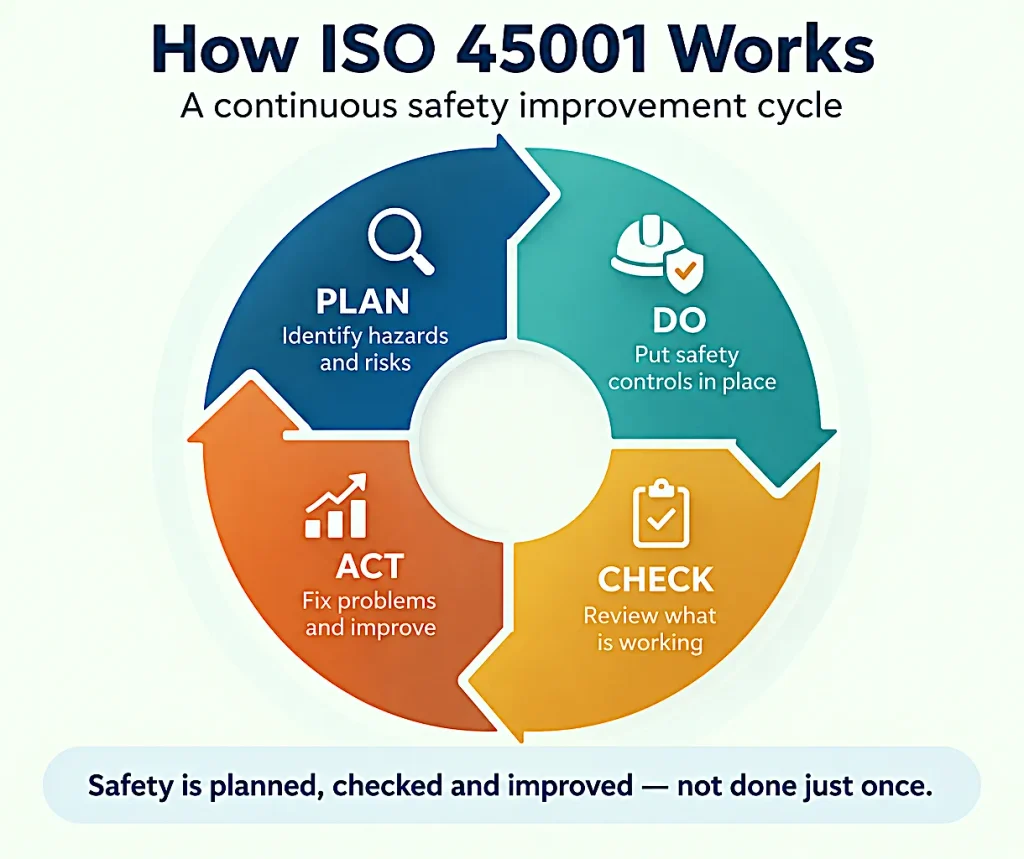
ISO 45001 follows a continuous improvement process called Plan–Do–Check–Act (PDCA).
Let’s understand how it works through a simple example. Imagine a warehouse where forklifts and employees regularly move through the same loading area.
Plan — Identify the Risk: Workers report several near misses involving forklifts at a busy corner. Management talks to employees, watches how vehicles move around the area, and identifies where someone could be hit by a moving forklift. The company then assesses the risk and decides what needs to change.
Do — Put Safety Measures in Place: The warehouse creates separate walking routes for employees, marks pedestrian crossings, and improves visibility around the busy corner. Supervisors explain the new arrangements to forklift operators, warehouse employees, and relevant contractors. They also assign responsibility for keeping the walking routes clear.
Check — See Whether the Measures Are Working: Supervisors observe the area, review near-miss reports, and ask workers whether the changes have made the area safer. During these checks, they discover that incoming deliveries sometimes block the designated pedestrian crossing.
Act — Fix Problems and Improve: The warehouse changes its delivery arrangements and introduces regular checks to make sure the crossing stays clear. Supervisors continue monitoring the area to confirm that the changes are working as intended.
This is how ISO 45001 connects everyday workplace safety activities. Putting a safety measure in place is not enough on its own. Businesses also need to check whether it works in real working conditions.
What Does ISO 45001 Certification Cover?
ISO 45001 covers the main activities businesses need to manage workplace health and safety effectively.
These activities work together. Management sets safety priorities, employees help identify problems, suitable safety measures are introduced, and the results are checked to see what needs improvement.
Table 1: Key Areas Covered by ISO 45001
| Key Area | What It Means in Practice |
| Leadership | Managers set safety priorities, provide the necessary resources, and follow up on safety concerns. |
| Worker participation | Employees are asked for their input and involved in identifying hazards and improving workplace safety. |
| Hazard identification and risk assessment | The business identifies what could cause harm and decides how to reduce the risks. |
| Operational safety controls | The business puts safe working methods, equipment controls, and suitable arrangements for contractors in place. |
| Legal requirements | The business identifies the health and safety rules that apply to its activities and checks whether it is meeting them. |
| Emergency preparedness | The business prepares for possible emergencies and tests its arrangements where appropriate. |
| Performance monitoring and improvement | Inspections, incident investigations, and audits help the business find weaknesses and decide what needs to improve. |
These activities are not just tasks to complete before applying for certification. They need to be part of the way the business operates.
For example, if an employee reports unsafe equipment, the company should have a clear way to review the concern, assign someone to fix the problem, and check that it has been resolved. This connection between employees, responsibilities, and follow-up is what makes the management system useful in everyday work.
How Is ISO 45001 Applied in a Real Workplace?
Illustrative example: A construction contractor operating in Doha, Qatar.
During the summer, several outdoor workers report feeling tired and dizzy while carrying out physically demanding work. Instead of simply reminding everyone to drink water, the contractor takes a closer look at the working conditions and the risks involved. First, supervisors identify which tasks expose workers to high temperatures and who may be affected. They also speak with employees to understand their working conditions and any difficulties they face.
Management then reviews the risks and assigns responsibilities. Supervisors look at work schedules, arrange suitable breaks, and make sure drinking water and shaded rest areas are available. Site managers also check whether subcontractors are following the required safety arrangements. The company continues to review working conditions and listen to worker feedback. If the existing measures are not working well enough, it makes further changes.
Qatar-specific consideration: Under Ministerial Decision No. 17 of 2021, certain outdoor work and work in inadequately ventilated shaded areas are restricted between 10:00 a.m. and 3:30 p.m., from June 1 to September 15. The importance of these requirements was highlighted in September 2026, when Qatar’s Ministry of Labour reported closing 388 worksites for not following summer heat-stress precautions.
These legal requirements apply whether or not a business has ISO 45001 certification. The management system helps businesses identify their responsibilities, manage the related risks, and regularly check whether the necessary measures are in place.
This is an illustrative example of how ISO 45001 Certification can support everyday workplace safety decisions. It is not a real client case and does not prove full compliance with the standard.
Which Businesses and Industries Can Use ISO 45001?
ISO 45001 can be used by businesses of different sizes and across different industries. The safety measures a business needs depend on the work it carries out and the risks its employees face.
For example:
- Construction and MEP companies: Can use ISO 45001 Certification to manage risks related to working at height, electrical installations, lifting equipment, and working with multiple contractors.
- Oil and gas businesses: Can use it to manage risks involving hazardous equipment, maintenance work, emergencies, and contractor activities.
- Manufacturing companies: Can use it to address machinery hazards, noise, manual handling, and equipment maintenance.
- Logistics and warehousing businesses: Can use it to manage risks involving moving vehicles, loading activities, and handling materials.
Office-based businesses can also use ISO 45001 Certification to manage relevant physical and work-related health risks. The important thing is to build a management system around the business’s actual activities, employees, and workplace hazards.
A small business does not need to copy all the documents and procedures used by a large industrial company. It needs arrangements that are suitable for its own operations and the risks it needs to manage.
What Are the Benefits of ISO 45001 Certification?
The main benefit of ISO 45001 comes from having a reliable way to manage workplace safety. Certification adds confidence by providing an independent assessment of the management system. The practical benefits may include:
- Identifying problems earlier: Regular hazard reporting and reviews of near misses can help businesses spot unsafe conditions before they lead to serious incidents.
- Clearer responsibilities: Assigning responsibility for safety concerns and checking corrective actions helps prevent important problems from being overlooked.
- Greater employee involvement: Workers can point out problems that management may not notice and suggest practical ways to improve safety.
- More consistent safety practices: Common procedures and regular checks help businesses maintain suitable safety measures across different activities.
- Greater customer confidence: When a client or tender requires ISO 45001 Certification, a valid certificate covering the relevant activities can support the business during supplier assessments.
These benefits depend on how well the management system is put into practice and maintained. Certification does not automatically guarantee fewer accidents, compliance with every legal requirement, lower insurance premiums, or successful tender applications.
ISO 45001 Implementation vs Certification: What Is the Difference?
Implementing ISO 45001 Certification and getting certified are two different things.
Implementation means setting up and running a system to manage workplace health and safety.
Certification means asking an independent certification body to assess that system against the requirements of ISO 45001.
ISO 45001 Implementation vs Certification
| Question | Implementation | Certification |
| Who is responsible? | The organization’s leadership, managers, and workers. | An independent certification body carries out the assessment and makes the certification decision. |
| What happens? | The business assesses hazards, puts safety measures in place, and reviews how well they work. | Auditors review records, speak with employees, and check how the management system works in practice. |
| What is the result? | A working occupational health and safety management system. | A certificate, if the system meets the requirements within the approved scope. |
| What happens afterward? | The business continues managing and improving workplace safety. | Surveillance and recertification audits check whether the system continues to meet the requirements. |
For example, a maintenance company must continue inspecting its equipment, reviewing workplace risks, and fixing problems even after receiving ISO 45001 Certification.
The certificate does not replace the company’s responsibility to keep its workplace safe.
What Does an ISO 45001 Certificate Actually Confirm?
An ISO 45001 certificate confirms that an organization’s management system has been independently assessed against the standard for a specific scope of certification. The scope explains which activities and locations are covered by the certificate.
For example, a certificate covering one facility does not automatically cover every branch, project, or subcontractor associated with the business. When checking a supplier’s certificate, businesses should look at:
- The company’s name.
- The activities covered by the certificate.
- The locations included in the certification scope.
- The certification body that issued it.
- Whether the certificate is still valid.
A valid certificate confirms that the management system has been assessed within the stated scope. It does not guarantee that every workplace is free from hazards or that incidents can never happen.
How Can a Business Get ISO 45001 Certification?
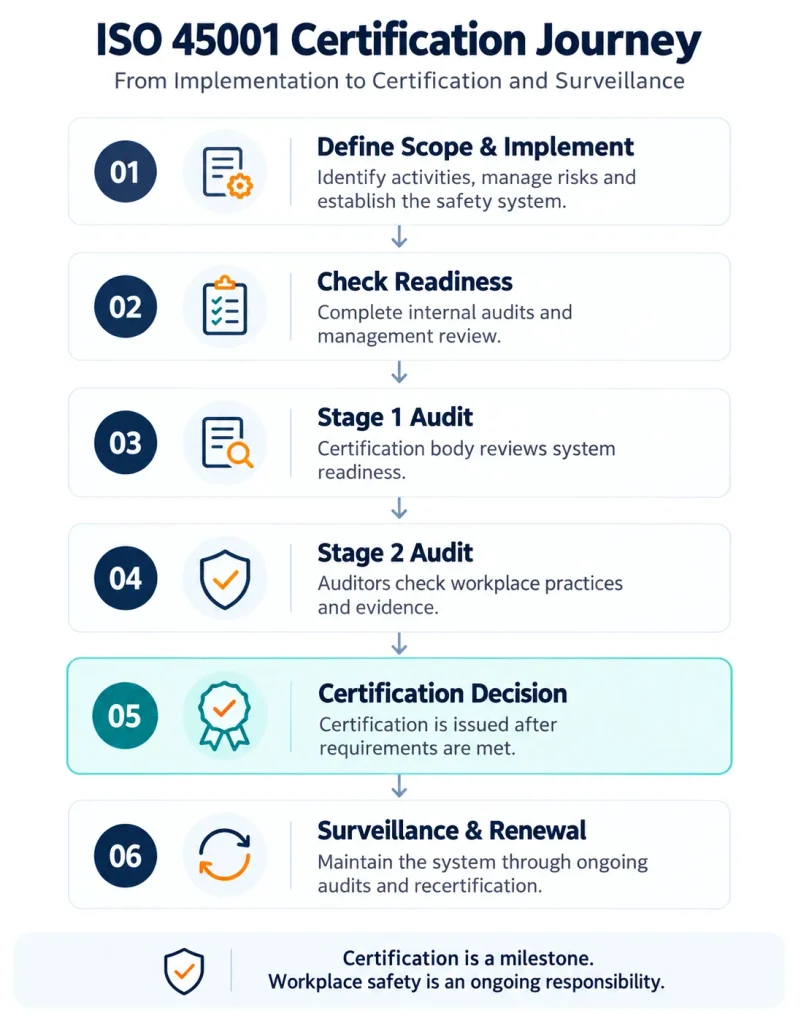
Getting ISO 45001 Certification generally involves six stages.
- Define the certification scope. Decide which business activities, workplaces, and locations will be included in the assessment.
- Set up the management system. Assess workplace risks, involve employees, put suitable safety measures in place, and keep records showing how the system operates.
- Check whether the business is ready. Carry out an internal audit and management review, identify any weaknesses, and address them before the external assessment.
- Complete the Stage 1 audit. The certification body reviews the main arrangements and checks whether the business is ready for the more detailed assessment.
- Complete the Stage 2 audit. Auditors check how the system works in practice by reviewing records, speaking with employees, and observing workplace activities. If they identify any nonconformities, the business may need to take corrective action before a certification decision can be made.
- Maintain certification. After a positive certification decision, surveillance audits are normally carried out during the three-year certification cycle. The business must then complete recertification before the certificate expires to continue its certification.
What Do Auditors Actually Look For?
Imagine a company has a written procedure stating that lifting equipment must be inspected regularly. An auditor may review the inspection records, check the condition of the equipment, and speak with operators to understand how faults are reported.
This helps the auditor determine whether the company follows its procedure during everyday work or whether the procedure exists only on paper. The time needed to obtain certification varies depending on the company’s existing arrangements, how prepared it is, the activities it carries out, the number of locations involved, and the complexity of its operations.
Your Partner for ISO 45001 Certification in Qatar
Guardian Middle East LLC represents Guardian Assessment UK Ltd, a UK-based certification body recognized by UAF and IAS. If your organization is planning ISO 45001 Certification in Qatar, Guardian can help you understand the certification requirements, define your certification scope, and navigate the independent audit process with a clear, structured, and impartial approach.
Whether you operate in construction, oil and gas, manufacturing, logistics, or another industry, the certification assessment focuses on how effectively your organization manages occupational health and safety risks within its defined scope.
Guardian Middle East LLC – Contact Details
- Location: Abo-Hamour Area, opposite the Medical Commission, Doha, Qatar
- P.O. Box: 23277, Doha, Qatar
- Phone: +974 7770 2602 | +974 7213 7770
- Email: info@guardian.qa
Final Takeaway
ISO 45001 certification is independent confirmation that an organization’s Occupational Health and Safety Management System meets the requirements of the ISO 45001 standard. For businesses in Qatar, the practical approach is to understand workplace hazards, assess occupational health and safety risks, meet applicable legal requirements, involve workers in safety decisions, and implement controls that work in everyday operations.
A well-prepared organization should be able to demonstrate more than written safety policies and procedures. It should show how workplace risks are identified, safety measures are implemented, their effectiveness is monitored, and improvements are made when necessary.
Ultimately, ISO 45001 Certification is not just about achieving certification. It is about building a workplace where health and safety are consistently managed, reviewed, and improved.
Frequently Asked Questions
Does ISO itself issue ISO 45001 certificates?
No. ISO develops and publishes standards but does not issue ISO 45001 certificates. Independent certification bodies assess organizations and issue certificates. Accreditation bodies may separately assess the competence of those certification bodies.
How long is ISO 45001 certification valid?
Accredited certification normally follows a three-year cycle. Surveillance audits are typically conducted annually, and recertification takes place before the next cycle. The organization must continue meeting the applicable requirements to maintain certification.
How can businesses verify an ISO 45001 certificate?
Businesses can check the certificate details with the certification body that issued it and the relevant accreditation body. Eligible accredited certificates may also be checked through IAF CertSearch.
If a certificate cannot be found in a database, it is best to contact the relevant body for confirmation before drawing any conclusions.
Does ISO 45001 guarantee that workplace accidents will never happen?
No. ISO 45001 helps businesses identify and manage workplace risks in a structured way, but it cannot remove every possible danger or guarantee that an accident will never occur.
Comments are closed