

Environmental responsibility is no longer just about having a policy on paper. For most organizations, the real challenge is knowing what environmental impacts matter, how to control them, and how to prove that the system actually works.
That is where ISO 14001 certification comes in. It provides independent confirmation that an organization has implemented an Environmental Management System (EMS) that meets ISO 14001 requirements and manages environmental responsibilities in a structured, measurable way.
In practice, this means identifying significant impacts, setting controls, meeting applicable obligations, monitoring performance, and continually improving. For organizations in Qatar, this may include areas such as waste, energy and water use, emissions, hazardous materials, environmental permits and operational environmental risks.
The current edition is ISO 14001:2026, the fourth edition of the standard, published on 15 April 2026.
What Is ISO 14001 Certification?
ISO 14001 is the internationally recognized standard for Environmental Management Systems.
Rather than telling every organization to achieve the same environmental result, it provides a management framework. Organizations use that framework to identify their environmental responsibilities, decide what needs to be controlled, set objectives, monitor performance, and continually improve.
The EMS is the working system behind the certification. It connects environmental management with everyday business activities: who is responsible, what environmental issues matter, which obligations apply, how controls are maintained, and how results are reviewed.
Certification adds another layer: independent assessment.
A certification body audits the EMS to determine whether it conforms to ISO 14001 requirements. If the certification requirements are met, the certification body can issue a certificate.
One point is worth making clear: ISO develops and publishes ISO 14001, but ISO itself does not audit organizations or issue ISO 14001 certificates. Certification is carried out by external certification bodies.
For example, a construction company may need to manage waste, fuel use, dust, noise, and spill risks. ISO 14001 is not simply asking that company to create procedures. It expects the organization to understand which impacts matter, put suitable controls in place, monitor whether those controls work, and respond when results fall short.
What Are the Core Principles of ISO 14001?
The practical thinking behind ISO 14001 includes leadership, environmental responsibility, risk and opportunity-based thinking, compliance obligations, life-cycle considerations, performance evaluation, and continual improvement.
A particularly useful way of understanding the system is through the Plan-Do-Check-Act (PDCA) approach.
How Does PDCA Work in ISO 14001?
- Plan: Understand environmental aspects, risks, opportunities, and obligations, then establish objectives.
- Do: Put responsibilities, resources, and operational controls into practice.
- Check: Monitor performance, evaluate compliance, conduct audits, and review results.
- Act: Correct problems and improve the EMS.
This is why ISO 14001 should not become a one-time documentation project. A functioning EMS keeps moving through this cycle as the organization, its activities, and its environmental context change.
What Are the Key ISO 14001 Requirements?
The main requirements are organized around context, leadership, planning, support, operation, performance evaluation, and improvement.
First, an organization needs to understand its operating context and decide what activities and locations will fall within the EMS. It also needs leadership commitment, an environmental policy, and clear responsibilities.
The organization then identifies its environmental aspects—the ways its activities, products or services interact with the environment—and determines which impacts are significant.
It must also understand relevant compliance obligations, risks and opportunities and establish meaningful environmental objectives.
From there, the organization needs competent people, suitable resources and appropriate controls. It must monitor environmental performance, prepare for relevant emergency situations, evaluate compliance, conduct internal audits and complete management reviews.
When something does not work as intended, the organization needs to investigate the issue, take corrective action and use the result to improve the EMS.
For organizations in Qatar, compliance obligations may include relevant environmental laws, regulations, permits, approvals, contracts and other requirements applicable to their activities. Qatar’s environmental legal framework includes Law No. 30 of 2002 promulgating the Law of the Environment Protection.
Table 1: ISO 14001 Requirements in Practice
| Requirement Area | What It Means in Practice | Typical Evidence |
| Context | Understand relevant environmental issues and define the EMS | Context review, EMS scope |
| Leadership | Set direction and assign responsibility | Environmental policy, responsibilities |
| Planning | Identify aspects, obligations, risks and objectives | Aspect-impact register, objectives |
| Support | Provide resources, competence and communication | Training and competence records |
| Operation | Control activities that can affect the environment | Operational controls, emergency plans |
| Performance Evaluation | Check whether the EMS is working | Monitoring, internal audits, management review |
| Improvement | Correct problems and improve the system | Corrective-action records |
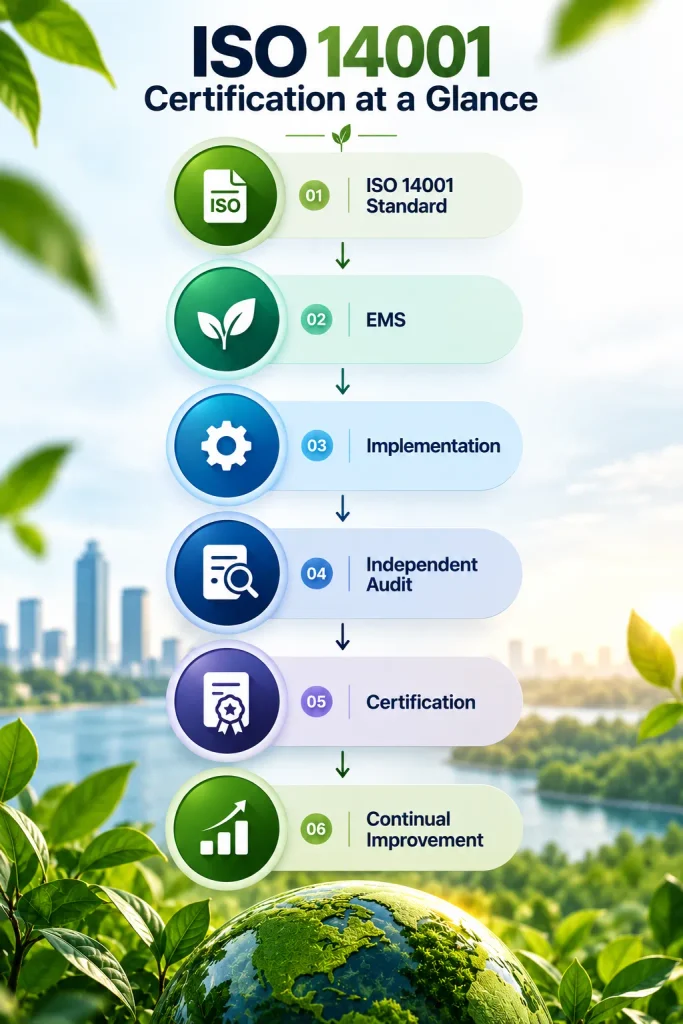
How Does the ISO 14001 Certification Process Work?
Certification normally comes after the EMS has been implemented, not before it.
Step 1 — Define the EMS Scope
Decide which sites, activities, products, and services are covered by the Environmental Management System.
Step 2 — Identify Environmental Aspects and Obligations
Understand how operations interact with the environment. Determine significant impacts and identify applicable legal, regulatory, contractual, and other obligations.
Step 3 — Implement the EMS
Put the environmental policy, objectives, responsibilities, controls, monitoring arrangements and necessary documented information into day-to-day use.
Step 4 — Conduct an Internal Audit and Management Review
Before certification, the organization should assess its own EMS and allow top management to review whether the system is suitable, effective, and ready for external assessment.
Step 5 — Stage 1 Certification Audit
The certification body reviews the organization’s readiness, EMS scope, and key system information before the main assessment.
Step 6 — Stage 2 Certification Audit
This is where auditors assess how the EMS works in practice.
They may review records, visit relevant areas, speak with employees, sample activities and examine whether environmental controls have actually been implemented.
Step 7 — Address Nonconformities and Certification Decision
If nonconformities are raised, the organization needs to address them appropriately.
Completing the audit does not automatically mean a certificate is issued. A certification decision is made after the assessment and required follow-up have been completed.
Step 8 — Maintain the Certification
Certification is maintained through ongoing surveillance and later recertification.
Planning ISO 14001:2026 Certification in Qatar?
If you are ready to begin the certification process, Guardian Middle East LLC can guide you through the certification stages, audit requirements, and next steps with a clear and independent approach.
→ Discuss Your ISO 14001 Certification Requirements
What Do ISO 14001 Auditors Actually Look For?
An effective ISO 14001 audit goes much further than asking, “Do you have a procedure for this?”
Auditors look for objective evidence that the EMS is understood and working.
That can include:
- Significant environmental aspects
- Operational controls
- Employee competence and awareness
- Compliance evaluation
- Emergency preparedness
- Environmental objectives
- Monitoring and measurement
- Internal audits
- Management review
- Corrective actions
Certification insight: One common gap is not identifying environmental issues—it is demonstrating that those issues are consistently controlled.
An organization may correctly list waste, emissions, or fuel use in its environmental-aspect register, for example. During certification, it also needs to show what controls are in place, who is responsible, what is monitored, and what happens when performance does not meet expectations.
That difference between documenting a system and operating a system is important.
How Long Does It Take to Get ISO 14001 Certified?
There is no single ISO 14001 certification timeline that applies to every organization.
A small organization with straightforward activities and an established management system may require less preparation than a large, multi-site organization with complex environmental risks.
Timing can depend on:
- Organization size
- Number of sites
- Nature and complexity of operations
- Environmental risks and significant aspects
- Existing management systems
- Availability of records
- Employee readiness
- Internal audit and management review status
- Nonconformities identified during assessment
It also helps to separate three different things:
EMS implementation → certification audits → closure of findings and certification decision
So, when someone says ISO 14001 can be completed in a fixed number of days, it is worth asking which part of the process they mean.
A realistic timeline should reflect the actual organization, not a standard promise.
What Are the Benefits of ISO 14001 Certification?
One of the main benefits of ISO 14001 is structure.
Instead of dealing with environmental issues only when something goes wrong, the organization creates a repeatable process for identifying, controlling, monitoring, and improving them.
ISO 14001 can help organizations:
- Identify environmental risks earlier
- Manage compliance obligations systematically
- Define environmental responsibilities more clearly
- Monitor objectives and environmental performance
- Improve waste and resource management
- Identify opportunities to use energy and water more efficiently
- Strengthen operational controls
- Demonstrate an independently assessed EMS to customers and other interested parties
ISO identifies improved environmental performance, better management of regulatory requirements, resource efficiency, and stakeholder confidence among the potential benefits of the standard.
However, ISO 14001 certification should not be treated as a guarantee of legal compliance, zero environmental incidents, or automatic cost savings.
The value depends on how effectively the EMS is implemented and maintained.
Why Is ISO 14001 Relevant for Organizations in Qatar?
Environmental management is increasingly relevant to organizations operating in Qatar because environmental sustainability is part of the country’s wider development priorities.
Qatar’s Ministry of Environment and Climate Change Strategy 2024–2030 focuses on environmental sustainability and climate change, innovation, environmental governance and sustainable institutional development. Qatar’s Third National Development Strategy also includes objectives relating to emissions, water, natural habitats and environmental-resource management.
These issues can be particularly relevant to sectors such as construction, infrastructure, energy, manufacturing, transportation, facilities management and hospitality.
ISO 14001 does not replace Qatar’s environmental legislation, permits or regulatory approvals.
Instead, the EMS gives an organization a structured way to identify the obligations that apply to it, assign responsibilities, maintain controls, monitor performance, and respond when gaps are identified.
Ready to Move Towards ISO 14001:2026 Certification?
Whether you are seeking certification for the first time or transitioning from ISO 14001:2015, speak with Guardian Middle East LLC to understand the certification scope, audit process, and path forward.
→ Start Your ISO 14001 Certification Journey now
ISO 14001 Implementation vs ISO 14001 Certification
An organization can implement ISO 14001 requirements without seeking third-party certification.
Certification is the additional step of having an independent certification body assess the EMS against the standard.
Table 2: ISO 14001 Implementation vs Certification
| Area | ISO 14001 Implemented | ISO 14001 Certified |
| EMS established | Yes | Yes |
| ISO 14001 requirements applied | Internally managed | Independently assessed |
| Third-party certification audit | Not required | Required |
| Certificate issued | No | Yes |
| Surveillance audits | No certification requirement | Part of certification cycle |
| Independent external assurance | No | Yes |
This distinction matters. Some organizations adopt ISO 14001 simply to improve environmental management, while others need independent certification because of customer, tender, contractual or supply-chain expectations.
Which Organizations in Qatar Can Get ISO 14001 Certified?
ISO 14001 can be applied by organizations of different sizes, sectors, and types.
In Qatar, this may include:
- Oil, gas and energy
- Construction and infrastructure
- Manufacturing
- Logistics and transportation
- Hospitality
- Facilities management
- Healthcare
- Education
- IT and data operations
- Professional services
What matters is not the industry name but the organization’s actual environmental interaction.
A construction business, for instance, may focus heavily on waste, dust, fuel, noise, and spill controls. An office-based business may have fewer direct impacts but still need to consider electricity, water, procurement, waste, and electronic equipment.
The EMS should reflect the real environmental context of the organization.
How Long Is ISO 14001 Certification Valid?
ISO explains that certified organizations usually undergo surveillance audits annually and a recertification audit every three years.
That means certification is not something an organization receives once and then forgets about.
Between certification and recertification, the organization needs to continue operating its EMS, monitoring performance, completing required internal activities, and addressing changes or problems that arise.
What Is the Latest Version of ISO 14001?
The current edition is ISO 14001:2026, published on 15 April 2026. It is the fourth edition and replaces ISO 14001:2015.
Organizations previously certified against ISO 14001:2015 need to consider the applicable transition arrangements and coordinate their transition with their certification body.
ISO 14001:2026 Changes and Transition Requirements
For organizations that need the detailed differences between the 2015 and 2026 editions, it is better to review those changes separately rather than treating them as part of the basic explanation of ISO 14001 certification.
How Should Organizations in Qatar Prepare for ISO 14001 Certification?
A good starting point is to understand how the organization actually operates, rather than beginning with templates.
A practical preparation sequence is:
- Define the EMS scope.
- Understand the organization’s environmental context.
- Identify environmental aspects and significant impacts.
- Determine applicable Qatar legal, regulatory, permit, and other obligations.
- Establish an environmental policy and measurable objectives.
- Assign responsibilities and implement operational controls.
- Build employee competence and awareness.
- Monitor environmental performance and retain suitable evidence.
- Prepare for relevant environmental emergencies.
- Conduct an internal audit.
- Complete management review.
- Correct identified gaps before certification.
When choosing a certification body, organizations should also check whether it has the appropriate competence and certification scope.
Where accredited certification is required, accreditation should be verified as well. ISO explains that accreditation provides independent recognition of a certification body’s competence.
Your Partner for ISO 14001:2026 Certification in Qatar
Guardian Middle East LLC represents Guardian Assessment UK Ltd, a UK-based certification body recognized by UAF and IAS.
If your organization is planning ISO 14001:2026 certification in Qatar or transitioning from ISO 14001:2015, Guardian can guide you through the certification process with a clear, structured, and independent approach.
Guardian Middle East LLC – Contact Details
- Location: Abo-Hamour Area, opposite the Medical Commission, Doha, Qatar
- P.O. Box: 23277, Doha, Qatar
- Mobile: +974 7770 2602 | +974 7213 7770
- Email: info@guardian.qa
- Website: www.guardian.qa
Final Takeaway
ISO 14001 certification is independent confirmation that an organization has implemented a structured Environmental Management System that conforms to ISO 14001 requirements.
For organizations in Qatar, the practical approach is to understand the current ISO 14001:2026 requirements, identify relevant environmental impacts and compliance obligations, implement the EMS properly, and make sure it is working before entering the certification process.
A well-prepared organization should be able to do more than show documents. It should be able to demonstrate how environmental responsibilities are understood, controlled, monitored, and continually improved in everyday operations.
Frequently Asked Questions
Does ISO 14001 certification guarantee legal compliance?
No. ISO 14001 requires organizations to identify relevant compliance obligations and evaluate their compliance, but certification cannot guarantee that a legal breach will never occur.
Can a small business in Qatar get ISO 14001 certified?
Yes. ISO 14001 can be used by organizations of different sizes. The EMS should be appropriate to the organization's actual activities, impacts, and risks.
Who issues an ISO 14001 certificate?
An independent certification body issues the certificate. ISO publishes the standard but does not certify organizations.
How much does ISO 14001 certification cost in Qatar?
There is no universal ISO 14001 certification price. Cost depends on factors such as organization size, number of sites, certification scope, operational complexity, and the amount of audit time required.
How long does ISO 14001 certification take in Qatar?
It depends mainly on the organization's EMS readiness and complexity. A business starting from the beginning usually needs more preparation than one that already has mature environmental controls, records, internal audits, and management processes.
Comments are closed