
10 Steps to Implement an Effective Energy Management System
Energy is a vital strategic asset in today’s competitive environment, not merely a utility expense. Uncontrolled energy use can reduce your earnings, raise your carbon footprint, and put your company at risk from price fluctuations. An organized framework for managing your energy consumption is offered by an Energy Management System (EnMS). The ISO 50001 standard, which offers a tried-and-true, data-driven method for enhancing energy performance, serves as the global standard for this. Putting in place an EnMS is more than just “being green”; it’s a smart business move that offers substantial cost savings, improved operational resilience, and a strong competitive edge. Every day, we at Guardian Middle East LLC assist companies with this procedure. The world-class ISO 50001 standard serves as the foundation for these crucial elements in the implementation of a successful EnMS.
Plan-Do-Check-Act (PDCA) is the cornerstone.
The Plan-Do-Check-Act (PDCA) cycle is the foundation of ISO 50001, as it is for all contemporary ISO standards. This guarantees that your EnMS is a living component of your company that promotes ongoing development rather than a “one-and-done” effort.
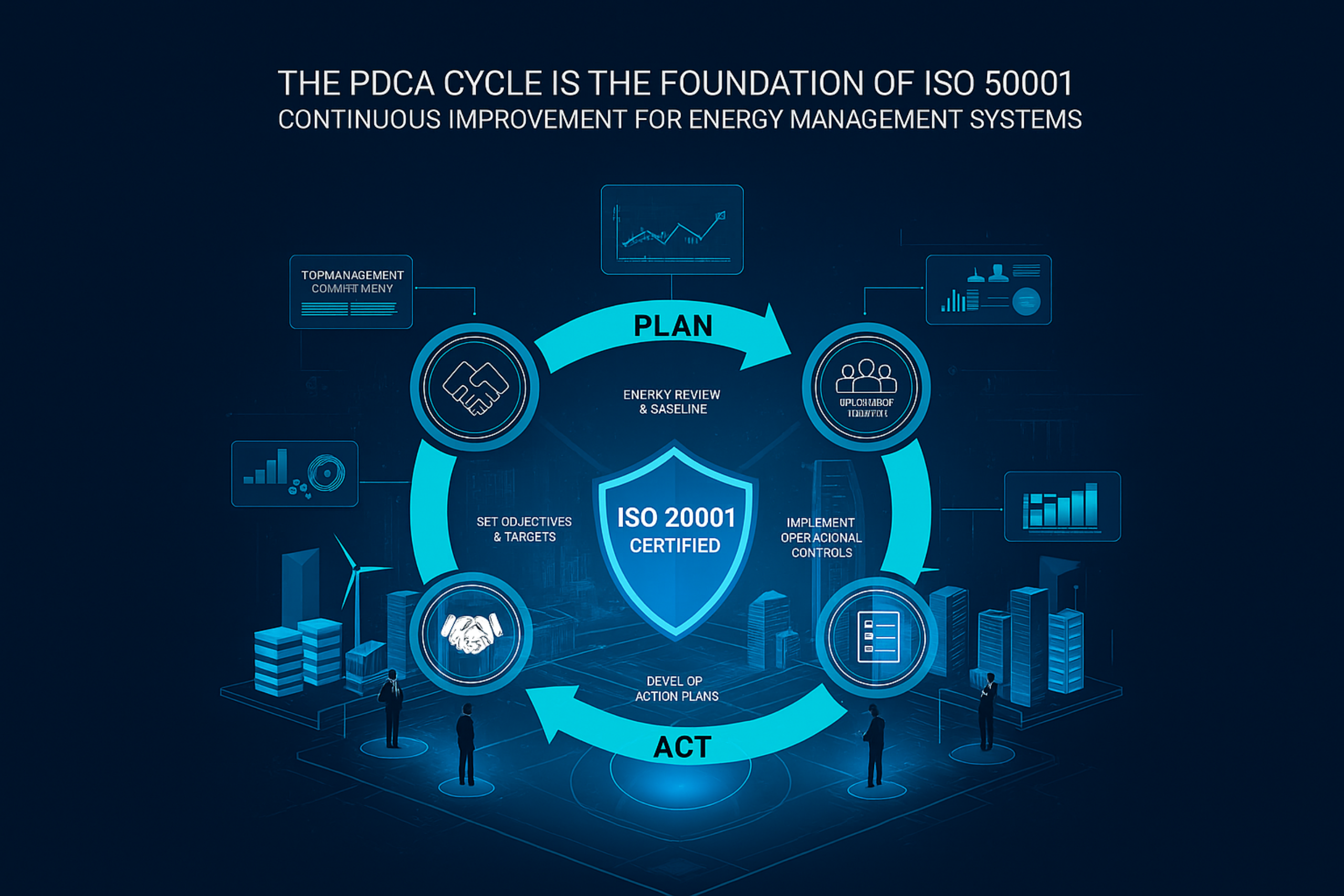
The "PLAN" Stage: Determining the Approach
This stage is the most crucial. All future savings are based on a solid strategy that is supported by solid evidence.
Step 1: Gain Top Management Commitment
This cannot be negotiated. The system won’t work if your leadership doesn’t actively and visibly support it. Senior management needs to:
- A formal energy policy (such as “We commit to reducing energy consumption per unit of production by 15% by 2030”) should be created and signed.
- Set aside the required funds, personnel, and time.
- Establish an Energy Management Team to oversee the execution.
Step 2: Conduct an Energy Review
What you do not measure, you cannot control. A thorough understanding of your present energy profile is provided by the energy review.
- Analyze Energy Sources: List all of the energy sources you utilize, such as diesel, natural gas, and electricity.
- Identify Energy Uses: FDetermine the direction of the energy. Make a map of every piece of machinery, air compressors, lighting, HVAC, and other energy-consuming equipment.
- Identify Significant Energy Uses (SEUs): Determine which facilities, processes, or assets are responsible for the majority of your energy usage. Your top priorities will be these.
Step 3: Establish an Energy Baseline & EnPIs
Using the data from your energy review, you will create your starting point.
- Energy Baseline (EnB): a “snapshot” of your energy performance over a given time frame, such the previous 12 months. This is the standard by which all subsequent advancements will be judged.
- Energy Performance Indicators (EnPIs): These are the main indicators that you will monitor. They have to be pertinent to what you do.
- Bad EnPI: The entire cost of electricity (which varies depending on tariffs).
- Kilowatt-hours (kWh) per tonne of product is a good EnPI.
- Good EnPI: The amount of energy used per square meter of air-conditioned office space.
Step 4: Set Objectives, Targets, and Action Plans
With a baseline and EnPIs, you can set realistic goals.
- A high-level objective (such as “Improve the efficiency of our compressed air system”).
- Target: A precise, quantifiable objective (e.g., “Reduce compressed air energy consumption by 10% within 18 months”).
- Plan of Action: The comprehensive “how-to” strategy for reaching the goal. Who has the blame? What is the due date? Which resources are required? (e.g., “Implement a compressed air leak detection program led by the maintenance manager, to be completed by Q3” ).
2. The “DO” Phase: Implementing the Strategy
Now you execute the plans you’ve developed.
Step 5: Implement Operational Controls
This involves integrating energy efficiency into your daily operations.
- Procurement: Establish procurement guidelines that prioritize energy efficiency when acquiring new machinery (e.g., buying only new chillers or high-efficiency motors).
- Operation: Create and put into place protocols (such as maintenance schedules and start-up/shutdown sequences) for the effective operation of your SEUs.
- Design: When creating new or altered buildings, machinery, or procedures, take energy efficiency into account.
Step 6: Ensure Competence, Training, and Communication
Your people are your greatest asset in energy management.
- Competence: Verify that the employees in charge of overseeing your SEUs possess the necessary knowledge, expertise, and training.
- Awareness: Educate all pertinent employees about the energy policy, their place in the EnMS, and how their actions affect energy use.
- Communication: To keep everyone involved, develop a strategy for sharing energy performance and goals across the entire company.
3. The “CHECK” Phase: Monitoring and Reviewing
This phase is essential for verifying your progress and ensuring the system is working effectively.
Step 7: Monitor, Measure, and Analyze
This is where your EnPIs and baseline come to life. You must:
- Routinely track your EnPIs (e.g., monthly) and compare them against your energy baseline.
- Compare your actual energy consumption against what you expected to consume.
- Investigate significant deviations. If energy use suddenly spikes, you must have a process to find out why and correct it.
Step 8: Conduct Internal Audits
An internal audit is a systematic check-up to see if your EnMS is compliant with ISO 50001 and your own policies. It asks:
- Are we adhering to our own protocols?
- Is the system producing the desired outcomes?
- Are we monitoring our SEUs and EnPIs accurately?
- Are documents being maintained appropriately?
This audit identifies any weaknesses (or “nonconformities”) before your external certification audit.
4. The “ACT” Phase: Driving Continual Improvement
Based on what you found in the “Check” phase, you now take action to improve.
Step 9: Address Nonconformities & Take Corrective Action
When an internal audit or monitoring finds a problem (a “nonconformity”), you must:
- Fix it: Resolve the current issue (e.g., fix the big air leak).
- Determine the Root Cause: What caused it to occur? (e.g., “Maintenance checks were not being performed on schedule” ).
- Take Corrective Measures: Put in place a long-term repair to address the underlying issue and stop it from occurring again (e.g., “Update the maintenance schedule and link it to the supervisor’s performance review”).
Step 10: Hold a Management Review
This completes the circle of the procedure. The entire EnMS must be reviewed by top management at least once a year. They’ll examine:
- Performance information (Baseline vs. EnPIs)
- Results of an internal audit
- Corrective action status
- The efficiency of the energy goals and policies
Leadership will make strategic choices to promote ongoing improvement based on this review, such as establishing new, more challenging goals, revising the baseline, or providing funds for fresh energy-saving initiatives.
Your Partner in Energy Excellence
One of the best investments your company can make is putting in place an ISO 50001 Energy Management System, which will provide a quick return on investment through lower expenses and improved sustainability. However, you are not required to work alone. Our professionals at Guardian Middle East LLC are skilled at assisting companies in Qatar and the surrounding area with each stage of this procedure, from the first energy evaluation to a successful certification.
Are you prepared to manage your energy expenses and create a more sustainable company? Get in touch with us now For a free consultation and to find out how we can assist you in obtaining ISO 50001 certification