
ISO 14001:2026 Certification in Qatar

ISO 14001:2026 Certification in Qatar
Quick Contact
Introduction
ISO 14001:2026 certification is based on the latest international standard for Environmental Management Systems (EMS). Published on 15 April 2026, it provides organizations with a structured framework to manage environmental responsibilities, address significant environmental impacts, meet applicable compliance obligations, and continually improve environmental performance.
ISO 14001:2026 can be adopted by organizations of any size or sector. It is particularly relevant to businesses whose activities involve:
- Energy and water consumption
- Waste and emissions
- Chemicals and hazardous materials
- Construction and industrial processes
- Transportation and logistics
- Natural resources and other significant environmental impacts
In Qatar, environmental management is becoming increasingly important as national policy places greater emphasis on climate action, pollution prevention, resource efficiency, biodiversity, waste management, and the circular economy.
Qatar’s Environment Protection Law No. 30 of 2002 provides the national framework for environmental protection and includes environmental impact and licensing requirements for relevant projects.
Qatar’s environmental priorities are also reflected in its national climate strategies:
- At least 25% reduction in greenhouse gas emissions by 2030 under the Qatar National Environment and Climate Change Strategy.
- 42 million tonnes of CO₂e mitigation actions by 2040 under Qatar’s NDC 3.0, submitted in November 2025.
These developments make a structured Environmental Management System increasingly relevant for organizations operating across Qatar’s construction, energy, industrial, infrastructure, logistics, and commercial sectors.
At Guardian Middle East LLC, based in Qatar, we provide independent ISO certification services through a structured and impartial certification process. For ISO 14001:2026 certification in Qatar, we represent Guardian Assessment UK Ltd., a United Kingdom–based certification body, recognized by UAF (United Accreditation Foundation) and IAS (International Accreditation Service, USA).
ISO 14001:2026 Key Facts At-a-Glance
Parameter | Details |
Standard | ISO 14001:2026 |
Full Title | Environmental management systems — Requirements with guidance for use |
Publication Date | 15 April 2026 |
Edition | 4th Edition |
Replaces | ISO 14001:2015 |
Management System | Environmental Management System (EMS) |
Transition Period | Typically around 3 years; applicable deadlines depend on certification and accreditation arrangements |
Certification Body | Guardian Assessment Pvt Ltd, represented in Qatar by Guardian Middle East LLC |
Accreditation | UAF and IAS |
QS / QGOS Registration | RB066-26 — ISO 14001 included within the registered scope |
Applicable To | Organizations of any size, type, or sector |
What Is ISO 14001:2026 Certification?
ISO 14001:2026 is the fourth edition of the internationally recognized Environmental Management System standard. It replaces ISO 14001:2015 and provides organizations with a systematic approach to managing environmental responsibilities and improving environmental performance.
The 2026 edition retains the established ISO 14001 framework while improving clarity and strengthening its connection with today’s environmental priorities and business environment.
Key areas covered by ISO 14001:2026 include:
- Environmental Aspects and Impacts – Identifying how activities, products, and services interact with and affect the environment.
- Compliance Obligations – Establishing processes for identifying and managing applicable environmental legal and other requirements.
- Risks and Opportunities – Considering environmental conditions, business risks, opportunities, and factors that may affect the EMS or its intended outcomes.
- Environmental Objectives and Performance – Establishing environmental objectives and monitoring progress and performance against them.
- Operational Control – Managing activities associated with significant environmental aspects through appropriate controls.
- Life-Cycle Perspective – Considering relevant environmental impacts associated with products, services, suppliers, and externally provided processes across the value chain.
- Performance Evaluation and Improvement – Using monitoring, internal audits, management review, corrective actions, and continual improvement to maintain an effective EMS.
ISO 14001 certification does not replace environmental laws, environmental permits, Environmental Impact Assessments (EIA), or regulatory approvals. Certification provides independent evidence that an organization’s Environmental Management System has been assessed against the requirements of ISO 14001:2026.
Why ISO 14001:2026 Certification Matters in Qatar
Qatar continues to develop major infrastructure, energy, industrial, construction, logistics, and commercial projects while strengthening environmental protection and climate-related policies.
Under Environment Protection Law No. 30 of 2002, relevant projects and establishments may be subject to environmental impact assessment, environmental licensing, pollution-control measures, and other environmental requirements depending on their activities.
At the policy level, Qatar is also increasing its focus on emissions reduction, water management, biodiversity, sustainable waste management, circular use of materials, resource efficiency, and climate resilience.
Qatar’s NDC 3.0 extends this direction toward 2040, with mitigation measures covering major sectors including:
- Oil and gas
- Power and water
- Industry and construction
- Transport
- Waste
For organizations operating in these and other environmentally significant sectors, ISO 14001:2026 provides a recognized management-system framework for bringing environmental responsibilities, operational controls, performance monitoring, risks, and continual improvement into one structured system.
ISO 14001:2026 and Qatar Tender Requirements
ISO 14001 certification is not universally mandatory for every organization or government tender in Qatar. Requirements vary according to the contracting authority, project, supplier category, environmental risk, and individual tender or prequalification conditions.
However, ISO 14001 already has practical relevance within Qatar’s procurement environment.
For example, Ashghal’s November 2025 prequalification documentation for certain subcontractors, service providers, and system integrators requests current ISO 14001:2015 certification or an accepted alternative/equivalent certificate.
Qatar’s Ministry of Finance supplier and service-provider classification framework also provides for the recording of environmental certifications under the ISO 14000 series.
Because these documents were issued before ISO 14001:2026 was published, some current tender, vendor-registration, and prequalification documents may continue to reference ISO 14001:2015 during the transition period.
Organizations should therefore follow the exact certification edition and requirements stated in each tender while also preparing for transition to ISO 14001:2026 in accordance with their applicable certification and accreditation arrangements.
ISO 14001 certification can support tender and supplier readiness where environmental management certification is specified or valued, but certification does not guarantee tender eligibility or contract award.
Who Should Adopt ISO 14001:2026 Certification?
ISO 14001:2026 can be adopted by any organization that wants to manage its environmental responsibilities through a structured Environmental Management System.
In Qatar, the standard is particularly relevant to organizations whose activities involve significant energy, water, materials, land use, waste, emissions, chemicals, transportation, or environmental risks.
Organizations that can particularly benefit include:
- Construction and Infrastructure Companies – Managing waste, dust, emissions, water use, materials, site activities, and environmental controls.
- Oil and Gas Companies – Supporting structured management of emissions, chemicals, waste, resource use, operational controls, and environmental emergencies.
- Manufacturing and Industrial Organizations – Managing energy, raw materials, wastewater, emissions, hazardous substances, and industrial waste.
- Energy and Utility Providers – Addressing resource efficiency, emissions, environmental risks, and operational impacts.
- Waste Management and Recycling Companies – Managing collection, storage, treatment, recycling, recovery, and disposal activities.
- Transport and Logistics Companies – Addressing fuel use, fleet emissions, waste, spill risks, warehousing, and transportation-related impacts.
- Engineering, Facilities Management, and Maintenance Companies – Managing chemicals, contractors, waste, resource use, maintenance activities, and services performed at client sites.
- Hospitality and Large Commercial Facilities – Managing energy, water, waste, purchasing, and other environmental aspects associated with large facilities.
- Government Contractors and Major Project Suppliers – Where ISO 14001 or environmental-management evidence forms part of tender, vendor-registration, customer, or prequalification requirements.
ISO 14001:2026 is especially relevant to organizations with significant environmental aspects, environmental permits, customer sustainability requirements, supply-chain obligations, or activities that can materially affect the environment.
Benefits of ISO 14001:2026 Certification
ISO 14001:2026 certification provides independent evidence that an organization’s Environmental Management System has been assessed against internationally recognized requirements.
The main benefits include:
- Improved Environmental Performance – Establish measurable objectives, controls, monitoring processes, and improvement actions for significant environmental aspects.
- Better Management of Compliance Obligations – Maintain a systematic process for identifying applicable environmental requirements and evaluating how they are being addressed.
- Reduced Environmental Risk – Identify and manage environmental risks before they develop into operational, regulatory, contractual, or reputational problems.
- Greater Resource Efficiency – Improve awareness and control of energy, water, fuel, raw materials, and other resources.
- Better Waste and Pollution Control – Strengthen management of waste, emissions, discharges, hazardous substances, spills, and other potential environmental impacts.
- Stronger Customer and Stakeholder Confidence – Demonstrate that environmental responsibilities are managed through an independently assessed management system.
- Improved Supply-Chain Management – Consider relevant environmental impacts associated with suppliers, externally provided processes, products, and services.
- Stronger Management Accountability – Integrate environmental responsibilities into leadership, planning, decision-making, and business processes.
- Continual Improvement – Use performance monitoring, internal audits, management reviews, corrective actions, and surveillance audits to continually evaluate and improve the EMS.
For organizations operating in Qatar, these benefits can support stronger environmental governance while responding to changing regulatory, customer, project, supply-chain, and sustainability expectations.
Request a Quote
Request a Quote
What's New in ISO 14001:2026?
ISO 14001:2026 does not require organizations to rebuild their Environmental Management System from the beginning. It retains the established framework of ISO 14001:2015 while refining requirements, terminology, and guidance.
Important developments include:
- Broader Environmental Context – Greater clarity around environmental conditions such as climate change, biodiversity, ecosystem health, pollution, and availability of natural resources.
- Leadership and Strategic Alignment – Stronger connection between environmental management, organizational purpose, strategic direction, governance, and business decision-making.
- Clearer Risk and Opportunity Planning – Planning requirements have been reorganized to make the relationship between environmental aspects, compliance obligations, risks, opportunities, and actions easier to follow.
- Planning of Changes – A dedicated Clause 6.3 formalizes how changes relevant to the EMS should be considered and managed in a planned manner.
- Life-Cycle and Value-Chain Considerations – Greater clarity around environmental impacts associated with externally provided processes, products, services, suppliers, and other areas the organization can control or influence.
- Greater Focus on Evidence and Performance – The revised standard reinforces the need to demonstrate that the EMS operates effectively and produces measurable environmental results.
- Improved Terminology and Guidance – Updated wording and Annex A guidance make the requirements easier to interpret and integrate with other ISO management-system standards.
For organizations already certified to ISO 14001:2015, the transition is therefore primarily about reviewing, refining, and strengthening the existing EMS against the revised requirements.
ISO 14001:2026 Structure and Requirements
ISO 14001:2026 continues to follow ISO’s harmonized management-system structure, which supports integration with standards such as ISO 9001 and ISO 45001.
The standard contains 10 clauses. Clauses 1 to 3 provide the foundation, scope, and terminology, while Clauses 4 to 10 contain the requirements assessed during certification.
Clause-by-Clause Map
- Clause 1 – Scope: Defines the purpose and applicability of ISO 14001.
- Clause 2 – Normative References: Identifies applicable normative references.
- Clause 3 – Terms and Definitions: Establishes terminology used throughout the standard.
- Clause 4 – Context of the Organization: Covers organizational context, environmental conditions, interested parties, and the scope of the EMS.
- Clause 5 – Leadership: Covers leadership commitment, environmental policy, responsibilities, authorities, and integration of environmental management into the organization.
- Clause 6 – Planning: Covers environmental aspects, compliance obligations, risks and opportunities, objectives, planned actions, and planning of changes.
- Clause 7 – Support: Addresses resources, competence, awareness, communication, and documented information.
- Clause 8 – Operation: Covers operational planning and control, externally provided processes, products and services, and emergency preparedness and response.
- Clause 9 – Performance Evaluation: Covers monitoring and measurement, evaluation of compliance, internal audits, and management review.
- Clause 10 – Improvement: Addresses nonconformity, corrective action, and continual improvement.
Key Clause Changes From ISO 14001:2015
The overall structure remains familiar, but several areas have been clarified or reorganized:
- Clause 4 – Context: Environmental conditions and their relationship with the organization receive clearer attention.
- Clause 5 – Leadership: Environmental management is more clearly connected with organizational purpose, direction, and leadership accountability.
- Clause 6 – Planning: Risks, opportunities, compliance obligations, environmental aspects, and planned actions are more clearly structured. Clause 6.3 addresses planning of changes.
- Clause 8 – Operation: Attention extends beyond traditionally outsourced processes to externally provided processes, products, and services.
- Clause 9 – Performance Evaluation: Monitoring, internal audit, management review, and evidence of effective EMS performance remain central to conformity assessment.
- Clause 10 – Improvement: The focus remains on addressing nonconformities, corrective actions, and continual improvement of the EMS and environmental performance.
The important point for certification is that organizations must be able to demonstrate how the EMS works in actual operations, not simply provide a collection of policies and procedures.
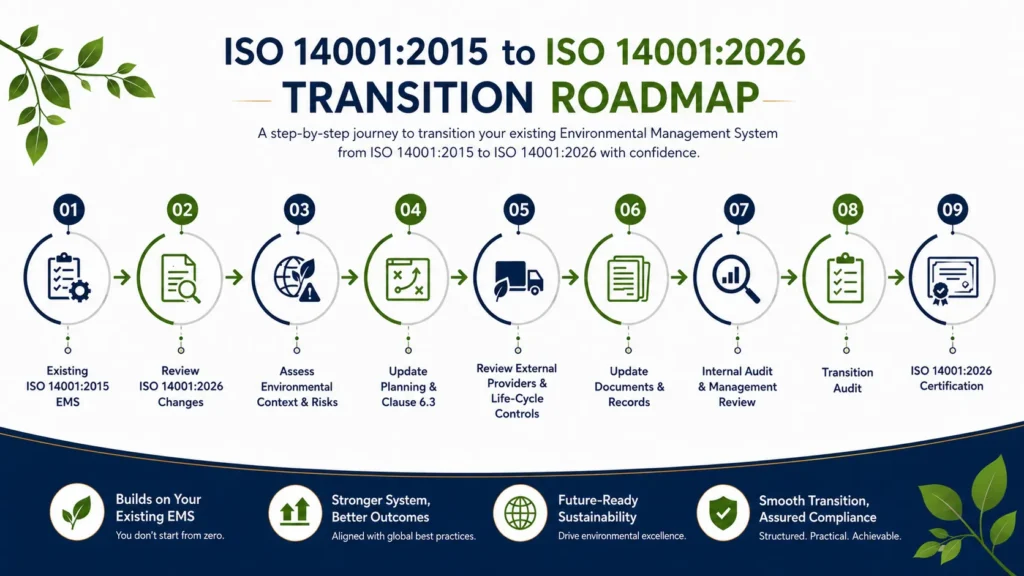
Transition From ISO 14001:2015 to ISO 14001:2026
Organizations currently certified to ISO 14001:2015 will need to transition to ISO 14001:2026 in accordance with the transition arrangements applicable to their certification and accreditation scheme.
ISO states that the transition timeframe is typically around three years, although organizations should confirm the applicable arrangements with their certification body.
Who Needs to Transition?
Organizations holding ISO 14001:2015 certification should review their existing EMS against ISO 14001:2026 and address relevant differences before transition certification activities are completed.
Does the EMS Need to Be Rebuilt?
Generally, no.
ISO 14001:2026 builds on the existing ISO 14001:2015 framework. For most established systems, the transition should involve reviewing and refining existing processes rather than creating an entirely new EMS.
What Should Organizations Review?
Transition preparation should consider areas such as:
- Revised environmental context considerations
- Environmental risks and opportunities
- Leadership and strategic alignment
- Clause 6.3 planning of changes
- Life-cycle perspective
- Externally provided processes, products, and services
- Monitoring and measurable environmental performance
- Revised terminology and documented information
- Internal audit and management review readiness
Organizations should also consider tender and customer requirements during the transition. Some Qatar procurement documents may continue to refer to ISO 14001:2015 until those documents are formally updated.
How to Get ISO 14001:2026 Certification in Qatar
The process for ISO 14001:2026 certification in Qatar follows a structured audit and certification framework to determine whether an organization’s Environmental Management System conforms to the requirements of the standard.
The certification process generally includes:
- Application – Provide organization details, activities, number of employees, locations, environmental information, and intended certification scope.
- Application Review – The certification body evaluates the information to determine certification scope, environmental complexity, audit duration, and audit requirements.
- Stage 1 Audit – Reviews the EMS structure, documented information, organizational context, environmental aspects, compliance obligations, internal audit and management-review status, and readiness for Stage 2.
- Stage 2 Audit – Evaluates how the EMS is implemented and operating in practice, including environmental controls, objectives, monitoring, compliance evaluation, responsibilities, and continual improvement.
- Corrective Actions, if Required – Identified nonconformities must be appropriately addressed within the certification process.
- Certification Decision – An independent technical review determines whether certification can be granted based on the audit evidence.
- Certificate Issuance – When certification is approved, the ISO 14001:2026 certificate is issued for the approved certification scope.
- Surveillance Audits – Surveillance audits are normally conducted during the certification cycle to confirm continued conformity.
- Recertification – A recertification audit is conducted before completion of the applicable three-year certification cycle.
This process helps ensure that certification remains impartial, evidence-based, and credible, in accordance with the applicable requirements for management-system certification bodies.
Documents and Records for ISO 14001:2026 Certification
There is no single universal document package that applies to every organization seeking ISO 14001:2026 certification. The documented information required depends on the organization’s activities, size, environmental aspects, compliance obligations, risks, and certification scope.
Core EMS Documented Information
Documents commonly relevant to the certification audit include:
- EMS Scope – Activities, locations, products, services, and organizational boundaries covered by the EMS.
- Environmental Policy – Top management’s commitments relating to environmental protection, compliance obligations, and continual improvement.
- Environmental Aspects and Impacts – Identification and evaluation of environmental aspects and significant environmental impacts.
- Compliance Obligations – Applicable environmental legal, regulatory, contractual, and other requirements.
- Risks and Opportunities – Relevant environmental and EMS-related risks and opportunities and actions taken to address them.
- Environmental Objectives – Objectives, responsibilities, resources, timelines, and methods used to evaluate progress.
- Operational Controls – Relevant controls for waste, emissions, chemicals, resource use, procurement, contractors, and other significant activities.
- Emergency Preparedness and Response – Arrangements for potential spills, leaks, releases, fires, or other relevant environmental emergencies.
Records Commonly Reviewed During Certification
The auditor may also review evidence such as:
- Environmental monitoring and measurement records
- Evaluation of compliance records
- Competence, training, and awareness records
- Internal audit reports
- Management review records
- Nonconformity and corrective-action records
- Environmental performance data
- Relevant environmental permits and approvals
- EIA or environmental-monitoring documentation, where applicable
For organizations operating in Qatar, relevant documentation should reflect both the organization’s EMS and the environmental requirements applicable to its actual activities.
During certification, auditors evaluate both documented information and practical implementation. Documents alone are not sufficient if the environmental controls and processes are not operating effectively.
Cost of ISO 14001:2026 Certification in Qatar
There is no single fixed cost for ISO 14001:2026 certification in Qatar. Certification cost is determined after the certification body understands the organization’s activities, size, scope, locations, and environmental complexity.
For a straightforward single-site organization, the required audit effort may be relatively easy to establish once the scope is confirmed. More complex industrial, construction, energy, or multi-site organizations may require additional audit time.
The main cost factors include:
- Organization Size and Effective Personnel – The number of people and functions included within the certification scope.
- Certification Scope – The activities, products, services, departments, and processes to be included on the certificate.
- Number and Location of Sites – Single-site and multi-site organizations require different audit programmes.
- Environmental Complexity – Activities involving significant emissions, hazardous substances, waste, wastewater, resource consumption, or other environmental impacts may require greater audit coverage.
- Nature of Operations – Office and service organizations generally have different audit requirements from construction, manufacturing, oil and gas, utilities, logistics, or industrial operations.
- Shifts and Operational Arrangements – Multiple shifts or activities carried out at different times may affect the required audit coverage.
- Integrated Certification – Where ISO 14001 is combined with compatible standards such as ISO 9001 or ISO 45001, some audit activities may be integrated where permitted, improving overall audit efficiency.
The required audit duration is calculated from these and other applicable certification factors.
The exact ISO 14001:2026 certification cost in Qatar can therefore only be confirmed once the certification scope and organizational details have been reviewed. Guardian Middle East LLC provides a formal certification proposal outlining the applicable audit stages, audit duration, certification scope, and fees before certification activities begin.
What Sets Guardian Middle East LLC Apart?
Guardian Middle East LLC provides ISO 14001:2026 certification services in Qatar through a locally established, independently verifiable certification framework.
- QS / QGOS Recognition for ISO 14001 – Guardian Assessment Pvt Ltd is recognized under QS Registration RB066-26 for ISO 9001, ISO 14001, and ISO 45001, with Guardian Middle East LLC listed as the represented entity in Qatar.
- QFC-Licensed Qatar Presence – Guardian Middle East LLC operates in Qatar under QFC Licence 03870.
- UK Certification-Body Representation – Guardian Middle East LLC also represents Guardian Assessment UK Ltd, a United Kingdom-based certification body accredited by UAF.
- Independent and Impartial Certification – Certification decisions are based on objective audit evidence. Guardian does not design or implement the Environmental Management System it certifies.
- Verifiable Credentials – Organizations can verify the applicable ISO certification-body registration and accreditation credentials before entering into a certification agreement.
Guardian Middle East LLC (Doha) | Serving the Middle East
Location: Abo Hamour Area, Doha, Qatar
P.O. Box: 23277, Doha, Qatar
Mobile: +974 7770 2602 | +974 7213 7770
Email: info@guardian.qa
Website: www.guardian.qa
With local presence in Qatar, QS recognition for ISO 14001, internationally accredited certification routes, and an impartial audit process, Guardian Middle East LLC provides organizations in Qatar with a credible route to ISO 14001:2026 certification.
Let’s discuss your Iso Certification needs—reach out today
Frequently Asked Questions
No. ISO 14001 is not mandatory for every organization in Qatar, but it may be required by certain clients, tenders, contracts, or prequalification processes.
Not for all tenders. Some government and project-specific prequalification requirements may request ISO 14001 certification, depending on the scope and contracting authority.
The cost depends on organization size, scope, number of sites, environmental complexity, and required audit duration.
The timeline varies based on EMS readiness, organization size, audit scope, number of sites, and whether corrective actions are required.
Common documents include the EMS scope, environmental policy, aspects and impacts, compliance obligations, objectives, internal audit records, and management review records.