
What Are the Requirements for ISO 9001?
ISO 9001 certification” is a well-known phrase for any Middle Eastern company hoping to boost quality, land big contracts, and find long-term success. It is the most prestigious Quality Management System (QMS) in the world. However, what are the real requirements for certification?
Although the ISO 9001 requirements may appear complicated, they are all based on a rational structure intended to improve the operation of your company. Fundamentally, the standard offers a “what to do” framework to make sure you satisfy customer expectations and keep improving, rather than telling you how to manage your company.
We at Guardian Middle East LLC, your partners, have simplified the requirements into an easy-to-follow guide.
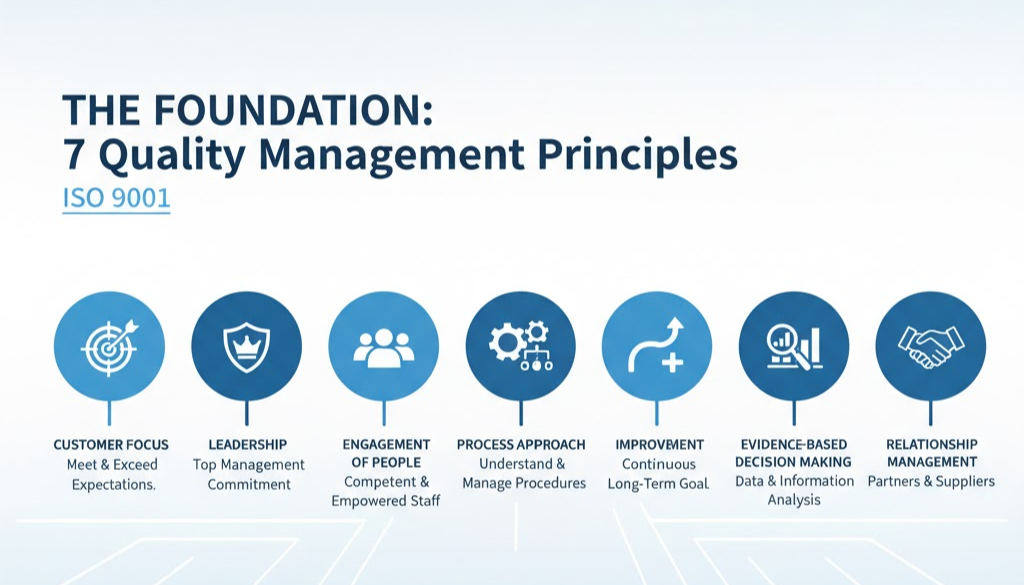
The Foundation: 7 Quality Management Principles
It’s useful to comprehend the underlying principles of ISO 9001 before delving into the specific provisions. These seven guiding concepts form the foundation of the entire standard:
- Customer Focus: Meeting and surpassing client expectations is the main objective.
- Leadership: The QMS requires the active participation and commitment of top management.
- Engagement of People: Everyone in the organization must be competent, empowered, and aware of their role in quality.
- Process Approach: Your company is a network of interconnected procedures. Results are more reliable when they are comprehended and controlled.
- Improvement: Continuous improvement is one of the organization’s long-term objectives.
- Evidence-Based Decision Making: Data and information analysis should serve as the foundation for decisions.
- Relationship Management: For long-term success, maintaining relationships with interested parties—such as partners and suppliers—is essential.
The Core Requirements: The 10 Clauses of ISO 9001:2015
In terms of structure, the ISO 9001:2015 standard is divided into ten “clauses.” While clauses 4–10 outline the auditable requirements your company must fulfill, clauses 1-3 serve as an introduction. These specifications adhere to the rational Plan-Do-Check-Act (PDCA) cycle, which serves as the catalyst for all enhancements.
PLAN: Providing Background Information (Clauses 4, 5, 6, 7)
Your QMS is defined during this stage of strategic planning.
Clause 4: Context of the Organization
You must demonstrate that you understand your business’s place in the world.
- What you must do:
- Use a SWOT or PESTLE analysis, for example, to determine which external and internal challenges are pertinent to your goal.
- Determine the needs of your “interested parties” (such as clients, vendors, staff, and authorities).
- Describe the areas of your business that your QMS covers.
- Make a map of your main procedures and their relationships.
Clause 5: Leadership
Quality is everyone’s responsibility, but it needs to be led from the top, as this phrase makes clear.
- What you must do:
- For the QMS, top management must show dedication and responsibility.
- Create a formal quality policy, which is the “constitution” of your business.
- Establish and disseminate positions, duties, and authority within the organization.
Clause 6: Planning
This is where your QMS should incorporate risk-based thinking.
- What you must do:
- Determine the opportunities and dangers associated with your business’s procedures and context.
- Make plans to deal with these opportunities and hazards.
- “Reduce customer complaints by 10%” is an example of a measurable quality objective.
- Make a plan for handling any modifications to your QMS.
Clause 7: Support
You have to demonstrate that you have the resources required to operate your QMS.
- What you must do:
- Resources: Provide the appropriate workforce, workspace, and infrastructure (buildings, machinery, and IT).
- Competence: Using education, training, or experience, make sure staff members are qualified for their positions.
- Ensure that everyone understands the Quality Policy, their role in the QMS, and the consequences of noncompliance.
- Communication: Arrange who will communicate both internally and externally, as well as what, when, and how.
- Documented Information: Manage the records and documentation that your QMS needs.
DO: Executing the Plan (Clause 8)
This clause, which covers the daily tasks you perform to supply your product or service, is the biggest and most important one.
Clause 8: Operation
- What you must do:
- Operational Planning: Arrange every stage required to develop your product or service, from inception to completion.
- Communication with Customers: Establish explicit procedures for interacting with customers (e.g., contracts, feedback, complaints, and queries).
- Development and Design: (If you design items) Establish a structured design process that covers inputs, controls, outputs, and change management.
- Authority over Outside Providers: Oversee your contractors and suppliers to make sure their goods and services satisfy your needs.
- Production & Service: Under regulated circumstances, manage your production and service procedures (e.g., using work instructions, quality checks).
- Product Release: Make sure the product or service satisfies all requirements before sending it to the customer by implementing a clear “final check” procedure.
- Nonconforming Outputs: Establish a procedure for locating, managing, and handling errors or subpar products.
CHECK: Measuring Performance (Clause 9)
You’ve made plans and carried them out. You now need to make sure everything is operating as it should.
Clause 9: Performance Evaluation
- What you must do:
- Measurement and Monitoring: Choose what, how, and when to monitor (e.g., process performance, product quality).
- Customer satisfaction: Keep a close eye on how successfully you’re fulfilling your clients’ needs (for example, by using surveys and feedback).
- Internal Audit: To determine whether your QMS complies with your own policies and the ISO 9001 standard, conduct routine internal audits.
- Management evaluate: To make sure the QMS is still appropriate, sufficient, and efficient, top management must formally evaluate it at predetermined times.
ACT: Making It Better (Clause 10)
This provision ensures that your QMS promotes genuine change and closes the loop.
Clause 10: Improvement
- What you must do:
- Nonconformity & Corrective Action: You need a procedure in place to respond to nonconformities, identify the underlying reason, and take corrective action to keep them from happening again.
- Continuous Improvement: To enhance your procedures, outputs, and the QMS itself, you must aggressively look for and seize chances.
What About Documentation?
The 2015 ISO 9001:2015 standard is far more adaptable than previous iterations. There aren’t a lot of steps involved. Rather, it calls for you to keep “documented information” that is essential to your QMS.
You must, however, have a few required records and documentation.
Mandatory Documents (what you must maintain):
- Your QMS’s Scope (from Clause 4.3)
- Your quality objectives (Clause 6.2), your quality policy (Clause 5.2), and the standards for assessing and choosing suppliers (Clause 8.4)
Mandatory Records (proof that you did something): You’ll need records to provide evidence of…
- Calibration of monitoring and measuring devices (Clause 7.1.5) Employee proficiency, education, expertise, and experience (Clause 7.2)
- Reviews of customer requirements (Clause 8.2.3)
- Inputs, controls, outputs, and modifications related to design and development (Clause 8.3)
- The outcomes of measurement and observation (Clause 9.1)
- The outcomes of your internal audit program (Clause 9.2)
- Nonconformities and the remedial measures implemented (Clause 10.2) The outcomes of management reviews (Clause 9.3)
How Guardian Middle East LLC Can Help
The first step is to comprehend ISO 9001 requirements. The next step is to successfully implement them. Guardian Middle East LLC collaborates with you rather than merely auditing you. To make your path to ISO 9001 certification easy and, most importantly, worthwhile, our team in Qatar offers professional training and certification services. We assist you in creating a quality management system that is a potent instrument for promoting actual business growth, not just a certificate to hang on the wall.
Ready to start your ISO 9001 journey? Contact us today for a free consultation.