

What Is ISO 14001:2026?
ISO 14001:2026 is the updated international standard for an Environmental Management System (EMS). It helps organizations manage environmental impacts in a structured way by setting clear processes for controlling risks, meeting legal and other requirements, and improving environmental performance over time.
ISO 14001:2026 – Quick Overview
- Standard focus: Environmental Management System (EMS)
- Who it’s for: Any organisation, any industry, any size
- Helps you manage: emissions, waste, resource use, environmental risks, and emergency response
- Supports: legal and other environmental obligations, documented controls, continual improvement
- Outcome: better environmental control, stronger accountability, and improved environmental performance
| Field | Details |
| Standard Name | ISO 14001:2026 – Environmental Management Systems |
| Published | April 2026 |
| Official Release Date | 15 April 2026 |
| Replaces | ISO 14001:2015 |
| Expected Transition Period | Usually up to 3 years from publication |
| Working Transition End Point | April 2029 |
| Purpose | To help organizations manage environmental responsibilities in a structured, measurable, and business-relevant way |
| Certification Structure | Guardian Middle East LLC is the authorized branch supporting organizations in Qatar and across the Middle East. Certificates are issued by Guardian Assessment UK Ltd (United Kingdom), and certification decisions and agreements are administered under the UK entity. Guardian Assessment Pvt. Ltd (India) supports operational delivery, and Guardian Middle East LLC is QS registered in Qatar as applicable. |
Introduction: Why ISO 14001:2026 Matters Now
Environmental management is no longer something businesses can keep in the background. Customers, regulators, supply chain partners, and investors now expect organizations to show real control over environmental risks and performance. That is why ISO 14001:2026 certification matters.
The new version of ISO 14001 was published in April 2026. It updates the environmental management system framework so it fits better with today’s business realities. It gives organizations a clearer structure for managing environmental responsibilities, improving performance, reducing waste, and building trust with stakeholders.
If your business already holds ISO 14001:2015, this is not something to leave for later. If you are planning to apply for certification for the first time, the 2026 version is now the one you should build your system around.
What Is ISO 14001:2026?
If someone asks, What is ISO 14001:2026, the simple answer is this: it is the latest international standard for an Environmental Management System, or EMS. It helps organisations identify environmental impacts, control them properly, meet compliance obligations, and improve environmental performance in a structured way.
Purpose and Scope of the New Standard
The purpose of the new standard is not to force every company to follow the same environmental target. Instead, it gives organizations a management framework they can use to:
- understand their environmental risks and opportunities
- control environmental impacts
- reduce waste and resource loss
- meet legal and other compliance obligations
- improve performance over time
This means the standard works for both high-impact industries and lower-impact service businesses. The difference is not whether the standard applies. The difference is how the organisation uses it in practice.
Who Needs ISO 14001:2026?
The standard can apply to organisations of all sizes and in almost every sector. It is especially relevant for:
- manufacturing companies
- construction and infrastructure businesses
- logistics and warehousing operations
- utilities and energy businesses
- food and beverage producers
- healthcare and pharmaceutical organisations
- IT and service companies working with large clients or international supply chains
- organizations involved in government tenders, exports, or multinational contracts
A practical example makes this easier to understand. A manufacturing company may use the EMS to manage emissions, waste, raw material use, and supplier controls. A software company may focus more on energy use, procurement choices, office waste, and environmental expectations from clients. The standard is the same, but the environmental issues are different.
The Evolution of ISO 14001: From 1996 to 2026
ISO 14001 has developed over time, and each version has moved the standard forward.
- The 1996 edition created the original environmental management structure and focused strongly on pollution control.
- The 2004 version improved clarity and made it easier to align with ISO 9001.
- The 2015 version was a major shift. It adopted the high-level structure, added the life cycle perspective, and pushed environmental management closer to business strategy.
- The 2026 version builds on that by making climate change, biodiversity, change management, and supply chain impact more visible inside the system.
So this new version is not a complete rewrite. It is a stronger and more practical version of the same management system approach.
Key Changes in ISO 14001:2026
This is where most businesses start asking about ISO 14001:2026 changes, ISO 14001:2026 requirements, and important ISO 14001:2026 clauses. The biggest changes are not about changing the full structure. They are about strengthening certain parts of the system so environmental management becomes more realistic and more relevant.
Climate Change and Biodiversity Are Now Explicit
One of the biggest ISO 14001:2026 changes is the stronger treatment of climate change and biodiversity. These topics are no longer treated as vague background issues. They now need proper attention inside the EMS.
This means your organisation should ask questions like:
- Could climate conditions affect our operations?
- Do our activities affect climate-related performance?
- Is biodiversity relevant to our sites, sourcing, projects, or land use?
- Are resource pressures likely to affect us in the future?
A practical example is a food manufacturer that depends on agricultural inputs. It may now need to look more closely at water availability, land-use pressure, sourcing risk, and transport impacts, not only waste from the factory.
New Clause 6.3: Planning of Changes
One of the most practical updates is ISO 14001:2026 Clause 6.3, planning of changes.
This new sub-clause requires organisations to manage important changes in a planned way. In simple terms, if something major changes in your business, you should review the environmental effect before the change is fully implemented.
This can include changes such as:
- a new supplier
- a new facility or site
- a process change
- a packaging change
- outsourcing part of the operation
- adding a new product line
A real-life example helps here. Imagine a company changes to a cheaper packaging supplier. Under the new approach, procurement should not only compare cost and delivery. The company should also check whether the new packaging affects recyclability, disposal, transport impact, or compliance obligations.
Expanded Life Cycle Perspective and Supply Chain Controls
The ISO 14001:2026 life cycle perspective is another important update. The previous edition already included life cycle thinking, but the 2026 version makes it more practical and more visible.
Now the organisation needs to think more seriously about environmental impact beyond its own walls, including:
- purchased materials
- outsourced services
- contractor activities
- transport and warehousing
- packaging
- end-of-life disposal
This matters because many environmental impacts sit in the supply chain, not just at the main site.
A simple example is a company that controls waste and energy well inside its factory, but its raw material sourcing is weak or its outsourced transport creates avoidable impact. In that case, the EMS is still incomplete.
Extended Leadership Accountability
Environmental responsibility is no longer something that sits only with one manager or department. The 2026 version expects accountability to be shared across the right roles in the organisation.
That means relevant responsibilities may sit with:
- top management
- operations
- maintenance
- procurement
- logistics
- site leadership
- department heads
This makes the EMS stronger because environmental control becomes part of daily decisions, not just an annual review topic.
Updated Terminology
The standard also updates some terms so it aligns more smoothly with other ISO management system standards. This helps organisations that already use ISO 9001 or ISO 45001, because the language and structure feel more consistent.
What Has Not Changed
Even with all these updates, the overall framework is still familiar. The core ISO management system structure remains in place. So for most existing users, the job is not to rebuild everything from zero. The job is to update the weak or changed areas properly.
ISO 14001:2015 vs ISO 14001:2026
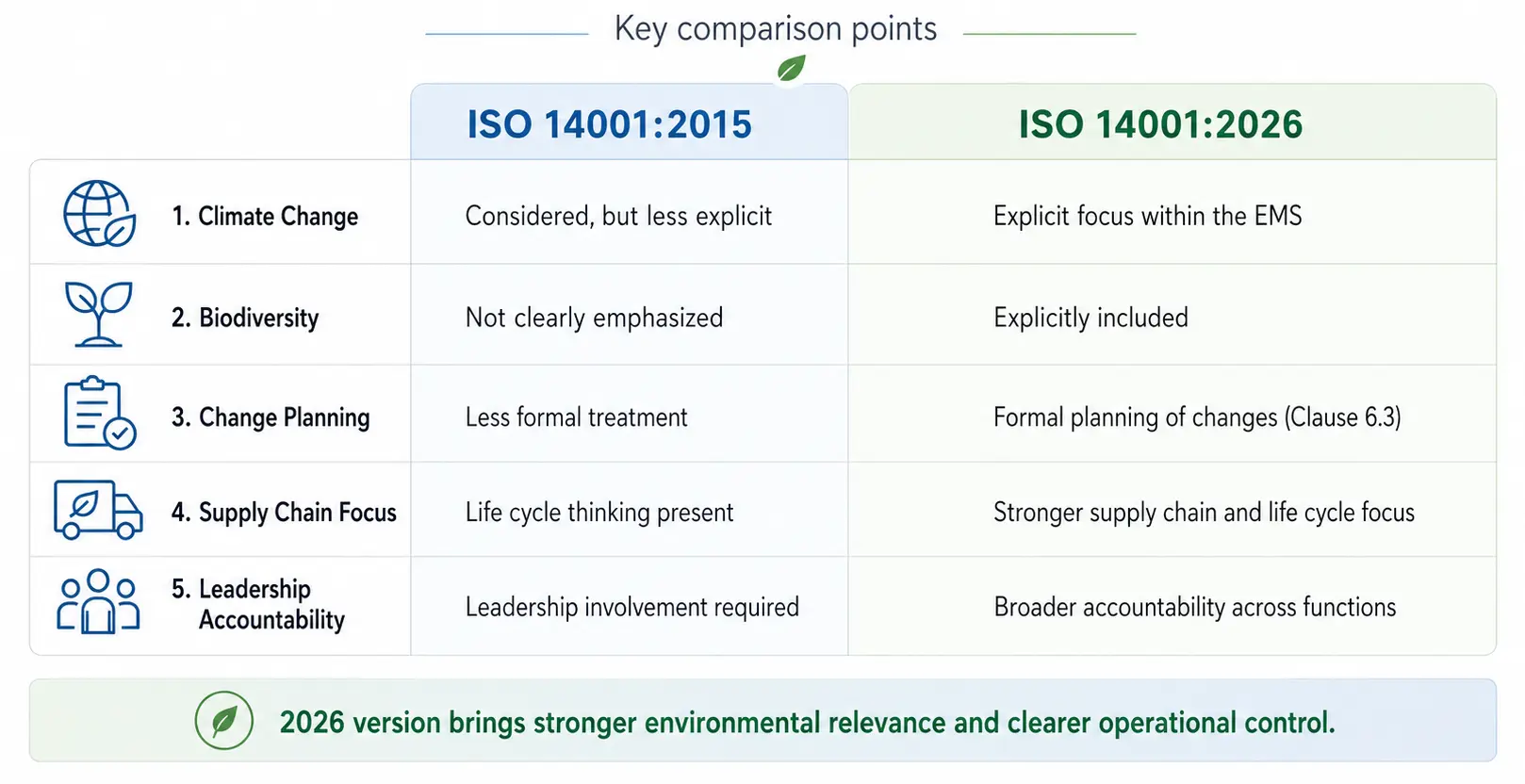
A lot of businesses will search for ISO 14001:2026 vs ISO 14001:2015 because they want to know whether this update is minor or major.
What Is Different
The main differences are:
- Climate change is more clearly built into the standard
- Biodiversity is explicitly included
- Clause 6.3 adds formal change planning
- The life cycle perspective is stronger
- Supply chain and externally provided processes matter more
- Leadership accountability is broader
- Some terminology is updated for better alignment
What Existing Certificate Holders Need to Review
If you already hold ISO 14001:2015, you should review at least these areas:
- context analysis
- environmental aspects and impacts register
- risk and opportunity review
- life cycle perspective
- supplier and outsourced process controls
- planning of changes
- role responsibilities
- An internal auditor’s understanding of the new version
Is It a Major Change or a Manageable Update?
For most businesses, it is a manageable update if they start early. It is not usually a total system rebuild. But it is still important enough that leaving it too late can create stress, gaps, and audit pressure.
Who Needs to Transition to ISO 14001:2026?
Existing ISO 14001:2015 Certificate Holders
If your organisation is certified to ISO 14001:2015, you should now plan the ISO 14001:2015 to 2026 transition. This is the group most directly affected by the new edition.
New Applicants
If you are applying now, you should build your environmental management system against the 2026 edition, not the old one.
Industries Most Affected
All sectors should review the new version, but the impact is likely to be stronger for industries with:
- larger environmental footprints
- multi-site operations
- complex supply chains
- client-driven sustainability expectations
- public tender requirements
- export exposure
- strong compliance pressure
That includes construction, manufacturing, logistics, energy, healthcare, food, and infrastructure-linked businesses.
ISO 14001:2026 Transition Timeline Explained
This section matters because one of the biggest questions businesses ask is when will ISO 14001:2015 expire.
The new edition was published in April 2026. If your business is still operating under ISO 14001:2015, the safest approach is to plan the ISO 14001:2026 transition early and confirm the transition schedule directly with your certification body.
Publication Date
ISO 14001:2026 was published in April 2026.
Transition Period
Your transition plan should follow the schedule and guidance given by your certification body. In practice, management system revisions commonly use a defined transition window, so organisations should not wait until the last moment.
Final Deadline
If your business is still certified to ISO 14001:2015, the smart move is to begin planning early instead of waiting until the end of the transition window.
What Happens If You Miss the Deadline?
If the old certificate is not transitioned in time, it may no longer remain valid for commercial use. That can affect:
- tender eligibility
- supplier approvals
- contract renewals
- public certificate visibility
- customer trust
A practical example is a business included on an approved supplier list. If a major client checks certification status during a renewal cycle and sees an outdated certificate, that can create immediate questions about compliance and reliability.
How to Transition from ISO 14001:2015 to ISO 14001:2026
If a company is asking how to transition to ISO 14001:2026, the process is usually manageable when done step by step.
Review the New Standard
Start by reviewing the new version carefully, especially the areas linked to context, planning, supply chain impact, and updated responsibilities.
Conduct a Gap Analysis
Run a proper gap analysis against the new requirements. This helps identify what is already covered, what is partly covered, and what is missing.
Update Context Analysis
Add climate change, biodiversity, and natural resource pressure where relevant.
Revise the Aspect-Impact Register
Update your environmental aspects and impacts register so it reflects the stronger life cycle and supply chain approach.
Implement Clause 6.3 Change Management
Create or strengthen your process for managing changes. This is one of the key parts of the ISO 14001:2026 transition.
Update Operational Controls and Supplier Controls
Review outsourcing, purchased materials, contractors, and externally provided processes.
Train Internal Auditors and Complete Internal Audit
Your internal audit team should understand the new version before they audit it. That is where ISO 14001:2026 lead auditor training or internal auditor training becomes useful, especially for businesses that want their team to understand the changes properly.
Apply for the Transition Audit
Once the system is updated and internally reviewed, you can apply for the ISO 14001:2026 transition audit.
A practical example is a logistics company with multiple branches. It might first update head office procedures, then train branch teams, then revise contractor controls, then schedule the transition audit to align with surveillance. That is much smoother than rushing everything near the end.
Benefits of Moving to ISO 14001:2026 Early
Moving early is not just about staying certified. It has real business value.
Better Environmental Compliance
The system helps organisations identify obligations clearly and control environmental risk more consistently.
Lower Waste, Energy, and Resource Costs
A structured environmental management system helps businesses use resources more efficiently, reduce waste, and improve operational control. That often leads to direct savings in energy, water, materials, and disposal costs.
Stronger Tender and Supply Chain Position
A valid and updated EMS can strengthen trust with procurement teams, contractors, and global buyers.
Better ESG and Sustainability Reporting Support
The standard gives businesses a stronger operational base for environmental reporting and sustainability-related communication.
Better Operational Control and Risk Management
When environmental responsibilities are planned properly, businesses usually benefit from:
- fewer surprises
- clearer controls
- better supplier management
- better emergency preparedness
- stronger evidence during audits and reviews
How the ISO 14001:2026 Certification Process Works
For businesses planning ISO 14001:2026 certification, the certification process usually follows a clear sequence.
Application and Scope Definition
The first step is to define what your certification will cover, such as:
- sites
- departments
- products or services
- outsourced or externally provided activities where relevant
Stage 1 Audit: Documentation Review
The auditor checks whether your EMS documents are ready for the full audit.
Stage 2 Audit: On-Site or Remote Evaluation
This is the main audit. It checks whether the EMS is actually implemented and working in practice.
Non-Conformity Resolution
If any issues are raised, the organisation must correct them and submit evidence.
Certification Decision and Issuance
Once the requirements are met, the certificate is issued.
Surveillance Audits and Recertification
The cycle then continues with surveillance audits and later recertification. If you are an existing certificate holder, the ISO 14001:2026 transition audit may sometimes be aligned with surveillance, depending on the certification body’s process.
Important Guidelines for Stakeholders
For Existing ISO 14001:2015 Certified Clients
If your company is already certified, the most sensible actions now are:
- review the new edition
- Complete a gap analysis
- Update EMS documents
- address climate change and biodiversity where relevant
- Review your life cycle perspective
- Implement a change management approach
- train your audit team
- Schedule the transition audit early
For Guardian Franchise and Global Partners
Partners and regional support teams should make sure clients understand:
- the update itself
- the transition expectations
- What documents and controls need review
- How early planning reduces pressure
This matters because it shows the update is being handled as a real certification responsibility, not just a marketing message.
Why Choose Guardian Middle East LLC for ISO 14001:2026 Support?
This section should build trust near the end of the blog, after the reader already understands the standard.
Accredited Certification Support Through Guardian Assessment Pvt. Ltd.
If you want to mention your certification pathway, this is the right place to introduce it naturally, including the relationship with Guardian Assessment Pvt. Ltd. and the accreditation position.
Multi-Sector Audit Experience
Environmental management does not look the same in every industry. A useful certification partner should understand different operational realities across sectors such as manufacturing, construction, healthcare, logistics, food, and services.
Regional Support Across the Middle East
For businesses in the Middle East, regional support matters because many organisations need help with:
- tender-driven certification priorities
- multi-site coordination
- timing of audits
- practical implementation guidance
- documentation updates that fit real operations
Clear, Structured, Long-Term Certification Support
The strongest trust point is not speed. It is structure, clarity, responsiveness, and long-term support through surveillance and recertification.
If you also want to target the keyword ISO 14001:2026 certification body in India, you can mention it naturally in this section if Guardian Assessment Pvt. Ltd. is part of your certification route, and that is factually accurate for your business offering.
Conclusion: Get Ready for ISO 14001:2026 With Confidence
ISO 14001:2026 is not just a routine version update. It reflects the way environmental expectations are changing in business. Climate change, biodiversity, supply chain controls, and planned change management now matter more clearly inside the EMS framework.
If your business already holds ISO 14001:2015, the smart move is to start the ISO 14001:2015 to 2026 transition early. If you are applying for the first time, this new version gives you a stronger and more current framework to build from.
The businesses that handle this update well will not only protect their certification status. They will also be in a stronger position when customers, procurement teams, and stakeholders ask whether the business can prove environmental control in a practical and credible way.
How Guardian Middle East Supports Your ISO Certification Journey in Qatar
After understanding the key points in this blog, the next step is choosing the right certification partner.
Guardian Middle East LLC supports companies all over the Middle East with ISO certification by helping you define the scope clearly, prepare the required documentation, implement the system in daily operations, and get ready for the certification audit.
As the exclusive representative of Guardian Assessment UK Ltd., a United Kingdom–based certification body operating under internationally recognized accreditation by the United Accreditation Foundation (UAF) and International Accreditation Service (IAS, USA), we support organizations with a structured certification journey and clear audit preparation. Based in Doha, we understand how procurement, tender expectations, and client audits typically work in Qatar.
What We Help You Achieve
- Define a clear certification scope
- Prepare audit-ready documentation
- Implement ISO processes in daily operations
- Ensure readiness for certification audits
Support Beyond Certification
- Surveillance audit preparation
- Continual improvement support
- System maintenance for long-term effectiveness
Ready to Strengthen Your Business With ISO Certification in Qatar?
ISO certification is more than a document. It is a structured system that improves consistency, builds trust, and supports better performance in daily operations.
For companies in Qatar looking to improve efficiency, reduce errors, and strengthen tender readiness, ISO certification is a strong long-term investment.
Get in Touch
Based in Doha, we support organizations in Qatar and across the Middle East.
Located in Doha, Qatar | Serving the Middle East
Mobile: +974 7770 2602 | +974 7213 7770
Email: info@guardian.qa
Website: www.guardian.qa
Contact us today to discuss your requirements and start your ISO certification journey with confidence.
Frequently Asked Questions
Is ISO 14001:2026 certification mandatory?
ISO 14001:2026 certification is voluntary. However, many businesses choose it because it improves environmental control, supports tenders and supply chain requirements, and builds trust with customers and stakeholders.
Can the ISO 14001:2026 transition audit be combined with a surveillance audit?
Yes, in many cases the ISO 14001:2026 transition audit can be combined with a scheduled surveillance or recertification audit. This usually saves time and reduces operational disruption.
Will I need a completely new audit if I already have ISO 14001:2015 certification?
Not always. If your current EMS is already in place, the transition usually focuses on updating the changed areas and verifying them during the transition audit, rather than starting the whole certification process from zero.
What if my company is already preparing for ISO 14001:2015 but has not completed certification yet?
If your company is already preparing for ISO 14001:2015 but has not completed certification yet, it is usually better to shift your preparation to ISO 14001:2026 instead of continuing with the older version. This helps you avoid doing the same work twice and makes sure your system is aligned with the latest standard from the start.
In practice, the best step is to review how much of your EMS is already prepared, identify what can still be used, and then update the missing areas to match the 2026 requirements. This way, your effort is not wasted, but your certification path becomes more practical and future-ready.
Can a newly certified company under ISO 14001:2015 still be expected to transition to ISO 14001:2026?
Yes. Even if a company has only recently been certified under ISO 14001:2015, it may still be expected to transition to ISO 14001:2026 within the official transition period. New certification under the older version does not remove the need to move to the updated standard before the deadline.
What is the best time to start preparing for ISO 14001:2026 transition?
The best time to start is as early as possible after the new version is published. Early preparation gives your team enough time to review the changes, update documents, train relevant staff, and plan the transition audit without last-minute pressure.
How long does the ISO 14001:2026 certification or transition process take?
The timeline depends on your organisation’s size, complexity, and how ready your current EMS is. For some businesses, the transition can be completed relatively quickly if the existing system is strong. For others, it may take longer if major updates are needed in documentation, controls, training, or internal audits.
Comments are closed